Written by: Mariana Fonseca, Editorial Team, AI Growth Agent | Last updated: July 21, 2026
Key Takeaways
- Perplexity SEO asks brands to structure content so PerplexityBot can crawl, trust, and cite it in AI answers instead of relying on traditional blue-link rankings.
- Technical crawl access, schema markup, data-dense formats, and entity authority across third-party sources all act as prerequisites for consistent Perplexity citations.
- Content needs the Answer–Evidence–Depth pattern, FAQPage and Article schema, and a 13-week freshness cycle to stay competitive in AI answers.
- Entity signals from Reddit, review platforms, PR, and Wikidata strengthen a brand’s citation chances more than self-published content alone.
- AI Growth Agent delivers a full production system that maps your long-tail universe, publishes citation-ready content, and keeps every article updated. See how the system performs in your first week.
Perplexity SEO and How It Changes Your Goal
Perplexity runs its own web index, built by PerplexityBot, and retrieves content at the passage level during query time to assemble cited answers. Traditional search ranks pages and serves links, while Perplexity synthesizes a response and attributes it to sources. A brand either appears in that response or it does not, with no fallback position two.
For CMOs and founders, this shift changes the optimization objective entirely. The goal no longer focuses on which page ranks for a keyword. The goal focuses on whether the content on that page is structured so PerplexityBot can find it, parse it, trust it, and quote it. That shift demands a different technical stack, a different content format, and a different measurement system than the one most marketing teams use today.
Perplexity search engine optimization covers three layers: technical crawl access, content structure, and entity authority. Each layer supports the next. A page PerplexityBot cannot crawl will never be cited, regardless of content quality. A crawled page with weak structure will be retrieved inconsistently. A well-structured page without entity authority will lose citations to competitors with stronger signals.
Review how AI Growth Agent builds all three layers for your brand starting in week one.
Core Concepts Behind Perplexity Citations
Before diving into implementation, you need three foundational concepts that govern how Perplexity decides what to cite.
PerplexityBot is Perplexity’s search and retrieval crawler. It is distinct from any training crawler and runs at query time to fetch pages for citations in answers. It publicly commits to robots.txt compliance and has been observed honoring it in production environments. A second agent, Perplexity-User, handles user-initiated page fetches and generally ignores robots.txt because a user request triggers the fetch.
Entity authority is the measurable coherence between how a brand is described across its own content and across third-party sources. A composite entity-maturity score aggregating Wikidata item quality, Schema @id graph coherence, and sameAs cluster consistency is the strongest predictor of LLM citation rate across six AI search systems. Brands in the bottom quartile of that score experience higher hallucination rates in LLM citations than brands in the top quartile.
Citation context replaces the old idea of a ranking number. Where a brand appears in an AI answer, which claim it supports, and which competitors it appears beside now form the leaderboard. Domain authority explains less AI citation variance, while topical authority explains more. A site with 30 tightly clustered pages can out-cite a 5,000-page domain with higher domain authority on a specific topic.
Explore how AI Growth Agent maps your entity signals across every surface PerplexityBot reads.
The Discovery Shift to AI Answers
Customer discovery has already shifted toward AI answers. Google’s AI Mode crossed 1 billion monthly users within its first year. A McKinsey survey of nearly 2,000 U.S. consumers found that 50% now intentionally seek AI-powered search tools, with most naming AI as their top digital source for buying decisions. When AI summaries appear, users click traditional search results far less often, and only a small share click source links inside the summary.
The impact on mid-market and enterprise brands is direct. For queries processed through Google AI Mode, organic SEO has zero reach unless the brand earns a citation inside the AI response, because AI Mode replaces traditional organic results with a conversational interface and drives a high zero-click rate. Perplexity behaves the same way. The answer becomes the destination, and the citation becomes the click.
Headless marketing fits this environment. It separates the brand’s curated main site from the engine that wins AI citations, running a fully optimized owned blog through a reverse proxy rewrite while the main site stays unchanged. The engine writes, publishes, monitors, self-heals, and reports. The brand controls the narrative without staffing a large team.
See how headless marketing places your brand inside AI answers instead of beneath them.
PerplexityBot Access, Robots.txt, and Verification
Crawl access sits at the base of every Perplexity strategy. A page PerplexityBot cannot reach will never appear in a Perplexity citation, regardless of content quality or schema.
The recommended robots.txt configuration for 2026 explicitly allows both PerplexityBot and Perplexity-User:
User-agent: PerplexityBot Allow: / Disallow: /admin/ Disallow: /api/ User-agent: Perplexity-User Allow: /Three additional steps complete crawl verification:
- Test access with
curl -A "PerplexityBot" -I https://yourdomain.com/your-page/and confirm HTTP 200 responses with no X-Robots-Tag: noindex header. - If you use a Web Application Firewall, create rules that combine User-Agent string matching for PerplexityBot with IP address verification from the official JSON endpoint, then set the action to Allow. Perplexity recommends automated processes that periodically fetch and update WAF rules with the latest IP ranges.
- Disable Cloudflare’s “Block AI Bots” toggle if it is active. This toggle overrides robots.txt settings for PerplexityBot and must be disabled in the CDN dashboard even when robots.txt allows the bot.
Unblocking PerplexityBot often produces more Perplexity citations within 90 days.
Content also needs to be HTML-first and readable with JavaScript disabled. A significant percentage of ChatGPT agents leave immediately because of blocks, redirects, or JavaScript-dependent content. PerplexityBot shows the same pattern.
Direct Q&A Content and Schema Markup
Schema markup does not guarantee a citation, yet it meaningfully raises the odds. Pages with FAQPage schema markup appear more often in AI responses, and schema contributes to ranking factors for platforms like Perplexity. Pages with proper schema markup are more likely to be cited in AI-generated answers because schema makes content boundaries explicit for RAG systems.

The priority schema types for Perplexity-focused work include:
- FAQPage: Structures Q&A pairs exactly as AI presents them. Use this only when the page genuinely contains FAQs. Each answer should run 50–150 words and target a specific user question.
- Article / BlogPosting: Supplies datePublished and dateModified for freshness signals, plus author attribution for trust. Update dateModified on every meaningful content change.
- HowTo: Marks step sequences for task-oriented queries and makes step-by-step instructions explicitly extractable by Perplexity’s retrieval pipeline.
- Organization: Appears in the page-level JSON-LD of every page that discusses the company, not only the homepage. Include sameAs links to Wikidata, Wikipedia, and authoritative review platforms.
- Person / Author: Establishes author authority with name, jobTitle, worksFor organization, and sameAs links, aligning with E-E-A-T signals that improve citability.
Place all schema in a single server-rendered script block in the HTML head and ensure it accurately describes content that appears on the page. Schema accuracy is non-negotiable, because JSON-LD properties that do not match visible content risk deprioritization by AI systems.
Data-Dense Formats and Citation-Friendly Layouts
Perplexity retrieves content at the passage level by chunking pages and embedding those chunks. Formats that create many independently retrievable passages outperform long-form essays that yield only one or two retrieval targets.
Statistics pages earn the most Perplexity citations per page because each sourced statistic functions as an independent retrieval target that can be cited across many unrelated prompts. The strongest template uses an H1 titled “{Topic} Statistics ({Year})”, a first paragraph with three headline numbers, and grouped stat blocks with source name, link, and year. These pages should refresh quarterly because of the engine’s freshness bias.
The Answer–Evidence–Depth (AED) pattern delivers clean, extractable answers:
- Answer: Provide a direct response in the first 50 words, using the exact primary keyword phrase and a specific, verifiable claim.
- Evidence: Follow with 100–150 words of supporting data, named sources, and statistics.
- Depth: Close with expanded context, caveats, and related sub-questions.
Beyond schema, content format matters, and tables plus structured data get cited more often than unstructured prose because they create more independently retrievable passages. A significant percentage of LLM citations come from the first portion of text, so leading with the direct answer in the first 40–60 words becomes critical.
Comparison tables earn citations when the verdict appears in the first two sentences, followed by a table that covers pricing and key decision dimensions. Balanced pages that concede strengths on both sides are favored over one-sided pages that read like ads.
See how AI Growth Agent structures every article for maximum passage-level extractability.
Building Entity Authority with Reddit, Reviews, and PR
Perplexity’s citation system leans on third-party signals to validate entity claims. This citation-first model explains why third-party signals matter so much, as discussed earlier. A brand that appears only on its own domain is structurally weaker than one whose claims are corroborated across independent sources.
The primary third-party signal channels for entity authority include:
- Review platforms: G2, Capterra, TrustRadius, and Trustpilot. Domains with profiles on these platforms are roughly more likely to be chosen as ChatGPT sources.
- Reddit and community forums: Authentic participation in relevant subreddits and communities where the target audience asks questions. AI engines aggregate signals from these platforms when building entity profiles.
- PR and earned media: Press placements on high-authority domains. Branded web mentions show the strongest correlation with AI Overview appearances compared with backlinks.
- Wikidata and Wikipedia: The sameAs property linking entities to Wikidata and Wikipedia entries is especially valuable for AI search engines because these knowledge bases serve as ground truth for entity resolution.
AI systems prioritize independent corroboration over self-attestation when building semantic mass, favoring entities with mentions in indexed journals, directories, and news articles over self-reported bios on a single website.
Keeping Content Fresh with Self-Healing Updates
Content freshness directly affects Perplexity citations. Amsive’s 2026 AI search citation freshness analysis found that a significant portion of content cited in AI search responses is less than 13 weeks old. Pages often slip after about three months, matching a three-month decay pattern in AI citation data.
A self-healing content system operates on three layers that work together to maintain citation eligibility. Scheduled refresh keeps priority content inside the 13-week window through planned cycles. Trigger-based updates handle urgent changes that cannot wait for the next scheduled cycle. Freshness signals ensure that every update, whether scheduled or triggered, is clearly communicated to PerplexityBot through schema, headers, and visible dates.
- Scheduled refresh: Update top-performing pages on a rotating cycle to keep the entire priority list inside the 13-week freshness window. Refresh competitive comparison pages and best-tools pages every 2–4 weeks, how-to guides quarterly, and conceptual explainers every 3–6 months.
- Trigger-based updates: Ship updates within 1–2 weeks when a product changes, a competitor makes a major announcement, or a cited statistic is corrected.
- Freshness signals: Reflect every meaningful update in JSON-LD dateModified schema, HTTP Last-Modified headers, visible last-updated dates, and sitemap lastmod values. Content updated within the prior 30 days received more AI citations for certain queries than stale pages.
Meaningful updates include adding new current-year statistics, revising comparison tables, adding FAQ sections, and updating schema markup. Cosmetic date changes or minor wording edits do not create citation lift.
Tracking Perplexity Citations and Visibility Gains
Perplexity optimization needs different measurement tools than Google Search Console alone. AI answers have no static ordered list, so order of mention and citation context become the new ranking signals.
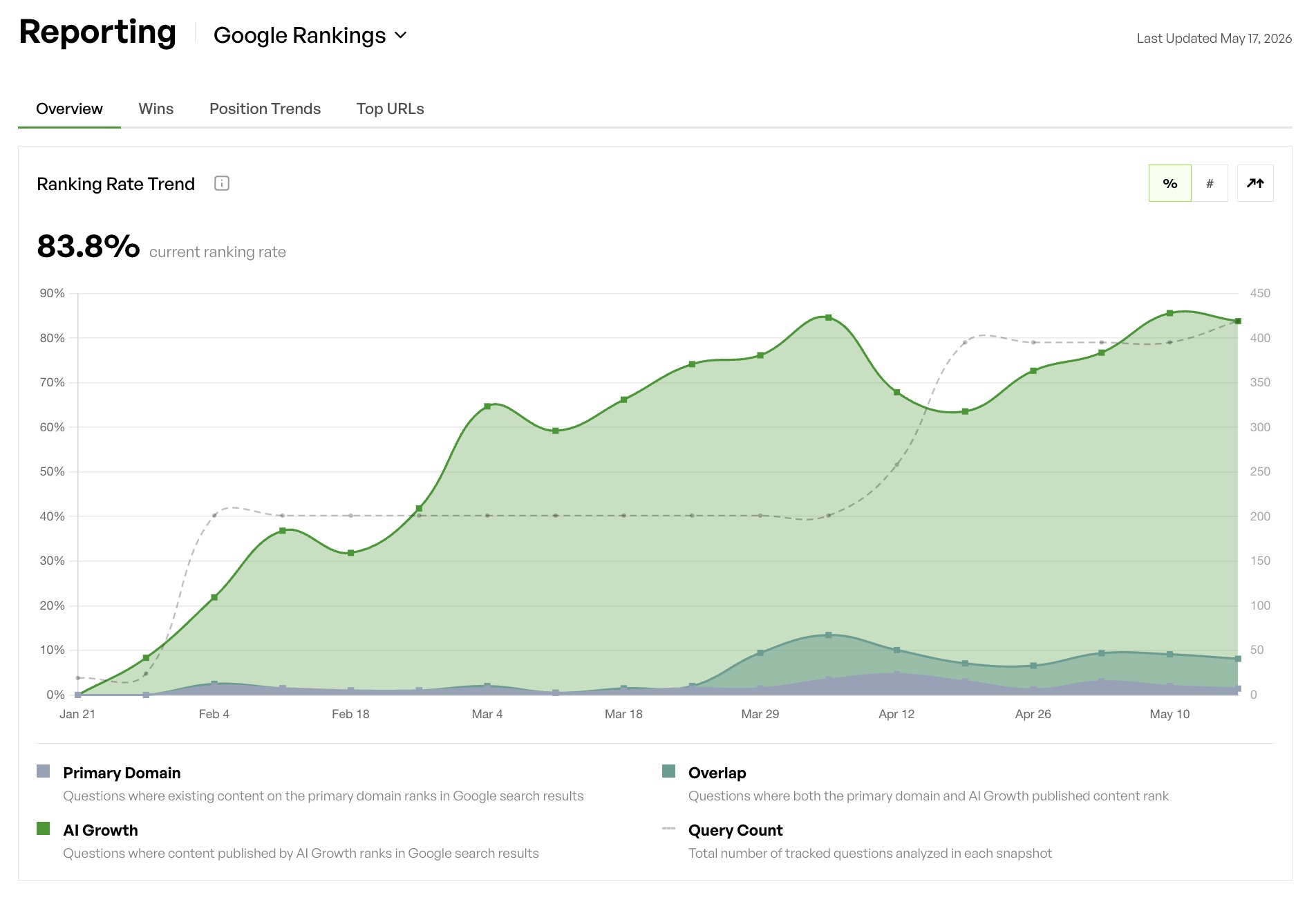
A complete citation tracking workflow combines four data sources:
- Per-article bot tracking: Log every bot interaction at the article level, including PerplexityBot crawls, ChatGPT citation sweeps, and AI training agents. This reveals which content bots read and how often.
- Google Search Console: Track impressions and query coverage for pages published through the optimized blog as an independent audit of indexing and traditional search visibility.
- Manual citation audits: Run target queries across Perplexity, ChatGPT, and Google AI Overviews monthly. Record which pages appear, at what position, and in what citation context.
- Incremental visibility reporting: Separate visibility generated by new content from visibility the brand already had so you can attribute gains to the optimization program instead of baseline brand equity.
Mapping Your Long-Tail Question Universe
Most brands track a small set of head terms and lose the rest of the conversation. Perplexity users ask in natural language, and their queries skew heavily long-tail. Google AI Mode runs multiple sub-queries per user prompt while ChatGPT does the same, and brands whose clusters cover several likely sub-queries get cited across multiple positions, while those covering only a few appear once.
Long-tail universe mapping starts with seed terms, which act as strategic anchor topics for the brand’s market. Each seed term spawns dozens of long-tail queries beneath it. The mapping process uses real-time AI Overview and ChatGPT search results as the objective function for which long-tail queries deserve coverage, so the topology stays evidence-based instead of guessed.
A mature content universe requires three elements:
- A minimum viable cluster of 7–8 interlinked pieces per topic, with one pillar article plus 6–7 spoke articles, to establish topical authority signals for AI systems.
- Bidirectional internal linking within clusters. Hub-and-spoke architectures push AI citation rates higher on pillar-topic queries.
- Entity vocabulary consistency across the cluster, using the same product names, concept definitions, and author names across every piece to support high retrieval confidence.
Comparing Monitoring Tools and Full Production Systems
| Approach | What It Does | Where It Stops |
|---|---|---|
| GEO / AI search monitors (e.g., Profound, Peec AI) | Tracks brand appearance for a capped set of prompts | Monitoring only, no content production, no publishing, no self-healing |
| Traditional SEO suites (e.g., Semrush, Ahrefs) | Keyword and rank data, topical authority scoring | No AI search content production, no citation-ready publishing |
| AI content writers (e.g., Jasper) | Generates article text on demand | No universe map, no technical SEO, no schema, no bot tracking |
| Headless marketing production system | Maps universe, produces content, publishes with full technical and agentic SEO, self-heals, reports incremental visibility | Requires kickoff interview and reverse proxy integration |
The sharpest line between monitoring and production is the gap between observation and execution. Monitoring tools tell a brand it is not appearing in Perplexity answers. A production system changes what the answer is. Only a small percentage of brands systematically track performance in AI search results. Of those, almost none run a system that acts on the data instead of only reporting it.
Evaluating Team Capacity and Scaling Options
Three capacity questions determine which implementation path your team can support.
- Technical depth: The internal team needs skills to provision schema, manage robots.txt for multiple bot agents, implement Blog MCP, publish llms.txt and llms-full.txt, and maintain a sitemap that reflects daily publishing. Most marketing teams lack this depth, and agencies often move too slowly for AI search’s update cadence.
- Publishing velocity: Organizations publishing at least 2–4 substantive pieces per month had 30–50% higher AI citation rates than infrequent publishers. A team that produces four articles per month cannot compete with a system producing dozens per day.
- Self-healing capacity: Content that goes stale loses citations. A team managing hundreds of articles manually cannot maintain the 13-week freshness cycle across the full universe, while an automated self-healing system can.
When teams lack technical depth, cannot sustain the required publishing velocity, or have no self-healing capacity, the practical solution is to separate responsibilities. The internal team handles brand direction and approval, while a headless engine handles production, technical SEO, and self-healing. This structure removes the gap between what engineers think content should be, what marketers want, and what robots need to cite it.
Five Stages of Perplexity SEO Implementation
A complete Perplexity SEO implementation moves through five stages.
- Crawl access and technical foundation: Update robots.txt to explicitly allow PerplexityBot and Perplexity-User. Disable any CDN-level AI bot blocks. Verify HTTP 200 responses. Ensure all content is server-rendered HTML. Deploy proper sitemap.xml and advanced robots.txt.
- Agentic discovery endpoints: Publish llms.txt and llms-full.txt so AI surfaces can read the brand in the format they require. Implement Blog MCP for direct interoperability with AI search. Serve OpenAI discovery and Agent Card guidance via /.well-known/. Enable natural language query parameters via /?s={query} so agents passing a query into the URL receive a tailored, internally linked response.
- Schema and content structure: Deploy FAQPage, Article, HowTo, Organization, and Person schema in JSON-LD across all relevant pages. Restructure content to the AED pattern. Add visible last-updated dates and dateModified schema to every page.
- Universe mapping and content production: Map seed terms and long-tail queries using real-time AI Overview and ChatGPT data. Build hub-and-spoke clusters with bidirectional internal linking. Produce statistics pages, comparison tables, and Q&A pages as priority formats.
- Entity authority and third-party signals: Claim and complete profiles on G2, Capterra, TrustRadius, and Trustpilot. Build Reddit and community presence. Pursue PR placements on high-authority domains. Add sameAs links to Wikidata and Wikipedia in Organization schema.
See how AI Growth Agent completes all five stages within the first week of kickoff.
Ongoing Management and Measurement Cadence
Perplexity optimization functions as an ongoing program, not a one-time project. The citation landscape shifts as competitors publish, AI models update, and your own content ages past the freshness threshold.
Ongoing management relies on four recurring activities:
- Weekly bot traffic review: Confirm PerplexityBot and other AI crawlers are visiting the blog. Track which articles receive the most bot attention and use that signal to prioritize internal linking and updates.
- Monthly citation audit: Run 15–20 representative queries across Perplexity, ChatGPT, and Google AI Overviews. Record which pages appear, at what position, and in what citation context, then build a citation frequency map to track share of voice over time.
- Quarterly cluster audit: Identify freshness gaps, new subtopics that need coverage, and accuracy issues across each content cluster. Use these findings to update the production roadmap and refresh schedule.
- Program-level reporting: Roll up bot traffic, citation data, and organic metrics into a single view that shows incremental visibility and revenue impact from the Perplexity SEO program.