Written by: Mariana Fonseca, Editorial Team, AI Growth Agent | Last updated: September 5, 2026
Key Takeaways for AI SEO in 2026
- AI content ranks in 2026 when it meets human-level quality standards and is engineered for AI citation, not when brands flood the web with unchecked output.
- Google penalizes scaled content abuse, regardless of how content is produced; data from Semrush, Ahrefs, and SE Ranking show edited, fact-checked AI content performs on par with human-written pages.
- DIY chatbots and standalone AI tools stop at the draft stage and leave gaps in query mapping, technical SEO, and ongoing updates that rankings and citations require.
- Traditional agencies and internal teams move too slowly for AI search, so long ramp times for content production allow models to train on generic web content instead of a brand’s own narrative.
- AI Growth Agent’s headless marketing engine maps queries, produces authoritative content, publishes on a client-owned site, and self-heals over time, and you can book a demo to see your first article live within a week.
Google’s Position on AI Content in Search
Google’s official position, first published in February 2023 and reaffirmed through 2026, is clear: “Our focus is on the quality of content, rather than how content is produced.” On May 15, 2026, Google released “Optimizing your website for generative AI features on Google Search,” confirming that optimizing for AI search remains SEO with the same core rules.
Google’s March 2024 spam policy targets “scaled content abuse,” which applies to both human and AI content created mainly to manipulate rankings. The May 2026 guidance states that SEO best practices still matter because generative AI features rely on core Search ranking and quality systems. Google’s AI Overviews and AI Mode use retrieval-augmented generation and query fan-out to pull from the existing Search index. Brands still need useful, non-commodity content with a first-hand point of view on technically sound, crawlable sites.
Originality.ai tracking found AI content in Google’s top 20 results grew from 2.27% in 2019 to 19.56% by July 2025, and an Ahrefs analysis of 600,000 pages found a correlation of 0.011 between AI content percentage and ranking position, effectively zero. Across major data sources, the pattern holds: Google penalizes bad content, not AI use.
What the Data Shows About AI Content Rankings
Semrush’s 2025 study of 20,000 blog URLs found near-parity: AI content appeared in the top 10 for 57% of queries versus 58% for human content. However, purely AI-generated content without human editing ranks an average of 31 positions lower for competitive commercial queries.
SE Ranking’s controlled experiment highlights the gap. Two thousand minimally edited AI articles on new domains initially ranked but collapsed completely in February 2025 with zero recovery, while six edited, fact-checked AI articles on an established blog achieved 555,000 impressions, with one article reaching position #1 and four of six cited in AI Overviews.
Ahrefs analyzed 331,000 pages and concluded “Google doesn’t punish AI content, it punishes bad content.” The January 2025 Quality Rater Guidelines state that AI-generated content receives the Lowest quality rating only when it shows “little to no effort, little to no originality, and little to no added value.” AI generation alone does not trigger penalties, and large-scale evidence now supports the “yes, but only if done right” answer.
The Four Paths to AI Content for SEO
Brands have four main ways to produce AI content for SEO in 2026, and each path delivers very different outcomes. The comparison below focuses on which approach consistently produces content that ranks and earns AI citations.
Path 1: DIY with ChatGPT or Claude
This path feels simple at first and then breaks under real workload. A chatbot can draft one solid article. Producing the second requires repeating the entire process with new prompts, more review cycles, and manual schema and formatting, which causes quality to drift over time.
One company produced roughly 300 articles this way, and none received AI citations. ChatGPT has no built-in keyword strategy, SERP data, content scoring, or publishing pipeline. It only drafts and does not manage content as a system. For a marketing leader without a technical team, this approach usually fails once they move beyond a few initial pieces.
Path 2: AI Content Tools Like Jasper, Surfer, and Frase
Purpose-built tools improve on raw chatbots and support stronger drafts. Jasper offers Brand Voice training and campaign management, Surfer SEO provides real-time content scoring against top-ranking pages, and Frase automates research and brief generation. These tools help teams that already have editors and SEOs in place.
All of them stop at the draft. None map a complete universe of queries, publish to an owned site with full technical SEO, track bot behavior, or self-heal content as it decays. An editor, an SEO specialist, and a web developer still need to close the loop. The subscription cost stays small while human hours become the real expense.
Path 3: SEO Agencies and Internal Teams
Traditional agency and in-house models move too slowly for AI search dynamics. An agency RFP often takes three months, followed by another three months to ship the first meaningful assets. Internal teams require coordination across an editor, SEO specialist, designer, and engineer.
Both models leave brands dependent on multiple vendors and tools and often ship content that starts aging the day it goes live. Google’s AI Mode crossed 1 billion monthly users within its first year and queries more than doubled every quarter. A year-long ramp effectively hands training data for the next generation of models to whatever content already exists on the open web instead of a brand’s own material.
Path 4: AI Growth Agent’s Headless Marketing Engine
AI Growth Agent provides an architecture that closes the loop from query to citation. It maps a brand’s entire universe of seed terms and long-tail queries from real-time Google and ChatGPT data. It then produces authoritative content that validates every claim and source.
The system stands up a fully optimized site the client owns within the first week. It also self-heals content over time as rankings, queries, and AI surfaces shift. This is headless marketing: marketing built for robots, without adding headcount.
A single engine replaces the SEO agency, content tool, web agency, GEO monitor, schema plugin, analytics stack, and PR firm. Across the first twelve weeks, clients average more than 12,000 additional AI citations and mentions, over 100,000 additional bot visits, and a lift of more than 20% in impressions.
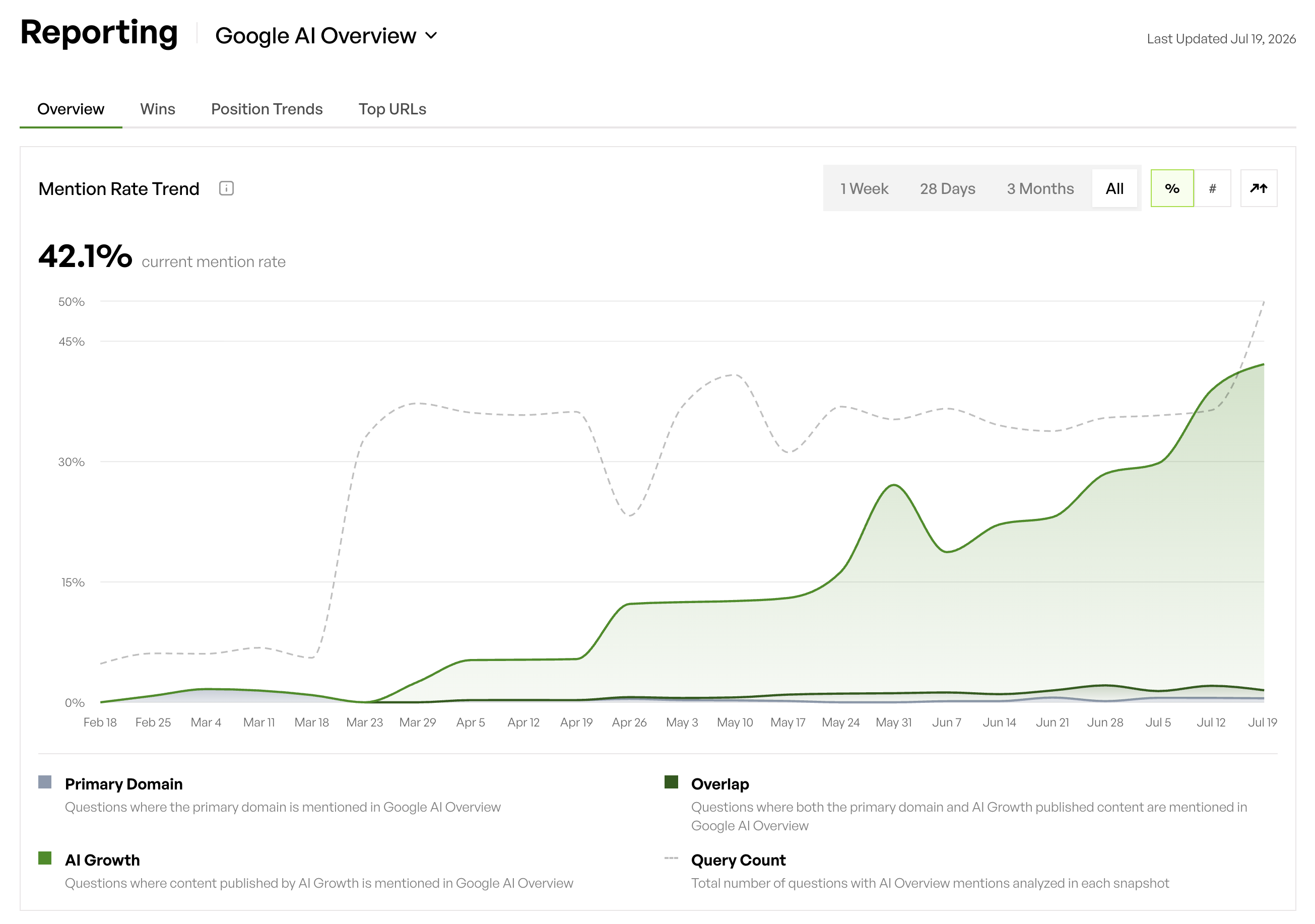
See how AI Growth Agent can map your brand’s universe and publish your first article within a week.
The 5-Step Workflow Behind AI Content That Ranks
This five-step workflow separates durable, ranking content from disposable AI output and gives a practical path to using AI for SEO without risking penalties.
- Keyword and Query Research. Robots search the long tail, while most brands track only a few head terms and lose the rest of the conversation. Use real-time AI Overview and ChatGPT results to identify long-tail queries worth pursuing. Customers can phrase the same need in hundreds of ways in AI search, and that surface area grows further when agents reason on top of user prompts.
- Content Structuring and Outlining. Structure content so AI surfaces can parse it cleanly. Use semantic HTML, clear heading hierarchies, and schema markup. Start each section with a direct answer to the implied question. Google’s May 2026 guidance confirms that useful, non-commodity content with a first-hand point of view on a technically sound site still drives generative AI features.
- Drafting with Authoritative Sources. Ground drafts in verified research instead of relying only on a model’s training data. Validate every claim and source against evidence found online. Run anti-hallucination checks across primary and external sources so the model’s confident tone matches factual reality.
- Human Oversight and Brand Voice Tuning. Assign a human owner to every article. Add what the model cannot know: first-party data, real examples, opinions, and lived experience. This work creates the “Experience” layer of E-E-A-T that AI cannot replicate, and a named author with credentials strengthens trust signals.
- Publishing, Technical SEO, and Continuous Optimization. Publishing marks the starting line, not the finish. Content has a shelf life, so teams need to refresh declining pages, update at scale when strategy shifts, prune pieces that never gained traction, and redirect safely. Content updated within three months gets 2x more AI citations than content left to go stale.
How to Prepare AI Content for AI Search (LLMO)
Traditional SEO focused on blue links, while large language model optimization (LLMO) focuses on what AI surfaces can find, trust, and cite. Google’s AI Mode crossed 1 billion monthly users within its first year, queries more than doubled every quarter, and AI Overviews now trigger on 48% of tracked queries, with organic CTR dropping by more than 60% when an AI Overview appears.
High organic rankings no longer guarantee AI citation. Roughly 60% of AI Overview citations come from URLs outside the top 20 organic results, and overlap between Google’s top-10 rankings and AI Overview citations fell from 75% in mid-2025 to between 17% and 38% by early 2026.
Winning AI citations requires content that is easy to extract, backed by validated primary sources, and refreshed often enough that the next training sweep reflects the brand’s current narrative. This setup includes full schema, MCP endpoints, an LLM.txt file, a proper sitemap.xml, and advanced robots.txt. Pages that look beautiful to humans but remain invisible to bots function as decoration instead of assets.

Common AI Content Mistakes That Damage Rankings
The most common mistake is mass-producing unedited AI content. Google’s March 2024 core update deindexed 837 websites and issued 1,446 manual actions, with every manually penalized site showing signs of AI content and half having 90–100% AI posts. The behavioral fingerprints are consistent: publishing velocity above 50 articles per day, thin topical coverage, zero author bylines, no outbound links to authoritative sources, and template-driven internal linking.
The second mistake involves weak factual accuracy. AI can state wrong dates, processes, or product details in a confident tone, so every claim needs verification against approved sources.
The third mistake ignores E-E-A-T. Google’s Quality Rater Guidelines state that AI-generated content receives the Lowest quality rating only when it shows “little to no effort, little to no originality, and little to no added value.” AI use alone does not cause penalties.
The fourth mistake is letting content sit untouched. Sites that update content within three months get 2x more AI citations. Stale content loses both rankings and AI visibility.
Frequently Asked Questions
Does Google penalize AI content?
Google’s official stance, published in February 2023 and reaffirmed through 2026, is that it rewards quality content “however it is produced.” Google penalizes scaled content abuse, which means mass-producing pages primarily to manipulate rankings, regardless of whether the content is AI-generated or human-written. The March 2024 spam policy and later updates target low-quality, unhelpful content. The January 2025 Quality Rater Guidelines confirm that AI generation alone does not trigger the Lowest quality rating, which applies only when content shows little effort, originality, and added value.
Can ChatGPT do SEO?
ChatGPT can draft content, but it does not function as an SEO platform. It lacks built-in keyword research, SERP data, content scoring, rank tracking, and a publishing pipeline. It cannot map a full query universe, validate every claim against primary sources, or self-heal content as performance changes. ChatGPT works as a drafting assistant, and ranking content requires a surrounding system that handles query research, structured content with schema and semantic HTML, anti-hallucination checks, human editorial oversight, and continuous optimization after publishing.
Is AI content good for SEO?
AI content supports SEO when teams apply strong editorial control. Semrush’s 2025 study found AI content appeared in the top 10 for 57% of queries versus 58% for human content, and Ahrefs’ analysis of 600,000 pages found no meaningful correlation between AI content percentage and ranking position. The key factor is oversight: purely AI-generated content without human editing ranks an average of 31 positions lower for competitive commercial queries. Edited, fact-checked AI content that demonstrates E-E-A-T performs comparably to human-written work.
How do I use AI for SEO without getting penalized?
Follow a five-step workflow: research the long tail of queries from real-time AI Overview and ChatGPT data, structure content with schema and semantic HTML so AI surfaces can parse it, draft with authoritative sources and anti-hallucination checks, apply human oversight and brand voice tuning to inject first-party data and real experience, and publish with full technical SEO while continuously optimizing. Never publish raw AI output at scale. Every page needs a human owner, a verifiable claim structure, and a refresh cadence that keeps it current, which also supports stronger AI citation rates.
Is SEO still worth it in 2026?
SEO remains a strong investment in 2026, and the strategic case has grown. The channel has shifted from chasing blue links to earning citations inside AI-generated responses across Google’s AI Mode, ChatGPT, and Perplexity. Brands that establish authoritative content now train the next generation of models with their own narrative. Paid media stops producing results when spend stops, while organic visibility compounds over time in a channel the brand can shape directly.
Conclusion: Competing in an AI-First Search Landscape
The evidence shows that AI content drives SEO results in 2026 when it is authoritative, validated, and engineered for AI surfaces. Winning brands treat AI as a production engine inside a disciplined system, not as a shortcut to mass content.
The four paths to AI content deliver very different outcomes. DIY chatbots struggle beyond a few posts, content tools pause at the draft, and agencies move too slowly for AI search cycles. AI Growth Agent provides an integrated engine that maps a brand’s universe, produces authoritative content, publishes on a client-owned site, and keeps that content updated as the landscape shifts.
The leaderboard for AI search is being written now. Brands that invest in authoritative, technically sound content today shape how future models answer questions in their category, while brands that delay leave that story to generic web content.