Written by: Mariana Fonseca, Editorial Team, AI Growth Agent
Scrunch AI vs Clover Labs: Key Takeaways
- Scrunch AI and Clover Labs sit in different categories: Scrunch AI monitors AI visibility, while Clover Labs automates content distribution. Neither produces the authoritative, self-healing content needed to change what AI surfaces say about a brand.
- Monitoring tools like Scrunch AI cap prompt coverage and create blind spots. Distribution tools like Clover Labs still rely on clients for source material and brand voice.
- Only 30% of brands stay visible from one AI answer to the next, and 40–60% of cited domains change monthly. Brands need continuous content production, not dashboards or distribution alone.
- AI Growth Agent maps the full universe of queries, produces validated content, self-heals over time, and reports incremental visibility gains. Clients see an average of 12,000+ new citations and a 20%+ impression lift within twelve weeks.
- Teams ready to move beyond dashboards and distribution can schedule a demo with AI Growth Agent to see how one engine replaces monitoring, content creation, and distribution at a flat fee.
How Scrunch AI and Clover Labs Compare as Competitors
Evaluation criteria matter more than any feature list. CMOs and founders should score candidates on implementation complexity, scalability, workflow fit, technical requirements, governance, reporting visibility, maintenance burden, and long-term adaptability. Conductor’s CMO evaluation guide adds that effective platforms connect reporting to implementation with prioritized recommendations and a direct path from visibility gaps to content generation in the same workflow.
Applying those criteria to Scrunch AI and Clover Labs shows how each tool performs on execution-focused dimensions. The comparison below maps both platforms across attributes that determine whether a tool closes the loop or only describes the problem.
| Attribute | Scrunch AI | Clover Labs |
|---|---|---|
| Core purpose | AI visibility monitoring and answer engine optimization | Content and video distribution automation |
| Prompt coverage | Starts at $250 per month for its Core plan for both brands and agencies, with prompt volume scaling by plan tier | Not applicable, distribution-focused, not prompt-tracking |
| Content production | Agent Experience Platform (AXP) delivers structured content for LLM crawlers; client supplies source material | Automates distribution of client-supplied content; does not produce original content |
| Technical SEO stack | Structured content tuned for LLM crawlers via AXP; GA4 OAuth integration for AI referral traffic | Distribution-layer integrations; technical SEO not a stated capability |
| Self-healing content updates | Not a stated capability | Not a stated capability |
| Incremental visibility reporting | Citation-level tracking, share of voice, competitive benchmarking | Distribution and engagement metrics; not citation-focused |
| Pricing model | $250 per month for its Core plan for both brands and agencies, scaling by prompt volume and engine coverage | Subscription tiers; pricing not publicly standardized at the same level of detail |
Scrunch AI’s main competitors in the monitoring category include Profound, Peec AI, Otterly, and Evertune. Sitecore acquired Scrunch in June 2026 for approximately $225 million, which signals that standalone visibility monitoring is consolidating into larger experience platforms instead of expanding into execution. That consolidation shows that monitoring alone is not a defensible category.
Scrunch AI Monthly Pricing and Its Tradeoffs
Scrunch AI starts at $250 per month for its Core plan for both brands and agencies, with higher tiers adding prompt volume, engine coverage, and reporting depth. The pricing model is prompt-based, so the number of queries tracked and AI engines monitored sets the plan tier and cost.
That structure creates a ceiling on visibility. AI visibility tools that price by prompts and engines charge more as teams expand coverage, so the more of the universe a brand wants to see, the more it pays. Teams that cap prompt volume to control costs stay blind to the queries they did not think to track.
A flat-fee architecture removes that ceiling. AI Growth Agent uses a flat price with no per-prompt billing, no credit limits, and no per-article charges. Prompt count never appears as a billed metric, so clients see their entire universe instead of a capped slice.
Scrunch AI vs Clover Labs for Content Automation
The category difference between Scrunch AI and Clover Labs is structural, not just a feature gap. Scrunch AI requires the client to produce content elsewhere, then monitors whether that content earns citations. Clover Labs automates distribution but still depends on the client for source material and brand voice. Neither tool closes the loop between spotting gaps and producing the content that fills them.
Monitoring-only tools answer “where do we stand?” but leave teams without a clear path to improve visibility. Many teams stall after the first dashboard review. Distribution tools move content faster but cannot turn generic content into authoritative coverage. In both cases, the brand stays dependent on external content production and cannot reshape what AI surfaces say.
The practical impact is significant. Only 30% of brands stay visible from one AI answer to the next, and 40 to 60% of cited domains change in just one month. A monitoring tool reports that churn. A distribution tool moves content into channels. Neither produces the validated, authoritative content that earns and holds citations over time.
Best AI Visibility Tools in 2026 by Category
AI visibility tools fall into three categories: monitoring dashboards, analytics plus recommendations platforms, and execution systems that close the loop with content creation and distribution. Scrunch AI fits the monitoring category. Clover Labs fits a distribution-focused variant of the execution category. Neither covers the full loop.
Fit depends on a team’s maturity. Scrunch AI suits teams that only need a monitoring dashboard and already run a strong content pipeline that produces authoritative work. Clover Labs suits teams with established brand voice and a content library that need faster distribution across channels. Both tools assume the hard problem, producing content that AI surfaces trust and cite, is already solved.
AI Overviews now appear in 48% of searches, up from 34.5% in December 2025, and 93% of AI Mode sessions end without a click. Brand visibility inside AI responses often becomes the only impression a brand receives. Monitoring that impression without the power to change it functions like a rearview mirror, not a strategy.
The Missing Execution Layer for AI Visibility
Two structural risks define monitoring-only and distribution-only approaches. First, monitoring tools create visibility blind spots by capping prompts. Smaller plans cover as few as 15 prompts across 4 engines, so most long-tail queries that customers actually ask go untracked. The universe a brand does not monitor becomes the universe it loses by default.
Second, automation tools without brand intelligence produce generic output that never earns citations. 85% of brand mentions in AI answers originate from third-party pages rather than brand-owned domains, and 97.4% of earned media citations in AI search come from non-Tier-1 sources such as trade publications, niche industry blogs, specialist review sites, regional outlets, and vertical-specific media. Generic content pushed at scale does not earn those citations. Authoritative, validated content does.
Three questions route the decision correctly:
- Do you need to see the full universe or a capped set of prompts?
- Do you need content produced or only distributed?
- Do you want incremental visibility proof or only activity metrics?
Answers that point to full universe, content produced, and incremental proof point to AI Growth Agent. The engine maps the entire universe of seed terms and long-tail queries from real-time Google and ChatGPT data. It produces authoritative, self-healing content that validates every claim and source. It reports the incremental visibility it generates week over week, separate from visibility the brand already had.
Operational and Long-Term Platform Considerations
Onboarding effort differs sharply across categories. Monitoring tools require prompt configuration and engine selection before data flows. Distribution tools require content pipelines, brand voice documentation, and channel integrations before distribution starts. Both approaches create cross-functional dependencies that slow time to value.
AI visibility monitoring tools help brands detect errors in how AI models describe them more quickly. Detection speed matters, but detection without correction still leaves the brand misrepresented. Content governance, which keeps published content accurate, current, and compliant, remains a maintenance burden that neither Scrunch AI nor Clover Labs handles autonomously.
Infrastructure needs compound over time. Given the citation volatility described earlier, tracking over an extended period helps teams spot meaningful trends instead of reacting to short-term noise. A stack that monitors churn without producing replacement content stays behind. Adaptability to changing search behavior requires a system that self-heals, not one that only reports decay after it occurs.
Best-Fit Use Cases for Each Platform
Scrunch AI fits teams with a functioning content operation that already produces authoritative output and need a dedicated dashboard to track citations across ChatGPT, Perplexity, Google AI Overviews, and Gemini. It does not replace the content operation.
Clover Labs fits teams with established brand voice and a content library that need to accelerate distribution across channels without building distribution infrastructure manually. It does not replace the content production function.
AI Growth Agent fits teams that need both mapping and production. The system maps the full universe, produces authoritative content validated against primary sources, publishes with full technical and agentic SEO, self-heals over time, and reports incremental visibility in isolation from existing brand equity. Clients average more than 12,000 additional AI citations and mentions, over 100,000 additional bot visits, and a 20%+ lift in impressions across the first twelve weeks, with content indexing in as little as ten days.
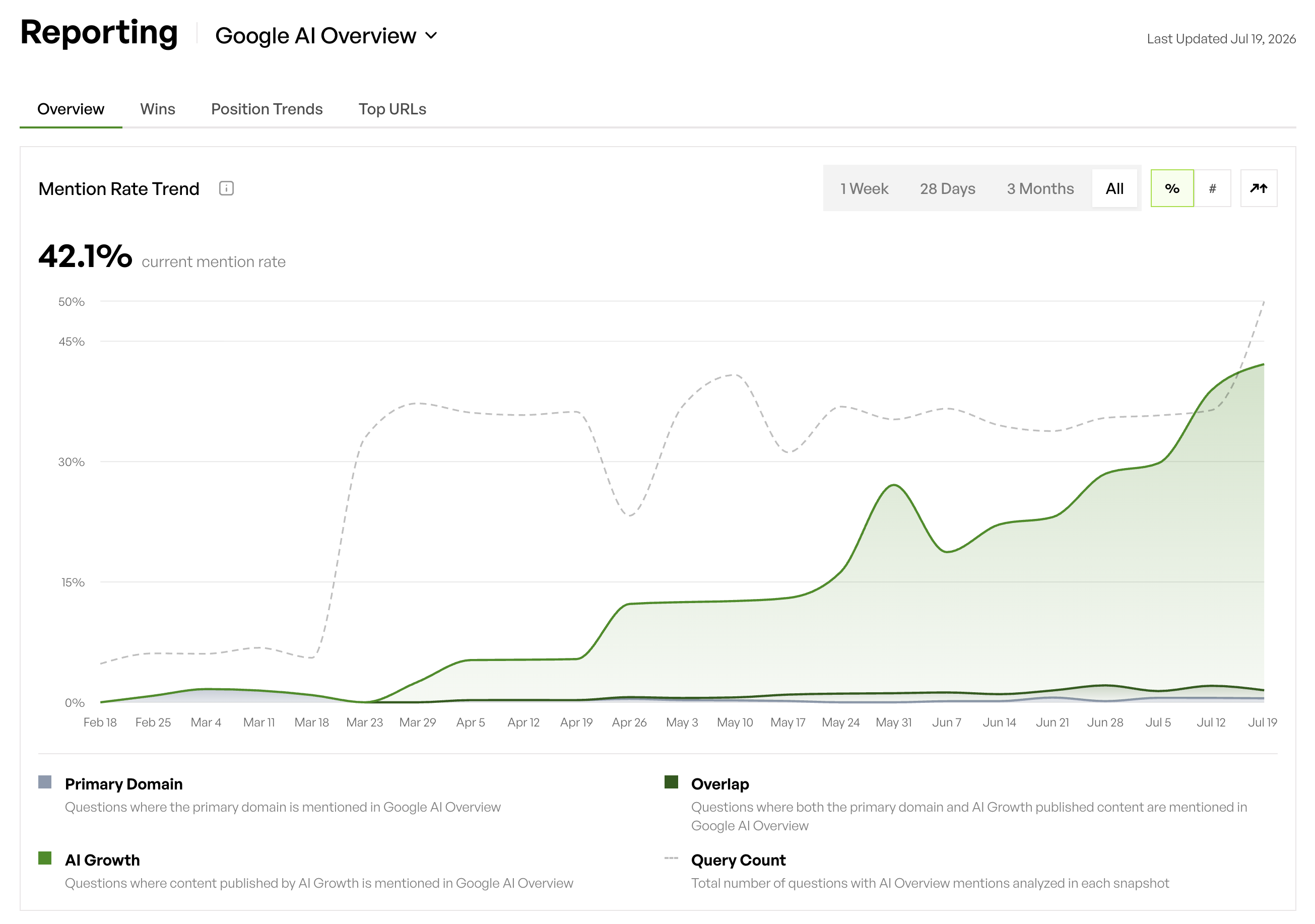
The distinction centers on category, not scale. Monitoring and distribution act as inputs to a content strategy. AI Growth Agent functions as the strategy, the execution, and the proof in one engine.
Conclusion: Moving Beyond Monitoring and Distribution
Scrunch AI and Clover Labs address real needs in their categories. Scrunch AI shows a brand where it stands in AI answers. Clover Labs moves content through distribution channels faster. Neither changes what AI surfaces say about a brand, because neither produces the authoritative, self-healing content that earns and holds citations over time.
AI search traffic converts at 14.2% compared to Google’s 2.8%, nearly five times higher, and AI-referred visitors spend 59% more time on sites than non-AI visitors. The channel carries high value. Brands that win it produce content models can find, trust, and cite, rather than only monitoring gaps or distributing generic output.
AI Growth Agent both maps the full universe and produces the content that wins citations. One headless engine replaces the monitoring tool, the content agency, the distribution stack, the technical SEO plugin, and the analytics layer, at a flat fee with no per-prompt billing and no credit limits. The client owns the site, the content, and the incremental visibility proof.
Frequently Asked Questions
What is the main difference between Scrunch AI and Clover Labs?
Scrunch AI is an AI visibility monitoring platform that tracks whether and how a brand appears in AI-generated answers across surfaces like ChatGPT, Perplexity, Google AI Overviews, and Gemini. It measures citation frequency, share of voice, and competitive positioning but requires the client to produce content through other means. Clover Labs is a content and video distribution automation platform that accelerates how existing content reaches channels and audiences. It does not produce original content and does not track AI citations. The two tools operate in different categories and address different problems, so buying one does not remove the need for the other.
Can Scrunch AI or Clover Labs improve what AI surfaces say about my brand?
Neither tool directly changes what AI surfaces say about a brand. Scrunch AI reports on existing citations and visibility gaps. Clover Labs distributes content that the client has already produced. Changing what AI surfaces say requires authoritative, validated content that models can find, trust, and cite. That content must be structured for AI crawlers, backed by primary sources, and refreshed over time so it does not decay between model training sweeps. Monitoring and distribution support that process but do not replace it.
Why does prompt capping matter when evaluating AI visibility tools?
Prompt capping limits the slice of the market a brand can see. Entry-level plans on monitoring tools track as few as 15 prompts across a handful of engines. Queries a brand does not track become queries it loses by default, because the tool cannot surface gaps it does not measure. The long tail of queries that customers actually ask in AI search is vast, and most of it falls outside the handful of head terms a brand pre-decides to defend. A pricing model that charges per prompt creates a financial incentive to track less of the universe, which runs counter to controlling the narrative across AI surfaces.
What does AI Growth Agent do that Scrunch AI and Clover Labs do not?
AI Growth Agent maps the full universe of seed terms and long-tail queries from real-time Google and ChatGPT data. It produces authoritative content that validates every claim and source, stands up a fully optimized site the client owns within the first week, and reports the incremental visibility it generates week over week in isolation from existing brand equity. The content stays living, because it self-heals and updates over time instead of going stale. Pricing uses a flat fee with no per-prompt billing, no credit limits, and no per-article charges. One engine replaces the monitoring tool, the content agency, the distribution stack, the technical SEO plugin, and the analytics layer. Scrunch AI monitors. Clover Labs distributes. AI Growth Agent produces, publishes, and proves.
How quickly can AI Growth Agent produce results compared to a monitoring-only approach?
A monitoring-only approach produces a dashboard immediately but no content, so it creates no new citations and no change in what AI surfaces say. AI Growth Agent moves from kickoff to the first published article in about one week, with content indexing in as little as ten days. The results described in the use cases section, including 12,000+ new citations, 100,000+ bot visits, and 20%+ impression lift, typically materialize within the standard three-month pilot period. A monitoring tool can tell a brand it is missing from AI answers on day one. AI Growth Agent starts changing that answer within the first week.