Written by: Mariana Fonseca, Editorial Team, AI Growth Agent
Key Takeaways for CPG AI Visibility
- CPG GEO depends on machine-readable product data, cross-channel consistency, and off-site authority signals so AI engines can find, trust, and cite specific SKUs.
- Retailers dominate AI citations. Brands must populate allergen fields, nutrition facts, pack-size attributes, and Q&A sections identically across every portal.
- Ingredient queries succeed only when full lists use standardized nomenclature, quantified nutrient claims, and machine-readable certifications with provenance data.
- Pack-size and case-pack consistency prevents duplicate listings and AI citation failures. Each variant needs its own GTIN and schema object.
- AI Growth Agent replaces the entire CPG marketing stack with one headless engine that maps query universes, auto-generates compliant product entities, and proves incremental visibility. Book a demo to get started.
Clean Ingredient Answers AI Agents Can Trust
Ingredient queries sit among the highest-volume CPG questions in AI search. Many AI-powered food shopping queries include a dietary preference or restriction such as vegan, gluten-free, or nut-free. A brand that cannot answer “what are the clean ingredients in Brand X” with structured, verifiable data will not appear in those answers.
The product-spec rules that govern ingredient data for AI citation work together as one system:
- Store the full ingredient list as free-text in descending order by weight, then link each ingredient back to the allergen schema so dietary claims are auditable, not inferred.
- This linkage enables the next requirement. Use complete standardized nomenclature (INCI or GS1) for every ingredient name, because non-standard names cause AI agents to fail verification and drop the SKU.
- Once ingredients are properly named and linked, convert vague benefit claims into quantified statements such as “Contains 1,000 mg Vitamin C (1,111% DV)” rather than “supports immune health.”
- After claims are quantified, map certifications (USDA Organic, Non-GMO Project Verified, Certified Gluten-Free, Whole30 Approved, Keto Certified) to verifiable machine-readable schemas so AI agents can corroborate each claim.
- With certifications structured, include provenance data such as country of origin and supplier identifiers, because AI agents evaluating CPG products query retailer APIs directly and treat missing provenance as a reliability failure.
- Finally, publish negative claims explicitly. Use discrete attribute fields for “no artificial flavors,” “no preservatives,” and “no added sugar,” not only marketing copy.
The retailer data-consistency requirement is absolute. AI shopping agents follow a retrieve-rank-verify pipeline. They pull candidates, score them against constraints, then verify and cite only products whose data is consistent across every channel. A discrepancy between a Walmart supplier feed and a Target partner portal registers as a reliability failure that disqualifies the SKU at the verify stage.
To ensure consistency across all channels, use this product description template that structures information in the order AI agents expect:
[Brand Name] [Product Type] is a [dietary claim: vegan / gluten-free / non-GMO] [format: powder / bar / beverage] made with [top 3 ingredients by weight in standardized nomenclature]. Each [serving size] delivers [quantified nutrient 1], [quantified nutrient 2], and [quantified nutrient 3]. [Certification 1] and [Certification 2] certified. Free from [allergen 1], [allergen 2], and [allergen 3]. Sourced from [country of origin]. [One sentence describing primary use case in natural language: e.g., “Formulated for post-workout recovery in adults following a plant-based diet.”]
This structure gives AI agents a direct answer in the first sentence, verifiable evidence in the attribute fields, and use-case language that matches the natural-language queries consumers actually ask. Adobe’s product marketing lead for CXO Solutions notes that people search for an experience from a product, not technical details, so pairing structured specs with use-case language earns citations.
See how AI Growth Agent auto-generates compliant, validated product descriptions at scale.
Pack Size, Net Weight, and AI-Ready Configuration
Pack-size and unit-of-measure inconsistencies are the most common cause of duplicate or conflicting listings across a retailer’s own SKUs. These inconsistencies directly corrupt unit-price comparisons in AI responses. Anglera’s CPG attribute research identifies pack size, net weight, count per pack, unit size, and case-pack attributes as critical for data consistency, with mismatches producing the highest rate of AI citation failures in the grocery and CPG category.
Pack-size and case-pack consistency rules create a single source of truth:
- Define one canonical value for net weight in grams or ounces, with both units present, and write it back to every channel such as the supplier feed, PIM, retailer portal, and owned product page.
- Express count per pack and case-pack quantity as integers, not ranges or approximations.
- Use GS1 GTIN at the lowest trade-item level for each distinct pack configuration. A 12-count case and a 6-count case require separate GTINs, not variants of the same record.
- Populate the size_system attribute in Google Merchant Center for country-specific unit conventions such as US oz versus EU g to prevent mismatches in cross-border AI answers.
- Set freshness timestamps on every pack-size attribute so AI agents can confirm the data is current.
Implement these rules using the following schema.org Product markup, which structures pack configuration data in a format AI agents can parse and verify:
{ "@context": "https://schema.org", "@type": "Product", "name": "[Brand] [Product Name] [Pack Size]", "sku": "[Unique SKU per variant]", "gtin13": "[13-digit GTIN]", "brand": { "@type": "Brand", "name": "[Brand Name]" }, "weight": { "@type": "QuantitativeValue", "value": "[net weight]", "unitCode": "GRM" }, "additionalProperty": [ { "@type": "PropertyValue", "name": "Count Per Pack", "value": "[integer]" }, { "@type": "PropertyValue", "name": "Case Pack Quantity", "value": "[integer]" }, { "@type": "PropertyValue", "name": "Unit Size", "value": "[value + unit]" }, { "@type": "PropertyValue", "name": "Storage", "value": "[shelf-stable / refrigerated / frozen]" } ], "offers": { "@type": "Offer", "price": "[live price]", "priceCurrency": "USD", "availability": "https://schema.org/InStock", "url": "[canonical PDP URL]" } }
Each pack configuration requires its own schema object. For variant products, implementing the variesBy property and separate schema objects for each variant ensures AI agents understand the full range of options. A 12-count and a 6-count sharing one schema record will produce wrong answers in AI comparisons and unit-price queries.
Retailer Coverage, Reviews, and Third-Party Signals
Retailer pages and third-party signals dominate AI citations for CPG queries. McKinsey research from October 2025 found that a brand’s own website supplies only 5–10% of the sources AI search engines consult when assembling answers. The other 90–95% comes from retailer listings, review platforms, editorial content, and third-party signals. Owned-site optimization without retailer-page dominance is an incomplete strategy.
Retailer page dominance requirements focus on structural and content consistency:
- Maintain identical product titles, descriptions, ingredient lists, and attribute fields across every retailer portal such as Amazon, Walmart, Target, Kroger, and Instacart, plus the brand’s DTC site. Cross-channel discrepancies register as reliability failures that disqualify SKUs at the AI verify stage.
- Populate the Q&A section on each retailer listing with at least ten brand-authored answers covering ingredient sourcing, allergens, taste, storage, and comparisons to alternatives, because Amazon’s AI assistant Rufus, which serves over 250 million shoppers, relies on complete Q&A sections for generating food and beverage recommendations.
- Use the product title formula [Brand] + [Product Type] + [Key Differentiator] + [Primary Benefit] + [Size/Quantity], which gives AI agents parseable attributes rather than keyword-stuffed strings.
- Publish hero images at minimum 800px with accurate alt text describing the product, pack configuration, and key visual claims. These structural elements ensure AI agents can parse your retailer listings, while the content within those listings, particularly customer reviews, requires its own optimization approach.
Review-language optimization is a distinct discipline. Consumer reviews contribute substantially to what AI tools scrape from retailer pages. A review stating “I switched from X brand because this one dissolves better and does not have that chalky aftertaste” becomes part of how AI describes the product in future answers. Brands that prompt buyers to mention specific attributes, dietary outcomes, and comparative statements in post-purchase review requests are building AI training data, not just social proof.
Review volume matters structurally. Gathering 1-10 reviews on a CPG product page yields a 52.2% uplift in conversion while supplying the consensus mass AI engines require to confidently cite the SKU. Brands mentioned on four or more platforms are 2.8 times more likely to appear in AI recommendations, which means review syndication across retailer pages, Google Shopping, and third-party editorial sites acts as a citation multiplier.
Off-site authority signals that AI engines weight heavily for CPG include editorial coverage in food and lifestyle media, Reddit threads where specific SKUs are discussed by name, comparison guides published by independent bloggers, and certification body listings such as USDA, Non-GMO Project, and NSF. Challenger CPG brands that publish detailed comparison guides and transparent ingredient sourcing stories are outperforming better-known category leaders in AI-driven recommendations because they own the third-party content layer that AI engines trust most.
KPIs for AI Citations, Bot Traffic, and Incremental Reach
AI answer visibility already functions as a core performance channel, yet fewer than 15% of enterprise marketing teams track it as a formal KPI, according to a 2025 Gartner survey. For CPG brand managers, this measurement gap creates a competitive opening. Brands that instrument AI visibility now are building a baseline their competitors cannot retroactively reconstruct.
The seven AI search visibility metrics, organized by tier and defined by Sequence Commerce, cover selection, credibility, and outcomes:
- Selection tier: Citation rate, which is the percentage of tracked buyer-intent queries where the brand is cited, mention share of voice, which is brand citations as a percentage of all brand citations in the category, and position within the answer, where first mention is treated as the default recommendation by AI models.
- Credibility tier: Sentiment score, which is the percentage of citations that are neutral or positive, and source link inclusion rate, which is the percentage of citations that include a clickable link to a brand or retailer page.
- Outcome tier: AI referral traffic, which is sessions originating from known AI referrers segmented in GA4, and AI conversion rate, which is conversions from AI-referred sessions compared to site average.
Benchmarks for CPG brands, per Sequence Commerce, give teams clear targets. A citation rate of 15–25% is strong, and 30% or higher indicates category leadership. Sentiment should reach at least 80% positive or neutral. Source link inclusion should exceed 50%. AI referral traffic should reach 5–15% of total organic by month six. AI conversion rate should land at 1.5–2 times the site average.
The KPI dashboard structure that gives CPG brand managers a defensible weekly report connects these metrics into one view:
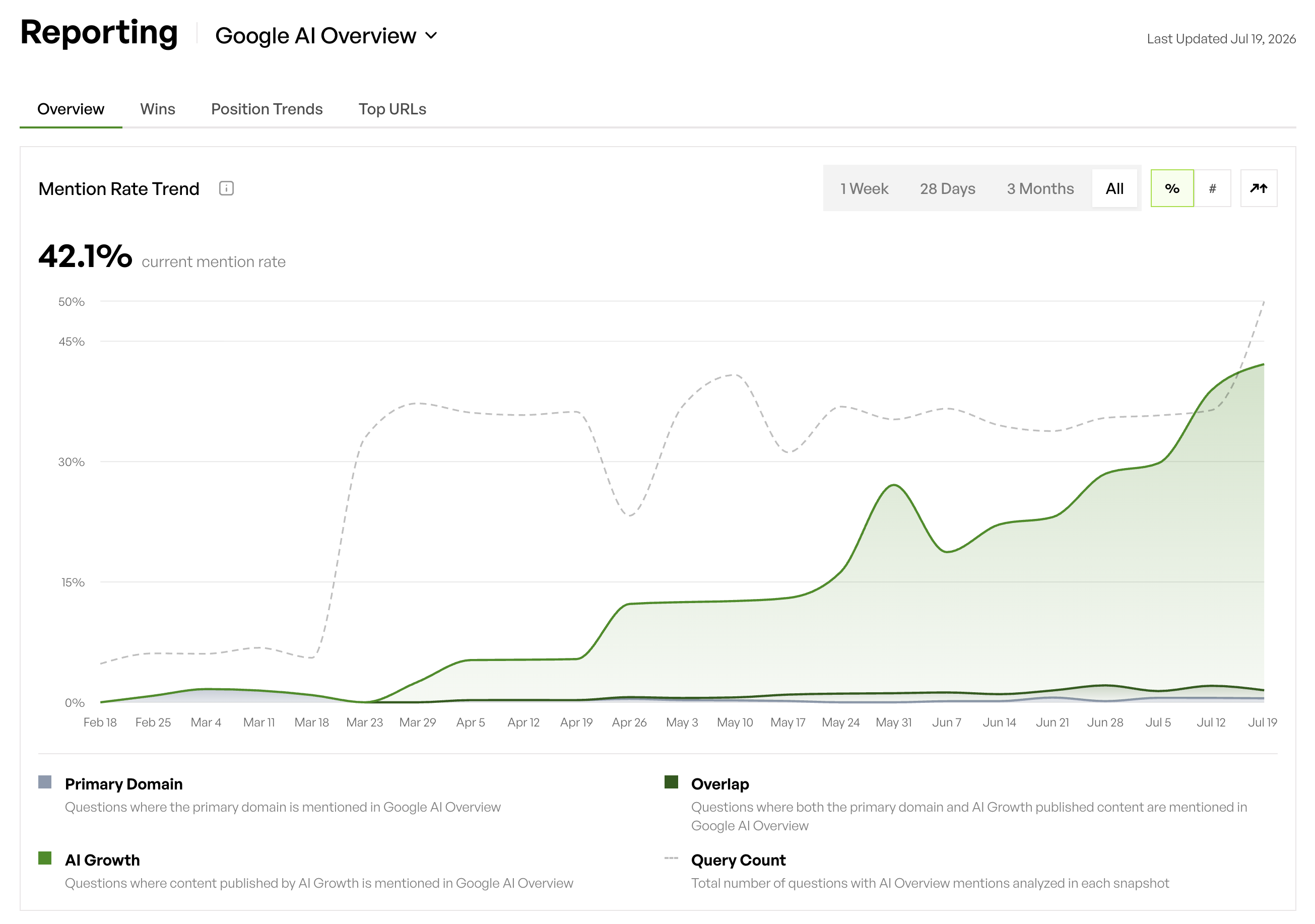
- Current state panel: 30-day averages for citation rate, mention share of voice, and position within answer across ChatGPT, Perplexity, Gemini, and Google AI Overviews. These baseline metrics feed the rest of the dashboard.
- Trend panel: Week-over-week and month-over-month movement for each Selection and Credibility metric, revealing whether optimization efforts are working.
- Competitive overlay: Brand citation rate versus three to five tracked competitors across the same query set, which contextualizes performance.
- Bot traffic panel: Per-article bot visits segmented by crawler type, including the bot ChatGPT uses to cite sources, cross-referenced against Google Search Console impressions.
- Incremental visibility panel: Impressions and citations attributable to new content, isolated from pre-existing brand visibility so teams can prove what the current effort actually generated.
- Action queue: Prioritized list of SKUs or content gaps where citation rate is below benchmark, with specific attribute or content fixes identified.
Measurement rules keep the program manageable. Track 30–50 high-value buyer-intent queries weekly rather than hundreds. Use GA4 with a custom AI referral segment for Outcome KPIs. Run manual spot-checks of how SKUs appear in ChatGPT and Perplexity shopping answers monthly. Isolate a control set of untouched SKUs to attribute enrichment lifts accurately, because AI citation and organic search performance changes typically appear over weeks rather than days as crawlers re-index.
How AI Growth Agent Replaces the CPG AI Stack
Throughout this guide, you have seen the technical requirements for CPG AI optimization, including schema markup, attribute consistency, retailer portal management, content creation, and citation tracking. The standard approach requires assembling a stack of separate tools such as a PIM system, a schema plugin, a GEO monitoring tool, a content agency, a web agency, an SEO suite, and a PR firm. Each carries its own contract, onboarding cycle, and integration dependency. An agency RFP alone often runs three months, then three more to produce the first assets. By the time the stack is assembled, the AI leaderboard for the brand’s category has already been written by faster competitors.
AI Growth Agent replaces that entire stack with one headless engine at a flat fee, with no per-article charges, credit limits, or per-prompt billing. The architecture is built specifically for the CPG discovery shift:
- Universe mapping: The engine maps the brand’s full CPG query universe, from head terms like “best protein bar” to long-tail queries like “high-protein bar without sugar alcohols for keto athletes,” using real-time Google and ChatGPT data as the objective function. Mature clients reach universes of more than 1,600 queries, with over 3,000 searches run weekly to refresh the snapshot.
- Auto-generated product entities: Product schema, allergen attributes, pack-configuration fields, and ingredient data are provisioned automatically and kept current, with no engineering hours required from the brand team.
- Retailer-first content: The engine produces authoritative content that answers the exact consumer questions AI engines cite. Each piece is structured with direct answers in the first 30 words, verifiable evidence in the body, and use-case language that matches natural-language queries.
- Agentic technical SEO: Every published page ships with Blog MCP, llms.txt and llms-full.txt, OpenAI discovery via /.well-known/, natural language query parameters, and Markdown served to agent crawlers, which makes the brand’s content readable by the AI surfaces doing the citing.
- Living, self-healing content: Content updates automatically as the world changes. When the year turns, every article in the brand’s sector is refreshed. When Google Search Console signals a page is losing ground, the engine re-indexes and strengthens it.
- Incremental visibility proof: AI Growth Agent publishes into a separate environment and reports only the visibility it actually generated, never taking credit for pre-existing brand authority.
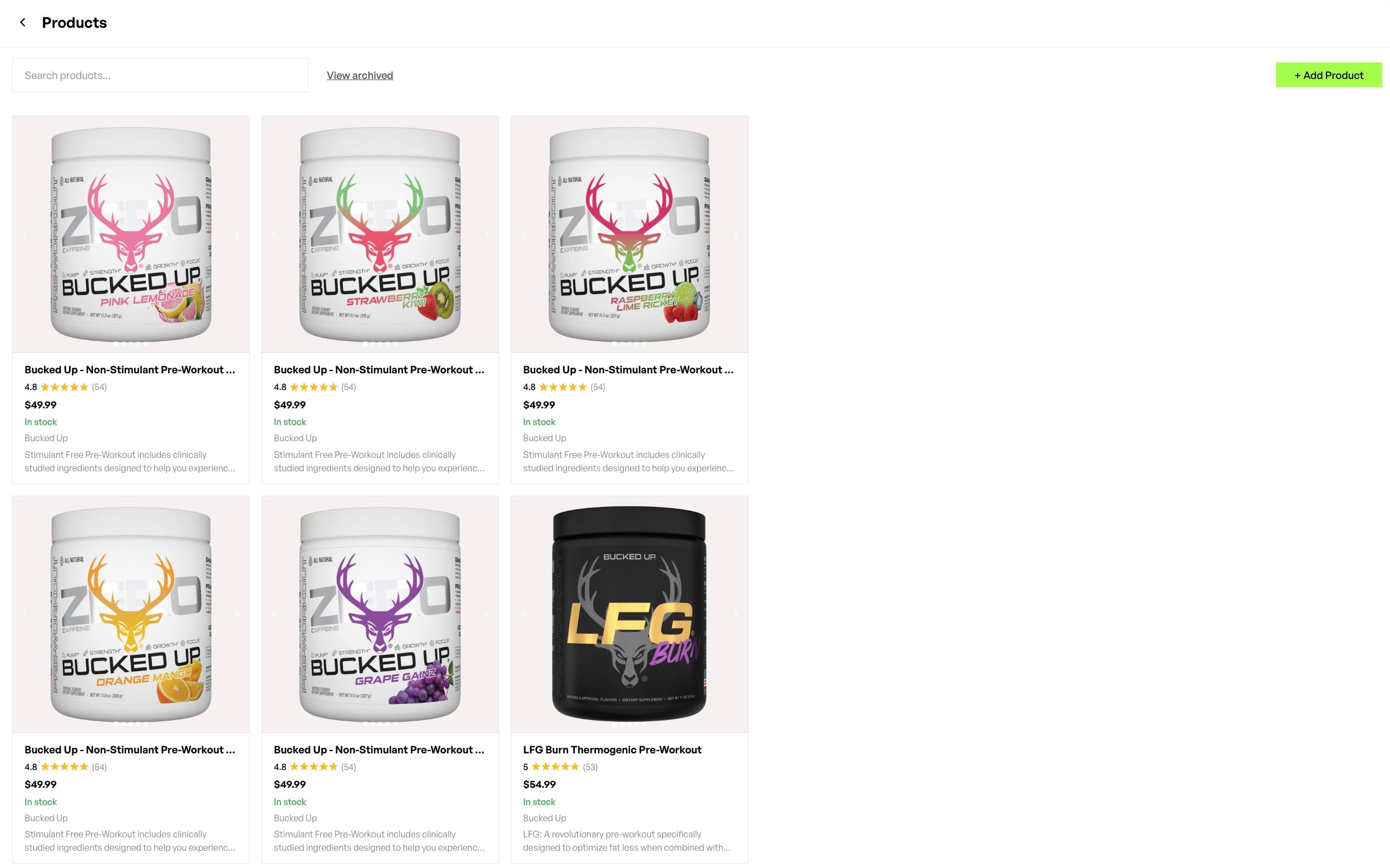
Across the first twelve weeks, clients average more than 12,000 additional AI citations and mentions, over 100,000 additional bot visits, and a lift in impressions above 20%. Bucked Up, a CPG supplement brand, became the number-one cited product for “Best Protein Soda” and was cited by ChatGPT within three weeks of launch. The engine moves from kickoff to the first published article in approximately one week, with content indexing in as little as ten days.
The brands cited in AI search this year are training the next generation of models with their own narrative. Brands that wait are training the next generation with whatever happens to be sitting on the open web. Get your first article live within a week with AI Growth Agent.
Frequently Asked Questions
How long does it take for CPG product content to appear in AI citations after optimization?
The timeline has two phases. Technical changes such as schema markup, attribute population, and retailer data consistency updates can be crawled and indexed within days. AI citation behavior typically reflects those changes over two to four weeks as models re-index and update their retrieval pools. Content published through AI Growth Agent has indexed in as little as ten days and often within two weeks. The standard engagement is a three-month pilot because citation rate and mention share of voice build incrementally as the brand’s authority across the query universe compounds. Brands that measure weekly using a fixed set of 30 to 50 high-value buyer-intent queries will see movement earlier than brands waiting for monthly reports.
Which retailer platforms matter most for AI citation in CPG categories?
Amazon, Walmart, Target, Kroger, and Instacart carry the highest weight for grocery and CPG AI citations because their product pages are crawled frequently by all major AI engines and their review ecosystems generate the third-party signals that AI models use to verify brand claims. Rufus, Amazon’s AI shopping assistant mentioned earlier, operates on this same principle across its massive user base. Walmart’s Sparky operates similarly. Beyond the major retailers, editorial coverage in food and lifestyle media, Reddit threads, and certification body listings such as USDA, Non-GMO Project, and NSF function as off-site authority signals that AI engines weight heavily. A brand that dominates retailer pages but has no third-party editorial presence will have a lower citation rate than a brand with both.
What is the difference between AI citation rate and traditional organic search ranking for CPG brands?
Traditional organic search ranking measures where a page appears in a list of blue links for a given keyword. AI citation rate measures the percentage of tracked buyer-intent queries where an AI engine names the brand in its generated answer. The two metrics are structurally different because AI answers have no static ordered list, and many AI Overview citations come from pages ranking below position five in traditional search, meaning traditional rank does not predict AI visibility. For CPG brands, citation rate is the more commercially relevant metric because AI-referred visitors convert at significantly higher rates than traditional organic visitors, and 68% of US Google searches ended without a click in the first four months of 2026, which makes citation inside the answer more valuable than a click-through ranking.
How should CPG brand managers handle product data governance across multiple retailer portals?
A centralized Product Lifecycle Management (PLM) system combined with a Digital Asset Management (DAM) platform forms the standard architecture for CPG data governance at scale. The PLM holds one canonical record for every attribute, including net weight, allergens, ingredients, certifications, and pack configuration. The DAM stores approved logos, certification seals, and nutrition panels. Both systems feed downstream retailer portals, supplier feeds, and the brand’s own PIM so that every channel receives identical, non-stale data. Cross-functional review with a four-eyes policy, involving regulatory, quality, and legal teams, ensures that claims are approved before they propagate to retailer APIs. For AI citation purposes, the critical governance rule is that any discrepancy between retailer feeds triggers the reliability failure described earlier, causing AI agents to drop the SKU during verification.
Can smaller CPG brands compete with enterprise players in AI search recommendations?
Smaller and mid-market CPG brands have a structural advantage in AI search right now because they can update product detail pages, enrich attributes, and publish new content faster than enterprise competitors who face internal approval cycles and legacy system dependencies. Few brands are currently achieving strong performance in the answer engine optimization space, which means the leaderboard is still being written. A plant-based beverage brand that adopted GS1 standards and expanded its platform presence saw its product recommendations triple within six months, consistent with the 2.8x multiplier effect of multi-platform visibility. A snack brand that added certified organic and carbon-neutral claims to its product feed saw a 35% increase in AI-driven recommendations on major digital grocery platforms. The brands winning AI recommendations in CPG categories are not necessarily the largest. They are the ones with the most complete, consistent, and machine-readable product data, combined with the strongest third-party signal networks.
Conclusion: Lead the CPG AI Discovery Shift
The CPG discovery shift is not a future event. It is happening now, with AI-powered search already reshaping how consumers discover and evaluate products. The brands that will capture this opportunity treat product data as a first-class asset, structure retailer pages for machine readability, and publish the authoritative content that AI engines cite when consumers ask the questions that drive purchase decisions.
The playbook is clear. Populate allergen and dietary claim fields first. Enforce pack-size consistency across every retailer portal. Structure ingredient data with standardized nomenclature. Build review ecosystems that generate attribute-specific language. Instrument citation rate and mention share of voice as formal KPIs. This work compounds only when supported by a system that maps the full query universe, auto-generates compliant product entities, publishes living content that self-heals over time, and proves incremental AI citations week over week.
AI Growth Agent provides that system. One headless engine replaces the SEO agency, the content tool, the GEO monitor, the schema plugin, the analytics stack, and the PR firm, at a flat fee with no per-prompt billing and no capped query universe. The brands cited in AI search this year are training the next generation of models with their own story.
Get your first article live within a week with AI Growth Agent.