Written by: Mariana Fonseca, Editorial Team, AI Growth Agent
Key Takeaways
- Large language model optimization replaces reactive monitoring with upstream narrative control that compounds across AI discovery platforms.
- Brands winning in AI search structure, validate, and make content discoverable rather than relying on budget or volume alone.
- Search Intelligence, Content Topology, agentic technical SEO, and living content form the repeatable system that drives consistent citations.
- Content freshness, authoritative schema, and agent-ready technical stacks are now table stakes for visibility in ChatGPT, Perplexity, and Google AI Mode.
- AI Growth Agent turns market diagnosis into cited authority across platforms, and you can schedule a demo to see your brand’s full universe and get your first article live within a week.
See Your Full Search Universe with Search Intelligence and Content Topology
Most brands track a handful of head terms and lose the rest of the conversation by default. A 2026 LumenGEO audit of over 1,000 brands found that only 12% are formally cited by ChatGPT for their target keywords, with the other 88% either vaguely mentioned without attribution or completely invisible, not because their content is poor, but because they are optimizing for the wrong slice of their market.
To solve this visibility gap, AI Growth Agent’s data foundation rests on four pillars that feed every content and technical decision:
- Search Intelligence: A complete portrait of the traditional search landscape, covering positioning, competition, and search volume, taken from raw situation to actionable diagnosis.
- AI Analytics: Brand value and consumer behavior across the full journey, from external touchpoints like Google and AI-tool queries through content consumption, demographics, and sentiment.
- Bot Tracking: Every bot interaction, traditional crawlers and AI training agents alike, including every crawl, citation, and training sweep.
- AI Ranking: Where the brand appears in AI answers and how that position evolves week over week, replacing the old idea of a static rank number.
Content Topology and the Content Planner extract hundreds of seed terms and long-tail queries from real-time Google and ChatGPT data. Real-time AI Overview and ChatGPT results define which long-tail queries are worth pursuing. A mature client universe reaches 1,600+ queries, with the system running 3,000+ searches every week just to refresh the snapshot. AI traffic grew 66% in 2025, and the brands capturing that growth are the ones mapping the full universe, not a capped handful of tracked terms.
Keep Authority High with Living Content That Never Sits Still
Content that goes stale loses citations fast. Content updated within the last 30 days receives 3.2× more AI citations than content older than 90 days, and pages not updated in three or more months are 3x more likely to lose citations in AI Overviews. Content cannot be shipped and forgotten.
AI Growth Agent’s multi-agent system produces what the company calls living content. Every article validates every claim against primary sources, runs a cascade of anti-hallucination checks, and self-heals over time. When the year changes, every article in a sector is refreshed automatically. When Google Search Console signals shift, the engine responds. Avanahub’s analysis found that a systematic six-month content refresh cycle is outperforming net-new content creation in 2026 for both traditional and AI search visibility. That pattern validates the living content model over the publish-and-forget approach.
Producing this living content at scale requires removing manual bottlenecks. The Headless Marketing Playbook removes the team from the equation entirely by automating every step of content production. It starts with a journalist-led interview that produces the brand manifesto, which then feeds into a multi-agent orchestration across OpenAI, Anthropic, Gemini, Grok, Perplexity, Exa, and Firecrawl to produce authoritative content single-shot. Style memories carry the brand’s voice rules forward across all content, while anti-hallucination controls validate every claim before anything ships. This automated pipeline enables the engine to produce between 2 and 50 articles per day per client, up to roughly 500 per month, with quality that holds at any volume.
A 16-month experiment publishing 2,000 fully AI-generated articles on zero-authority domains found that only 3% of pages reached the top 100 within three months, confirming that volume without authority, validation, and technical structure does not produce lasting visibility. The system around the model creates durable results, not the model alone.
Ship an Agent-Ready Technical SEO Stack by Default
Traditional technical SEO remains table stakes, and AI Growth Agent handles it automatically. Every article and site ships with the complete foundation: highly structured HTML and full metadata for crawlability, rich schema markup for semantic understanding, internal and sanitized external linking for authority flow, proper sitemaps and robots.txt for crawler guidance, automated web stories for multimodal reach, instant indexing for speed to visibility, and autoredirects plus 404 tracking to maintain site health. None of it requires action from the client.
On top of traditional technical SEO, AI Growth Agent ships the complete agentic technical SEO stack. The following elements are included in every package:
- Blog MCP (also compatible with Chrome 146+ and other WebMCP-enabled browsers), with schema, manifest, discovery, and capability guidance exposed to agents. AI Growth Agent was the first to bring Blog MCP to market, with clients running it in the summer of 2025.
- OpenAI discovery and Agent Card guidance served via
/.well-known/. - Natural language query parameters via
/?s={query}that auto-trigger personalized, internally linked responses so an agent passing a query straight into the URL receives a tailored answer. - Markdown served to agent crawlers for clean, token-efficient content delivery.
- llms.txt and llms-full.txt published so AI surfaces can read the brand the way they need to.
Schema markup is applied across Article, Organization, FAQPage, Author, Product, Review, LocalBusiness, and SoftwareApplication types, provisioned automatically and kept current. Pages with FAQ schema receive higher citation weighting in ChatGPT source selection than pages without these elements, consistent with the 37% lift in AI Overview inclusion noted earlier. Pages with HowTo, FAQ, or Article schema markup are included in AI Overviews at a rate 37% higher than equivalent unstructured pages.

The only integration step on the client’s side is the reverse proxy rewrite that connects the blog to a subdirectory under their domain. Everything else ships out of the box.
Meet Exact Requirements for ChatGPT, Perplexity, and Google AI Mode
ChatGPT, Perplexity, and Google AI Mode use structurally different citation logic. Only 14% of the top 50 most-cited sources are shared across all three platforms, with 86% of top-cited domains unique to a single platform. Focusing on one platform without accounting for the others leaves most of the AI search landscape unaddressed.
| Factor | ChatGPT | Perplexity | Google AI Mode |
|---|---|---|---|
| Schema priority | FAQPage and Article schema increase citation probability by approximately 40% (Authoritas 2025) | FAQPage schema with verifiable statistics and named sources with methodology (Leapd.ai 2026) | Pages with HowTo, FAQ, or Article schema markup are included in AI Overviews at a rate 37% higher than equivalent unstructured pages, and semantic completeness correlates at r=0.87 |
| Recency requirement | Citation half-life of 3.4 weeks, with a clear recency bias that rewards content refreshed within the last month, consistent with the 3.2× citation lift noted earlier (Rankeo 2026) | Citation half-life of 5.8 weeks; content updated within 30 days cited at 82% rate, dropping to 37% for content older than 12 months (Frase.io 2026); recency is the highest-weighted signal after domain authority (Clarity Digital 2026) | Citation half-life of 4.3 weeks; 40–60% of cited sources change month-to-month (Scrunch/Stacker, March 2026; UpGrowth April 2026) |
| Agentic technical SEO requirements | Bing indexing via Bing Webmaster Tools, encyclopedic and well-structured content, and third-party brand presence on G2, Capterra, Reddit, and YouTube (SCALZ.AI 2026; Averi.ai 2026) | Real-time web indexing, verifiable statistics with named sources, content that cites other authoritative sources, and PerplexityBot crawl access unblocked (Nadia Mohamed 2026; Leapd.ai 2026) | Traditional domain authority signals, query fan-out, and multimodal content, with YouTube accounting for 18.2% of AI Overview citations from outside the top 100, while robots.txt directives for Googlebot control AI feature visibility (Averi.ai 2026; Google via CapConvert 2026) |
Pages with sequential heading structures achieve 2.8x higher citation rates in AI answers, while rich schema provides separate lifts of 13% or 3.2x. 44.2% of all LLM citations are drawn from the first 30% of content, making answer-first formatting a structural requirement, not a stylistic preference.
Prove Incremental Visibility Without Adding Headcount
AI Growth Agent publishes into a separate environment so it can take credit only for the visibility it actually generates. Week-over-week reporting isolates exactly what the engine produced, cross-referencing bot traffic, Google Search Console, and citation data. The following client outcomes reflect that incremental measurement.
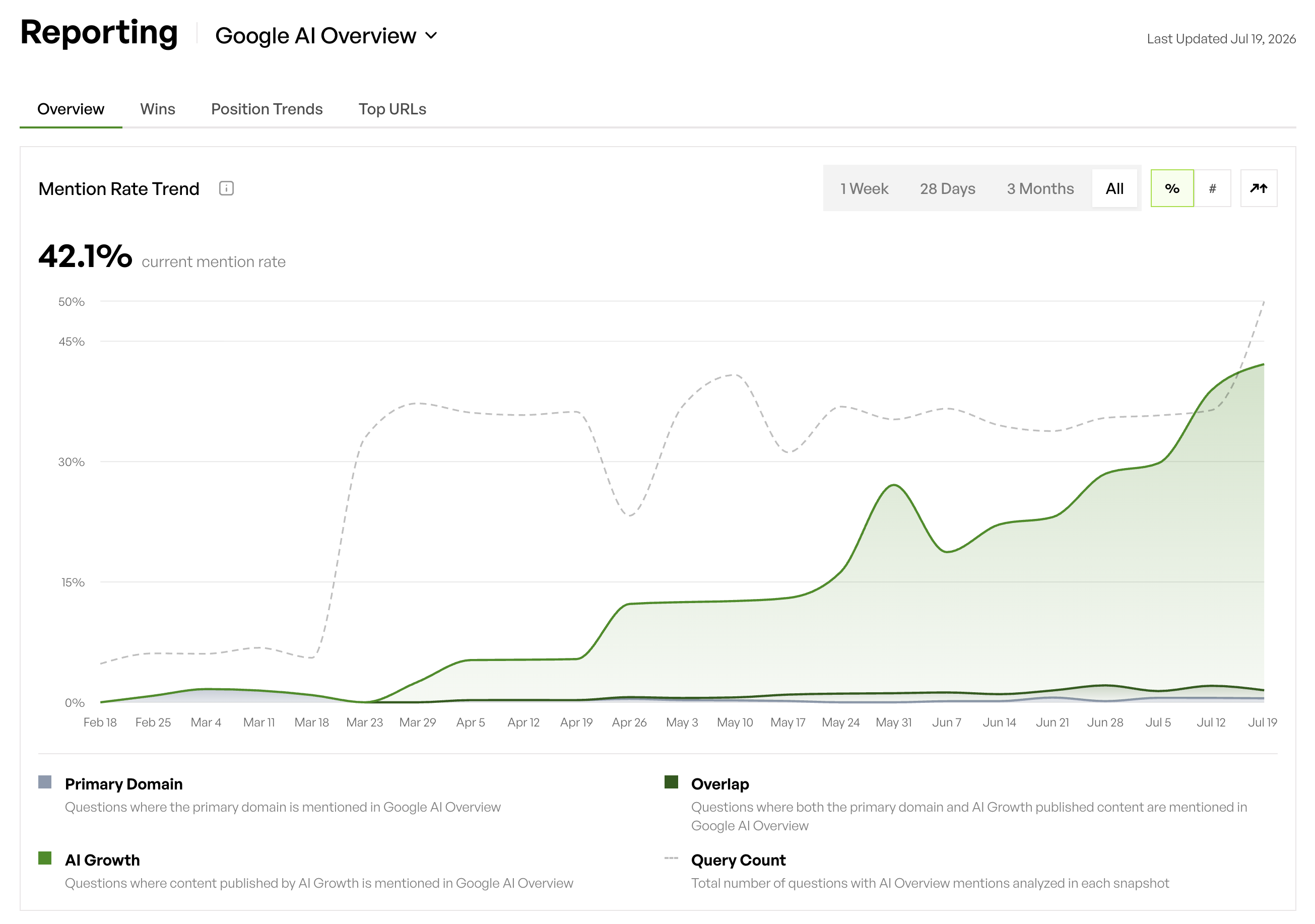
Leva Sleep is now the most mentioned retailer for adjustable beds in Canada. ChatGPT cites Leva Sleep content over 10,000 times per month. Google Search Console impressions on AI Growth Agent content doubled. Deals of $40,000 to $50,000 closed in under three weeks from buyers who walked into the store carrying the blog and asking about specific features they had discovered through AI Growth Agent content.
“AGA’s content didn’t just drive traffic, it drove customers into our stores. In a matter of weeks, sales teams were closing deals ($40,000 to $50,000 in sales in under 3 weeks, to be exact) with buyers who discovered us through AI Growth Agent’s articles.” — Matthew Timmins, CEO of Leva Sleep
Breadless is now one of the most recommended healthy franchises in the US, ahead of CAVA, Rush Bowls, and Sweetgreen in its search universe. Google Search Console impressions grew roughly 30x in six months, from 387,000 to 12.3 million. ChatGPT cites eatbreadless.com over 45,000 times per month. The brand generates 10 to 15 highly qualified franchisee leads per week.
Bisutti has 71% of its brand mention visibility driven by AI Growth Agent and is now the second most recommended events brand by AI in Brazil, with its corporate pages the most cited domains in the sector.
Exceeds.ai has 55%+ of traffic sourced from generated content and is consistently recommended across Perplexity, ChatGPT, and Google AI Mode.
Across the first twelve weeks, AI Growth Agent clients average more than 12,000 additional AI citations and mentions, over 100,000 additional bot visits, and a 20%+ lift in impressions, with content indexing in as little as ten days.
Avoid the Wrong Doors and Common Objections
Leaders who decide to take AI search seriously often face two broken options. The first is the traditional agency route, where an RFP runs about three months, then three more to produce the first assets. Nearly a year passes before anything is in motion. The second is the DIY chatbot path. One company produced roughly 300 articles this way. Not one was cited, and the articles were full of errors and gaps.
Monitoring tools represent a third wrong door. Over 73% of brands have zero mentions in AI-generated responses despite ranking on Google page one. Knowing that fact does not change it. Monitoring tells a brand it is missing from AI answers and stops there. It does not produce content, own publishing, or act on the data.
The deeper problem with monitoring-only tools is structural. Brand mentions across the web correlate with AI citation at r=0.664, roughly three times stronger than backlinks (r=0.218). Authoritative content at scale drives AI citation, not a dashboard that only shows where the brand is absent.
Headless marketing is the architecture none of the alternatives are built for. The brand keeps its curated main site. AI Growth Agent stands up a separate, fully optimized blog the brand owns, connected through a reverse proxy rewrite. The engine writes, publishes, monitors, self-heals, and reports. There is no team to manage on the brand’s side.
Frequently Asked Questions
How long does it take to see results from large language model optimization?
The first article is typically live within a week of kickoff. Content has indexed in as little as ten days and often within two weeks. Meaningful citation pattern changes typically establish over four to eight weeks after implementing structural content and schema updates. The standard engagement is a three-month pilot, because indexing takes time and varies by industry, but clients see movement early. Perplexity responds fastest due to its recency bias, while ChatGPT and Google AI Mode weight established authority signals that build over time.
Does the internal team need technical skills to run this?
No. The engine provisions schema, the WordPress plugin, robots.txt, sitemaps, automatic web stories, Blog MCP, agent discovery via /.well-known/, llms.txt and llms-full.txt, instant indexing, autoredirects, and 404 tracking automatically. The only integration step on the client’s side is the reverse proxy rewrite that connects the blog to a subdirectory under their domain. The internal team gives feedback in plain language and the system learns, so the same correction is never needed twice.
How is AI Growth Agent different from a monitoring tool like Profound or Scrunch AI?
Monitoring tools track whether a brand appears for a capped set of prompts and stop there. They tell a brand it is not showing up and leave it to solve the problem. AI Growth Agent is not a monitoring company. It maps the full universe, produces authoritative living content, owns the publishing, and proves the incremental result week over week. The differentiator is not who has more data. AI Growth Agent turns data into published, self-healing content and isolates exactly what it generated.
How does AI Growth Agent keep content from going stale or hallucinating?
Content is living. It self-heals and updates over time. When the year turns, every article in a sector is refreshed automatically. Accuracy is enforced by a cascade of anti-hallucination checks across primary and external sources, with every claim, source, and quote validated before anything ships. The engine never relies on a model’s training data. It pulls from the brand manifesto, primary-source links, product pages, and memories, then validates every external source before passing it into the content generation pipeline.
How do you measure what AI Growth Agent actually generated versus visibility the brand already had?
AI Growth Agent publishes into a separate environment and reports incremental visibility, isolating exactly what it generated week over week. Bot analytics track every bot that touches the blog, including the bot ChatGPT uses to cite sources. Google Search Console serves as an independent audit. Clients who measure best capture source at the conversion moment and consistently see a lift in organic leads after starting, separate from any paid or existing organic activity.
Conclusion: Take Narrative Control Now
The leaderboard in AI search is being written in 2026. Global household brands appear in 73% of relevant AI answers, while mid-market and regional brands operate at substantially lower visibility rates. The gap is not brand equity. The gap is the presence or absence of a repeatable system that maps the universe, produces authoritative living content, ships the complete agentic technical SEO stack, and proves incremental visibility without adding headcount.
Traditional search tools show you where your brand stands. AI Growth Agent makes your brand the answer. The system goes from kickoff to the first published article in about one week, with content indexing in as little as ten days. One engine replaces the SEO agency, the content tool, the web agency, the GEO monitor, the schema plugin, the analytics stack, and the PR firm, at a flat fee with no per-article charges, credit limits, or per-prompt billing.
The brands cited in AI search this year are training the next generation of models with their own narrative. Brands that wait are training the next generation with whatever happens to be sitting on the open web.