Written by: Mariana Fonseca, Editorial Team, AI Growth Agent
Key Takeaways
- AI search now synthesizes single answers from trusted sources, so controlling what models cite is essential for brand reputation.
- Mapping every relevant query and auditing entity consistency across platforms removes conflicting signals that lower AI confidence.
- Earned third-party mentions and structured, extractable content sharply increase the likelihood of being cited in AI answers.
- Agentic technical SEO, weekly sentiment monitoring, and incremental visibility reporting create a system that compounds authority over time.
- AI Growth Agent delivers a headless engine that maps, produces, monitors, and reports AI search visibility, so schedule a demo to see it in action.
Seven-Step System for AI Search Visibility
The following seven steps move from diagnosis to production to monitoring. Step 1 maps the queries where your brand should appear. Step 2 aligns your entity profile so models can recognize and trust you. Step 3 builds third-party consensus that AI treats as proof of reliability. Steps 4 and 5 make your content extractable and discoverable to the crawlers doing the citing. Steps 6 and 7 close the loop by tracking what AI systems say and measuring whether your content investment is working. Each step builds on the one before it, so skipping ahead produces incomplete results because AI citation functions as a system, not a single tactic.
-
Step 1: Map Your Full Query Universe With Search Intelligence
Goal: Establish a complete picture of every query and prompt that describes your market before you publish new content.
Actions: Run real searches across head terms and long-tail queries using real-time Google and ChatGPT data as the objective function. Those searches reveal which seed terms anchor your category, which long-tail queries sit beneath each one, and which domains currently win each result. For every result where your brand appears, document the citation context, including where your brand appears in AI answers, who it is grouped with, and what claim it is cited for. This baseline shows where you are visible, where you are missing, and where AI misrepresents you.
Why it matters: A significant portion of Google AI Overview citations come from URLs that do not rank in the top 20 organic results, which means the queries you are not tracking are often the ones where your brand is missing or misrepresented.
Validation: You have a topology of seed terms with documented long-tail queries beneath each one, a weekly snapshot of who is winning each result, and a baseline citation context report across ChatGPT, Perplexity, and Google AI Mode.
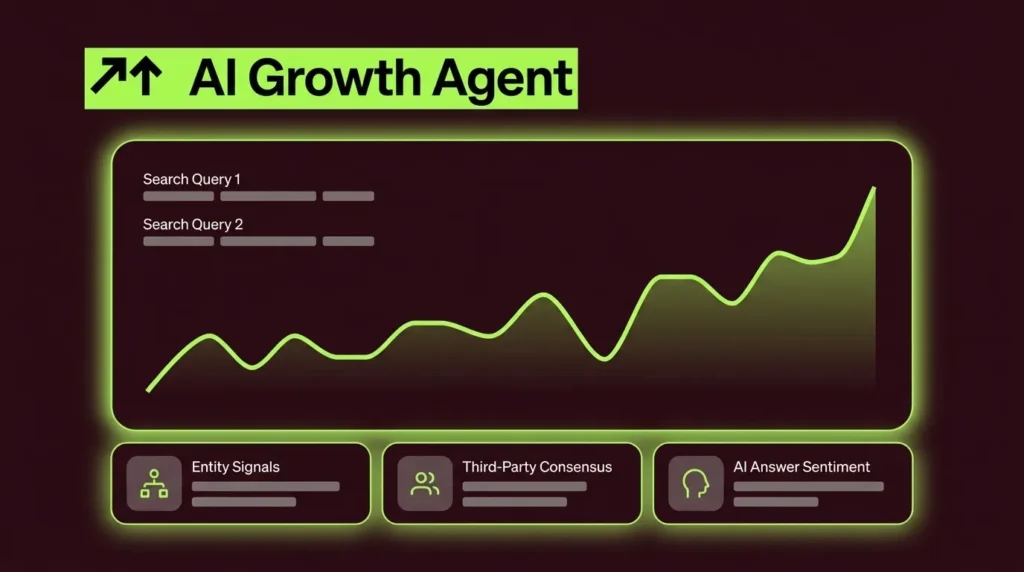
AI Growth Agent's Content Planner show each brand's universe of search (tracked prompts/queries) and its visibility (ranking rate) on both Google Rankings, Google AI Overviews, and ChatGPT citations and mentions. Step 2: Align Entity Signals Across Every Public Surface
Goal: Remove conflicting signals so AI systems can build a coherent entity profile and cite your brand with confidence.
Actions: Audit your brand name, category, description, positioning language, and founding data across LinkedIn, Crunchbase, G2, Capterra, Wikipedia or Wikidata when relevant, industry directories, and press coverage. Synchronize every surface to a single canonical description. Deploy structured data markup using the same name format, description, and category across every crawlable property so crawlers see one consistent entity.
Why it matters: Brands with more than 20% variance in descriptions across five or more public sources score lower on AI recommendation confidence than brands with aligned messaging, based on Astiva AI platform data tracking 500+ brands in Q1 2026. Conflicting entity signals cause AI models to discount the entity or default to a competitor whose profile looks more coherent. Brands with a presence across multiple platforms are often more likely to appear in ChatGPT responses.
Validation: Every major platform returns the same canonical description, category, and founding data. Structured data markup is live and validated. No conflicting signals appear in a cross-platform audit.
Step 3: Grow Third-Party Consensus With Earned Mentions
Goal: Establish external consensus that AI systems treat as evidence of reliability.
Actions: Identify the publications, forums, review platforms, and communities where your category is discussed. Prioritize earned mentions in those sources within 5 to 10 words of a category-defining attribute instead of chasing raw mention volume. Contribute substantively to Reddit threads and community discussions in your space. Secure press coverage, expert roundups, and review platform listings that describe your brand in category language.
Why it matters: A large majority of brand mentions in AI search originate from third-party pages rather than brand-owned domains, and brands are more likely to be cited through third-party sources than through their owned domains, per AirOps’ 2026 State of AI Search report analyzing over a billion citations. Branded web mentions correlate more strongly with AI Overview visibility than backlinks, per an Ahrefs study of 75,000 brands.
Validation: Your brand appears in third-party sources with category-defining language. Review platform listings are complete and current. Mention volume grows week over week.
Step 4: Publish Structured, Extractable Content at Scale
Goal: Create content that AI systems can parse, extract from, and cite with confidence.
Actions: Place direct answers in the first two to three sentences of every page so crawlers see the core claim immediately. Use comparison tables with named brand columns and descriptive headers to clarify differences. Deploy ordered and unordered lists in semantic HTML to mark steps and features. Write self-contained paragraphs of 50 to 150 words so models can lift clean segments. Use question-format H2 headings that create exact semantic matches to user queries. Add FAQ schema, Article schema, and Organization schema with sameAs links so crawlers can connect entities. Publish original data, proprietary research, and specific numbers wherever possible to give models concrete facts to cite.
Why it matters: Structural optimization alone produced a measurable improvement in AI citation rates with no changes to semantic content, per the GEO-SFE study (arXiv:2603.29979) published March 2026 by researchers including those at the University of Tokyo. Pages with at least one well-formed HTML table earn more citations on comparison and data queries than prose-only pages, per Presenc AI’s May 2026 tracking across 2,100 brand-query pairs. A majority of pages cited by Google AI Mode include structured data markup (65%), and a majority of pages cited by ChatGPT include structured data (71%), per SE Ranking 2026 industry data.
Validation: Every published page has a direct-answer opening, at least one structured element such as a table or list, question-format headings, and valid schema markup. Content is indexed and appears in bot tracking reports.
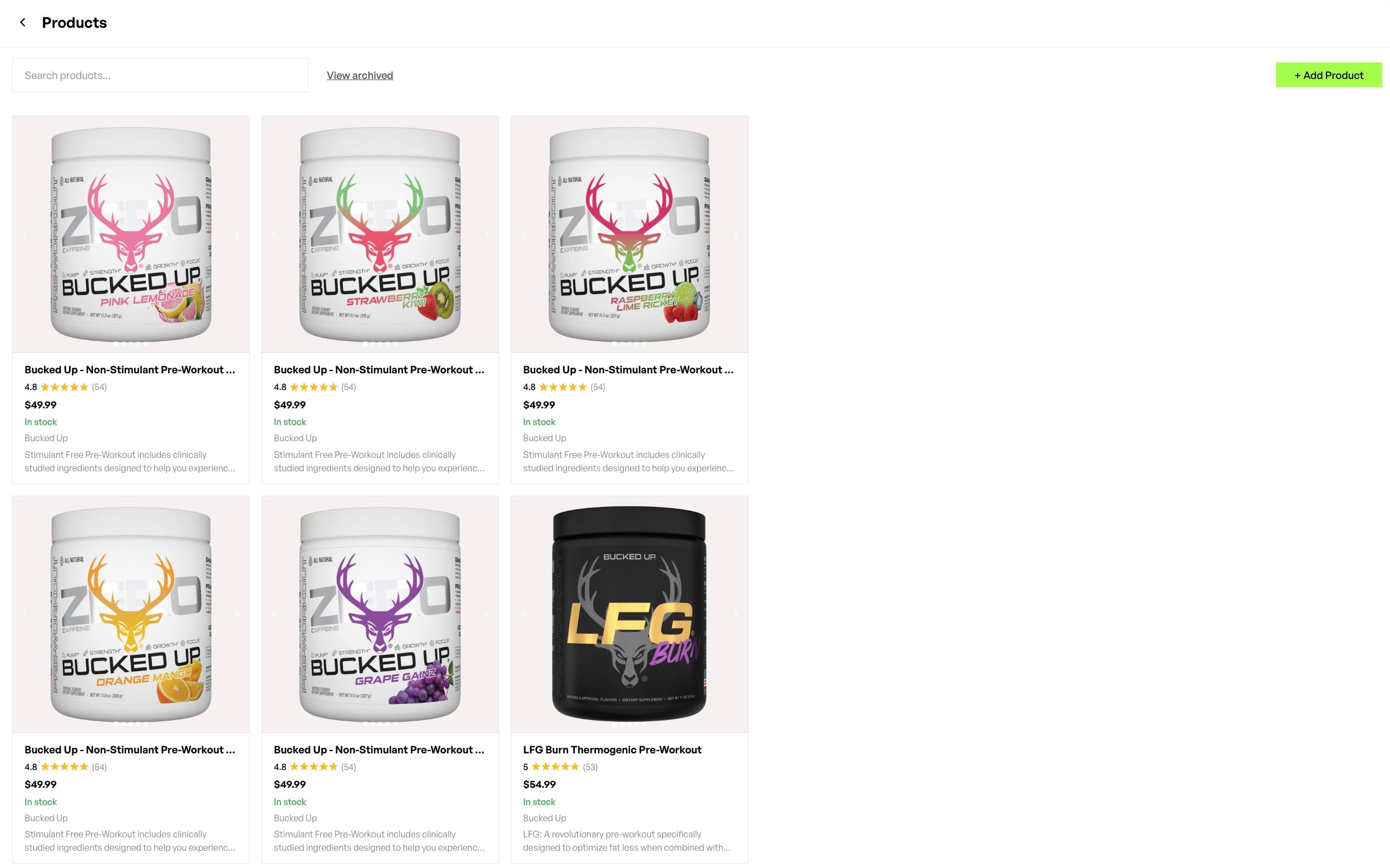
AI Growth Agent's personalization section lets brands add product schemas. Step 5: Make Crawlers and Agents First-Class Visitors
Goal: Make your content readable and actionable for the crawlers, training agents, and AI surfaces that determine citation.
Actions: Publish llms.txt and llms-full.txt so AI surfaces can read your brand the way they need to. Implement Blog MCP with schema, manifest, discovery, and capability guidance exposed to agents so they know what your site can answer. Configure natural language query parameters at
/?s={query}so agents passing a query into the URL receive a tailored, internally linked response. Serve Markdown to agent crawlers so they see clean structure. Maintain a current sitemap.xml, an advanced robots.txt, and instant indexing so new pages become visible quickly. Deploy automated web stories for every article to create additional structured entry points.Why it matters: Pages that look polished to a human visitor but remain invisible to a bot do not function as assets. The crawlers, training agents, and AI surfaces doing the citing read structured signals, not visual design. Every surface in the agentic stack needs a clear, documented path to your content.
Validation: llms.txt and llms-full.txt are live and accessible. Blog MCP is confirmed active. Bot tracking shows AI training agents and citation crawlers reaching your content. Instant indexing is confirmed for new articles.
Example of long-form article produced by AI Growth Agent: fact-checked, credible research meets unique content, derives from a brand's Company Manifesto. Step 6: Track and Fix Negative Sentiment in AI Answers
Goal: Spot unfavorable or inaccurate AI characterizations and trace them to their source before they compound.
Actions: Build a prompt set of 30 to 80 buyer questions weighted toward pricing, reviews, alternatives, and trust. Run those prompts across ChatGPT, Gemini, Perplexity, Claude, and Google AI Mode. Classify each response as positive, neutral, or negative, then identify the cited sources driving negative framing. Fix the underlying operational cause first, then publish corrective content on owned properties. Update outdated pages with visible last-updated dates. Add targeted FAQs that address common objections directly so models see clear, current answers.
Why it matters: Negative sentiment is often driven by a small number of specific citations, most commonly from review-platform profiles, forum and Reddit threads, and news articles. A systematic methodology of auditing, source tracing, content creation, and monitoring can produce a measurable sentiment uplift in AI responses within 3 to 6 months, per TrySight analysis.
Validation: Net sentiment score is tracked per platform on a trailing seven-day basis. Negative prompt families are identified and assigned to a fix owner. Re-testing confirms sentiment has shifted after corrections are live.
Step 7: Measure Incremental AI Visibility Every Week
Goal: Isolate the visibility your content investment actually generated, separate from the visibility your brand already had.
Actions: Publish AI-optimized content into a separate environment so incremental gains can be measured independently. Track bot visits, Google Search Console impressions, citation rate, and AI mention rate week over week. Cross-reference per-article bot tracking with Search Console data to identify which articles drive new citations and which need internal linking support. Report citation context changes, including shifts in where your brand appears in AI answers and what claims it is cited for.
Why it matters: As noted in Step 1, most brands do not persist across multiple AI answer runs, so incremental visibility reporting separates compounding authority from one-time appearances.
Validation: Weekly reports show bot traffic, impressions, citation rate, and AI mention rate attributed specifically to new content. Internal linking is adjusted based on which articles index well and which do not.
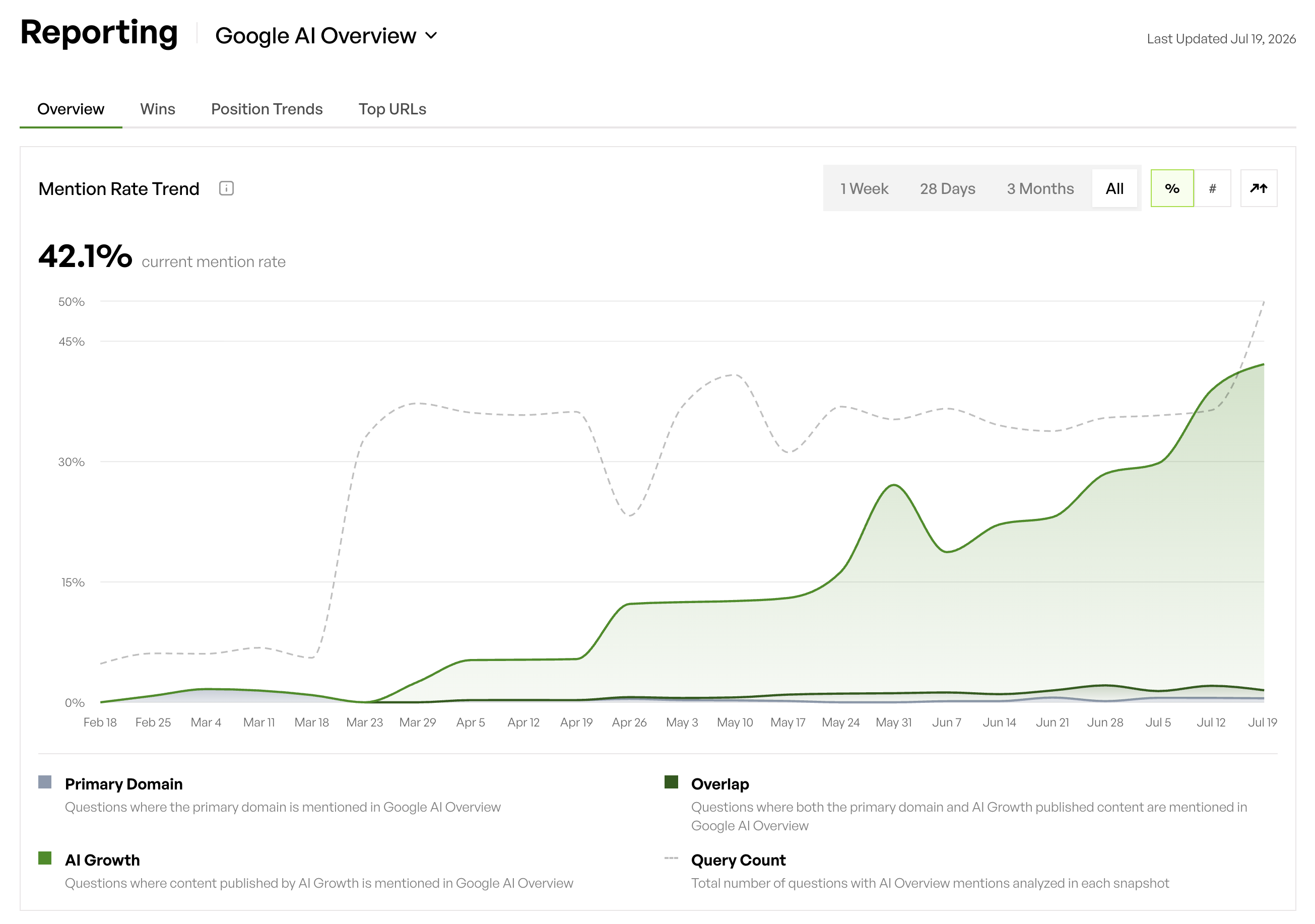
AI Growth Agent's Reporting dashboard, with ranking rates and their separation between Primary Domain results, Overlapping results, and AI Growth Agent content results (incremental visibility). Weekly Monitoring Prompts for AI Brand Sentiment
Step 6 describes why sentiment monitoring matters, and this section shows how to run it. Run the following prompts across ChatGPT, Gemini, Perplexity, Claude, and Google AI Mode each week. Log sentiment class, exact descriptor phrase, cited domains, and date for each response.
- What is [Brand] and what does it do?
- Is [Brand] reliable?
- What are the main alternatives to [Brand]?
- [Brand] vs [primary competitor] which is better?
- What do customers say about [Brand]?
- What are the disadvantages of [Brand]?
- Is [Brand] worth the price?
- Who is [Brand] best for?
- What is the best [category] for [use case]?
- What are the top [category] solutions in [market]?
- Why would someone choose [Brand] over [competitor]?
- What problems does [Brand] solve?
- Has [Brand] had any complaints or issues?
- What do experts say about [Brand]?
- What is [Brand] known for in [category]?
Alert immediately when sentiment flips on any commercial prompt, when risk words such as “complaints,” “lawsuit,” or “breach” appear in a description, or when net sentiment score drops more than 10 points over seven days on any platform. Confirm persistence across two consecutive runs before escalating to a fix workflow.
Living, Self-Healing Content in 2026
The seven steps above describe what to build, and this section explains how to maintain it. Content published and forgotten becomes a liability. Content updated recently is cited more often than older content, and pages that go unrefreshed for more than a quarter are more likely to lose their citations, per AirOps’ 2026 State of AI Search report.
Living content addresses this structurally rather than reactively. When the year turns, every article in a sector refreshes automatically. When Google Search Console signals show a page losing impressions, the engine flags it for update. When bot tracking shows a training agent sweeping a section of the site, the content in that section is reviewed for currency and accuracy. Every article’s relationships, performance data, and indexing signals sit in one system so authority compounds instead of decaying in place.
Self-healing mechanics operate at three levels. At the article level, stale claims are identified through a cascade of anti-hallucination checks that validate every claim, source, and quote against evidence found online rather than a model’s training data. At the site level, internal linking adjusts as new articles index, routing authority toward pages that gain traction and lifting pages that lag. At the entity level, canonical descriptions are monitored across platforms and updated when a product change, leadership change, or category shift requires it.
The compounding effect becomes measurable over time. Brands that maintain living content across their full universe build a self-reinforcing signal network. Each new article adds citation surface area. Each refresh signals recency to AI crawlers. Each internal link strengthens topical authority across the cluster. The result is a presence that grows week over week instead of peaking at publication and declining.
AI Growth Agent: Common Questions From Brands
How long does it take to see results from optimizing for AI search?
Timeline depends on the starting point and the industry, yet movement becomes measurable within weeks when the full system is in place. Content can index in as little as ten days and often within two weeks of publication. Citation rate and bot traffic act as the earliest indicators. Sentiment shifts in search-augmented platforms like Perplexity tend to appear faster than in model-weight responses, which reflect training cycles that run over months. A three-month pilot is the standard engagement because it captures enough indexing cycles to show compounding results, and clients typically see the first citations and impression lifts before the pilot ends.
Who owns the content and the site produced through this process?
The brand owns everything outright. The optimized blog is stood up under the brand’s domain, connected through a reverse proxy rewrite or subdomain, and the brand retains full ownership of the site, the content, and the relationship with AI surfaces. There is no agency dependency, no lock-in, and no situation where a vendor controls access to the brand’s own property. The engine handles publishing, schema, bot tracking, and self-healing, while the asset belongs to the client from day one.
What tools or technical resources does the brand need to provide?
The only integration step on the brand’s side is the reverse proxy rewrite that connects the blog to a subdirectory under the brand’s domain. Everything else, including the full technical and agentic SEO stack, schema, llms.txt, Blog MCP, agent discovery, instant indexing, autoredirects, and 404 tracking, is included and provisioned automatically. The internal team does not need engineering skills or SEO expertise. Feedback is given in plain language and the engine applies it to every future generation through a memory system so the same correction is never needed twice.
How is AI search visibility measured differently from traditional SEO?
Traditional SEO is measured by keyword rank position, a static ordered list. AI search has no equivalent list, so the metrics shift to citation rate, AI mention rate, citation context, and order of mention within an AI answer. These are tracked per platform because only 11% of domains cited by ChatGPT are also cited by Perplexity for the same queries, which makes platform-level reporting necessary rather than a single aggregate score. Incremental visibility reporting isolates what new content actually generated, separate from the visibility the brand already had, so the measurement reflects real contribution rather than preexisting brand equity.
What happens when negative sentiment appears in AI outputs about the brand?
Negative sentiment in AI outputs almost always traces back to one to three specific cited sources, most commonly review-platform profiles, forum threads, or outdated owned pages. The correct response starts with fixing the underlying operational cause, then publishing corrective content on owned properties that addresses the specific claim directly. Updating cornerstone pages with visible last-updated dates, adding targeted FAQs that address common objections, and strengthening third-party evidence through review responses and earned coverage act as the primary levers. Sentiment in search-augmented platforms like Perplexity can shift within weeks of corrections going live. Model-weight responses take longer because they reflect training cycles, yet consistent authoritative content across the full universe accelerates the correction over time.
Ready to make AI search work for you instead of against you? Schedule a consultation session today.
Conclusion
The seven steps above form a complete system that moves from mapping to measurement. You map the universe with Search Intelligence, enforce entity consistency across every platform, build third-party consensus through earned mentions, produce structured and extractable content at scale, deploy agentic technical SEO, monitor and correct negative sentiment, and report incremental visibility week over week. Each step addresses a distinct failure mode that leaves brands missing or misrepresented in AI answers, and together they create a self-reinforcing presence that compounds authority instead of decaying after publication.
The brands winning AI search in 2026 are not the ones with the largest content libraries or the highest domain authority scores. They are the ones with the most coherent entity signals, the strongest third-party consensus, and the most structurally extractable content, refreshed consistently and tracked at the citation level. That pattern represents a system problem rather than a simple content problem, so it requires a system answer.
AI Growth Agent functions as a single headless engine that replaces the SEO agency, the content tool, the web agency, the GEO monitor, the schema plugin, the analytics stack, and the PR firm. It maps the full universe, produces authoritative living content, stands up a fully optimized site the brand owns within the first week, and reports the incremental visibility it generates week over week with no added headcount. The discovery shift has already happened, and the leaderboard is being written now.