Written by: Mariana Fonseca, Editorial Team, AI Growth Agent | Last updated: July 2, 2026
Key Takeaways
- AI search surfaces like ChatGPT and Perplexity rely on entity consistency, third-party proof, and structured content more than classic rankings.
- The 3-tier playbook moves from entity audits and directory fixes through structured content deployment to living content and incremental measurement.
- Technical foundations such as llms.txt, Blog MCP, schema markup, and agent discovery files make content discoverable and credible to AI crawlers.
- Measurement combines per-article bot tracking, Google Search Console impressions, and citation context to show real visibility gains.
- AI Growth Agent delivers a full execution stack that replaces multiple agencies and tools; book a demo to launch your first optimized article within a week.
How AI Search Decides Citations
AI surfaces do not rank pages with a static ordered list the way traditional search engines do. Four kinds of intelligence shape what a model says about a brand when a customer asks.
Search Intelligence maps the traditional search landscape, including who is winning each result, what the competitive structure looks like, and where the white space sits. It turns the raw situation into an actionable diagnosis.
AI Analytics covers brand value and consumer behavior across the full journey, from external touchpoints like Google and AI-tool queries through content consumption, demographics, and sentiment.
Bot Tracking records every bot interaction, including traditional crawlers and AI training agents, across every crawl, citation, and training sweep. Without this layer, a brand cannot tell whether AI systems are reading it at all.
AI Ranking replaces the old position number with citation context. It tracks where the brand appears in the answer, what claim it is cited for, and how that position changes week over week.
These four intelligences reinforce each other. A brand that scores well on entity consistency earns more bot visits. More bot visits produce more citation data. More citation data sharpens the content decisions that improve AI Ranking. The 3-tier framework below maps directly to this loop, moving from entity foundations through structured content deployment to living content and measurement.
Tier 1: Establish Entity Consistency and Third-Party Signals
Phase 1: Audit Current Citations and Entity Presence
Goal: Build a complete, accurate picture of how AI surfaces currently read your brand before any new content goes live.
Actions:
- Run your brand name and core product queries across ChatGPT, Perplexity, and Google’s AI Mode. Record the exact language each surface uses to describe you, who you are grouped with, and what claims they attribute to you.
- Audit your entity data across Google Business Profile, major directories, and any structured data already on your domain. Flag every inconsistency in name, address, phone, category, and description.
- Pull your current bot traffic logs. Identify which AI training agents and crawlers visit your domain and how often they appear.
- Document your existing schema markup. Note which schema types are present, which are missing, and whether any are malformed.
Required inputs: Brand name variants, product and service taxonomy, existing domain URLs, access to Google Search Console, and any prior SEO or GEO audit reports.
Validation checkpoint: You have a written record of how each major AI surface currently describes your brand, a list of entity inconsistencies, and a baseline bot-visit count.
Phase 1 Checklist:
- ChatGPT brand query recorded
- Perplexity brand query recorded
- Google AI Mode brand query recorded
- Entity data audited across all major directories
- Inconsistencies flagged and prioritized
- Bot traffic baseline established
- Schema audit complete
Phase 2: Strengthen Third-Party Proof Across Directories, Reddit, and Reviews
Goal: Give AI surfaces a consistent, corroborated picture of your brand across the open web so every citation draws from the same accurate entity.
Actions:
- Correct every entity inconsistency identified in Phase 1. Name, address, phone, category, and description must match exactly across Google Business Profile, Apple Maps, Bing Places, Yelp, and any sector-specific directories.
- Seed your brand into relevant Reddit communities, Quora threads, and niche forums where your customers actually ask questions. Keep contributions substantive and accurate, not promotional, because AI surfaces weight community discussion heavily as unsponsored third-party validation.
- Solicit and publish verified reviews on Google, G2, Trustpilot, or the review platform most relevant to your sector. Review content that mentions specific product attributes or use cases gives AI surfaces citation-ready language.
- Confirm that your Wikipedia or Wikidata entry, if one exists, reflects current and accurate information. AI surfaces treat these as high-trust entity anchors.
Required inputs: Corrected entity data, a list of relevant communities and forums identified through Search Intelligence, and a review solicitation workflow.
Validation checkpoint: Entity data is consistent across all major directories, at least three substantive community contributions are live, and a review pipeline is active.
Phase 2 Checklist:
- Entity data corrected across all directories
- Google Business Profile updated and verified
- Community contributions live on relevant forums
- Review solicitation workflow active
- Wikipedia or Wikidata entry verified (if applicable)
Tier 2: Deploy Structured Content and Technical Foundations
Phase 3: Publish Structured, Evidence-Based Content at Scale
Goal: Produce authoritative content across the full long tail of queries your customers actually ask, with every claim validated and every article structured for bot consumption.
Actions:
- Build a Content Topology from your seed terms. Map each seed term to dozens of long-tail queries drawn from real-time AI Overview and ChatGPT search results, not from a generic keyword tool.
- Produce articles that validate every claim against primary sources. AI surfaces cite content they can trust, so content that leans on a model’s training data instead of verified external sources will fail a citation pass.
- Apply full schema markup to every article, including Article, Author, FAQ, Organization, and any sector-specific types such as Product or LocalBusiness. Schema helps bots understand the content and powers rich results.
- Publish llms.txt and llms-full.txt at your domain root so AI surfaces can read your brand in the format they need.
- Deploy Blog MCP with schema, manifest, discovery, and capability guidance exposed to agents. AI Growth Agent brought Blog MCP to market first, with clients running it in the summer of 2025.
- Serve agent discovery files via /.well-known/ for both OpenAI discovery and Agent Card guidance.
Required inputs: Completed Content Topology, brand manifesto, primary-source URLs, and schema suite.
Validation checkpoint: First articles are live with valid schema, llms.txt is accessible, Blog MCP is responding, and agent discovery files are served correctly.
Phase 4: Launch a Headless, Brand-Owned Blog in One Week
Goal: Launch a fully optimized, brand-owned property that connects to your existing domain without touching your curated main site.
Actions:
- Stand up a WordPress installation styled to match your brand. Connect it to your domain through a reverse proxy rewrite under a subdirectory, or through a subdomain, so your existing site structure stays intact.
- Install and configure the full technical and agentic SEO stack. No engineering hours are required on your side when you use AI Growth Agent because every package includes the full stack out of the box.
- Configure natural language query parameters at /?s={query} so that an agent passing a query directly into the URL receives a personalized, internally linked response.
- Verify that Markdown is served to agent crawlers and that your sitemap.xml and robots.txt are correctly structured.
The shift from traditional to agentic technical SEO requires a different file structure that speaks to AI crawlers as clearly as it serves human browsers. The table below shows which files you need at each layer to make your content discoverable and trustworthy to AI surfaces.
| Layer | Traditional Technical SEO | Agentic Technical SEO | Included in AI Growth Agent |
|---|---|---|---|
| Crawl guidance | robots.txt, sitemap.xml | llms.txt, llms-full.txt, agent discovery via /.well-known/ | Yes, all |
| Structured data | Schema markup (Article, FAQ, etc.) | Blog MCP with schema, manifest, and capability guidance | Yes, all |
| Content format | HTML for browser rendering | Markdown served to agent crawlers | Yes, both |
| Query handling | Standard URL routing | Natural language query parameters via /?s={query} | Yes |
Validation checkpoint: The blog is live under your domain, all files in the table above are accessible, and the first article has been submitted for indexing.
Tier 3: Activate Living Content and Measure Incremental Visibility
Phase 5: Keep Content Living and Self-Healing
Goal: Keep every article aligned with the current state of your market so the next AI training sweep finds your latest narrative, not an outdated version.
Actions:
- Configure automatic refresh triggers tied to Google Search Console signals and bot-traffic data. When an article’s performance declines or a sector changes, the engine refreshes the content instead of leaving it to decay. This real-time responsiveness keeps your content aligned with current market conditions and protects citation trust.
- Set up year-turn automation so that every article in a sector updates when the calendar year changes. AI training sweeps run continuously, so even small temporal signals matter, and stale date references quickly erode citation trust.
- Centralize all article relationships, performance data, and bot and Search Console signals in one place. This central view makes it possible to manage automated updates at scale and allows authority to compound instead of decay.
- Use internal linking to lift articles that are indexing but not yet ranking. Once you have centralized visibility, the engine can spot articles that sit near the citation threshold and build internal links that push them over that line.
Phase 6: Measure Incremental Visibility With Three Data Streams
Goal: Prove that the visibility you gain comes from your new content investment, not from brand equity you already had.
Actions:
- Track every bot interaction at the per-article level, including the bot ChatGPT uses to cite sources. This signal shows whether your content is being read by the systems that matter.
- Cross-reference bot traffic with Google Search Console impressions week over week. GSC serves as an independent audit of the visibility AI Growth Agent generates.
- Monitor citation context, including where your brand appears in AI answers, what claim it is cited for, and who it is grouped with. This context replaces the old idea of a single ranking number.
- Report incremental visibility separately from existing brand visibility. Publishing into a separate environment makes this isolation possible and keeps the impact of the engine clear.
This three-stream approach appears in full detail in the “How to Track Brand Mentions in AI Search” section below.
The 90-day rollout timeline below maps each phase to AI Growth Agent’s standard engagement structure.
| Week | Milestone | Expected Signal |
|---|---|---|
| Week 1 | Kickoff interview, manifesto, Content Topology, first articles live | First articles submitted for indexing |
| Weeks 2 to 3 | Entity corrections live, community seeding active, schema validated | First indexing confirmed, bot visits begin |
| Weeks 4 to 6 | Content production at scale, living content active, agentic files verified | Bot visit volume increases, first AI citations appear |
| Weeks 7 to 9 | Internal linking pass, GSC cross-reference, citation context baseline set | Impression lift visible in GSC, citation context tracked |
| Weeks 10 to 12 | Incremental visibility report, self-healing triggers active, universe expansion | Clients see additional AI citations, bot visits, and an impression lift across the first 12 weeks |
Troubleshooting Common Gaps
Stale content. Content that was accurate at publication becomes a liability as the market moves. A self-healing system tied to GSC signals and bot-traffic data replaces manual refresh cycles. If your current setup has no automated refresh trigger, every article you have published is already decaying.
Measurement gaps. Most teams measure AI search visibility with a monitoring tool that tracks a capped set of prompts. That approach stays blind to the long tail, where most customer queries actually live. A stronger approach uses a measurement layer that combines per-article bot tracking, centralized GSC data, and citation context signals, cross-referenced weekly.
Agency dependency. When an agency controls your site, you do not own your organic presence. Every content decision, schema update, and technical change runs through a dependency that slows you down and leaves you exposed when the agency relationship ends. A brand-owned property connected through a reverse proxy rewrite, with no agency in the loop for publishing or technical SEO, removes that risk.
How to Track Brand Mentions in AI Search
Tracking brand mentions in AI search works best when three distinct data streams operate together, not when a single monitoring dashboard stands alone.
The first stream is bot tracking at the per-article level. Every AI surface that cites content sends a bot to read it first. Identifying which bots visit which articles, and how often they appear, shows which content sits in active consideration for citation. The bot ChatGPT uses to cite sources is identifiable in server logs and in a properly configured bot-tracking layer.
The second stream is Google Search Console impressions, segmented by the content AI Growth Agent publishes versus the content already on your domain. GSC provides an independent, weekly audit of visibility that is not subject to the prompt caps that limit monitoring tools.
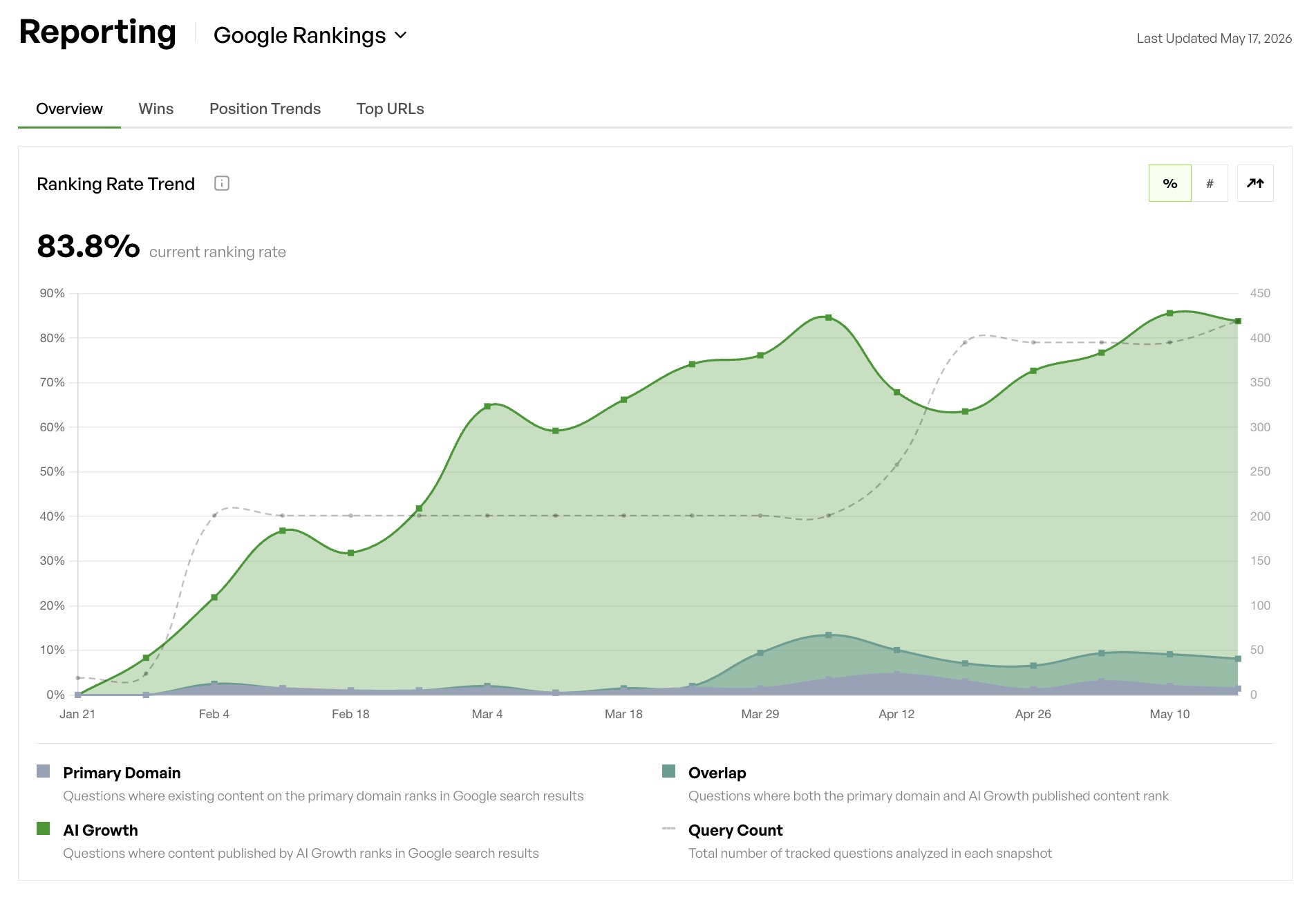
The third stream is citation context, meaning the actual language AI surfaces use when they mention your brand, the claims they attribute to you, and the competitors they group you with. Teams track this by running structured queries across ChatGPT, Perplexity, and Google’s AI Mode on a weekly cadence and recording the output systematically, not by relying on a tool that samples a fixed set of prompts.
The combination of these three streams produces incremental visibility reporting, which proves that the visibility you gain is new and not a restatement of brand equity you already had.
How to Get Cited by ChatGPT
Getting cited by ChatGPT depends on two factors: whether the model can find your content and whether it trusts the claims enough to attribute them to you.
On the findability side, the requirements are technical. Your content must be accessible to the bot ChatGPT uses to read sources. That means the full technical stack described in Phase 3, including robots.txt that does not block AI crawlers, sitemap.xml, llms.txt files, and agent discovery via /.well-known/. Content served only in JavaScript-rendered formats that bots cannot parse remains invisible regardless of its quality.
On the trust side, the requirements are editorial. ChatGPT cites content that validates its claims against primary sources rather than relying on a model’s training data. Every factual claim in your content should be traceable to a verifiable source. Schema markup, particularly Article and Author schema with named authorship, signals to the model that the content has a credible origin. FAQ schema surfaces specific question-and-answer pairs that map directly to the natural language queries users ask.
The structural requirement most teams miss is the evidence-based long tail. ChatGPT does not primarily cite head-term content. It cites content that answers the specific, conversational, long-tail queries users actually type. A Content Topology built from real-time ChatGPT search results, rather than from a traditional keyword tool, identifies which long-tail queries deserve coverage and supports authoritative content against each one at scale.
Conclusion: Control the Narrative Before Models Learn Someone Else’s Version
The 3-tier system in this playbook functions as an execution architecture, not a monitoring strategy. Tier 1 establishes the entity consistency and third-party signals that give AI surfaces a coherent, corroborated picture of your brand. Tier 2 deploys the structured content and technical foundations that make your content findable, trustworthy, and machine-readable. Tier 3 activates living content that does not decay and measurement that proves what you actually generated.
The brands cited in AI search this year are training the next generation of models with their own narrative. The brands that wait are training the next generation with whatever happens to be sitting on the open web. That dynamic reflects how large language models work. The content they read during training and citation sweeps is the content they reproduce in answers. Controlling what they read means controlling what they say.
Traditional search tools show you where your brand stands. AI Growth Agent makes your brand the answer. One engine replaces the SEO agency, the content tool, the web agency, the GEO monitor, the schema plugin, the analytics stack, and the PR firm, at a flat fee with no per-article charges, credit limits, or per-prompt billing.
Frequently Asked Questions
What is the difference between AI search citations and traditional search rankings?
Traditional search rankings assign a position number to a page for a given query. That number is static, auditable, and tied to a specific URL. AI search citations work differently. There is no ordered list. A model produces a natural language answer and may reference one or more sources inline. The relevant metrics are citation context, meaning where your brand appears in the answer, what claim it is cited for, and who it is grouped with, and order of mention, which functions as the new leaderboard. A brand can rank on page one of Google and be entirely absent from AI answers, and the reverse can also occur. The two channels require different strategies, different technical foundations, and different measurement frameworks.
How long does it take to start appearing in AI search answers?
The timeline depends on your domain’s existing authority, the competitiveness of your sector, and how quickly your new content is indexed. AI Growth Agent clients typically see their first article live within the one-week window described earlier and first indexing in as little as ten days. First AI citations can appear within a few weeks for clients in less competitive sectors. The standard engagement is a three-month pilot because indexing takes time and varies by industry, but the measurement framework tracks bot visits and GSC impressions from week one, so you see movement before citations are confirmed. Living content and a self-healing architecture help visibility compound over time instead of plateauing after the initial publication burst.
Why do monitoring tools alone not solve the AI citation problem?
Monitoring tools tell you whether your brand appears for a capped set of prompts. They do not produce content, publish it, apply technical SEO, or act on the data they surface. The gap sits in execution, not in information. A brand that knows it is absent from AI answers still has to produce the content that earns citations, structure it so bots can parse it, deploy the technical files that make it discoverable to AI crawlers, and refresh it as the market changes. Monitoring tools stop at the diagnosis. The 3-tier playbook in this article covers the full execution path from entity audit through living content and incremental visibility measurement.
What does “living content” mean in practice, and why does it matter for AI citations?
Living content is content that updates and self-heals over time rather than going stale the day it ships. In practice, this means automatic refresh triggers tied to Google Search Console signals and bot-traffic data, year-turn automation that updates date references and sector-specific facts when the calendar changes, and a centralized system that tracks every article’s relationships, performance, and indexing status. Living content matters for AI citations because AI surfaces run citation sweeps continuously. A training agent that reads your content in January and finds it current will cite it. The same agent running a sweep in October that finds outdated statistics, superseded product details, or stale date references will deprioritize or drop the citation. Brands that treat content as a one-time asset lose ground to brands whose content reflects the present state of the market.
How does AI Growth Agent prove that the visibility it generates is incremental and not just existing brand equity?
AI Growth Agent publishes into a separate environment, a brand-owned blog connected to the client’s domain through a reverse proxy rewrite, rather than into the client’s existing site. This separation makes it possible to report exactly what the new content generated, week over week, without attributing pre-existing brand visibility to the new effort. The measurement layer combines per-article bot tracking, Google Search Console impressions segmented by AI Growth Agent content versus existing content, and citation context data drawn from structured weekly queries across ChatGPT, Perplexity, and Google’s AI Mode. The result is incremental visibility reporting, a defensible, auditable record of what the engine produced, not a blended number that mixes new results with visibility the brand already had.