Written by: Mariana Fonseca, Editorial Team, AI Growth Agent
Key Takeaways
- Enterprise LLM optimization replaces fragmented monitoring with full-stack execution that balances cost, latency, security, and governance while driving measurable incremental visibility.
- Production techniques such as model routing, semantic and prompt caching, quantization, RAG, and fine-tuning together reduce costs by 40 to 90 percent and keep p95 latency under two seconds.
- The 2026 decision framework treats RAG and fine-tuning as additive layers, with RAG as the default for dynamic knowledge and fine-tuning for stable, high-volume behavioral consistency.
- Four observability pillars, Search Intelligence, AI Analytics, Bot Tracking, and AI Ranking, connect infrastructure spend to brand visibility outcomes across AI surfaces.
- See how AI Growth Agent turns monitoring insights into executed content and routing decisions, with your first article live within a week.
The Discovery Shift From Monitoring To Execution
Customer discovery has shifted from blue links to AI answers, and those answers increasingly appear without a click. Customers ask ChatGPT, Perplexity, and Google’s AI Mode. What those systems can find, trust, and cite now decides whether a brand appears in the conversation at all.
Monitoring-only tools reveal where a brand stands. They track a capped set of prompts, surface a gap, and stop. The enterprise then produces and publishes content with no execution system behind it. That view is a rearview mirror. The brands winning AI search are not watching the leaderboard. They are changing what the answer is.
Enterprise LLM API spending doubled from $3.5 billion in late 2024 to $8.4 billion by mid-2025. That spend concentrates in high-volume, low-complexity tasks where optimization delivers the highest return. Organizations that treat LLM infrastructure as a monitoring problem rather than an execution problem pay full price for half the result.
Full-stack execution combines routing, RAG, caching, quantization, and evaluation with the content layer that makes a brand the cited answer. Monitoring tells you the score. Execution changes it.
Core Components Of Enterprise LLM Optimization Architecture
A production-grade enterprise LLM optimization strategy rests on five technical components that compound when applied together. The architecture flows in layers. Incoming queries first hit the semantic cache, which intercepts near-duplicate requests before they reach any model. Cache misses move to the routing classifier, which sends simple tasks to smaller models and reserves frontier models for complex reasoning. For queries that reach a model, prompt caching reuses computed state for repeated prefixes, while quantization reduces memory footprint for self-hosted deployments. RAG and fine-tuning then handle knowledge grounding and behavioral consistency.
Model routing directs each query to the cheapest capable model. Production deployments demonstrate roughly 50 to 60 percent savings for mixed workloads, with RouteLLM research showing more than 2x cost reduction, and up to 85 percent on some benchmarks, while maintaining 95 percent of GPT-4 quality. Intelligent routing reduces inference costs in mixed-workload environments by sending most routine traffic to smaller models and reserving frontier models for complex tasks.
Semantic caching intercepts semantically equivalent queries using vector embeddings before they reach the model. Semantic caching delivers substantial cost reduction and faster responses on cache hits. Roughly 31 percent of production LLM queries are near-duplicates, which makes caching the highest-frequency optimization lever in enterprise deployments.
Prompt caching reuses computed state for repeated prompt prefixes. Anthropic’s API reduces cached token reads to 0.1× base input price, such as $0.30 per million for Sonnet, a 90 percent reduction versus uncached input. PwC research found prompt caching reduced API costs by 41 to 80 percent and improved time-to-first-token by 6 to 31 percent across providers tested.
Quantization reduces model memory footprint for self-hosted deployments. FP8 quantization produces effectively zero accuracy degradation across the full Llama-3.1 model family based on over 500,000 evaluations. INT8 quantization cuts roughly half the model memory footprint with under 1 percent quality loss on most tasks.
RAG and fine-tuning address knowledge grounding and behavioral consistency respectively. The canonical pattern treats these as distinct optimization layers rather than competing choices, covered in detail in the decision tree section below.
When applied together in this layered architecture, model routing, prompt caching, context compression, batch inference, and related techniques produce 70 to 85 percent total cost reduction on typical enterprise workloads.
Decision Tree For Routing, Fine-Tuning, And RAG
The routing versus fine-tuning versus RAG decision has matured significantly since 2024. Three forces changed the calculus: million-token context windows, dramatically better embeddings, and open-source fine-tuning costs dropping to $50 to $200 per run versus the prior $5,000 to $50,000 range.
The decision follows a sequential logic.
- Start with routing. Classify query complexity and route to the cheapest capable model. Apply semantic and prompt caching at the gateway layer. This layer alone delivers 40 to 70 percent cost reduction with no model changes.
- Add RAG when knowledge changes faster than monthly, citation or audit trails are required, or the corpus exceeds 200,000 tokens. RAG delivers lower annual TCO than fine-tuning for knowledge bases that require frequent updates. RAG serves as the default for regulated workloads where source attribution is mandatory.
- Add fine-tuning when style and format consistency matter more than knowledge accuracy, knowledge is stable, or volume exceeds one million queries per month. Fine-tuning economically beats RAG above roughly one million queries per month when knowledge is stable.
- Apply the hybrid pattern for regulated sectors. By 2026, the canonical enterprise pattern fine-tunes a small open model for behavior and format, then places it behind a RAG pipeline for knowledge retrieval. This pattern dominates in BFSI and healthcare.
Monitoring-only tools cannot execute any of these decisions. They surface the gap and leave the architecture work to the enterprise. Full-stack execution implements the routing logic, the RAG pipeline, the caching layer, and the content that makes the brand the cited answer, without additional headcount.
Ten-Step Implementation Checklist For Enterprise LLM Execution
- Audit current LLM spend by use case. Identify the 20 to 30 percent of use cases that generate 60 to 80 percent of costs. Treat these as the highest-ROI targets for routing and caching.
- Deploy an LLM gateway as the central control plane. A production-grade LLM gateway provides unified API access, caching, routing, resilience, and governance as its five core responsibilities.
- Implement semantic caching with a cosine similarity threshold between 0.90 and 0.98. Target the 31 percent of queries that are near-duplicates first. Measure cache hit rate weekly.
- Configure prompt caching for all workloads with stable system prompts exceeding 1,024 tokens. This configuration delivers 90 percent cost reduction on cached inputs with zero accuracy impact.
- Build a model routing classifier. Route classification, extraction, and summarization tasks to smaller models. Reserve frontier models for complex reasoning. Aim for 80 percent of traffic on cheaper models.
- Apply the RAG versus fine-tuning decision tree. Default to RAG for dynamic knowledge. Add fine-tuning only when behavioral consistency or volume economics justify it.
- Implement quantization for self-hosted workloads. Start with FP8 or INT8 for near-zero accuracy loss. Evaluate INT4 only for narrow classification tasks where the accuracy trade-off is acceptable.
- Establish a FinOps dashboard tracking cost-per-successful-output. The FinOps Foundation recommends tracking cost-per-successful-output rather than cost-per-token, because optimizing solely for token cost can increase real business costs when retry or hallucination rates rise.
- Deploy governance controls at the gateway layer. Start with request-level budget enforcement to prevent cost spikes from turning into compliance events. Layer Zero Data Retention routing so sensitive workloads reach only compliant providers. Add Data Loss Prevention scanning to catch leaks before data leaves the enterprise perimeter. Finally, implement immutable audit logs to satisfy the reconstructability requirements of SOC 2, GDPR, and the EU AI Act.
- Instrument the four observability pillars. Track tokens, latency percentiles, quality metrics such as hallucination rate and groundedness, and cost with per-tenant budgets. Set alert thresholds and runbooks for each pillar.
Measurement Across The Four Observability Pillars
Effective enterprise LLM optimization relies on four distinct intelligence layers. Teams that see only one or two of these layers make architecture decisions with incomplete information.
Search Intelligence provides a complete portrait of the traditional search landscape, including positioning, competition, search volume, and the structure of who already wins each query. This layer turns raw data into an actionable diagnosis. Without it, routing and content decisions rely on a partial map of the market.
AI Analytics covers brand value and consumer behavior across the full journey, from external touchpoints such as Google and AI-tool queries through content consumption, demographics, and sentiment. This layer connects LLM optimization decisions to business outcomes instead of infrastructure metrics alone.
Bot Tracking records every bot interaction, traditional crawlers and AI training agents alike, including every crawl, citation, and training sweep. That visibility serves two purposes. First, it acts as a security control. Between October 2025 and January 2026, 91,403 attack sessions targeted exposed LLM services, and bot tracking forms the first line of detection. Second, it acts as a citation signal. If a team cannot see which AI agents read its content, it cannot determine whether the brand is being cited or which assets drive those citations.
AI Ranking replaces the static ordered list with order of mention and citation context. AI answers have no fixed positions from one through ten. Where a brand appears in the answer, what claim it is cited for, and how that position evolves week over week now form the leaderboard. Teams that measure only traditional rank remain blind to the channel where discovery actually happens.
These four pillars feed the content decisions that change what AI surfaces say about a brand. Monitoring tools see one or two of them. Full-stack execution instruments all four and acts on them in the same week.
KPI Framework For Quality, Cost, Speed, Reliability, And Security
Instrumenting those four pillars requires tracking five production dimensions, quality, cost, speed, reliability, and security, each with its own KPI set. The following table maps each dimension to its primary metrics, production targets, and how it connects to the incremental visibility outcomes the four pillars measure. Every figure is drawn from production research.
| Dimension | Primary KPIs | Production Targets | Incremental Visibility Link |
|---|---|---|---|
| Quality | Hallucination rate, groundedness score, task success rate, answer relevancy | High groundedness and low hallucination rates for knowledge-based tasks | Higher groundedness scores correlate with citation eligibility across AI surfaces |
| Cost | Cost-per-successful-output, cost per request, token usage by model tier | Significant cost reduction achievable combining routing, caching, and quantization | Cost efficiency enables sustained content production volume without budget overruns |
| Speed | Time to first token (p95), end-to-end latency (p95), cache hit ratio | p95 latency under 2.0 seconds with substantially reduced response time on cache hits | Sub-2-second p95 latency is the production SLO threshold for AI surface eligibility |
| Reliability | Error rate, timeout rate, task completion rate, input distribution drift | 99.99% service availability demonstrated in production at 1,500 QPS peak concurrency | Reliable serving ensures bot crawlers and AI training agents receive consistent, citable responses |
| Security | Prompt injection detection rate, PII leakage rate, audit trail completeness, jailbreak detection rate | Incomplete audit trails can represent a compliance liability under the EU AI Act | Governance posture determines whether content passes data residency and citation trust thresholds on regulated AI surfaces |
The 12-Month Roadmap And FinOps Dashboard
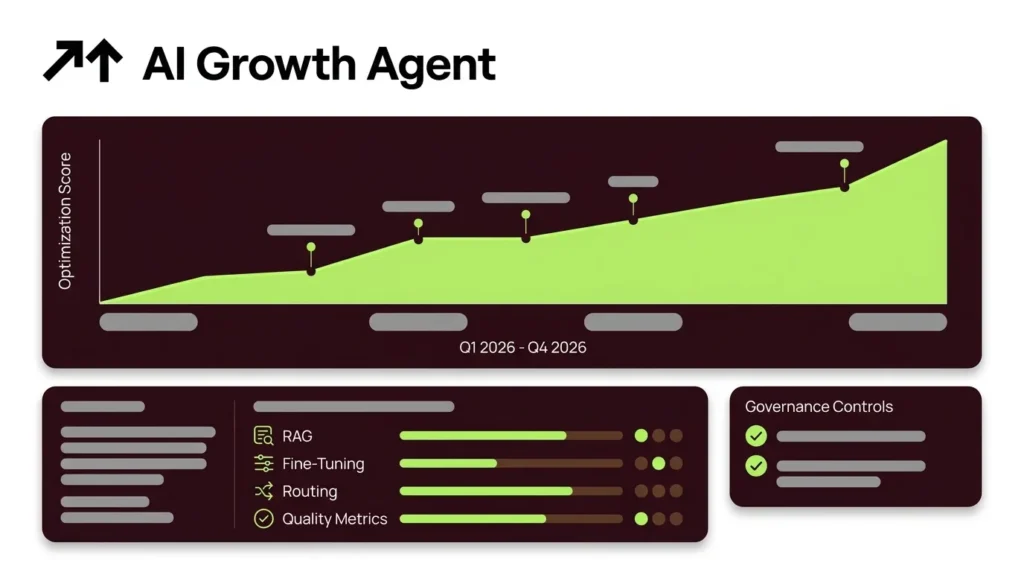
A 12-month enterprise LLM optimization roadmap follows three phases, and each phase builds on the previous layer’s instrumentation.
Months 1 to 3: Foundation and quick wins. Deploy the LLM gateway. Implement semantic and prompt caching. Configure model routing for the highest-volume use cases. Stand up the FinOps dashboard tracking cost-per-successful-output by use case and tenant. Establish baseline KPIs across all five dimensions. Prompt caching on large classification workloads can eliminate a substantial portion of costs, which shows that foundation-layer optimizations deliver material returns before any architectural changes.
Months 4 to 6: Architecture optimization. Apply the RAG versus fine-tuning decision tree to the top five use cases by volume. Implement quantization for self-hosted workloads. Deploy governance controls including Zero Data Retention routing, DLP scanning, and immutable audit logs. Begin instrumenting the four observability pillars with alert thresholds and runbooks. By mid-2026, enterprise teams increasingly treat prompt, retrieval, and adapter changes as software releases subject to CI/CD, canarying, and regression tests.
Months 7 to 12: Narrative control and compounding visibility. Shift from infrastructure optimization to content execution. The FinOps dashboard now tracks cost-per-successful-output alongside incremental visibility metrics such as bot visits, AI citations, Search Console impressions, and citation context by query cluster. Content production targets the long tail of queries where AI surfaces actively cite competitors. Architecture decisions track the price curve, not the hype curve, and the same principle applies to content. The brands establishing authoritative content in 2026 train the next generation of models with their own narrative.
The FinOps dashboard for a mature deployment tracks seven metrics in a single view. These metrics include cost-per-successful-output by use case, cache hit rate by model tier, p95 latency by endpoint, hallucination rate by workflow, audit trail completeness, incremental bot visits week over week, and AI citation rate by query cluster. Together they connect infrastructure spend to brand visibility in a single reporting surface.
How AI Growth Agent Delivers Full-Stack Execution
The gap between monitoring and execution is where most enterprise LLM optimization strategies stall. Monitoring tools surface the gap. Full-stack execution closes it.
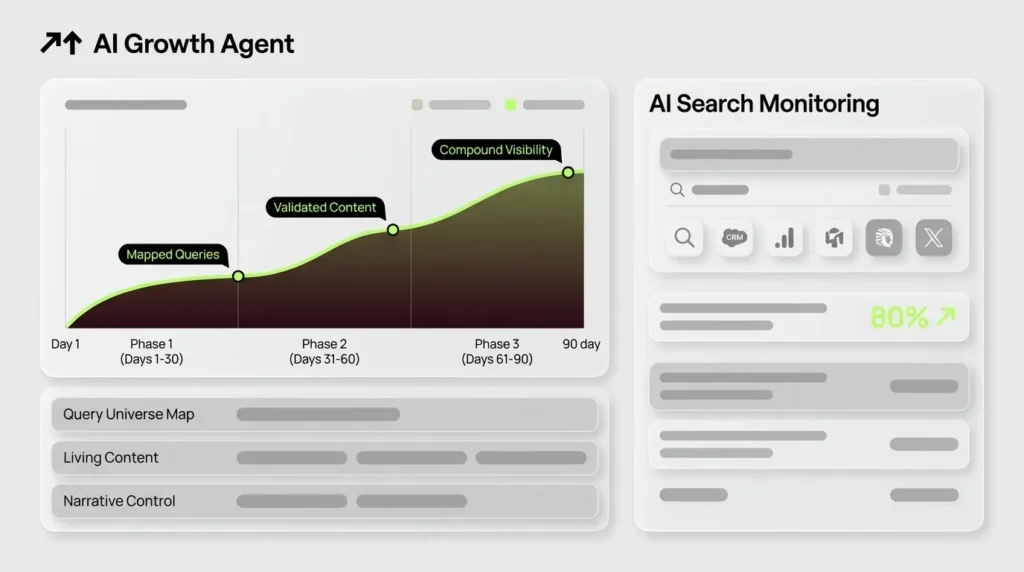
AI Growth Agent acts as the autonomous engine that maps a brand’s universe across online search and wins it on autopilot. It replaces the SEO agency, the content tool, the web agency, the GEO monitor, the schema plugin, the analytics stack, and the PR firm with a single headless marketing engine. The content behaves as a living system. It updates and self-heals over time instead of going stale.
The four pillars of Search Intelligence, AI Analytics, Bot Tracking, and AI Ranking are instrumented from day one. Every article ships with traditional technical SEO and agentic technical SEO. That stack includes Blog MCP, OpenAI discovery via /.well-known/, Agent Card guidance, natural language query parameters, Markdown served to agent crawlers, and llms.txt and llms-full.txt so AI surfaces can read the brand the way they need to.
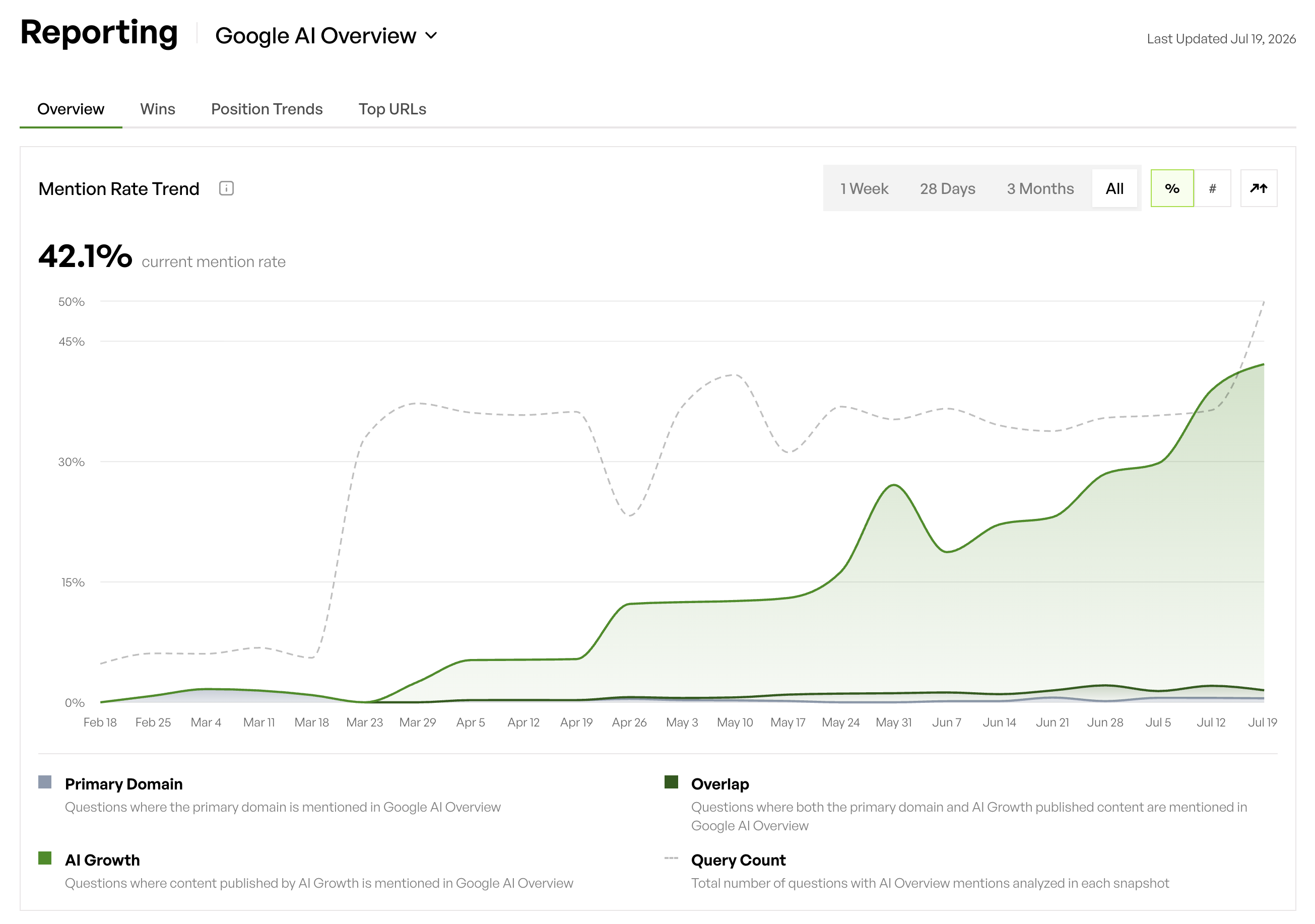
Across the first twelve weeks, clients average more than 12,000 additional AI citations and mentions, over 100,000 additional bot visits, and a 20 percent or greater lift in impressions. Breadless grew from 387,000 to 12.3 million Google Search Console impressions in six months, with ChatGPT citing eatbreadless.com over 45,000 times per month. Leva Sleep closed $40,000 to $50,000 in deals in under three weeks from buyers who discovered them through AI Growth Agent content. Jota reached a 190 percent traffic increase from generated content over three months.
Pricing uses a flat fee with no per-article charges, credit limits, or per-prompt billing. Clients own all the content they produce. The first article goes live within a week of kickoff.
Conclusion: Narrative Control As The Real Differentiator
Enterprise LLM optimization strategy in 2026 functions as an execution discipline, not a monitoring discipline. The technical components described earlier, routing, caching, quantization, RAG, and fine-tuning, together deliver the cost and latency targets enterprise deployments require when applied in a production-grade reference architecture. The governance layer, including immutable audit logs, Zero Data Retention routing, DLP scanning, and the four observability pillars, keeps that architecture compliant as regulatory requirements tighten under the EU AI Act and equivalent frameworks.
Narrative control separates the brands winning AI search from the brands watching it. The FinOps dashboard, the 12-month roadmap, and the KPI framework all point to the same conclusion. The brands cited in AI answers this year train the next generation of models with their own story. Brands that wait train the next generation with whatever happens to be sitting on the open web.
Monitoring tools show where a brand stands. AI Growth Agent changes what the answer is.
Frequently Asked Questions
What is the difference between LLM cost optimization and enterprise LLM optimization strategy?
LLM cost optimization forms a subset of enterprise LLM optimization strategy. Cost optimization focuses on reducing per-inference spend through techniques such as model routing, semantic caching, prompt caching, quantization, and batch processing. Enterprise LLM optimization strategy includes cost alongside latency, security, governance, and measurable incremental visibility. A team that optimizes only for cost can increase real business costs if retry rates, hallucination rates, or task completion rates degrade. The full strategy treats cost-per-successful-output as the governing metric and connects infrastructure decisions to brand visibility outcomes across AI surfaces.
When should an enterprise choose RAG over fine-tuning, and vice versa?
The decision framework described earlier treats RAG and fine-tuning as additive layers. The key distinction is simple. RAG excels when you need fresh knowledge or source attribution, while fine-tuning wins on behavioral consistency at scale. Most regulated enterprises use both, a fine-tuned model for format and tone, with RAG handling knowledge retrieval. The full decision tree appears in the “Decision Tree For Routing, Fine-Tuning, And RAG” section above.
What governance controls are non-negotiable for enterprise LLM deployments in 2026?
Four governance controls are non-negotiable for enterprise LLM deployments facing EU AI Act, SOC 2, and GDPR obligations. First, immutable structured audit logs that capture every prompt, retrieved context, model version, response, tool call, and user identity in a reconstructable format. Second, Zero Data Retention routing that directs sensitive workloads only to compliant providers. Third, Data Loss Prevention scanning at the gateway layer before data leaves the enterprise perimeter. Fourth, request-level budget enforcement with hard limits per tenant to prevent cost spikes from becoming compliance events. Beyond these four, organizations should maintain a model inventory covering every AI model in production, including shadow deployments, because 62 percent of mid-market organizations cannot produce a complete list of AI models in production. The absence of a model inventory creates regulatory exposure under the EU AI Act, with potential fines of up to 7 percent of global annual turnover.
How does AI Growth Agent differ from GEO monitoring tools like Profound or Athena?
GEO monitoring tools track whether a brand appears for a capped set of prompts and then stop. They function as diagnostic instruments. AI Growth Agent operates as an execution engine. The distinction does not hinge on data volume. It hinges on what happens after the gap is identified. Monitoring tools surface the gap and leave the enterprise to produce and publish content with no system behind it. AI Growth Agent maps the brand’s full universe of seed terms and long-tail queries using real-time Google and ChatGPT data, produces authoritative self-healing content validated against primary sources, stands up a fully optimized site the client owns within the first week, and reports the incremental visibility it generates week over week. Bot tracking, centralized Google Search Console data, and cross-referenced citation signals feed content decisions in the same week they are identified. Pricing uses a flat fee with no per-prompt billing, so clients see their entire universe rather than a capped handful of tracked terms.
What results can an enterprise realistically expect in the first 90 days of an LLM optimization and content execution program?
Results vary by industry, domain authority, and content volume, but the pattern across AI Growth Agent clients remains consistent. The first article typically goes live within a week of kickoff. Content has indexed in as little as ten days and often within two weeks. Across the first twelve weeks, clients average more than 12,000 additional AI citations and mentions, over 100,000 additional bot visits, and a 20 percent or greater lift in impressions. Jota saw a 52 percent rise in daily average impressions and a 36 percent rise in clicks in the first three weeks. Arco saw a 22 percent rise in impressions and 25 percent in clicks within 28 days. Jelly reached the number one cited solution for its target query within three weeks. The standard engagement runs as a three-month pilot because indexing timelines vary by industry, but the infrastructure layer, including full technical SEO, agentic technical SEO, schema, bot tracking, and the FinOps reporting baseline, goes live from day one.