Written by: Mariana Fonseca, Editorial Team, AI Growth Agent
Key Takeaways
- Enterprise AI search visibility starts with mapping the full universe of seed terms and long-tail queries to expose white space competitors miss.
- Four pillars drive results: Search Intelligence, AI Analytics, Bot Tracking, and AI Ranking, executed through headless marketing that produces living, self-healing content.
- Entity reconciliation across Wikipedia, Wikidata, schema, and third-party profiles prevents AI systems from conflating or ignoring the brand.
- Agentic technical SEO (llms.txt, Blog MCP, OpenAI discovery endpoints) must sit on top of traditional technical SEO so AI agents can actually read and use your content.
- AI Growth Agent delivers the complete headless marketing engine that runs this 7-step playbook and proves incremental visibility week over week, book a demo to get started.
Step 1: Map the Full Query Universe with Search Intelligence
Search Intelligence starts with a complete portrait of the traditional search landscape: positioning, competition, search volume, and who is already winning. This foundation enables every later step, because you cannot plan content, reconcile entities, or shape AI answers without knowing which queries buyers actually use. The output is not a keyword list. It is an actionable diagnosis of the entire universe, from head terms to the long-tail queries where B2B tech searches now trigger AI Overviews. Brands that map only head terms stay blind to most of their own market.
Here is how to execute this mapping systematically over the first four weeks.
Tier 1 actions for the first two weeks:
- Run a systematic autocomplete extraction using category seed terms plus a-to-z letter modifiers to generate raw query suggestions, then expand high-promise suggestions through People Also Ask and Related Searches.
- Mine AI responses across 50 to 100 query variations in ChatGPT, Perplexity, and Google AI Mode, documenting which brands are mentioned, which attributes are highlighted, and which sources are cited.
- Identify white space by finding queries where no authoritative content exists and where the brand has a legitimate claim to the answer.
Tier 2 actions for weeks three and four:
- Expand the universe to 300 to 400 queries by adding long-tail variations for each core topic.
- Use real-time AI Overview and ChatGPT results as the deciding factor for which queries to pursue, instead of relying on internal assumptions.
- Assign a named owner to the universe map and schedule weekly refresh runs.
Tier 3 validation: confirm that the universe is refreshed weekly to capture new queries and competitive shifts. Verify that prompt count is never a billed or capped metric, because unlimited query testing is essential for discovering white space. Ensure the map reflects the language of the ideal customer rather than a generic keyword dump, since AI visibility depends on matching buyer phrasing.
Schedule a consultation session to map your full universe across seed terms and long-tail queries.
With your universe mapped, you now have the raw material to build a strategic content hierarchy, which is exactly what Step 2 delivers.
Step 2: Turn the Universe Map into a Content Topology and Planner
A Content Topology translates the universe map into a strategic hierarchy, with seed terms at the top and dozens of long-tail queries beneath each one. B2B organizations prioritize queries using four intent layers: Problem Awareness, Solution Exploration, Vendor Evaluation, and Purchase Validation. Vendor Evaluation queries receive the highest priority because they directly shape AI-generated shortlists.
Tier 1 actions:
- Build a pillar-and-spoke architecture with pillar pages of 4,000 to 6,000 words that serve as definitive category resources, supported by spoke pages targeting sub-queries.
- Score content opportunities across business relevance, audience pain, search opportunity, content decay, competitive feasibility, conversion proximity, and production effort before assigning them to a sprint.
- Prioritize transaction pages, first-hand product tests, original market research, and documented customer case studies, because these assets carry the highest citation potential.
Tier 2 actions:
- Deprioritize standalone commodity definitions, rehashed explainers without original value, and programmatic pages built from public data, since AI answers can fully satisfy those needs without citing the brand.
- Map each content asset to a specific buyer-journey stage and assign a citation-potential score.
Tier 3 validation: confirm that the Content Planner is evidence-based, that every seed term has a documented set of long-tail queries beneath it, and that the topology is reviewed and updated at least quarterly.
With a clear content topology in place, you can now make sure AI systems recognize your brand correctly, which is the focus of Step 3.
Step 3: Fix Entity Confusion Across Every Public Surface
AI systems produce incorrect entity descriptions through three patterns: conflation of similarly named entities, persistence of stale pre-rebrand snapshots, and hallucination of facts for sparse entities that lack sufficient authoritative signals. Each pattern stems from inconsistent or incomplete entity data across public surfaces. When AI finds several conflicting versions of a company, it cannot determine which one is authoritative, so it stops recommending the brand.
The reconciliation workflow starts with a canonical first-party record that includes the approved brand name, legal entity, DBA names, retired names, acronyms, domains, social profiles, major executives, headquarters, phone numbers, and brand relationships such as subsidiaries and acquisitions. That record is then compared against every public surface.
Exact steps for aligning Wikipedia, LinkedIn, subsidiaries, and schema:
- Query Wikidata for registered headquarters, sector, founder, and founding date. Create or update the entry using third-party, non-self-referential sources such as chamber of commerce registrations when the entry is missing or stale.
- Run the homepage through Google's Rich Results Test to extract the Organization schema block. Verify legalName, address, founder, and sameAs links. Declare links to LinkedIn, Wikidata, and Crunchbase so AI systems can unify the entity across graphs.
- Review Google Business Profile for address, primary category, and legal name, and flag any non-exact matches against the canonical record.
- Audit LinkedIn, Crunchbase, industry directories, press releases, and high-authority media mentions for name variants, outdated headquarters, and inconsistent category labels.
- Handle subsidiaries carefully. When the parent is market-facing, present subsidiaries as branded offerings with internal links and schema. When subsidiaries operate independently, give each its own entity page and reputation footprint while clearly connecting to the parent through ownership language.
- After acquisitions, publish an explicit integration narrative that states who acquired whom, when it occurred, and whether the acquired brand remains active.
- Maintain an entity reconciliation register that records each name variant, where it appears, whether it is correctly mapped, and which remediation actions are complete.
Tier 1 actions: complete the 20-minute audit procedure above and document all mismatches. Tier 2 actions: correct mismatches at the appropriate source and publish updated Organization schema with sameAs declarations. Tier 3 validation: register durable identifiers such as a Wikidata QID and confirm that a Schema App-style sameAs implementation is in place.
With your entity properly reconciled across public surfaces, AI systems can now identify your brand confidently. The next step is making your content technically accessible to both traditional crawlers and AI agents, which Step 4 covers.
Step 4: Add Technical and Agentic Infrastructure for AI Discovery
Traditional technical SEO remains table stakes and covers highly structured HTML, full metadata on every asset, rich schema markup, internal linking, sanitized external linking, proper sitemaps, and a detailed robots.txt. Agentic technical SEO adds the layer most enterprise stacks still lack, which makes content legible to AI agents specifically.
Tier 1 actions for traditional technical SEO:
- Provision valid schema across article, author, FAQ, organization, product, and software application types on every published asset.
- Publish a proper sitemap.xml and a dedicated web-stories sitemap, and generate automated web stories for every article that point back to the source.
- Configure advanced robots.txt with differentiated handling for training crawlers, search and indexing crawlers, and user-requested retrieval agents. Common training bots to deny include GPTBot, ClaudeBot, CCBot, and Google-Extended, while retrieval and search bots to allow include OAI-SearchBot, PerplexityBot, and ChatGPT-User.
Tier 2 actions for agentic technical SEO:
- Deploy Blog MCP with schema, manifest, discovery, and capability guidance exposed to agents.
- Publish llms.txt and llms-full.txt so AI surfaces can read the brand in the format they require.
- Serve OpenAI discovery and Agent Card guidance via /.well-known/.
- Enable natural language query parameters via /?s={query} so an agent passing a query straight into the URL receives a tailored, internally linked response.
- Serve Markdown to agent crawlers.
Tier 3 validation: confirm that robots.txt is enforced at the WAF or CDN layer, not just as a statement of intent. Enterprises should layer WAF and CDN enforcement for non-compliant bots that bypass directives. Review crawler governance quarterly because user-agent lists and compliance behavior change frequently.
Once the technical foundation is in place, you can focus on producing content that stays fresh and citable, which is the goal of Step 5.
Step 5: Ship Living, Self-Healing Content at Scale
Living content updates and self-heals over time instead of going stale. Content updated within the last 30 days is more likely to be cited by AI engines. A content strategy that ships assets and then ignores them creates decay, not AI search visibility.
Tier 1 actions:
- Produce content as a coordinated workflow across multiple AI providers instead of relying on a single model behind one prompt. Select models by task such as research, writing, reviewing, humanization, anti-hallucination, and image generation. This multi-model approach reduces the risk that one model's weaknesses will shape the final asset.
- Validate every claim, source, and quote against evidence found online before publication, and never rely on a model's training data as a primary source. This step turns AI drafts into authoritative content that AI systems can trust enough to cite.
- Structure every article with H2 headers, short paragraphs of two to four sentences, and 50 to 120 word extractable answer blocks at the top of each section. This structure maximizes extractability, since a significant portion of LLM citations come from the first 30 percent of a page's text.
Tier 2 actions:
- Implement a quarterly refresh cadence. When the year turns, refresh every article in a sector automatically. Add new data points and update time-sensitive statistics rather than simply changing the date, because this three-to-six-month refresh cycle is essential for maintaining citations in AI search.
- Centralize every article's relationships, performance, and bot and Search Console data so authority compounds instead of decaying.
- Use internal linking to lift underperforming assets and compound authority across the universe.
Tier 3 validation: confirm that the content production system enforces brand voice, blocks unwanted language, and cites external research in APA-format citations. Confirm that no article ships without a cascade of anti-hallucination checks across primary and external sources.
Schedule a demo to see if you are a good fit for living, self-healing content at enterprise scale.
With living content in place, the next priority is shaping how AI systems cite and group your brand, which Step 6 addresses.
Step 6: Improve Citation Context and Control the Narrative
AI answers have no static ordered list, so citation context replaces the old idea of a ranking number. What matters is where the brand appears in the answer, who it is grouped with, and which claim it is cited for. Omniscient Digital's analysis of citations found that a majority of citations for branded queries come from third-party sources rather than the brand's own website.
Tier 1 actions:
- Produce original data and proprietary research, because content with original statistics is more likely to be cited than otherwise-comparable content without them.
- Pair owned content with third-party corroboration. A brand mentioned positively across at least four non-affiliated surfaces is more likely to appear in ChatGPT responses.
- Claim and verify profiles on G2, Capterra, Trustpilot, Crunchbase, and LinkedIn. Brands with profiles on these platforms have higher citation rates from ChatGPT than domains without them.
Tier 2 actions:
- Use declarative phrasing. Declarative phrasing earns AI citations at a higher rate compared with passive or hedged language, because AI systems favor confident, unambiguous statements when selecting citation-worthy content.
- Add visible author credentials to every article. Pages with visible author credentials are cited more often than pages with generic bylines or no author, since this signals expertise and authority that AI systems use as a trust proxy.
- Syndicate original research to trade press and industry publications. Distributing identical content through third-party news outlets produces a significant lift in AI search visibility compared with brand-owned distribution alone, because this third-party amplification creates the corroboration signal AI systems look for.
Tier 3 validation: confirm that citation context is tracked week over week, that the brand's position in AI answers is improving against the content plan, and that third-party corroboration is growing across independent platforms.
With content deployed and optimized for citation context, the final step is proving that your investment is working, which Step 7 covers.
Step 7: Measure Incremental Visibility and Diagnose Issues
Incremental Visibility reporting isolates the visibility a new effort actually generated, separate from the visibility the brand already had. Without this separation, leaders cannot tell whether their content investment is working or whether they are taking credit for visibility that existed before they started.
The core AI-specific metrics to track are distinct from traditional SEO metrics. Together, these four metrics reveal whether AI systems are discovering, trusting, and citing your content, which traditional rankings and click-through rates cannot show.
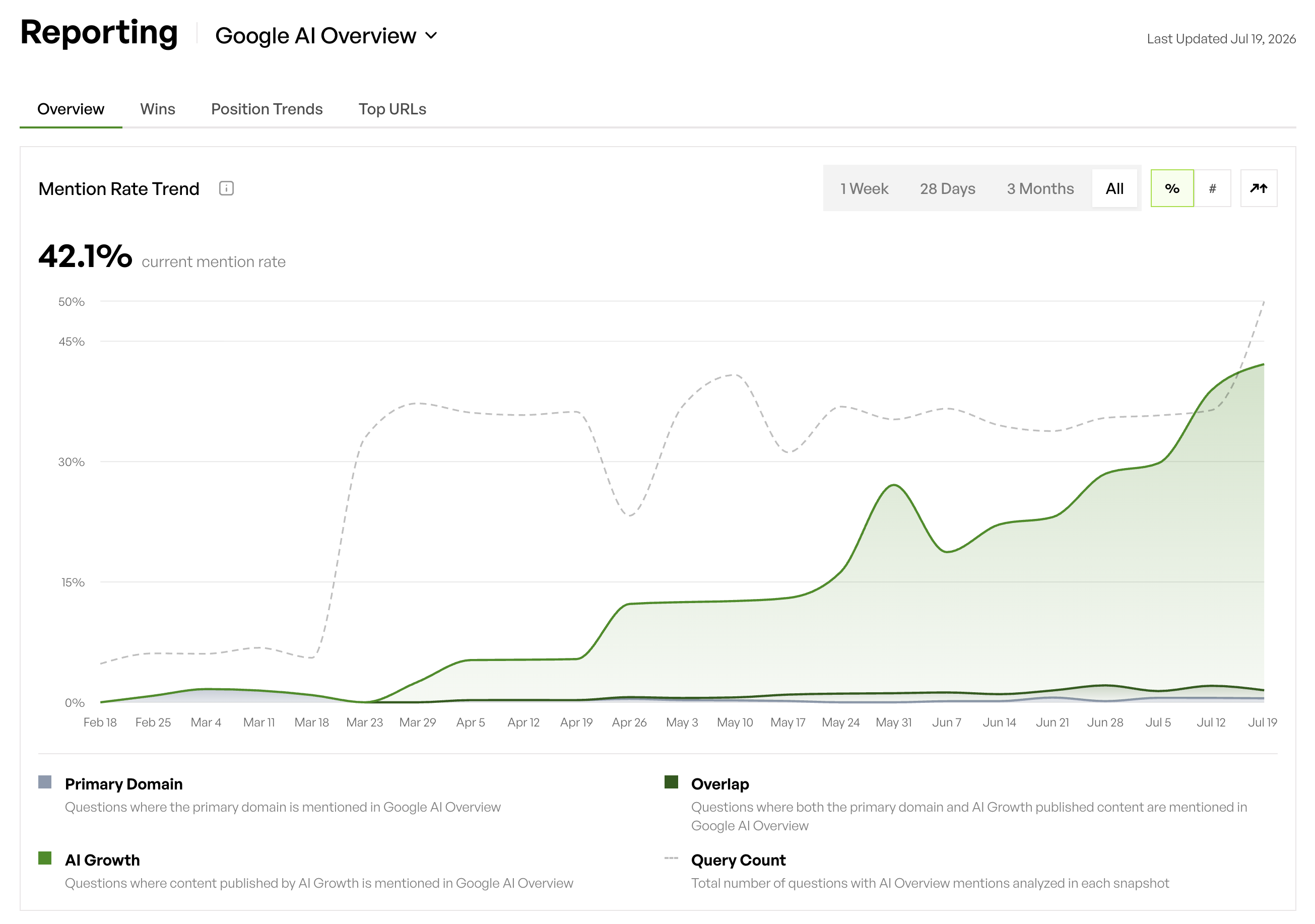
- Mention rate: the share of AI-generated responses that name the brand across a fixed prompt set. The median non-branded mention rate across tracked brands is approximately 31 percent.
- Citation rate: the share of AI responses that include a link to the brand's domain.
- Bot traffic: every bot interaction, including traditional crawlers and AI training agents, tracked per article and per platform.
- Incremental impressions: Google Search Console impressions attributable to new content, isolated from pre-existing brand visibility.
Tier 1 actions:
- Run a fixed prompt panel of 20 to 50 buyer-language prompts, each run three to five times in logged-out sessions across ChatGPT, Perplexity, and Google AI Mode, to establish repeatable baselines. This repetition is required for statistically valid AI visibility estimates because responses are non-deterministic.
- Track mention rate and citation rate separately, since they measure different behaviors and move independently.
- Cross-reference bot traffic, Google Search Console, and citation data weekly.
Tier 2 actions:
- Double down on content that indexes well and use internal linking to lift content that does not.
- Troubleshoot citation gaps by checking entity consistency first, then content extractability, then third-party corroboration, because weakness in any one of these three areas suppresses citations even when the others are strong.
Tier 3 validation: confirm that the measurement set covers at least 50 queries across a minimum of three platforms, that incremental visibility is reported separately from pre-existing brand visibility, and that reporting follows a weekly cadence.
Measurement and Troubleshooting for AI Visibility
The measurement framework for enterprise AI search visibility separates AI answer behavior from page-level rankings and traffic. 93 percent of Google AI Mode searches end without a click, so impression and click data from traditional analytics undercount the real impact of AI visibility by a wide margin.
The four metrics introduced in Step 7, mention rate, citation rate, bot traffic, and incremental impressions, form the foundation of this framework. When these metrics reveal underperformance, the following troubleshooting patterns help diagnose the root cause and guide your next action.
- High bot traffic, low citation rate: content is being read but not trusted. Check entity consistency across Wikidata, schema, and Google Business Profile, then add third-party corroboration.
- Low bot traffic: content is not being found. Check robots.txt, llms.txt, and agentic technical SEO configuration, and confirm that retrieval bots are allowed while training bots are blocked.
- Mention rate declining week over week: content is going stale. Refresh articles with new data points, following the cadence established in Step 5.
- Citation rate flat despite strong content: third-party corroboration is insufficient. Expand presence on review platforms, trade press, and community platforms.
Conclusion: Turn AI Search into a 90-Day Advantage
The discovery shift has moved visibility from blue links to AI answers, and the leaderboard is being written now. Brands that establish authoritative content across the four pillars of AI search intelligence in the next 90 days train the next generation of models with their own narrative. Brands that wait train those models with whatever happens to be sitting on the open web.
The 7-step playbook above is executable without adding headcount. One headless engine replaces the agency stack, maps the full universe, deploys living and self-healing content, and proves the incremental result week over week. The first article can be live within a week of kickoff.
Frequently Asked Questions
What is the difference between mention rate and citation rate in AI search visibility?
Mention rate measures how often a brand's name appears in AI-generated responses across a fixed set of prompts. Citation rate measures how often a link to the brand's domain appears in those same responses. The two metrics move independently. A brand can have a high mention rate and a low citation rate when AI surfaces reference the brand by name but draw their information from third-party sources instead of the brand's own content. Tracking both separately is essential because they diagnose different problems. Low mention rate points to a content and entity gap, while low citation rate with high mention rate points to a corroboration gap where third-party sources are not reinforcing the brand's owned claims.
Why do monitoring tools fail enterprise CMOs trying to control their AI search narrative?
Monitoring tools cap clients at a small set of tracked prompts, so they only reveal the slice of the market leaders already thought to ask about. The long tail of queries that customers actually use in AI search, which is where most discovery happens, remains invisible. Beyond the prompt cap, monitoring tools produce a diagnosis without a prescription. They show that the brand is not appearing in AI answers but provide no mechanism to change what those answers say.
Narrative control requires producing the content AI surfaces will use to describe the brand, in the formats and structures those surfaces can read, with the validation that earns the citation. That requirement creates an execution problem rather than a monitoring problem, and monitoring tools are not built to solve it.
How does headless marketing differ from hiring an SEO agency or building an internal content team?
An agency RFP often runs three months, followed by three more months to produce the first assets, which puts the brand close to a year away from having anything live. Internal teams require an editor, an SEO specialist, a designer, and an engineer working in coordination, and few organizations have all four skills aligned to the specific requirements of AI search. Both approaches also produce content that goes stale the day it ships, because neither includes a self-healing mechanism.
Headless marketing replaces the entire stack with one engine. The brand does an interview, the engine maps the universe, produces authoritative content, stands up a fully optimized site the brand owns, and self-heals the content over time. The first article is typically live within a week of kickoff, with no RFP, no year-long ramp, and no dependency on an agency that controls the site.
What does agentic technical SEO include and why does it matter for AI search visibility?
Traditional technical SEO covers structured HTML, metadata, rich schema markup, internal linking, sitemaps, and robots.txt. Agentic technical SEO adds the layer that makes a site legible to AI agents specifically. It includes Blog MCP with schema, manifest, discovery, and capability guidance exposed to agents, llms.txt and llms-full.txt so AI surfaces can read the brand in the format they require, OpenAI discovery and Agent Card guidance served via /.well-known/, natural language query parameters that return personalized, internally linked responses to agents passing queries directly into the URL, and Markdown served to agent crawlers.
Without agentic technical SEO, a site may be perfectly optimized for human visitors and traditional search crawlers while remaining effectively invisible to the AI agents that now mediate a growing share of discovery. Both layers are required, and neither substitutes for the other.
How long does it take to see measurable results from an AI search visibility program?
Content has indexed in as little as ten days and often within two weeks of publication. Meaningful movement in mention rate and citation rate typically appears within the first four to six weeks for AI surfaces that incorporate live search, such as Perplexity and Google AI Mode. Foundational knowledge base impact, where a model incorporates the brand's narrative into its base understanding, takes three to six months.
The standard engagement is a three-month pilot because indexing timelines vary by industry and competitive density. Clients who measure results correctly capture source at the conversion moment and consistently see a lift in organic leads after starting, even in a zero-click environment where direct attribution from AI recommendation to sale remains structurally incomplete.