Written by: Mariana Fonseca, Editorial Team, AI Growth Agent
Key Takeaways
Enterprise AI search replaces simple keyword matching with hybrid retrieval, citation-backed generation, and continuous evaluation so teams get accurate, auditable answers from private data.
Internal AI search and external discoverability now share the same foundation, so weak internal retrieval limits the authoritative content AI systems can safely cite in public answers.
Three early decisions shape every enterprise AI search program: data grounding with RAG, permission-aware access governance, and integration with existing tools.
Teams should assess five dimensions before choosing a solution path: team capacity, data quality, governance readiness, scalability, and integration depth.
AI Growth Agent runs all seven pillars of enterprise AI search on autopilot, from data grounding and permission-aware retrieval through publishing, technical SEO, and incremental reporting, so you can schedule a demo and see your first article live within a week.
Why Internal AI Search Now Drives External Discoverability
AI-generated answers have replaced blue-link lists as the primary way many people experience search results. When employees, partners, and customers query ChatGPT, Perplexity, or Google AI Mode, those systems rely on what they can find, trust, and cite. A 2026 survey of enterprise marketing leaders identified improving crawlability for AI-powered search tools as a core AI search optimization tactic.
AI Growth Agent's Content Planner show each brand's universe of search (tracked prompts/queries) and its visibility (ranking rate) on both Google Rankings, Google AI Overviews, and ChatGPT citations and mentions.
Internal AI search strategy and external discoverability now operate as one problem. Organizations that cannot retrieve their own knowledge accurately cannot publish the authoritative content that AI surfaces feel confident citing. Both internal and external systems depend on grounded retrieval, permission-aware architecture, and continuous evaluation.
Creating an Enterprise AI Strategy That Actually Ships
Given that internal and external search now share the same technical foundation, an enterprise AI strategy starts with three linked decisions. These decisions mirror the pillars that appear most consistently in Google’s AI Overview: data grounding via retrieval-augmented generation, access governance through permission-aware architecture, and system integration across existing enterprise tools. Every later pillar extends one of these three.
Organizations that skip any of these foundations face predictable outcomes. Systems that lack grounding hallucinate. Systems that ignore permission-aware design leak restricted data. Systems that do not integrate with existing tools stall in pilot because employees never adopt them.
Example of long-form article produced by AI Growth Agent: fact-checked, credible research meets unique content, derives from a brand's Company Manifesto.
Hybrid retrieval combines sparse methods such as BM25 with dense vector embeddings, then merges the results through Reciprocal Rank Fusion. Hybrid search that blends BM25 and vector search with RRF can reach higher recall than dense-only or sparse-only approaches. No Forrester report claims a 62% reduction; one industry blog reports a 43% reduction in RAG hallucinations from hybrid search per a Retrieva Labs benchmark.
Market Landscape: Monitoring Tools vs Execution Engines
The enterprise AI search vendor landscape splits into two clear categories: tools that report visibility and tools that change it. Monitoring platforms track whether a brand or knowledge asset appears for a capped set of prompts. These tools reveal the gap but leave the organization to close it by coordinating an engineer, a content team, and a stack of additional tools.
Analyst time to act on data, separate content team required
SEO suites
Keyword and rank data, established workflows
No AI search content production, no agentic technical SEO
Content team and separate publishing infrastructure required
Content factories
High volume at low cost
No brand intelligence, commodity output, Earned media accounts for 82 to 94% of all AI citations across ChatGPT, Gemini, and Claude according to five independent analyses
Editorial oversight required to maintain quality
Agencies
Done-for-you execution, strategic input
Slow RFP cycles, site lock-in, limited AI search capability
High retainer cost, 6 to 12 months to first meaningful output
Internal teams
Deep brand knowledge, direct stakeholder access
Skill divide across engineering, content, and AI surfaces, inconsistent at scale
Editor, SEO specialist, designer, and engineer required in coordination
Five Evaluation Factors Before You Choose a Path
Teams should review five evaluation factors before committing to any enterprise AI search solution. These factors determine whether a deployment reaches production or stalls in pilot.
Team capacity: Many companies admit their data assets are not ready for generative AI. This admission reveals that the first constraint often lies in internal bandwidth to clean, structure, and classify data for ingestion.
Data quality: Surveys highlight incomplete, inconsistent, and inaccurate data as common management hurdles. Weak data quality upstream produces weak retrieval quality downstream.
Phase 2 (Months 4 to 6): Design. Produce the AI operating model, role matrix, risk assessment framework, and workforce capability plan. Run a second pilot team. Gate: operating model validated against ISO/IEC 42001 and NIST AI RMF.
Phase 4 (Months 10 to 12): Optimization. Conduct a full maturity reassessment, analyze pilot outcomes for scaling or decommissioning, and define Cycle 2 priorities. Customer-facing features appear only at this stage and focus on the lowest-risk patterns.
Company size shapes this roadmap. Mid-market organizations with smaller data estates can compress Phases 1 and 2 into a single 90-day sprint. Large global enterprises with multi-region compliance requirements should treat Phase 3 as a full quarter per region instead of a single rollout.
Downloadable asset: The enterprise AI search strategy PDF and example roadmap referenced in this section are available as a structured planning template. Request access during your kickoff session to receive the full 12-month roadmap with phase gates, evaluation criteria, and company-size variations.
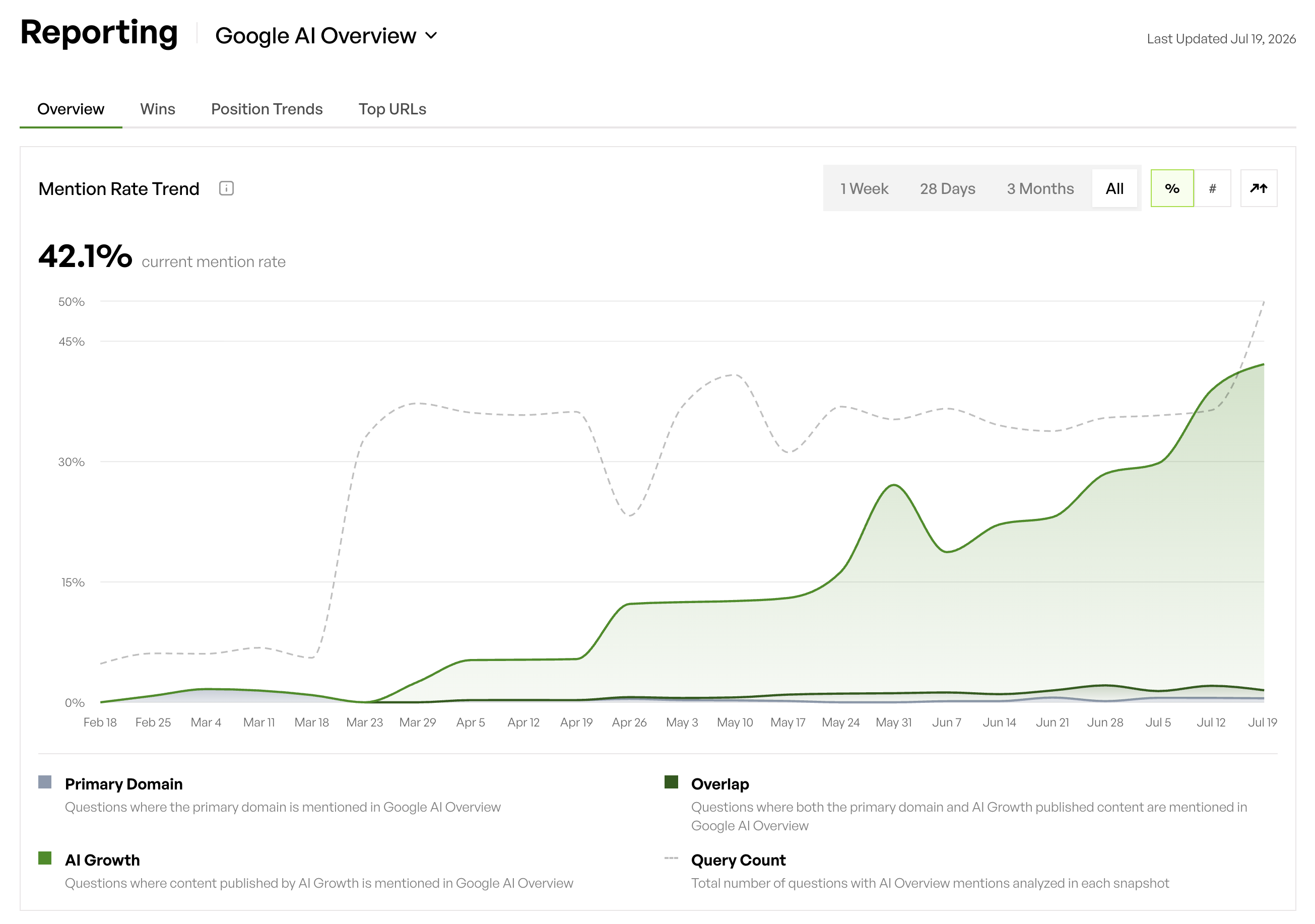
AI Growth Agent's Reporting dashboard, with ranking rates and their separation between Primary Domain results, Overlapping results, and AI Growth Agent content results (incremental visibility).
Incremental visibility reporting isolates what a new effort actually generated. Conductor’s January 2026 survey of more than 250 enterprise digital leaders found that 97% said AEO and GEO were delivering measurable impact on their business. The organizations capturing that impact accurately are the ones reporting incrementally instead of claiming credit for pre-existing brand recognition.
Risks, Limitations, and Frequent Implementation Mistakes
Enterprise AI search projects tend to fail in four recurring categories. Each category reflects a different layer of the stack.
Summary and Decision-Support Criteria: The 7-Pillar Framework
A production-ready enterprise AI search strategy depends on seven pillars working together. Each pillar covers a specific layer of the system, and none of them can be skipped.
Data grounding via RAG: Answers should come from company sources, not training-data memory. Every claim needs an inline citation to a source document.
Hybrid retrieval: Implement the hybrid retrieval architecture described earlier, then add a reranker to the merged top candidates before generation.
Permission-aware architecture: Enforce the permission-aware design at three levels: source, retrieval, and output. Never rely on the presentation layer to hide restricted content.
System integration: Connect to the business tools employees already use. Permission filtering should inherit from source-system controls instead of recreating them in a separate layer.
Continuous evaluation: Maintain a golden evaluation dataset of 200 to 500 expert-reviewed query and answer pairs. Gate every production deployment on context precision, context recall, groundedness, and answer relevance.
Phased governance: Follow a four-phase roadmap with formal gates. Treat governance as a design property baked into the platform, not an administrative overlay added later.
Incremental-visibility measurement: Report citation rate, AI share of voice, citation accuracy, and AI-referred conversion rate on a fixed prompt panel. Separate new visibility from pre-existing brand strength.
Organizations choosing between solution paths should apply three decision criteria that directly test whether a solution implements the seven pillars correctly. First, confirm that the solution enforces permissions at the retrieval layer rather than the presentation layer, which validates the permission-aware architecture. Second, confirm that it produces living, self-healing content instead of static assets that decay, which demonstrates continuous evaluation and refresh. Third, confirm that it reports incremental visibility rather than claiming credit for existing brand recognition, which reflects the measurement discipline behind the framework.
The single headless engine that replaces the full stack is the one that executes all seven pillars on autopilot. That engine handles data grounding, permission-aware retrieval, publishing, technical SEO, and incremental reporting without requiring the organization to assemble and coordinate a separate team for each layer.
What is the difference between enterprise AI search and a standard enterprise search system?
Standard enterprise search systems match keywords against indexed documents and return a ranked list of links. Enterprise AI search replaces that model with hybrid retrieval that combines keyword precision and semantic similarity, then passes the retrieved context to a large language model that generates a cited, conversational answer. The critical additions include permission-aware retrieval, which ensures the model only receives documents the querying user is authorized to see, and continuous evaluation against a golden dataset, which gates every deployment on measurable accuracy instead of subjective review. The result is a system that answers questions instead of returning links while preserving auditability and access controls.
How long does it realistically take to deploy an enterprise AI search system?
A realistic 12-month roadmap divides into four phases. The first three months establish the platform foundation and deliver one working internal pilot feature. Months four through six produce the operating model, governance framework, and a second pilot. Months seven through nine scale to multiple business units with formal monitoring in place. Customer-facing features appear only in months ten through twelve, and only after the platform has run reliably for at least six months with proven governance.
Mid-market organizations with smaller data estates can compress the first two phases into a single 90-day sprint. Large global enterprises with multi-region compliance requirements should treat the third phase as a full quarter per region. The most common failure pattern involves skipping phases, because a pilot without platform foundations cannot scale and a multi-BU rollout without governance creates operational chaos.
What are the most important metrics for measuring enterprise AI search performance?
The core measurement framework covers three layers: visibility, quality, and outcome. Visibility metrics include citation rate, AI share of voice, and answer presence rate, measured monthly against a fixed prompt panel across the AI platforms that matter to the organization. Quality metrics include citation accuracy score, which tracks the percentage of citations where the AI describes the organization or its content correctly, with accuracy below 90% treated as a critical issue.
Outcome metrics include AI-referred sessions, AI-referred conversion rate, and AI-influenced pipeline, reviewed quarterly. The most important discipline involves incremental reporting, which isolates what the new system generated from visibility the organization already had. Without incremental reporting, teams cannot distinguish genuine performance improvement from pre-existing brand recognition.
What are the most common reasons enterprise AI search projects fail?
Failure modes cluster into four categories that mirror the risks described earlier. Retrieval architecture failures include chunking documents by fixed character counts instead of semantic boundaries, relying on vector search alone without a keyword fallback for exact-match queries, and skipping a reranker that would materially improve precision. Permission and governance failures include vector databases that store embeddings without tenant-level segmentation, service account credentials that surface data the end user is not authorized to access, and access controls enforced only at the presentation layer.
Data quality failures include indexing documents once without a continuous refresh pipeline, which causes the system to cite retired policies, and ingesting unstructured data without classification or sensitivity tagging. Organizational failures include fragmented ownership across data, engineering, legal, and business teams, along with technology-first sequencing that deploys systems before governance structures exist.
How does permission-aware retrieval work in practice?
In practice, the permission-aware architecture described earlier operates through a three-stage enforcement sequence. The preferred order is policy evaluation first, followed by candidate retrieval, followed by reranking, and finally generation. Access controls must be enforced at three distinct levels: source-level permissions inherited from the original repository, retrieval-level metadata filters in the vector database that enforce user-specific authorization at query time, and output-level filters that block sensitive content categories even if they pass retrieval.
Chunk-level access metadata should remain consistent with the parent document, because a single section can retain obsolete access after the source document changes. Security filters must persist through every retrieval stage, including the reranker, any cache layer, and any fallback search path, so that no excluded candidate reenters the pipeline downstream.