Written by: Mariana Fonseca, Editorial Team, AI Growth Agent
Key Takeaways
- Brand narrative control in AI search is evidence engineering. You shape the sources and facts models use when describing your brand.
- Single-engine monitoring is unreliable. Brand mentions disagree 61.9% of the time across platforms, so audits must run across ChatGPT, Gemini, Perplexity, and Google AI Mode using eight structured prompt types.
- The shadow brand of outdated pages, stale directories, and competitor-framed content often overrides new messaging. Cleanup must precede new publishing.
- AI surfaces cite Reddit, Wikipedia, YouTube, LinkedIn, and review platforms far more than traditional top-ranking pages. Brands must earn presence on those specific source ecosystems.
- AI Growth Agent executes the full loop by mapping queries, producing authoritative content, publishing on an owned site, and self-healing, without requiring a content or SEO team.
Book A Demo With AI Growth Agent
How To Track Brand Mentions In AI Search
A single response is a single sample, not a signal. Brand mentions in AI responses disagreed 61.9% of the time across Google AI Overviews, Google AI Mode, and ChatGPT, and only 11% of domains are cited by both ChatGPT and Perplexity. Single-engine monitoring produces a false picture. The audit instrument below runs across all four primary surfaces.
These eight prompt types map the full buyer journey, from first awareness to final purchase decision, so gaps in any one category reveal where your narrative is weakest:
- Identity prompts: “What is [brand]?” and “What does [brand] do?”
- Category prompts: “What are the best [category] tools for [use case]?”
- Positioning prompts: “Who is [brand] for?” and “What makes [brand] different?”
- Comparison prompts: “[Brand] vs [competitor]” and “How does [brand] compare to [competitor]?”
- Alternatives prompts: “Alternatives to [brand]” and “Best [brand] alternatives”
- Evaluation prompts: “Pros and cons of [brand]” and “Is [brand] worth it?”
- Trust prompts: “Is [brand] legit?” and “Is [brand] reliable?”
- Purchase prompts: “Should I buy [brand]?” and “Is [brand] good for [specific need]?”
Run each prompt across ChatGPT, Gemini, Perplexity, and Google AI Mode, because a single platform gives you a false picture. For each run, record four fields: mention rate, citation sources, factual errors, and competitor co-occurrence. Comparison and evaluation prompts deserve multiple runs in fresh sessions, since their answers vary most between sessions. Comparative prompts produced an accuracy rate of only 18.8% in Seer Interactive's study of 28,123 AI responses, with platforms declining to answer 80.3% of the time on those query types. That non-answer rate is itself a visibility loss.
Watch specifically for consensus fabrication, where a competitor-authored framing appears in the answer as neutral fact. A single negative client review from 2018 became the basis for AI models repeatedly asserting “high account turnover” about an agency. No single page served as the definitive source. The model assembled a generalized narrative from scattered signals. That pattern is consensus fabrication and is the hardest inaccuracy to trace and correct.
Also track the non-answer. AI platforms declined to answer branded prompts 31.2% of the time on average. Absence is a larger drag on raw accuracy than incorrect answers.
51% of B2B software buyers now begin their software research in an AI chatbot, up from 29% in April 2025, and 69% chose a different vendor than initially planned based on AI chatbot guidance. The audit now sits at the core of brand measurement.
See How AI Growth Agent Runs This Audit For You
What Is The Shadow Brand And Why It Shapes AI Answers
The audit above surfaces more than gaps in your current messaging. It also reveals a contradictory footprint underneath it, and that footprint must be addressed before any new content is published. AI models still ingest stale press releases, abandoned subdomains, outdated partner decks, dead product pages, and old pricing pages. Publishing accurate content on top of a contradictory evidence base creates competition between signals. Older material often wins because it has more inbound references and a longer indexing history.
The shadow brand is the aggregate of everything the model can find about your brand that you did not intend to be the current record. This work is subtraction before addition and is the step most playbooks name without explaining.
The discovery method is direct. Search your brand name plus category terms across ChatGPT, Gemini, Perplexity, and Google AI Mode. Inspect which URLs the answers cite. Trace each cited URL back to its owner and its last update date. The five common culprits for incorrect AI claims are:
- Your own outdated pages
- Competitor comparison pages that misrepresent your product
- Third-party directories with stale data
- Forum and Reddit threads with outdated user comments
- News articles about a former product version
The Wayback Machine helps here. Your own site may have served incorrect information at some point, and cached versions persist in training data long after you update the live page.
Sequence the cleanup before publishing new content. Start with the pages you control and update or redirect outdated owned pages. Then work outward to third-party directories, submitting corrections where the data is stale. Finally, request updates from publishers where practical. AI answers are corrected indirectly over time after recrawl or index refresh, with Perplexity potentially reflecting changes within days due to freshness weighting, and Wikipedia and Crunchbase corrections typically propagating within weeks to months. The correction timeline varies by platform and source layer, so plan the sequence with that lag in mind.
Which Sources AI Models Cite Most For Brand Stories
The source ecosystems AI surfaces draw from are not interchangeable. Only 11% of domains are cited by both ChatGPT and Perplexity, and only 12% of URLs cited by AI tools overlap with Google's top-10 organic results. That 11% overlap mentioned earlier shows why a single content strategy does not succeed across all surfaces.
Citation share concentrates in a handful of source ecosystems that traditional SEO rarely prioritizes, and each one requires a different presence strategy:
- Reddit is the most-cited domain across all major AI platforms combined, per Peec AI's March 2026 analysis of 30 million citations. Presence comes from substantive participation in relevant subreddits. Content with 50 or more upvotes in active subreddit threads is the precise pattern Perplexity and Google AI Mode extract as citations.
- Wikipedia accounts for approximately 47.9% of ChatGPT's top-10 source share. Fixing Wikipedia inaccuracies has outsized impact because the correction propagates through the most frequently cited source across AI platforms.
- YouTube appeared in 29.5% of Google AI Overviews and is cited roughly 200 times more than any other video platform.
- LinkedIn is cited in approximately 15% of Google AI Mode responses. For Copilot, LinkedIn accuracy is a key correction path because Microsoft owns LinkedIn and weights it heavily for brand entity verification.
- Review and comparison platforms dominate commercial-intent queries. G2, Capterra, Gartner Peer Insights, TrustRadius, and Software Advice account for 88% of review-based AI citations across ChatGPT, Perplexity, and AI Overviews.
- Editorial media gained citation share during the September 2025 ChatGPT rebalancing, with PR Newswire, Forbes, and Medium all increasing their share as Reddit and Wikipedia lost ground.
Knowing which sources AI cites is only half the picture. The other half is knowing which content type those sources reward, and the evaluation-query content class is the highest-leverage category for shaping the AI narrative. “Alternatives to,” “pros and cons of,” “who should not use,” and “X vs Y” pages shape the AI narrative more than “why choose us” pages for a structural reason. Buyers produce this content type when they are closest to a decision, and AI surfaces treat it as evidence of category authority rather than promotional copy.
A large share of high-intent Perplexity prompts are evaluative rather than navigational, and in these prompts citations function like evidence cards, so a brand that is not cited loses credibility at the decision point, not just traffic. Write evaluation-query content honestly, including genuine limitations and the use cases where a competitor is a better fit. AI surfaces extract structured, declarative content, so vague marketing copy is invisible to them. LLMs extract data from tables at 81% accuracy versus 23% for prose.
Several additional content signals raise citation probability. Adding statistics to content improved AI citation visibility by 41%. Pages with FAQPage schema were cited by AI search engines 41% of the time, compared to 9% without structured data. 44.2% of all AI citations are extracted from the first 30% of a page, so the most important claims belong at the top. Content updated within the last three months is twice as likely to be cited as older material.
How To Fix Inaccurate AI Descriptions Of Your Brand
When the audit surfaces a specific inaccuracy, the correction loop runs in sequence: source-level fix first, owned-content fix second, third-party reinforcement third.
Identify the likely source of the wrong claim. Seer Interactive's study found three root causes of AI brand inaccuracies: training data baked in before the brand could correct it, live retrieval from a stale source, and own-site misreads where the model draws the wrong inference from the brand's own content. Each has a different fix timeline. Stale facts on directories correct in days to weeks once the source is updated. Own-site misreads correct quickly by adding explicit language. Narratives baked into training data take months and require a sustained campaign of better signals to displace them.
For fabricated claims with no single traceable source, the fix is source density, not source correction. Fabricated claims often emerge when the model has sparse data about your brand, so the fix is publishing enough accurate content that the model has no gaps left to fill. Do not block AI crawlers. Blocking prevents platforms from retrieving your correct, updated information and makes misinformation worse, not better.
Corrections propagate at different speeds. Outdated facts on Perplexity correct in 3 to 14 days; on Google AI Overviews in 1 to 3 weeks; on ChatGPT browsing in 2 to 6 weeks; and on ChatGPT and Gemini training data in 3 to 6 months. Plan the correction timeline by platform and source layer, not by when you published the fix.
How To Win Brand Visibility In AI Search
Correction is reactive. The more durable work is proactive: building the visibility signals that make AI surfaces cite you correctly in the first place. Traditional SEO optimizes for ranking blue links. AI search visibility rewards content that gets cited and recommended in synthesized answers. The share of Google AI Overview citations coming from top-10 organic results collapsed from 76% to 38% in eight months, so ranking on page one is no longer a reliable path to being cited by Google's AI.
The signals that drive AI citation likelihood are structurally different from traditional ranking signals. Brand search volume is the strongest known predictor of AI citation likelihood. Its 0.334 correlation is materially stronger than backlinks. Brand web mentions carry a 0.664 correlation with AI visibility, and YouTube mentions carry a 0.737 correlation. A brand can rank on page one of Google and be invisible in AI-generated responses simultaneously.
AI search visibility is also a brand reputation problem. LLMs do not generate sentiment about a brand independently. They reflect the sentiment of the sources they cite. A brand whose citations skew toward negative Reddit threads, defensive press coverage, or critical reviews will be described in those terms. Sentiment management is source-portfolio management.
How To Measure Brand Narrative Control Over Time
A single response is a single sample. Measurement that survives probabilistic output requires repeated testing on a fixed cadence across a stable prompt set. Run the full eight-prompt-type audit on a weekly or monthly schedule, depending on category velocity. Use the same prompt wording every cycle. Run prompts in fresh sessions so prior context does not influence the output.
Track five metrics per cycle: mention rate, citation sources, factual accuracy, competitor co-occurrence, and source-mix changes. Define what movement looks like before you start. A mention rate of 40% tells you nothing without a competitor benchmark. If competitors occupy 70% of AI-generated responses in a category while a brand occupies 15%, that gap has revenue implications regardless of Google rankings.
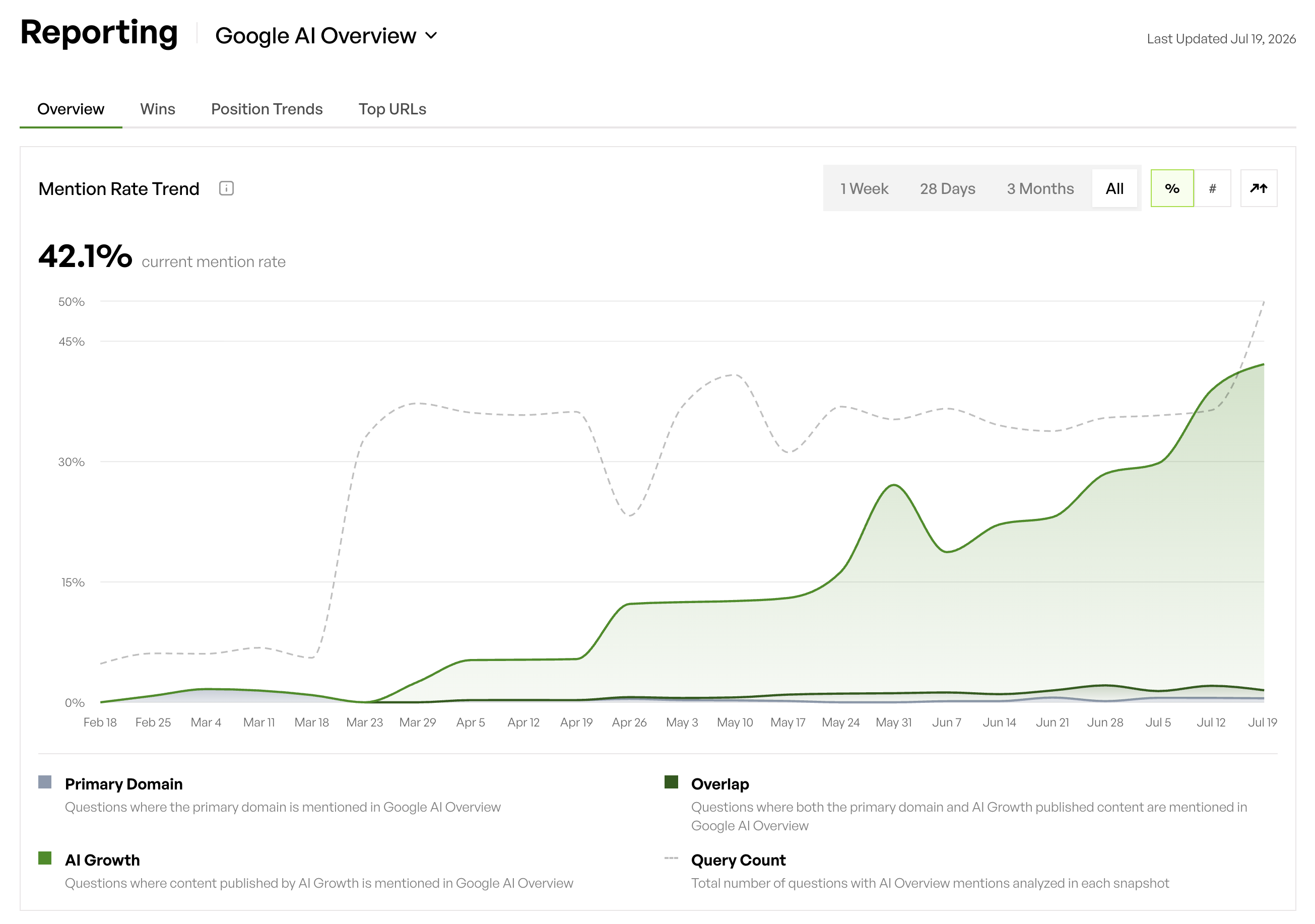
Escalate when corrections are not propagating. If sentiment scores on affected prompt families do not move within four to six weeks after publishing corrective content or earning new third-party citations, the correction has not yet entered the model's retrieval layer and a different source must be tried.
Track source-mix changes separately from factual-accuracy scores. A brand whose citation sources are shifting from owned pages toward third-party review platforms is gaining earned authority. A brand whose citations are shifting toward competitor comparison pages is losing narrative control at the source layer, not the content layer.
Where AI Growth Agent Fits In This Playbook
The playbook above describes the operating procedure. AI Growth Agent is the engine that executes the entire loop without requiring a content team, an SEO agency, a web agency, or a stack of monitoring tools.
The architecture is headless marketing: marketing by and for the robots, with no headcount. AI Growth Agent maps a brand's full universe of seed terms and long-tail queries from real-time Google and ChatGPT data. It produces authoritative content that validates every claim and source and stands up a fully optimized site the brand owns within the first week. The content is living. It self-heals and updates over time instead of going stale. Every article ships with the full traditional and agentic technical SEO stack: Blog MCP, llms.txt and llms-full.txt, agent discovery via /.well-known/, FAQPage schema, Organization schema, and automated web stories. All of it works out of the box with no engineering hours required from the client.
The distinction from monitoring-first tools is architectural. It is not about who has more data. Monitoring-first tools stop at tracking and hand work back to the client. AI Growth Agent closes the loop. The table below shows where the two categories diverge.
| Attribute | Monitoring-First Tools (e.g., Profound, Peec AI, Athena) | AI Growth Agent |
|---|---|---|
| Core Function | Track brand appearance across a metered set of prompts. 2026 bolt-ons include draft agents and to-do lists that hand work back to the client. | Map the full universe, produce authoritative content, publish, and self-heal on a site the client owns. Agent Actions recalculate the next best action daily. |
| Prompt Limits | Prompt cap varies by tier. Expanding coverage requires a higher tier. | No prompt cap. The full universe is mapped and refreshed weekly. |
| Action Layer | Human-led execution. Recommendations return as homework and a human approves every publish. | Level 4 autonomy. The engine creates plans, executes them, handles its own errors, and alerts a human only at a roadblock it cannot resolve. |
| Site Ownership | No owned-site publishing. Shadow pages or draft agents do not replace a client-owned property. | A fully optimized blog the client owns, live within the first week, connected via reverse proxy rewrite or subdomain. |
Across the first twelve weeks, clients average more than 12,000 additional AI citations and mentions, over 100,000 additional bot visits, and a 20%+ lift in impressions. Breadless is now one of the most recommended healthy franchises in the US, with ChatGPT citing eatbreadless.com over 45,000 times per month and a 30x lift in Google Search Console impressions over six months. Leva Sleep is now the most mentioned retailer for adjustable beds in Canada, with ChatGPT citations topping 10,000 per month and deals of $40,000 to $50,000 closed in under three weeks from buyers who discovered the brand through AI Growth Agent content.
Incremental visibility reporting isolates exactly what AI Growth Agent generated, week over week, separate from visibility the brand already had. That is the defensible answer for the board meeting.
Conclusion: Turning This Playbook Into Execution
AI surfaces are describing your brand with outdated product lines, dead pricing tiers, or positioning a competitor wrote for a comparison page. You control the evidence base the model synthesizes from, even though you cannot control the output directly. Brand narrative control in AI search is evidence engineering. Audit the current narrative, prune the shadow footprint, build the evidence base across the source ecosystems AI surfaces actually cite, publish evaluation-query content that shapes the narrative at the decision point, and measure against probabilistic output on a fixed cadence.
The brands cited in AI search this year are training the next generation of models with their own story. The brands that wait are training the next generation with whatever happens to be sitting on the open web. AI Growth Agent is the engine that executes the entire loop, from universe mapping to self-healing content to incremental visibility reporting, on a site you own, without a team to manage.
Take Control Of Your AI Narrative
Frequently Asked Questions
What Is The Difference Between A Brand Mention And A Brand Citation In AI Search?
A brand mention means the AI engine names your brand somewhere in the body of its answer. A brand citation means the engine attributes a specific claim to your domain and links to it in the source list. These are distinct outcomes with different authority implications. Mentions indicate brand recognition. Citations indicate source authority and compound over time because they reinforce the evidence layer that drives future mentions. A brand can be mentioned frequently while being cited from a competitor's comparison page, meaning someone else controls the AI brand story even when your name appears. Tracking both separately, and tracking which URLs are cited when your brand is mentioned, is the minimum viable measurement posture.
Why Do AI Models Describe My Brand Inaccurately Even When My Website Has The Correct Information?
AI models do not read your website the way a human does. They synthesize from a corpus of sources assembled during training and retrieval, and that corpus includes third-party directories, review platforms, forum threads, press coverage, and competitor comparison pages, many of which may contain outdated or competitor-framed information about your brand. If those sources are more numerous, more frequently linked, or more structurally parseable than your own pages, the model weights them more heavily. Your website being correct is necessary but not sufficient. The correction loop runs at the source layer: update the third-party directories, earn corrective coverage on the platforms the model actually cites, and publish structured content dense enough that the model has no gaps left to fill with inference. Corrections propagate at different speeds depending on whether the error lives in a retrieval-based system like Perplexity, which can reflect changes within days, or in training data, which may take months to update.
Which AI Platforms Should I Prioritize For Brand Narrative Monitoring?
The minimum viable set is ChatGPT, Perplexity, Google AI Mode, and Google AI Overviews. Adding Microsoft Copilot and Gemini provides broader coverage. The platforms are not interchangeable. Only 11% of domains are cited by both ChatGPT and Perplexity, meaning a brand well-represented on one surface can be invisible on another. Citation logic also does not transfer between surfaces built by the same company. Reddit accounted for 44% of social media citations inside Google AI Overviews in one measured month but only 5% inside Google Gemini in the same month, despite both surfaces being Google products. Each platform requires its own prompt audit and its own source strategy. Monitoring only one platform produces a systematically false picture of your brand's AI-narrated identity.
What Is Evaluation-Query Content And Why Does It Matter More Than Branded Content?
Evaluation-query content is the content class built around queries buyers use when they are closest to a decision. These include “alternatives to,” “pros and cons of,” “who should not use,” and “X vs Y” pages. These pages shape the AI narrative more than “why choose us” pages because AI surfaces treat them as evidence of category authority rather than promotional copy. When a buyer asks an AI surface which tool to use, the model synthesizes from the sources that have already answered that question in a structured, extractable way. A brand that has published honest, specific evaluation-query content, including genuine limitations and use cases where a competitor is a better fit, is more likely to be cited in those high-intent responses than a brand whose content is exclusively promotional. The content must be written in clear, declarative sentences with specific facts, because AI surfaces extract structured content far more reliably than vague marketing language.
How Long Does It Take For Brand Narrative Corrections To Appear In AI Responses?
The timeline depends on the platform and the source layer where the error lives. The timelines vary by platform and source layer, as outlined in the correction section above. Perplexity corrects fastest, training data slowest. If corrections are not propagating within four to six weeks on retrieval-based platforms, the source fix has not yet entered the model's retrieval layer and a different source must be targeted.