Written by: Mariana Fonseca, Editorial Team, AI Growth Agent
Key Takeaways: Closing the AI Production Gap
- AI visibility tools fall into three categories in 2026, and only full-stack production engines close the production gap by generating, publishing, and improving content.
- Monitor-only tools like WithGauge, Profound, Peec AI, and Otterly report visibility scores but provide no mechanism to create or publish content that improves those scores.
- Hidden production costs for content creation, publishing, and technical SEO often dwarf the price of monitoring subscriptions, creating an expensive and fragmented workflow.
- Full-stack engines like AI Growth Agent deliver measurable results, averaging 12,000+ new AI citations and 100,000+ bot visits within twelve weeks, while handling schema, agentic SEO, and self-healing content automatically.
- Stop letting AI define your brand at random. Control the narrative across online search with AI Growth Agent.
Why Teams Outgrow WithGauge’s Monitoring Workflow
WithGauge is a prompt-sampling monitor. It tracks how often a brand appears in answers to a defined set of queries across selected AI engines and surfaces that data in a dashboard. The workflow ends there. When a brand scores low or disappears from answers entirely, WithGauge reports the absence. It does not generate content, publish pages, provision schema, or self-heal what is already live. The result is a production gap: the team knows the score but has no engine to change it.
A 2026 B2B SaaS monitoring guide states directly: “Monitoring tells you the score. The score only changes when content changes.” That observation explains why CMOs and founders who have used monitoring dashboards eventually look for something that acts on the data rather than just displaying it.
This limitation is not unique to WithGauge. It reflects how the entire monitor-only category handles AI visibility.
Monitor-Only Tools and the Hidden Production Cost
Pure monitors include Profound, Peec AI, Otterly, and Elmo. Each tracks brand mentions or citations across a prompt set and returns a visibility score. The measurement methodologies differ enough to produce incompatible numbers. A controlled 15-day test of seven AI citation tracking tools on the same domain found an 8.2x gap between the lowest and highest citation count, with Otterly AI reporting 38 citations and Peec AI reporting 312 for identical queries and time period.
Beyond measurement inconsistency, the structural limitation is scope. Platforms with only surface dashboards function as reporting tools rather than improvement tools when they surface Share of Voice without connecting it to specific content gaps or concrete next steps. The team still needs to commission content, find a publisher, configure schema, manage a CMS, and coordinate technical SEO separately. A closed-loop AI visibility platform that integrates tracking, content generation, CMS publishing, and monitoring can reduce analyst stitching time compared with using four separate tools.
The hidden production cost compounds quickly. In-house content production for AI visibility in 2026 involves substantial fully loaded costs for a mid-level US content marketer, who often produces only a few quality long-form pieces monthly after accounting for meetings and other duties. For teams without in-house capacity, freelance alternatives run $300 to $900 per piece at mid-range rates, leading to $4,500 to $13,500 monthly for 15 pieces before editing or QA. Against these production costs, a monitoring subscription is a small fraction of the total, but it does nothing to reduce the larger expense.
2026 Pricing and Results Reality Check
Gauge’s AI visibility platform starts at $599/month for multi-engine coverage (6 platforms including ChatGPT) with a custom Enterprise tier above that. Profound’s Starter plan at $99/month (billed annually) provides only ChatGPT tracking, requiring the $399/month Growth plan for access to three engines and agents. Neither price includes content production, publishing, schema, or technical SEO.
Time-to-results benchmarks sharpen the comparison. The median time for a newly published page to earn its first AI citation is 6.81 days, and pages not cited within 37 days almost always have a technical problem. That clock starts only after content is published. A monitor-only tool does not start it at all. Meanwhile, AI search visits grew 42.8% year over year from 15.6 billion in Q1 2025 to 27.4 billion in Q1 2026, and AI-referred visitors converted at 14.2% compared to 2.8% for standard Google organic search in an analysis of 312 technology firms. Every week without published, citable content is a week of compounding opportunity cost.
Total cost of ownership for AI visibility platforms in 2026 includes platform subscription fees, content production, publishing infrastructure, audit and remediation, internal ownership time, reporting, tooling redundancy, and the opportunity cost of the wrong setup. Software and SaaS AI tools represent roughly 30-40% of total enterprise AI budgets in 2026, while AI visibility platform tool subscriptions typically account for the large majority of their own total cost of ownership after adding about 23% in hidden costs.
These hidden costs and opportunity losses explain why teams eventually look beyond monitoring dashboards to production systems that close the gap.
When a Full Engine Beats a Dashboard
AI Growth Agent is a headless production engine, not a monitor. It maps a brand’s full universe of seed terms and long-tail queries using real-time Google and ChatGPT data. It produces authoritative living content validated against primary sources, stands up a fully optimized site the client owns within the first week, and reports the incremental visibility it generates week over week. The content self-heals over time rather than going stale. Technical and agentic SEO, including Blog MCP, llms.txt, llms-full.txt, full schema, and agent discovery via /.well-known/, ships automatically with every article and every package.

Across the first twelve weeks, clients average more than 12,000 additional AI citations and mentions, over 100,000 additional bot visits, and a 20%+ lift in impressions, with content indexing in as little as ten days. Breadless, a healthy fast-casual franchise, grew from 387,000 to 12.3 million Google Search Console impressions in six months and is now cited by ChatGPT over 45,000 times per month. Leva Sleep closed $40,000 to $50,000 in deals in under three weeks from buyers who found them through AI Growth Agent content.
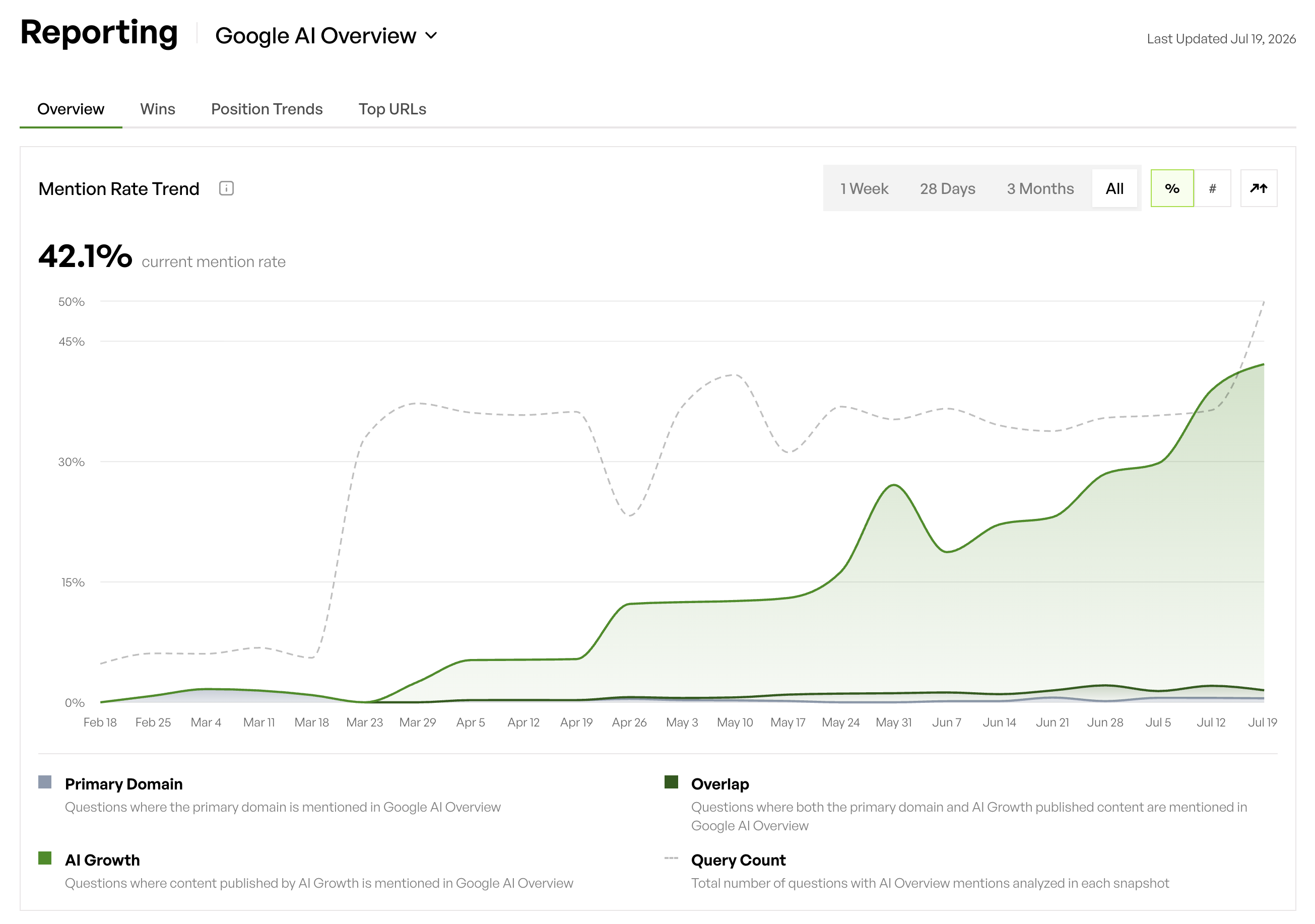
The following table illustrates the fundamental difference between monitoring what exists and building what is missing, showing which capabilities each tool category provides and which it leaves to separate vendors.
| Tool | Scope | Time to First Published Article | Technical SEO and Agentic SEO Included | Self-Healing Content | Incremental Visibility Reporting | Pricing Model |
|---|---|---|---|---|---|---|
| Profound | Monitor only | Not applicable, no publishing | No | No | Visibility score only, no isolation of new vs. existing | $99/month (ChatGPT only); $399/month for 3 engines |
| Peec AI | Monitor only | Not applicable, no publishing | No | No | Citation count tracking, methodology variance produces results up to 8.2x different from other tools on the same domain | Subscription, prompt-capped tiers |
| Otterly | Monitor only | Not applicable, no publishing | No | No | Citation count tracking, reported 38 citations vs. Peec AI’s 312 on the same domain in a 15-day controlled test | Subscription, prompt-capped tiers |
| Elmo | Monitor only | Not applicable, no publishing | No | No | Dashboard visibility score, no production layer | Subscription, prompt-capped tiers |
| AI Growth Agent | Full-stack production engine | About 1 week from kickoff | Yes, full traditional and agentic SEO stack included in every package | Yes, living content updates and self-heals automatically | Incremental visibility isolated from existing brand visibility, cross-referenced with bot traffic and Google Search Console | Flat fee, no per-article charges, credit limits, or per-prompt billing |
How Each Tool Category Performs in Practice
Pure monitors require minimal setup but deliver no production output. A team evaluating Profound, Peec AI, Otterly, or Elmo can expect a dashboard within days and a visibility score within a week. The operational ceiling is that score. Improving it requires a separate content workflow, a separate publisher, and a separate technical SEO layer, each with its own vendor, contract, and review cycle. An AI readiness audit and remediation for a typical SMB site requires technical work on schema and linking, content rewriting, and entity reconciliation before monitoring data becomes actionable.
Content-only tools generate text on demand but leave publishing, schema, bot tracking, and self-healing to the client. Quality control drifts without a brand manifesto anchoring every generation. AI tools struggle with contextual understanding, cultural nuances, and originality, often producing formulaic or inconsistent output when brand controls are not properly configured.
Full-stack production engines handle setup complexity, publishing infrastructure, technical depth, and scalability in one system. The trade-off is a higher initial commitment. Teams complete a kickoff interview, a topology review, and a first-article approval cycle. After that, the engine runs on autopilot. Teams achieving full AI integration saw content velocity rise to 20 to 35 posts per person per month, compared with a pre-AI baseline of 4 to 8 posts.
Decision Framework by Team Size and Budget
Team size and budget shape which category fits best. The following scenarios map common situations to tool categories.
- Growth-stage team, limited budget, no dedicated content function. Growth-stage teams typically need 50 to 200 tracked prompts across 3 to 6 AI models. A monitor-only tool covers measurement but leaves the production gap entirely unsolved. A full-stack engine at a flat fee replaces the content, SEO, and publishing stack in one line item.
- Mid-market CMO with a non-technical team. The team can brief content but cannot provision schema, manage a CMS, or configure agentic SEO. A production engine that ships the full technical stack automatically removes every dependency that would otherwise require an agency or an engineer.
- Enterprise with existing SEO tooling. Enterprise teams for AI visibility tools often need support for thousands of prompts, SOC 2 compliance, API access or equivalent exports, and multi-brand management with role-based permissions. A monitor-only tool at the enterprise tier covers measurement breadth but still requires a separate production system. A full-stack engine with incremental visibility reporting gives the enterprise CMO a defensible answer for the board every week.
- Agency owner adding a new service line. A production engine that runs on behalf of multiple clients, each with its own universe map and content topology, converts AI search from a threat to earned media into a high-margin recurring service.
How to Measure Incremental AI Visibility
Incremental visibility isolates what a new content effort actually generated, separate from the visibility a brand already had before the effort began. The method requires publishing into a separate environment so that bot traffic, Google Search Console impressions, and citation data can be attributed to new content rather than blended with existing brand signals.
The 2026 AI citation tracking framework defines citation rate as cited responses divided by total prompts tested, and separately tracks share of voice, citation position, and link rate. Linked citations carry referral traffic potential while named mentions build awareness without clicks, making link rate a distinct metric from overall citation rate. A 2026 synthesis of six independent studies concludes that citation rate, recommendation rate, freshness-adjusted currency, and zero-click exposure must be tracked as four separate metrics rather than one blended AI visibility score, because these metrics no longer move together.
The four core GEO KPIs, citation rate, AI share of voice, AI referral traffic, and AI-sourced conversion value, map to different stages of buyer discovery and reveal that citations are only the top of the funnel while referral traffic and conversion value are downstream outcomes monitoring alone cannot produce.
Migration Checklist for Moving Beyond Monitoring
Switching from a monitor-only tool to a production engine follows a clear sequence.
- Export your current prompt set and visibility baseline from the monitor tool. This becomes the benchmark against which incremental gains are measured.
- Complete a brand manifesto interview. The manifesto is the single source of truth for voice, factual references, deny lists, and compliance requirements.
- Review the keyword topology. Confirm which seed terms and long-tail queries the engine will pursue first, and identify white space the monitor tool was not tracking.
- Approve the reverse proxy rewrite. This is the only technical step required on the client side. It connects the production engine’s blog to a subdirectory or subdomain under the brand’s domain.
- Review and approve first articles. Tune the engine during the kickoff week so that every future generation reflects brand voice and factual standards without re-briefing.
- Establish the incremental visibility baseline. Record bot traffic, Google Search Console impressions, and citation counts at the moment the first article is published so that all subsequent reporting isolates what the engine generated.
- Retire redundant tools. A full-stack production engine replaces the monitoring subscription, the content tool, the schema plugin, and the analytics stack in one line item.
Best-Fit Use Cases for Production Engines
Enterprise CMO with a non-technical team. The CMO owns the budget and the agency relationships but has no engineers on the marketing team. An agency RFP takes roughly three months, then three more to produce the first assets. A production engine moves from kickoff to first published article on the one-week timeline mentioned earlier, with the full technical and agentic SEO stack included automatically. The CMO gets a defensible incremental visibility report for the CEO every week without managing a vendor stack.
Builder or CEO wearing all hats. The operator has real revenue and no time. They tried producing content with a chatbot, discovered that the second article means running the whole process again, and watched quality drift. A production engine takes a kickoff interview and runs on autopilot from there, producing and self-healing authoritative content without requiring the operator to manage a tool, a team, or an agency.
PR agency owner adding a new service line. The agency wins attention through earned media but clients are asking why competitors surface in ChatGPT answers. A production engine becomes the intelligence and content layer behind the agency’s offering, turning AI search from a threat into a high-margin recurring service. The agency walks into client meetings with a data-backed point of view and walks out delivering visibility in AI answers, not just impressions.
Operational and Long-Term Considerations
Onboarding effort for a monitor-only tool is low and the ceiling is low. Onboarding a production engine requires a kickoff interview and a topology review, after which the engine runs without additional headcount. Teams with an integrated operating model gain a discoverability advantage in AI search because metadata and structure are built into the production process rather than added as an afterthought, making content easier for engines like ChatGPT, Perplexity, and Gemini to cite.
Content governance is handled through the manifesto and memory systems. Style rules, legal disclaimers, deny lists, and anti-hallucination focus areas are configured once and applied to every future generation. Without schema validation, review workflows, and audit trails, generative AI in content systems can create accuracy and compliance problems faster than humans can discover them. A production engine with cascading anti-hallucination checks and primary-source validation addresses this by design.
Adaptability to changing search behavior is a structural advantage of living content. Forty to sixty percent of cited domains change monthly across major AI platforms, with Google AI Overviews at 59.3% citation drift and ChatGPT at 54.1%. Content that self-heals and updates automatically stays current through those shifts. Content published once and left static does not.
Risks, Limitations, and Common Misconceptions
Monitor-only tools carry a specific risk: the monitor-only trap. A team invests in a dashboard, watches the score, and concludes that visibility is a measurement problem. It is a production problem. Fifty-four percent of marketing teams plan to implement GEO, but only 23% are actively measuring GEO performance, which illustrates the gap between intention and execution when no production system exists.
Content-only tools carry a quality drift risk. Without a brand manifesto, memory systems, and cascading validation, output becomes inconsistent at scale. One company produced roughly 300 articles with a chatbot and not one was cited.
Full-stack production engines require a kickoff commitment and a reverse proxy integration. They are not instant-on tools. The trade-off is that the engine then runs without additional headcount, while still delivering the one-week path to first live content referenced earlier.
A common misconception is that traditional SEO rank is a proxy for AI citation. The overlap between top-10 Google rankings and AI Overview citations fell from approximately 75% in late 2024 to as low as 17% in early 2026. A brand ranking well in traditional search is not automatically cited in AI answers. The content must be structured, validated, and technically accessible to the bots doing the citing.
Decision Checklist: Choosing Your Tool Category
Use the following checklist to identify which category fits your situation.
- If you need to understand your current AI visibility baseline and have a separate content team ready to act on the data, a monitor-only tool covers the measurement layer.
- If you need content generated but already have publishing infrastructure, schema management, and technical SEO in place, a content-only tool adds production capacity without replacing your stack.
- If you need to close the full visibility loop, mapping your universe, producing authoritative living content, publishing with full technical and agentic SEO, and reporting incremental visibility, without adding headcount or assembling a vendor stack, a full-stack production engine is the only category that solves the problem end to end.
- If your team is non-technical and cannot provision schema, configure agentic SEO, or manage a CMS, a monitor-only tool or content-only tool leaves you dependent on additional vendors to act on the data.
- If your CEO is asking why the brand is not showing up in AI answers and you need a defensible incremental answer every week, a production engine with isolated incremental visibility reporting is the only tool that provides it.
- If you are an agency owner who needs to deliver AI search visibility across multiple clients without hiring an engineer or an SEO specialist, a production engine that runs on behalf of clients converts monitoring data into a billable service.
Frequently Asked Questions
How long does implementation take, and what expertise is required from my team?
The first published article is typically live within one week of kickoff. The only technical step required from the client is a reverse proxy rewrite that connects the production engine’s blog to a subdirectory or subdomain under the brand’s domain. Setup documentation is generated for the client’s specific host. After that, the engine provisions schema, robots.txt, sitemaps, Blog MCP, agent discovery, llms.txt, instant indexing, autoredirects, and 404 tracking automatically. No engineering background is required from the marketing team. The kickoff itself is a journalist-led interview that builds the brand manifesto, which becomes the source of truth for every future generation.
How does AI Growth Agent measure results, and how do I know the visibility gains are actually from the engine and not from existing brand equity?
AI Growth Agent publishes into a separate environment so that bot traffic, Google Search Console impressions, and citation data can be attributed to new content rather than blended with existing brand signals. Incremental visibility reporting isolates exactly what the engine generated week over week. The reporting cross-references bot analytics, Google Search Console as an independent audit, and citation data that no single monitoring tool brings together. Clients watch results in the reporting view, in the Content Planner for which keywords and prompts are ranking, and through Google Search Console independently.
Can this scale across multiple brands or client accounts, and how does quality stay consistent at volume?
The engine scales across multiple brands by running a separate universe map and content topology for each. Quality consistency is enforced through the brand manifesto, style memories, factual memories, and cascading anti-hallucination checks that apply to every generation. When a client gives feedback, the engine saves a memory so the same correction is never needed twice. Output stays consistent at any volume because the orchestration draws on the manifesto and primary sources rather than a model’s training data. The engine produces between 2 and 50 articles per day per client, up to roughly 500 per month, with memory systems that enforce brand voice and block unwanted language across every piece.
How does the engine handle technical integration with my existing site?
The production blog connects to the client’s domain through a reverse proxy rewrite, usually under a subdirectory, or through a subdomain. It does not touch the client’s curated main site or its existing structure. The client owns the blog outright. The WordPress plugin includes the full technical SEO stack described earlier, plus bot tracking, advanced robots.txt, a proper sitemap.xml, a dedicated web-stories sitemap, automatic web stories, instant indexing, autoredirects, and 404 tracking, all configured out of the box. Agentic technical SEO, including OpenAI discovery and Agent Card guidance served via /.well-known/, natural language query parameters, Markdown served to agent crawlers, and llms.txt and llms-full.txt, is included in every package without any additional configuration from the client.
How do I evaluate whether AI Growth Agent is the right fit before committing?
The standard engagement is a three-month pilot. The kickoff week produces a manifesto, a keyword topology, and first articles, giving the client a concrete view of the universe the engine will pursue and the quality of the output before the full pilot is underway. The topology review is a joint session where the client and the AI Growth Agent team confirm which seed terms to attack and where the white space is. Because pricing is a flat fee with no per-article charges, credit limits, or per-prompt billing, the client sees their entire universe rather than a capped handful of tracked terms. The most reliable way to evaluate fit is to experience the kickoff process and see live content on the same one-week timeline.