Written by: Mariana Fonseca, Editorial Team, AI Growth Agent
Key Takeaways
- Programmatic SEO in 2026 must support AI search visibility as well as traditional rankings, because ChatGPT, Perplexity, and Google AI Mode now cite and act on content.
- The most important decision in any platform comparison is the architecture you adopt, because it determines whether pages earn AI citations or stay thin and uncited.
- Database tools like SEOmatic and Whalesync excel at accurate, structured data pages but rarely earn AI citations without unique editorial enrichment.
- AI content tools like Byword and AirOps enable high-volume prose but risk quality drift and Google penalties without sustained editorial oversight.
- AI Growth Agent replaces the entire stack with one AI-native, headless engine that delivers living, self-healing content optimized for AI search visibility.
Evaluation Criteria for Comparing Programmatic SEO Platforms
The platforms in this comparison are evaluated on the same seven criteria so you can compare them consistently.
- Implementation complexity: how much technical skill and setup time the platform requires
- Scalability: how the platform performs as page counts grow into the thousands
- Automation depth: how much of the workflow runs without manual intervention
- CMS integration: compatibility with WordPress, Webflow, and other publishing targets
- Data architecture: whether the platform is database-driven, AI-content-driven, or headless
- AI-search visibility: support for ChatGPT, Perplexity, and Google AI Mode citations
- Maintenance burden: the ongoing cost in time and resources to keep content current
Pricing is described qualitatively throughout. Specific figures change frequently and are best confirmed directly with each vendor.
Top Programmatic SEO Platforms at a Glance
The table below summarizes the six platforms in this comparison. It highlights their primary use case, key strength, technical skill required, and pricing model so you can quickly shortlist options for deeper review.
| Platform | Best For | Key Strength | Technical Skill Required | Pricing Model |
|---|---|---|---|---|
| SEOmatic | Guided dataset-to-CMS workflows | Template-level variable validation | Low to moderate | Subscription-based, tiered |
| Slate | B2B SaaS and governed content operations | Built-in AI search tracking and direct publishing | Moderate | Subscription-based, tiered |
| Whalesync | Database-to-CMS syncing | Seamless two-way record sync | Low to moderate | Subscription-based, tiered |
| Byword | Rapid AI article production | Minimal setup for bulk text output | Low | Subscription-based, tiered |
| AirOps | Custom engineering pipelines | Granular control over research and QA | High | Custom, usage-based |
| DIY/Headless (AI Growth Agent) | AI-native, headless marketing at scale | Replaces entire stack with one engine | None required | Flat fee, no per-article charges |
SEOmatic: Guided Dataset-to-CMS Workflows
SEOmatic is a no-code programmatic SEO platform that turns rows from Google Sheets, Airtable, or CSV files into templated pages. Its template builder includes conditional logic, automatic internal linking, and indexing API integration. The platform also handles canonicals and sitemaps automatically, which removes meaningful technical overhead for non-engineering teams.
SEOmatic suits teams with a clean structured dataset who need hundreds to thousands of variation pages without engineering involvement. Its tiered subscription model scales with page volume, which makes it accessible for small agencies and SaaS companies targeting location-based content or product variations.
The primary limitation is AI-search visibility. SEOmatic’s architecture is deterministic: if the database states a value, the page renders that value accurately and without hallucination. That accuracy is a strength for structured data. The weakness is that templated pages optimized to match a query pattern rarely earn AI citations, because AI engines look for self-contained passages worth quoting, corroborated elsewhere, attached to something that reads like a source rather than an inventory row. Without unique editorial fields enriching each row, content drifts toward thin.
If your team needs more than templated pages and wants to track and improve AI citations directly, a different type of platform can serve you better.
Slate: Scalable Content Operations with AI Search Tracking
Slate combines AI search visibility tracking with bulk content creation and refresh. Its AI Visibility Tracking monitors citations across ChatGPT, Perplexity, Gemini, and Google AI Mode. A Sheets-style execution layer runs workflows across hundreds of keywords or URLs, and direct CMS publishing connects to WordPress and Webflow.
Verified enterprise users on G2 describe Slate’s workflow engine as enabling a content engineering pipeline rather than manual SEO task management. They also note that its AEO tracker provides share-of-voice and competitor visibility insights across LLM answers. The platform’s ecosystem of integrations is still expanding, and it requires more setup and technical comfort than entry-level tools.
Slate focuses on monitoring citation performance more than engineering content specifically for citation. It is a strong choice for B2B SaaS teams that need governed multi-user workflows and want to track what is happening in AI answers alongside their page generation program.
Whalesync: Database-to-CMS Syncing Infrastructure
Whalesync is a two-way sync tool that connects structured records in Airtable or Notion directly to Webflow or Framer. It supports linked records and rich text and keeps records in sync bidirectionally. For no-code teams that already have a database and a CMS, Whalesync provides the plumbing layer between them.
The platform does not generate content. It has no AI-search visibility features and no content strategy layer. A typical no-code programmatic SEO stack using Whalesync costs roughly $152 per month at entry level when combined with Airtable and a CMS, and that figure does not include any content generation or monitoring capability. Whalesync is infrastructure, not a content engine, and teams using it still need a separate strategy for what goes into each record.
Byword: Rapid AI Article Production
Byword is an AI article generator that produces high-volume text content from seed keywords or briefs. It publishes directly to WordPress, Webflow, Shopify, Ghost, HubSpot, and Notion, and offers an API for CSV-to-article pipelines. Setup is minimal and output is fast.
The tradeoff is quality at scale. AI content quality drops as volume increases, and the risk of thin content rises sharply without human editorial review at every stage. Byword articles are not structured specifically for LLM citation. Google’s scaled content abuse policy, enforced through 2025 and into 2026, actively penalizes unedited AI-generated text and thin pages with no original data. Teams using Byword at volume need editorial capacity to govern output quality, or they risk producing content that neither ranks nor earns citations.
AirOps: Custom Workflow Automation for Engineers
AirOps is a multi-step AI content workflow builder for teams that want to engineer custom programmatic SEO pipelines. It integrates with Postgres, Webflow, Airtable, and Notion, and gives engineering teams granular control over research, drafting, QA, and publishing steps. AirOps is positioned as an enterprise-grade platform with custom pricing, designed for teams with technical resources who need full control over content creation and publishing workflows.
The maintenance burden falls entirely on the team. There is no out-of-the-box AI-search visibility optimization, and the quality of citation-readiness depends entirely on how the team configures each workflow step. AirOps is powerful for complex pipelines but requires sustained engineering investment to operate and improve.
Across SEOmatic, Slate, Whalesync, Byword, and AirOps, a pattern emerges: the underlying architecture matters more than any individual feature.
The Architecture Decision: Database, AI Content, or DIY/Headless
Programmatic SEO platform selection in 2026 is fundamentally an architecture decision. The tools you choose are implementations of three underlying models, and each model solves a different problem.
Database and template-based programmatic SEO (SEOmatic, Whalesync) works best for structured data such as product listings, location pages, and comparison pages where each row has unique fields. The approach is deterministic and accurate. If the database states a product costs a specific amount, the generated page will display that amount and never hallucinate a different price. As noted with SEOmatic, templated pages rarely earn AI citations unless enriched with unique editorial content. Thin content in programmatic SEO is rarely a template problem but a data problem: pages feel the same to a crawler when their underlying data records are too similar to produce meaningfully different outputs.
AI content generation (Byword, AirOps) suits content that requires nuance and prose. The quality drift risk discussed earlier grows as volume increases. AI content still depends on human editorial guidance for quality, tone, and accuracy, and without that governance, output becomes interchangeable across pages, which is exactly what Google’s helpful content systems penalize.
The DIY/headless approach (AI Growth Agent) combines AI content, technical SEO, and monitoring in one engine, tuned for AI search visibility. Content behaves like a living system and self-heals over time instead of going stale. The architecture mirrors headless commerce: the brand keeps its curated main site while the engine runs the content layer autonomously behind it.
The decision framework stays simple. If you have a clean database and need thousands of product pages, a database tool may suffice. If you need content that answers complex queries and must be cited by AI, consider an AI-native platform. If you want to control your narrative across AI surfaces without a large team, a headless engine like AI Growth Agent is the most comprehensive option.
See which architecture fits your scale and goals.
How to Evaluate a Programmatic SEO Platform: Questions to Ask
Before you commit budget and engineering time to any platform, use these questions to surface tradeoffs that vendor comparisons often omit.
- How does the platform handle indexation at scale? For example, mass page launches that exceed crawl budget are a common cause of low indexation rates, so the platform should have a clear answer for how it manages this.
- Can it integrate with your existing CMS without requiring an engineering sprint on your side?
- What is the total cost of ownership, including setup, maintenance, and the tools you still need to buy separately?
- Does it support AI search visibility as well as traditional SEO? Monitoring citations differs from engineering content to earn them.
- How does it prevent thin content? For example, in 2026, Google evaluates the ratio of unique, useful content to templated filler across the entire page, not just whether any unique text exists.
- What reporting does it provide to prove incremental visibility, separate from the visibility you already had?
Common Pitfalls in Programmatic SEO and How to Avoid Them
Three failure modes account for most programmatic SEO programs that underperform.
Thin content appears most often. Unique data per page is the single most important factor in surviving Google’s core updates. A single unique paragraph per page no longer provides enough differentiation.
Indexation problems often follow from launching too many pages too fast. Simultaneous launch of all programmatic pages was a primary factor in systematic de-indexation, with Google pulling pages within weeks of initial indexation. In documented case studies, phased publishing of 25–30 pages per week outperformed bulk launches in indexing rates and is recommended over simultaneous launches.
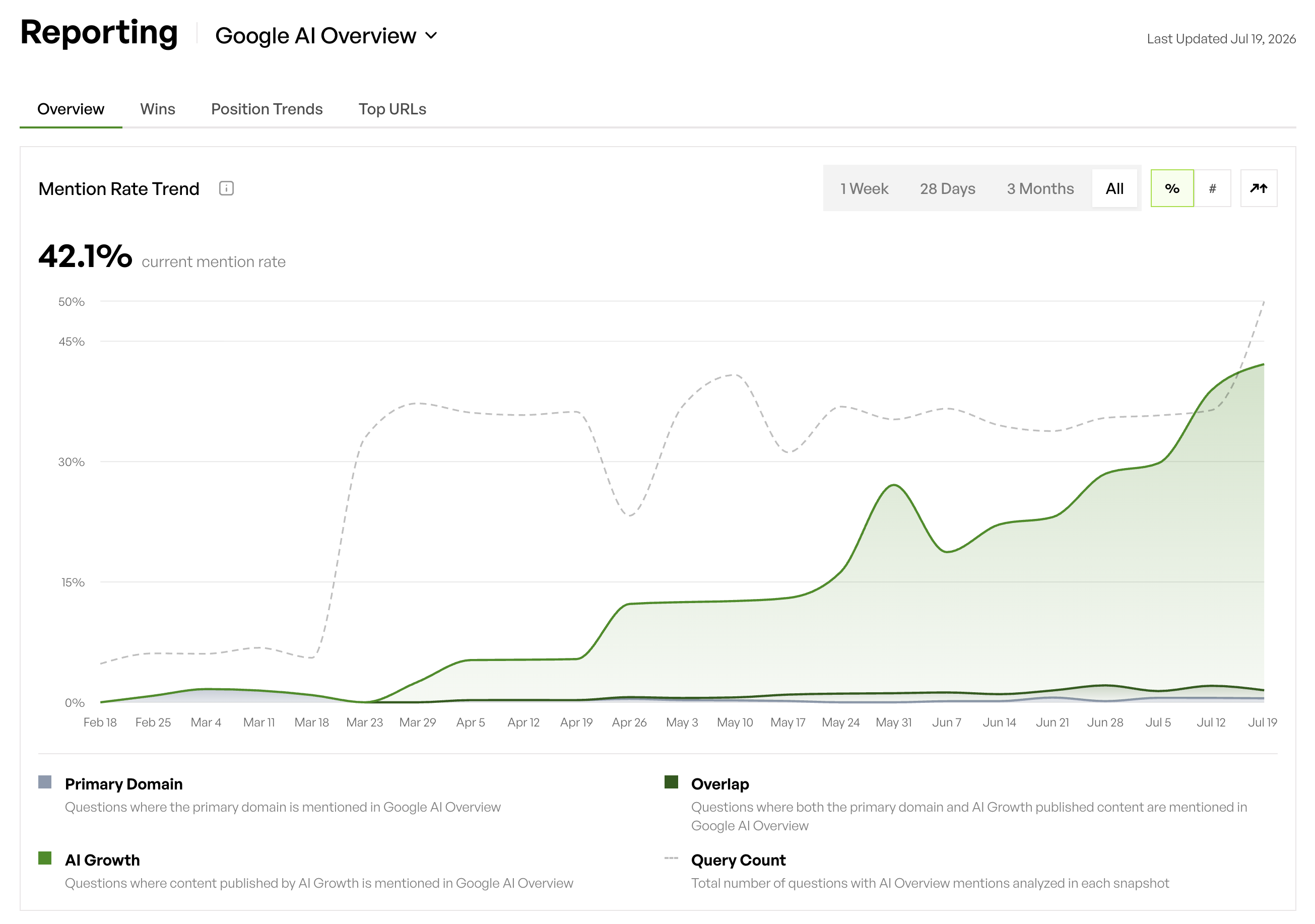
Content decay quietly erodes results over time. Most platforms produce content and ship it. Without a self-healing mechanism, articles go stale as the world changes, and stale content loses both rankings and AI citations over time. That is why AI Growth Agent’s living content model updates and self-heals automatically, so authority compounds instead of decaying. When evaluating any platform, ask directly how the vendor handles content freshness at scale.
Frequently Asked Questions
What is the best programmatic SEO tool?
No single tool fits every situation. The right choice depends on your data architecture, scale, and need for AI-search visibility. Database tools like SEOmatic and Whalesync suit teams with clean structured datasets who need accurate, deterministic page generation. AI content tools like Byword and AirOps suit teams with editorial capacity who need prose at volume. For mid-market to enterprise companies that need to win in AI search and be cited by ChatGPT, Perplexity, and Google AI Mode, a headless engine like AI Growth Agent is the most comprehensive option because it combines content generation, technical SEO, monitoring, and self-healing in one engine without requiring a team to operate it.
How do I choose a programmatic SEO platform?
Start with your architecture and then review the feature list. Map your data situation first: decide whether you have a clean structured database or need to generate prose from scratch. Then assess your team’s technical capacity and your tolerance for maintenance burden. If you have a clean database and need thousands of product pages, a database tool may suffice. If you need content that answers complex queries and must be cited by AI, consider an AI-native platform. If you want to control your narrative across AI surfaces without managing a stack of tools and agencies, a headless engine is the most comprehensive option. Evaluate every platform on total cost of ownership, not just the subscription price, because the tools you need to buy separately to fill gaps often exceed the platform cost itself.
Can programmatic SEO work for AI search?
Programmatic SEO can work for AI search when content is structured for large language model citation. As noted with SEOmatic, templated pages that simply swap city names or product codes rarely earn AI citations. AI engines look for self-contained passages worth quoting, corroborated by other sources, attached to a domain that reads like an authority rather than an inventory. Content needs unique data, validated sources, and technical SEO that makes it readable by AI crawlers, including proper schema, MCP endpoints, llms.txt files, and structured sitemaps. This architectural fit matters more than any single tool feature, because a database tool that produces accurate but thin pages will not earn citations regardless of how many pages it generates.

What is the difference between database and AI content programmatic SEO?
Database programmatic SEO renders pages from structured rows in a spreadsheet or database. The output is deterministic and accurate: the page displays exactly what the database contains, with no hallucination risk. The limitation is that pages can feel templated if the underlying data lacks sufficient unique fields to produce meaningfully different outputs. AI content programmatic SEO uses large language models to generate prose, which reads more naturally and can address nuanced queries. The quality drift risk discussed earlier grows at scale, particularly without human editorial review at every stage. The best approach for AI search combines both. Database accuracy handles structured facts, while AI-generated and human-reviewed narrative gives AI engines something worth citing. This hybrid is what a headless engine like AI Growth Agent is built to deliver.
Conclusion: Choosing an Architecture-First Stack for 2026
The platform comparison that matters in 2026 is architectural and not purely feature-based. Database tools solve structured data problems accurately and at scale. AI content tools solve volume problems for teams with editorial governance. For mid-market to enterprise companies that need to win the discovery shift and be cited by AI surfaces, neither architecture alone is sufficient.
The headless, AI-native approach is the most comprehensive option because it replaces the entire stack: the SEO tool, the content tool, the monitoring platform, the schema plugin, and the analytics layer, in one engine at a flat fee. Content is living, self-healing, and tuned for the AI crawlers that determine whether a brand appears in the conversation at all.
Traditional search tools show you where your brand stands. AI Growth Agent makes your brand the answer. See your first article live within a week.