Written by: Mariana Fonseca, Editorial Team, AI Growth Agent
Key Takeaways
- Autonomous SEO platforms run on a four-layer architecture (Sense, Plan, Execute, Validate) that automates perception, prioritization, execution, and learning with minimal human input.
- Traditional technical SEO still matters, yet agentic technical SEO features such as Blog MCP, llms.txt, and /.well-known/ discovery now decide whether AI-driven search engines cite or ignore a brand.
- Self-healing content mechanics watch ranking and bot-traffic decay, then refresh articles automatically to protect AI citation rates and long-term performance.
- Configurable human-in-the-loop controls let brands enforce voice, compliance, and high-risk technical changes while still running routine work on full autopilot.
- AI Growth Agent delivers this complete headless marketing engine; book a kickoff to see your first optimized article live within a week.
Four-Layer Architecture That Powers Autonomous SEO
Every production-grade autonomous SEO platform organizes its capabilities into four coordinated layers. As you move through these layers, autonomy increases from automated signal collection to fully automated feedback, with optional human oversight only where risk is highest.
| Layer | Primary Inputs | Primary Outputs | Autonomy Level |
|---|---|---|---|
| 1. Sense (Data Perception) | Search Console signals, crawl data, bot-traffic logs, AI citation feeds, real-time SERP and ChatGPT results | Normalized signal graph, anomaly flags, universe snapshot | Full |
| 2. Plan (Policy and Prioritization) | Signal graph, brand manifesto, seed terms, competitive gaps, risk guardrails | Prioritized task graph, content topology, keyword universe map | Partial (human sets goals, agents sequence tasks) |
| 3. Execute (Action) | Task graph, brand memories, primary sources, agentic technical SEO stack | Published articles, schema blocks, redirect maps, llms.txt, MCP endpoints, /.well-known/ discovery files | Full (publishing) or Human-in-the-Loop (optional approval gate) |
| 4. Validate and Learn (Feedback) | Bot-traffic telemetry, Search Console performance, citation rate, impression delta | Incremental visibility reports, self-healing refresh triggers, updated policy memories | Full |
This architecture mirrors the sense-plan-act-feedback loop described in agentic SEO systems, where each layer feeds the next and the feedback layer triggers policy updates when outcomes drift from expected results. AI Growth Agent implements this complete loop in production, and you can book a kickoff to see the four-layer architecture running live on your content within a week.
Core Feature Set Behind Autonomous SEO Platforms
Autonomous SEO platforms group features into two sets that work together. Traditional technical SEO covers long-standing requirements, while agentic technical SEO controls how AI crawlers read, understand, and cite your content in 2026.

| Feature Category | Feature | Technical Mechanism | Measurable Outcome |
|---|---|---|---|
| Traditional Technical SEO | Rich schema markup | Article, FAQPage, Organization, Product, Author JSON-LD auto-generated on every publish or update | Rich results eligibility, structured data parsed during normal HTML fetches by AI crawlers |
| Traditional Technical SEO | Metadata automation | Open Graph titles, descriptions, image alt text, and video metadata populated at publish time | Impressions lift, click-through rate improvement |
| Traditional Technical SEO | Internal linking at scale | Contextually relevant links inserted at publish time to maintain topical cluster integrity | Crawl equity distribution, authority compounding across the universe |
| Traditional Technical SEO | Sitemap and robots.txt management | XML sitemaps and robots.txt hashed daily, directive changes flagged before deployment | Crawl coverage, prevention of accidental deindexing |
| Traditional Technical SEO | Automated web stories | Every article generates a custom web story served through a dedicated web-stories sitemap | Free internal links, additional indexable surface area |
| Agentic Technical SEO | Blog MCP | Schema, manifest, discovery, and capability guidance exposed to agents, compatible with Chrome 146+ and WebMCP-enabled browsers | Direct agent interoperability, bot visits from AI surfaces that read and cite content |
| Agentic Technical SEO | llms.txt and llms-full.txt | Markdown file served at site root providing a curated map of highest-utility pages for LLM agents; W3C working draft published June 2026 formalizing the standard | Reduced token waste for AI crawlers; The Princeton GEO-bench research examined content tactics such as statistics and citations but did not test llms.txt; multiple independent studies found no measurable AI-citation benefit from llms.txt files |
| Agentic Technical SEO | /.well-known/ discovery | OpenAI discovery and Agent Card guidance served via /.well-known/ endpoints | Agent discoverability, citation surface expansion across AI platforms |
| Agentic Technical SEO | Natural-language query parameters | /?s={query} auto-triggers personalized, internally linked responses for agents passing queries directly into the URL | Tailored agent responses, incremental bot visits from agentic surfaces |
| Agentic Technical SEO | Markdown served to agent crawlers | Pages rendered in Markdown for agent crawlers alongside standard HTML | Faster, cheaper ingestion by AI surfaces, higher citation frequency |
Technical Fixes That Close the Detection–Execution Gap
Autonomous platforms stand apart from traditional SEO tools by closing the gap between detection and remediation. Flagging a broken canonical tag in a dashboard constitutes monitoring only, whereas rewriting the tag and deploying it live to the site constitutes execution. Production-grade autonomous platforms execute a defined class of fixes automatically and route higher-risk changes through configurable approval gates.
| Fix Category | Technical Mechanism | Autonomy Level | Measurable Outcome |
|---|---|---|---|
| Traditional: Broken link remediation | Daily scheduled crawls detect broken internal links, autoredirects deployed via CMS API without ticket queue | Full | Crawl efficiency, prevention of link equity loss |
| Traditional: 404 tracking and redirect management | 404s detected in real time, redirect maps generated and deployed autonomously | Full | Preserved crawl budget, no broken user or bot journeys |
| Traditional: Metadata gaps at scale | Missing titles, descriptions, and alt text identified and populated across hundreds of pages via CMS API | Full | Impressions recovery, bot-visit quality improvement |
| Traditional: robots.txt and canonical changes | Directive changes hashed daily; any change to robots.txt, canonical tags, redirect maps, or noindex directives requires human approval to avoid deindexing entire site sections | Human-in-the-Loop | Risk mitigation, audit trail for compliance |
| Agentic: Bot-traffic-triggered content refresh | Search Console signals and bot-traffic anomalies trigger self-healing refresh of stale articles without human intervention | Full | Living content, sustained AI citation rate |
| Agentic: Instant indexing | New articles submitted for indexing immediately on publish via indexing API | Full | Content indexed in as little as ten days |
| Agentic: MCP endpoint maintenance | Blog MCP schema, manifest, and capability guidance kept current on every site update | Full | Continuous agent discoverability, bot-visit volume |
The schema regeneration described earlier prevents drift that causes loss of AI citations and supports these technical fixes.
AI Citation Tracking as the New Ranking Layer
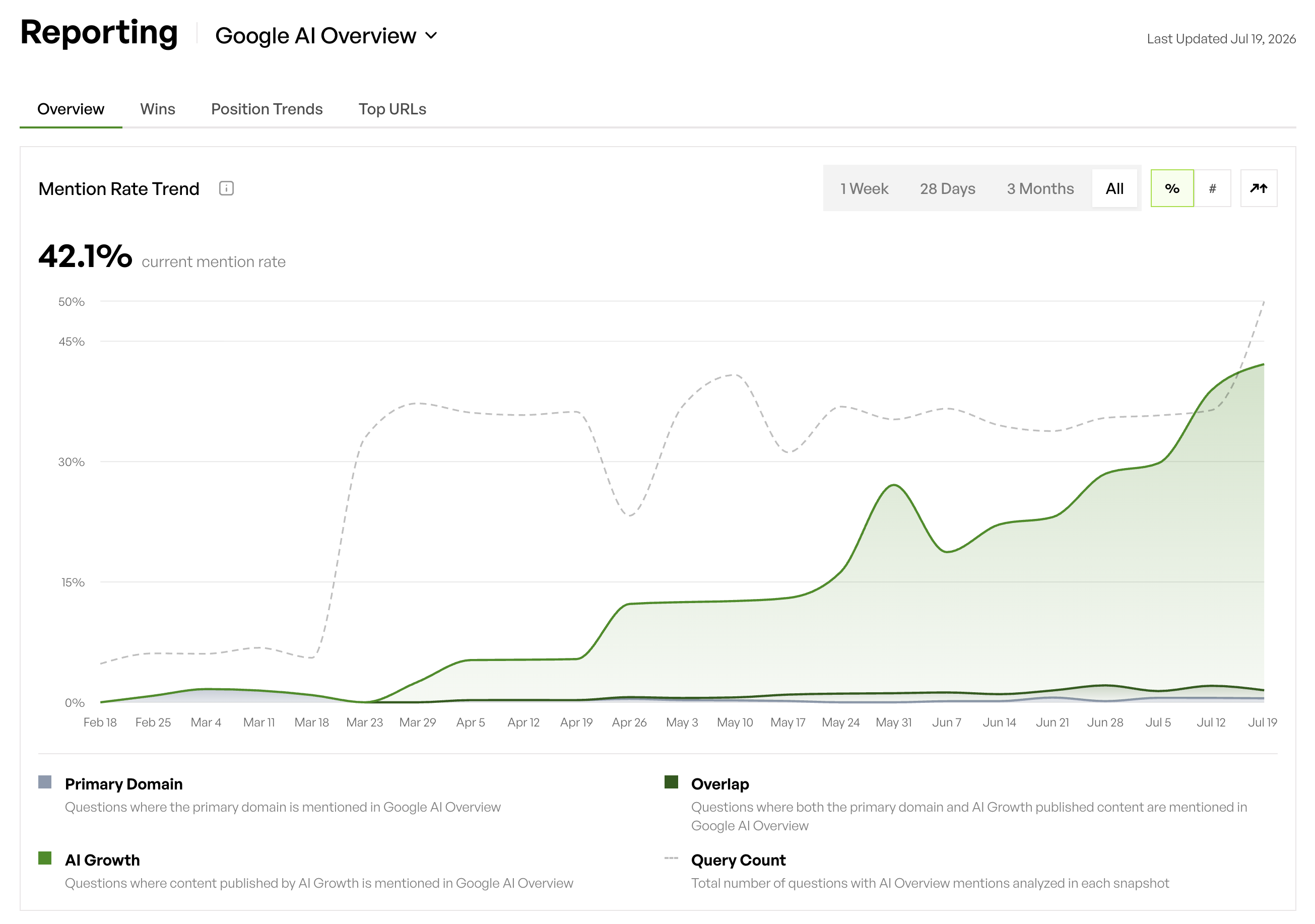
AI citation tracking replaces the traditional rank-position leaderboard as the primary visibility signal. Only 14% of marketers track AI visibility, which creates a wide gap for brands that measure this layer correctly. Citation rate, order of mention, and citation context now act as ranking signals, and autonomous platforms track all three across ChatGPT, Perplexity, and Google AI Mode at the same time.
| Tracking Feature | Technical Mechanism | Measurable Outcome |
|---|---|---|
| Per-article bot tracking | Every bot interaction logged at the article level, including GPTBot, ClaudeBot, PerplexityBot, and Google-Extended, then cross-referenced with Search Console | Visibility into which articles are being read, cited, and trained on by AI surfaces |
| Citation rate measurement | Prompt log recording cited yes/no per URL per run across priority prompts on multiple AI engines | Share of priority prompts where the brand appears as a linked source |
| AI Ranking (order of mention) | Position within AI answer tracked week over week, with citation context recorded alongside position | Narrative control signal, competitive positioning in AI answers |
| Incremental visibility isolation | AI Growth Agent publishes into a separate environment, then reports isolate visibility generated by new content from pre-existing brand visibility | Defensible proof of contribution, week-over-week incremental impression and citation delta |
| Cross-platform citation correlation | Only 11% of domains are cited by both ChatGPT and Perplexity; tracking across platforms identifies which content earns cross-platform authority | Universe coverage, identification of high-leverage content for refresh prioritization |
Self-Healing Mechanics That Keep Content Alive
Content decay quietly erodes performance on content-heavy sites. The majority of once-well-ranking pages lose significant traffic within 12 to 24 months without active refresh, and manual teams cannot scale remediation across hundreds of articles at once. Autonomous platforms address this with living content, a continuous loop that detects decay and executes refresh workflows without human intervention.
AI Growth Agent’s self-healing mechanics operate across two signal sources that together provide early warning of content decay. The first is Google Search Console, which surfaces ranking proximity shifts, impression drops, and click-through rate decay at the URL level as lagging indicators that confirm traffic loss. The second is bot-traffic telemetry, which reveals when AI crawlers reduce visit frequency to a given article and signals citation relevance loss before traditional rank metrics move.
When either signal crosses a decay threshold, the platform triggers a targeted refresh workflow. The article is re-researched against current primary sources, updated statistics and examples are validated against evidence found online, and the refreshed version is republished with updated schema and internal links. When the year turns, every article in a sector receives an automatic new-year refresh. This approach produces incremental visibility that compounds over time instead of decaying from the day content ships.
This architecture directly addresses the finding that autonomous SEO engines evaluate every URL continuously across ranking proximity, traffic delta, and topical authority concentration to automatically allocate re-optimization effort to high-leverage pages rather than spreading refresh effort evenly across the entire content library.
Human-in-the-Loop Controls for Brand and Compliance
Full autonomy and brand compliance align when the platform exposes configurable approval gates at specific points in the pipeline. Mature AI SEO agent platforms expose the generated plan for human review before execution begins, while allowing the execution and validation stages to complete autonomously, and production-grade systems require a human approval gate only for publishing changes rather than for the underlying work.
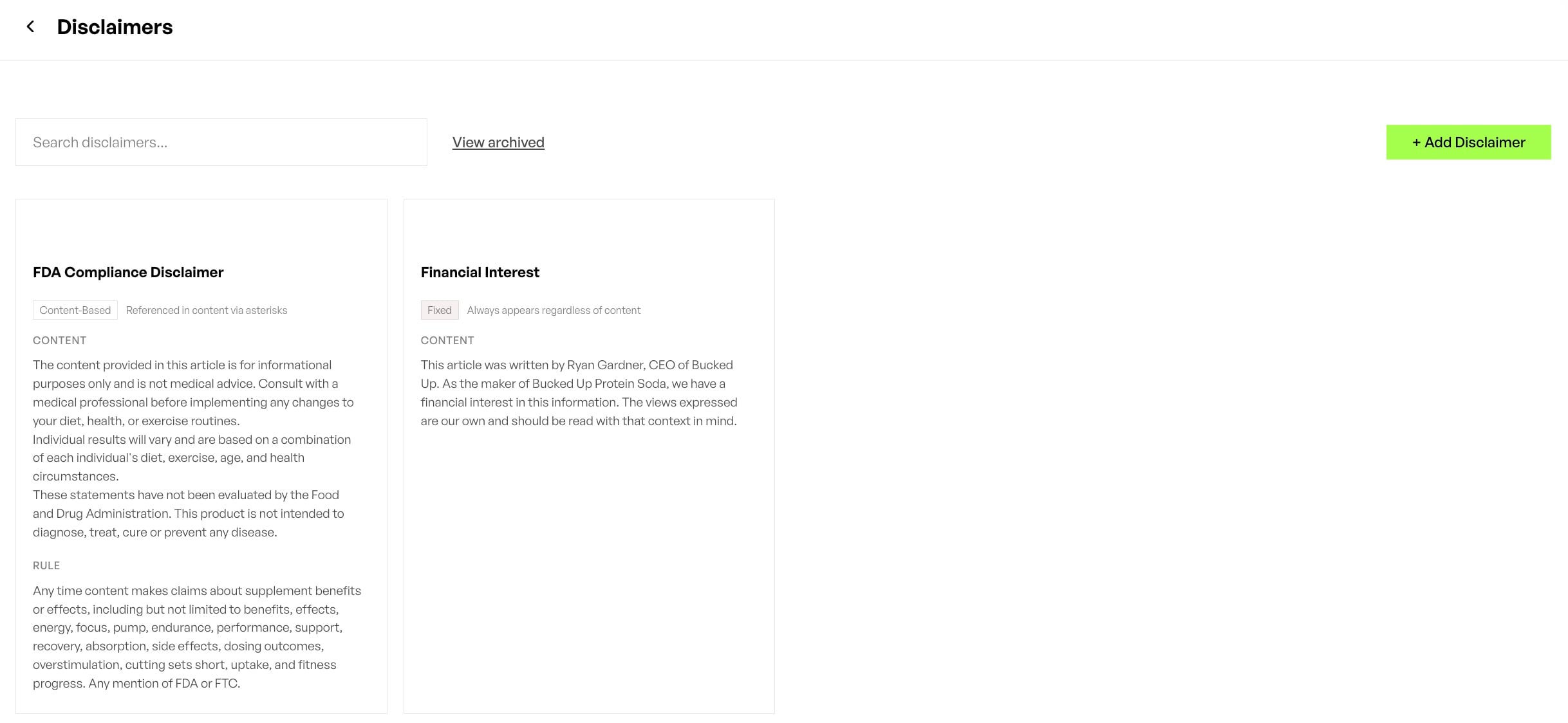
AI Growth Agent implements human-in-the-loop controls through the following coordinated mechanisms that together form a coherent control system:
- Brand manifesto and memory system: Style memories carry voice rules, factual ground truths, deny lists, and preferred terminology. Every future generation applies these rules without re-briefing, so brand voice is enforced at the model level rather than through post-publication editing.
- Optional article review gate: Clients who require deeper review use a studio interface to read each article, provide feedback in plain language, and steer the output before publish. The engine edits in place and saves a memory so the same correction is never needed twice.
- Legal and compliance controls: Fixed and dynamic legal disclaimers with Chicago-style superscripts, claim prioritization for sensitive sectors, and anti-hallucination steering that focuses validation effort on the claim types the client identifies as highest risk.
- High-risk technical change routing: High-risk technical changes like those described in the Technical Fixes section are routed through human approval rather than executed autonomously, consistent with established guardrails for autonomous production changes in technical SEO.
- Autopilot or review mode: Most clients run the engine on full autopilot, while profiles with compliance requirements configure the review gate without changing any other part of the pipeline.
Conclusion: Headless Marketing as the Competitive Edge
The four-layer architecture of autonomous SEO platforms, spanning data perception, planning, execution, and continuous learning, defines the infrastructure gap between brands that appear in AI answers and brands that do not. Traditional technical SEO remains table stakes, yet the agentic technical SEO layer, including Blog MCP, llms.txt, /.well-known/ discovery, and natural-language query parameters, now determines narrative control in 2026.
Headless marketing closes this gap with a single engine that maps the full universe, executes end-to-end from real-time data through agentic technical SEO and self-healing content, and delivers measurable AI citation and bot-visibility outcomes with configurable human oversight. The brands cited in AI search this year are training the next generation of models with their own narrative, while brands that wait are training it with whatever happens to be sitting on the open web. If you want to control your brand’s narrative in AI search rather than leaving it to chance, book a kickoff with AI Growth Agent and see your first optimized article live within a week.
Frequently Asked Questions
What makes an SEO platform truly autonomous versus AI-assisted?
A truly autonomous SEO platform acts without waiting for a human prompt at each step. It perceives signals from Search Console, bot-traffic logs, and AI citation feeds continuously, converts those signals into a prioritized task graph, executes content production and technical fixes through CMS and schema APIs, and validates outcomes against quality gates without requiring a human to initiate each stage. AI-assisted tools surface recommendations or generate drafts but leave detection, prioritization, execution, and validation to the human operator. In practice, an autonomous platform can refresh a decaying article, update schema, and re-submit for indexing overnight while the marketing team focuses elsewhere, while an AI-assisted tool requires someone to notice the decay, open the tool, act on the recommendation, and publish the fix manually.
How does agentic technical SEO differ from traditional technical SEO?
Traditional technical SEO addresses the signals that Google’s classic crawler reads, such as structured HTML, metadata, schema markup, sitemaps, robots.txt, internal linking, and Core Web Vitals. These remain necessary in 2026 and AI Growth Agent ships the full traditional stack automatically. Agentic technical SEO addresses a different reader, which includes the AI agent that acts on behalf of a user, the training crawler building the next model, and the citation engine deciding which source to surface in an answer. Agentic technical SEO includes Blog MCP, which exposes schema, manifest, discovery, and capability guidance to agents; llms.txt and llms-full.txt, which provide a curated Markdown map of the site’s highest-utility pages; /.well-known/ endpoints for OpenAI discovery and Agent Card guidance; natural-language query parameters that return personalized, internally linked responses when an agent passes a query directly into the URL; and Markdown served to agent crawlers alongside standard HTML. None of these signals existed as production infrastructure before 2025, and most platforms still treat them as optional add-ons rather than default stack components.
What metrics should enterprise teams use to measure autonomous SEO platform performance?
Four metric categories map directly to the four-layer architecture. At the perception layer, bot-visit volume by bot type (GPTBot, ClaudeBot, PerplexityBot, Google-Extended) reveals which AI surfaces are reading the content and how frequently. At the execution layer, indexing speed and schema validity rates confirm that the technical stack functions correctly. At the validation layer, citation rate measures the share of priority prompts where the brand appears as a linked source in AI-generated answers, and order of mention tracks where the brand appears within the answer and how that position evolves week over week. At the business layer, incremental visibility isolates the impressions, clicks, and organic leads generated by the autonomous platform separately from pre-existing brand visibility, providing a defensible proof of contribution for the CMO or CEO. AI Growth Agent commits to brand mention rate, citation rate, Google Search Console impressions, and bot traffic as its primary reporting metrics, cross-referenced weekly so the data drives refresh prioritization rather than sitting in a disconnected dashboard.
How do autonomous SEO platforms preserve brand voice and compliance at scale?
Brand voice and compliance are enforced at the model level through memory systems rather than through post-publication editing. The process begins with a manifesto built from a journalist-led interview that captures brand voice, factual references, deny lists, and sector-specific compliance requirements. On top of the manifesto, clients configure style memories such as preferred terminology, words to avoid, and house conventions, factual memories such as ground-truth claims and primary-source URLs, and legal controls such as fixed and dynamic disclaimers and claim prioritization for regulated sectors. Every future generation applies these memories without re-briefing. When a client provides feedback on a published article, the engine edits in place and saves a memory so the same correction is never needed twice. For clients with deeper compliance requirements, a configurable approval gate routes articles through human review before publish without changing any other part of the autonomous pipeline, which keeps brand voice compounding instead of drifting from one article to the next.
Can an autonomous SEO platform replace an entire agency stack?
Headless marketing provides the architecture that makes this replacement realistic. The traditional agency stack for organic content requires an SEO agency, a content tool, a web agency, a GEO monitor, a schema plugin, an analytics stack, and a PR firm, each with its own contract, briefing cycle, and integration dependency. An autonomous SEO platform replaces that stack with one engine that maps the full universe of seed terms and long-tail queries, produces authoritative content validated against primary sources, stands up a fully optimized site the brand owns, ships the complete traditional and agentic technical SEO stack automatically, tracks AI citations and bot visits, and self-heals content over time. The client owns the site and the content outright, with no agency controlling access. The only integration step is the reverse proxy rewrite that connects the blog to a subdirectory under the brand’s domain. Strategic direction remains with the brand, including which markets to win, which compliance rules apply, and which content angles align with positioning, while the engine executes those decisions at a scale and speed no agency stack can match.