Written by: Mariana Fonseca, Editorial Team, AI Growth Agent
What Enterprise Leaders Gain From This 90-Day AI Visibility Model
- An AI search visibility strategy maps every buyer prompt, resolves entity data, builds citable content, and measures pipeline impact across AI platforms.
- 94% of B2B buyers now use AI in purchasing, so absence from AI answers becomes a direct pipeline loss for enterprises.
- Only 14% of marketers track AI citations, which leaves most companies blind to the majority of their market conversations.
- AI-referred traffic converts at 14.2% versus 2.8% for Google organic, turning citations into a measurable revenue variable.
- AI Growth Agent delivers the complete 90-day operating model that maps prompts, resolves entities, and earns citations. See the complete operating model in action.
Map Buyer Prompts To Reveal Your Real AI Search Universe
AI search visibility starts with a complete picture of the prompts buyers actually use, not the head terms a brand pre-decided to defend. The buyer prompt universe spans seed terms, standard long-tail queries, and evidence-based long-tail queries at scale. These are the hundreds of natural-language variations an AI agent reasons over when a buyer asks a category question. Most enterprises track a handful of head terms and lose the rest of the conversation by default.
The four pillars that feed this map are Search Intelligence, AI Analytics, Bot Tracking, and AI Ranking. Search Intelligence covers the full traditional search landscape. AI Analytics tracks brand behavior across the buyer journey. Bot Tracking captures every crawl and citation sweep by AI training agents. AI Ranking measures order of mention and citation context inside AI answers. Goodfirms’ 2026 SEO Statistics study found that only 14% of marketers track AI search citations, so the prompt universe most enterprises operate from represents only a fraction of their actual market.
A mature AI Growth Agent client reaches a universe of 1,600-plus queries, with more than 3,000 searches run weekly to keep the snapshot current. Mapping the buyer prompt universe reveals which questions your brand should answer. AI systems still will not cite you consistently if they cannot trust your entity data.
Fix Enterprise Knowledge-Graph Coherence So AI Can Trust Your Brand
AI systems cite what they can trust, and trust begins with a coherent entity. When a corporate site, investor relations pages, regional domains, and partner directories describe the same company in contradictory terms, AI models learn conflicting patterns and produce inconsistent outputs. Poor data quality costs U.S. businesses an estimated $3.1 trillion per year, with individual enterprises losing $12 to $15 million annually according to Gartner.
The resolution challenge is organizational as much as technical. Enterprise data systems in 2026 accumulate overlapping records across operational platforms, legacy systems, CRM, ERP, finance, procurement, compliance databases, and vendor feeds, which produces duplication, semantic drift, conflicting identifiers, and unstable hierarchies. IBM’s Edward Calvesbert states that the core issue preventing generative AI projects from reaching production is enterprises focusing on the application layer rather than fixing the essential data foundation underneath, with unstructured data as the biggest hurdle.
Resolving knowledge-graph coherence requires three sequential actions.
- First, audit every domain where the brand appears and identify contradictory name variants, founding dates, product descriptions, and leadership claims. This diagnostic step reveals the scope of inconsistency across your entity footprint.
- Second, establish a single authoritative source of truth, typically the brand’s primary domain with full Organization schema, and propagate it to Wikidata, Wikipedia, and partner directories. This correction step aligns external sources to your canonical data.
- Third, implement a governance cadence that catches drift before the next AI training sweep absorbs it. This maintenance step prevents the problem from recurring as new content and partnerships are added.
Discover how AI Growth Agent resolves entity coherence for enterprise clients.
Build Citable Commercial Pages That AI Overviews Prefer
AI systems prioritize pages that answer a question directly, carry structured schema, and demonstrate freshness. A page that looks polished to a human visitor but lacks structured data, direct-answer paragraphs, and recent update signals remains invisible to the systems doing the citing. Lower-ranked websites saw up to a 115% AI-visibility increase from citation optimization and other GEO tactics, while adding citations boosted visibility by up to 40%, which makes structural decisions a high-impact revenue lever.
The structural requirements for citation-eligible commercial pages are clear.
- A direct-answer paragraph in the first 100 words that states the claim the page supports.
- Full schema markup covering Article, Organization, Product, FAQ, and Author entities.
- Primary-source citations for every data point, validated against evidence found online rather than a model’s training data.
- A refresh cadence tied to bot-traffic signals, because 65% of AI bot hits target content published within the past year.
- Agent-readable formats including llms.txt, llms-full.txt, and Markdown served to crawler agents.
Seer Interactive’s longitudinal study tracking 2.43 billion impressions across 53 brands and 5.47 million queries found that cited brands earn 120% more organic clicks per impression than uncited brands on the same AI Overview query. Structure becomes a direct driver of revenue, not a technical afterthought.

Win The Third-Party Evidence Layer That AI Relies On
AI systems weight third-party corroboration heavily when deciding which brand to cite. A brand that appears only on its own domain receives lower confidence than one corroborated by industry publications, academic studies, and authoritative directories. Opollo’s analysis of 312 B2B technology firms found that AI-referred traffic converts at a mean rate of 14.2% compared to 2.8% for Google organic traffic, which establishes AI citation as a direct pipeline variable rather than a vanity metric.
The pipeline gap is significant and persists at scale. The 5× gap held even among firms getting 100-plus AI-referred sessions a month. During the 2025 holiday season, AI referrals to US retail sites converted 31% better than non-AI traffic and produced 254% higher revenue per visit year over year, according to Adobe Digital Insights analysis of over 1 trillion site visits.
Building the third-party evidence layer requires a focused plan.
- Earning placements in industry publications that AI systems cite frequently in the brand’s category.
- Generating original research that other publications reference, which creates a citation chain the AI can follow.
- Maintaining Wikidata and Wikipedia consistency so entity recognition passes at Layer 1 of any prompt audit.
- Distributing content across multiple publications, because distributing the same content across multiple publications can lift AI citations by up to 325% versus single-site publication.
Run Prompt Auditing And Close AI Visibility Gaps
Prompt auditing systematically tests which buyer questions return the brand as an answer and which return a competitor or nothing. Without a structured audit, enterprises optimize for the prompts they already thought to ask and remain blind to most of their market. Consecutive citation-source sets in AI answers show a mean Jaccard overlap of 0.396, so quarterly audits represent a minimum operational requirement.
The recommended enterprise prompt-auditing framework follows four sequential steps.
- Set up prompts. Use a 15-prompt universal starter set across three diagnostic layers: Entity Recognition, Visibility, and Recommendation, executed 3 to 5 times across at least two LLMs to account for variance.
- Run and track responses. Cover five core prompt types: informational, comparative, instructional, brand-specific, and transactional, run across ChatGPT, Perplexity, and Google AI Overviews.
- Analyze and diagnose gaps. In an April 2026 audit of 40 SaaS brands, only 30% cleanly passed all Layer 1 entity recognition sub-tests, with the Knowledge Graph entity identified as the binding constraint that does not improve with model upgrades.
- Fix and repeat. Sequence fixes by layer. Address Knowledge Graph and schema first, visibility gaps second, and recommendation fixes last due to 60 to 90-day lags from PR and third-party evidence.
AI Growth Agent maps buyer prompt universes starting at 300 to 400 queries for new accounts and expands as the brand wins more of its universe. Real-time AI Overview and ChatGPT results serve as the objective function for which long-tail queries deserve pursuit.
Assign Cross-Functional Ownership Without Adding Headcount
AI search visibility requires ownership beyond the SEO team. The signals determining whether AI systems recommend one brand over another often originate from Brand, Product, PR, editorial, customer experience, community discussions, creator content, reviews, and third-party recommendations outside the SEO department. The operating model that works assigns explicit ownership while keeping headcount flat.
The five-seat ownership model distributes accountability across existing roles.
- SEO or GEO lead: runs prompt tracking, citation analysis, source diagnosis, and weekly reporting.
- Product marketing: owns positioning accuracy and claim validation.
- Content: ships source updates and maintains refresh cadence.
- PR or communications: owns reputation corrections and third-party outreach.
- Legal or leadership: handles high-risk approvals for regulated or material claims.
Organizations whose SEO, content, brand, and digital teams share a monitoring cadence can move from a visibility gap to coordinated content action in weeks rather than quarters, while unaligned teams take three to five times longer due to repeated cross-functional negotiation. The headless marketing engine replaces coordination overhead by running the detection, production, publishing, and reporting loop autonomously. The five-seat model then focuses on governance decisions rather than operational execution.
Explore how the five-seat model works without new headcount.
The 90-Day Enterprise Plan And Eight Core KPIs
The 90-day operating model runs in three phases, each with defined deliverables, owners, and KPIs tied directly to pipeline. The headless marketing engine handles production and technical work in every phase. The cross-functional team focuses on governance and prioritization.
| Phase | Days | Core Actions | Owner |
|---|---|---|---|
| Audit and Foundation | 1–30 | Kickoff interview and manifesto, buyer prompt universe map (300–400 queries), entity coherence audit across all domains, schema and llms.txt deployment, baseline prompt audit across ChatGPT, Perplexity, and Google AI Overviews | AI Growth Agent engine plus SEO lead |
| Content and Evidence Build | 31–60 | First citable commercial pages live, third-party evidence outreach, answer capsules and FAQ schema on priority pages, bot tracking active, AI citation rate baseline established | AI Growth Agent engine plus content and PR leads |
| Optimization and Scale | 61–90 | Prompt audit re-run, gap pages produced, internal linking compounding authority, incremental visibility report isolating AI Growth Agent contribution, KPI dashboard reviewed with leadership | AI Growth Agent engine plus CMO and analytics lead |
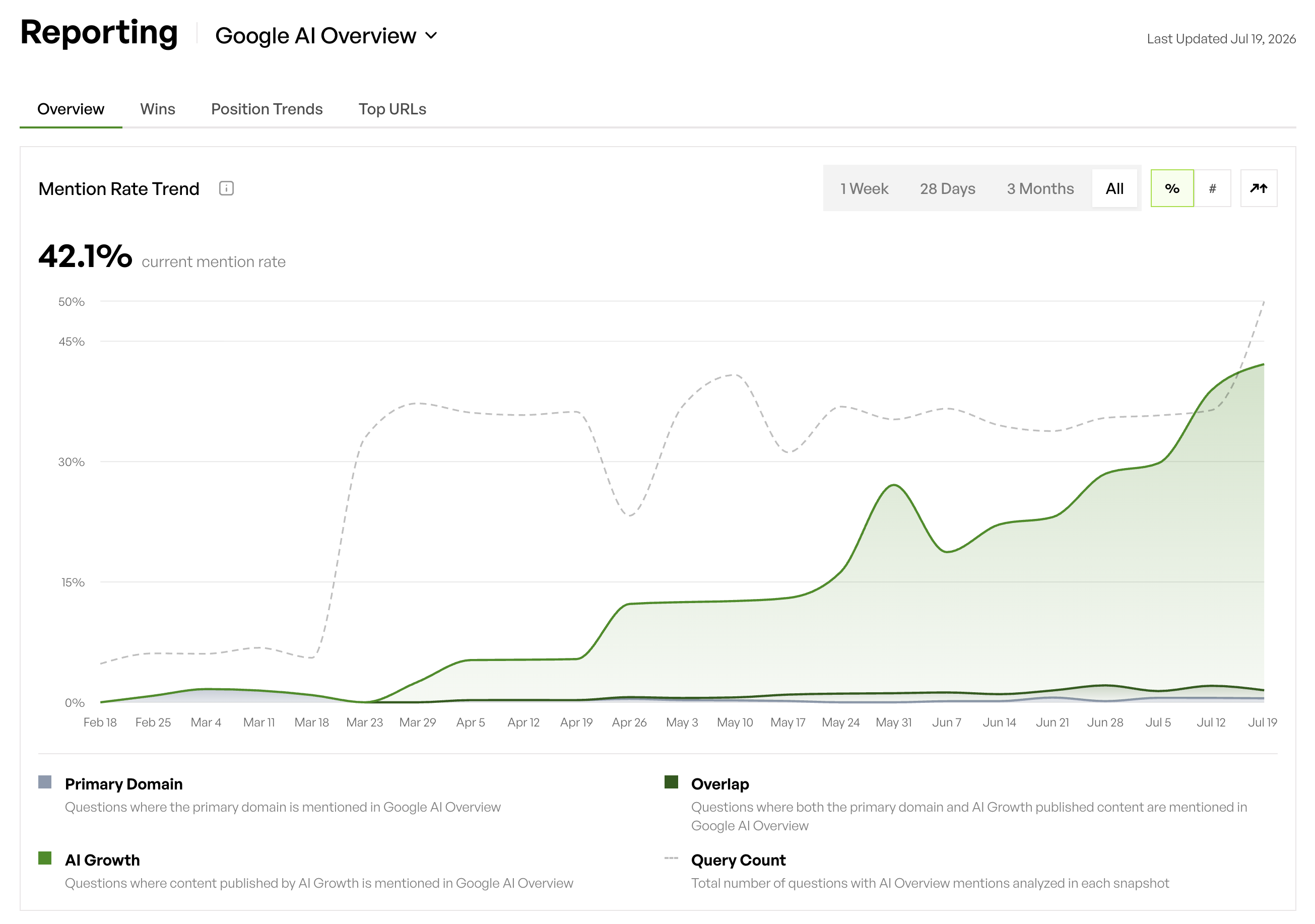
The eight core KPIs that govern the operating model are drawn from the four pillars of Search Intelligence, AI Analytics, Bot Tracking, and AI Ranking.
| KPI | Definition | Target Benchmark | Reporting Cadence |
|---|---|---|---|
| AI Citation Rate | Percentage of tracked prompts where the brand is named or linked in an AI answer | 25–40% = category contender, 40%+ = category leader | Weekly |
| AI Share of Voice | Brand citation frequency versus nearest competitor across tracked prompts | Positive competitive citation gap | Biweekly |
| AI Referral Traffic | Sessions originating from chatgpt.com, perplexity.ai, and AI Mode referrers | AI search visits grew 42.8% year over year from Q1 2025 to Q1 2026 | Weekly |
| AI Referral Conversion Rate | Percentage of AI-referred sessions converting to demo requests or qualified inquiries | Target the 5× conversion advantage documented in the evidence layer above | Monthly |
| Entity Accuracy Score | Correctness of category placement, positioning, and factual data across five AI engines | Score of 10 or above out of 15, below 10 indicates inconsistent entity data | Monthly |
| Bot Visit Volume | Total AI training and citation bot visits to owned content | AI Growth Agent clients average 100,000-plus bot visits in the first 12 weeks | Weekly |
| Google Search Console Impressions (Incremental) | Impressions attributable to AI Growth Agent content, isolated from pre-existing brand visibility | 20-plus percent lift in first 12 weeks (AI Growth Agent client average) | Weekly |
| Revenue at Risk (Pipeline Exposure) | Monthly category AI query volume multiplied by estimated conversion rate multiplied by average deal size multiplied by (1 minus AI Share of Voice) | Declining quarter over quarter as citation share grows | Quarterly |
One headless marketing engine replaces the SEO agency, content tool, web agency, GEO monitor, schema plugin, analytics stack, and PR firm at a flat fee with no per-article charges, credit limits, or per-prompt billing. The engine provisions valid schema, Blog MCP, agent discovery via /.well-known/, llms.txt and llms-full.txt, instant indexing, autoredirects, and bot tracking automatically. The client owns the site and all content produced. Across the first 12 weeks, AI Growth Agent clients average more than 12,000 additional AI citations and mentions and a 20-plus percent lift in impressions, with content indexing in as little as 10 days.
Conclusion: Turn AI Citations Into A Predictable Pipeline Channel
Traditional search tools show you where your brand stands. AI Growth Agent makes your brand the answer. The 90-day operating model above shifts you from monitoring a problem to solving it. Your team gains a buyer prompt universe mapped at scale, entity data resolved across every domain, citable commercial pages built for AI systems, a third-party evidence layer that earns citations, prompt audits that close gaps quarterly, and cross-functional ownership that runs without adding headcount. Every step ties to the eight KPIs that connect AI citations directly to pipeline.
Start your 90-day visibility transformation.
Frequently Asked Questions
What is a buyer prompt universe and why does it matter for enterprise AI search visibility?
A buyer prompt universe is the complete set of natural-language questions and queries that buyers in a given market use when asking AI systems like ChatGPT, Perplexity, or Google’s AI Mode about a category, problem, or vendor. It spans seed terms, standard long-tail queries, and evidence-based long-tail queries at scale, the hundreds of variations an AI agent reasons over when a buyer asks a category question. Most enterprises track a small number of head terms and remain blind to the majority of their market. A complete buyer prompt universe map forms the foundation of any enterprise AI search visibility strategy because AI systems return different vendor recommendations depending on how questions are framed. A brand that wins on head terms but loses on long-tail queries stays absent from most of the conversations that drive pipeline.
How does knowledge-graph coherence affect whether an AI system cites a brand?
AI systems build their understanding of a brand from every source they can read: the corporate website, investor relations pages, regional domains, partner directories, Wikidata, Wikipedia, and third-party publications. When those sources describe the same company in contradictory terms, such as different founding years, inconsistent product descriptions, or conflicting leadership names, AI models learn contradictory patterns and produce inconsistent outputs. The result is that the brand either fails entity recognition entirely or appears with inaccurate information that undermines buyer trust. Resolving knowledge-graph coherence means auditing every domain where the brand appears, establishing a single authoritative source of truth with full Organization schema, propagating that truth to external directories, and maintaining a governance cadence that catches drift before the next AI training sweep absorbs it. Entity accuracy functions as a prerequisite for citation, not an optional optimization layer.
What KPIs should enterprise CMOs use to tie AI search visibility directly to pipeline?
The eight KPIs that connect AI search visibility to pipeline are AI Citation Rate, AI Share of Voice, AI Referral Traffic, AI Referral Conversion Rate, Entity Accuracy Score, Bot Visit Volume, incremental Google Search Console Impressions, and Revenue at Risk. Among these, AI Referral Conversion Rate and Revenue at Risk provide the most direct pipeline signals. AI-referred traffic converts at a materially higher rate than Google organic traffic, so each citation earned translates to a measurable increase in qualified inquiries. Revenue at Risk converts citation shortfalls into a quantifiable pipeline exposure figure by multiplying monthly category AI query volume by estimated conversion rate by average deal size by the inverse of AI Share of Voice. Reporting these KPIs weekly and monthly, with Revenue at Risk reviewed quarterly, gives enterprise CMOs a defensible answer for the CEO and a clear signal of where to invest next in the operating model.
How does cross-functional ownership work for AI search visibility without adding headcount?
Cross-functional ownership for AI search visibility distributes accountability across five existing roles: the SEO or GEO lead runs prompt tracking and reporting, product marketing owns positioning accuracy, content ships source updates, PR or communications handles third-party outreach and reputation corrections, and legal or leadership approves high-risk claims. The key governance rule states that the SEO lead owns detection and diagnosis while the business owner of the claim owns the correction. This model works without new headcount because the headless marketing engine handles operational execution. Detection, content production, publishing, schema, bot tracking, and incremental visibility reporting all run autonomously. The five-seat team makes governance decisions rather than operational ones, which creates a far lighter workload than running the program manually.
Why does headless marketing replace the agency stack rather than complement it?
The agency stack, typically an SEO agency, a content agency, a web agency, a GEO monitor, a schema plugin, an analytics stack, and a PR firm, was designed for a world where content was produced slowly, published to a static site, and measured by blue-link rankings. That architecture moves too slowly for AI search, where the leaderboard updates in real time, training sweeps absorb whatever sits on the open web, and brands that wait train the next generation of models with whatever happens to be there. Headless marketing replaces the stack with one engine because the stack’s fundamental problem is coordination overhead. Each agency requires briefing, onboarding, and review cycles that add months before anything goes live. The headless engine moves from kickoff to first published article in about one week, with content indexing in as little as 10 days. The client owns the site, the content, and the relationship with AI surfaces, with no agency dependency and no year-long ramp.