Written by: Mariana Fonseca, Editorial Team, AI Growth Agent
Key Takeaways for Device Manufacturers
- AI search surfaces such as ChatGPT, Perplexity, and Google AI Mode now influence which medical devices HCPs and procurement teams discover first, so structured entity data and device-class schema have become essential for visibility.
- Medical device brands need four pillars working together – Search Intelligence, AI Analytics, Bot Tracking, and AI Ranking – to ensure AI systems trust, cite, and correctly describe their devices.
- Generic SEO advice ignores device-class requirements; Class II and III devices require specific JSON-LD schema, IFU formatting, and regulatory workflows that standard agencies rarely implement.
- AI Growth Agent’s headless engine delivers compliant, self-healing content with regulatory review gates, enabling first articles to publish in about one week and index in as little as ten days.
- Brands that control their clinical narrative through AI-ready, compliant content are training next-generation models with their own data – request a device-universe mapping session with AI Growth Agent to secure that advantage.
The Four Pillars of AI Visibility for Regulated Device Content
Four kinds of intelligence now shape what an AI surface says about a medical device brand, and each one maps to a concrete operational requirement in a regulated environment.
Search Intelligence provides a complete portrait of the traditional search landscape: which device categories, clinical indications, and regulatory terms generate queries, who wins each result, and where white space exists. For a Class II or Class III device manufacturer, this means knowing which 510(k) and PMA terminology, device classification codes, and clinical application terms procurement teams and HCPs actually use when searching.
AI Analytics tracks brand value and behavior across the full discovery journey, from unbranded clinical queries through device-specific comparisons and procurement shortlisting. In medical-device language, this includes monitoring how AI surfaces characterize a device’s indications, contraindications, and regulatory status relative to competitors.
Bot Tracking records every interaction from traditional crawlers and AI training agents, including every crawl, citation, and training sweep. By logging these interactions with timestamps and source identifiers, it creates an audit trail that shows exactly which content AI systems access. For a medical device brand, this mechanism confirms whether AI systems are reading your IFU-aligned content, your FDA clearance pages, and your clinical evidence summaries, or ignoring them entirely.
AI Ranking replaces the static ordered list with order of mention and citation context. Where your device appears in an AI-generated answer, whether it is cited as the primary recommendation or as a secondary alternative, and how that position changes week over week, now functions as the leaderboard for device visibility.
See where your device brand stands across all four pillars — request a visibility audit.
The Current Market Gap: Device-Class Schema and IFU Formatting
Most resources on medical device SEO still focus on metadata, backlinks, and keyword targeting, while ignoring device-class-specific schema structures, IFU integration rules, and the 90-day regulatory workflows a mid-market or enterprise device company needs to compete in AI search.
The gap is structural. The FDA Product Classification database contains roughly 7,058 device types, each identified by a three-letter product code that links classification data to 510(k) clearances, PMA approvals, device listings, recalls, and MAUDE adverse-event reports. A Class II device requires schema fields for product code, regulation number (21 CFR citation), submission type, and special-control attributes. A Class III device requires more granular identity, clinical evidence context, and risk flags. Generic SEO advice does not distinguish between these two structures at all.

On the EU side, EU MDR Regulation (EU) 2017/745 classifies devices into risk groups I, IIa, IIb, and III according to Annex VIII rules, with each class requiring different Notified Body involvement and evidence documentation. Schema for a Class IIb implantable device must expose richer evidence and implant-specific metadata than schema for a Class IIa device. No generic SEO checklist captures that distinction.
The IFU integration gap creates a second structural problem. Clinical documents for RAG systems should be chunked by section headings or semantic units, with contraindications kept together with the drug or device description they modify, and each chunk carrying metadata including document source, publication date, medical specialty, document type, and evidence level. Standard content agencies rarely format IFU data this way, which prevents AI systems from reliably retrieving or citing it.
Map your product codes to compliant schema — see how we handle Class II and Class III requirements.
Solution Paths Compared: From DIY Content to Headless Engines
Medical device teams evaluating AI search visibility solutions usually choose among four realistic paths. The table below compares them across scope, speed to first indexed content, and compliance risk.
| Solution Path | Scope | Speed to First Indexed Content | Compliance Risk |
|---|---|---|---|
| DIY with AI tools | Single articles, no universe map, no device-class schema, no IFU formatting, no self-healing | Weeks to months per article cycle, no publishing infrastructure | High: no anti-hallucination controls, no regulatory review gates, no claim validation against primary sources |
| AI search monitoring tools (e.g., Profound, Athena) | Tracks a capped prompt set, no content production, no schema, no action on gaps | Not applicable: monitoring only, no content output | Medium: surfaces compliance gaps but provides no mechanism to close them |
| Legacy SEO or content agencies | Keyword research and content production, rarely includes device-class JSON-LD, IFU formatting, or agentic technical SEO | Three months for RFP, three more for first assets, close to a year before anything indexes | Medium to high: agency content often lacks regulatory review integration and goes stale without self-healing |
| Headless engine (AI Growth Agent) | Full universe map, device-class schema, IFU-aligned content, living self-healing articles, bot tracking, incremental visibility reporting | First article live within approximately one week, content indexing in as little as ten days | Low: claim validation against primary sources, configurable legal disclaimers, regulatory review gates, and anti-hallucination controls built into every generation |
The compliance risk column is the decisive differentiator for medical device brands because regulatory exposure can halt operations entirely, which outweighs speed or scope advantages. Medical device websites require a medical review process for all content and documented substantiation for product claims to comply with FDA and EMA guidelines. A solution path that cannot integrate regulatory review gates is not a viable option for a regulated manufacturer.
See how our regulatory review gates integrate with your approval workflow.
Key Evaluation Criteria for Medical-Device Teams
Medical device CMOs and regulatory-affairs leads should apply four criteria that generic marketing tools do not address, because these criteria close the compliance and schema gaps described above.
Regulatory review gates. The solution must support configurable approval workflows that integrate medical, legal, and marketing sign-off before any content publishes. Medical device SEO requires regulatory awareness that general SEO does not, including staying within FDA-cleared indications and avoiding off-label claims. A solution that cannot enforce these gates at the content generation stage creates downstream liability.
Entity consistency requirements. UDI compliance must be reflected identically in both regulatory submissions and physical labeling across US FDA, EU EUDAMED, and Singapore HSA systems. Because AI systems aggregate data from multiple sources to generate answers, any inconsistency between regulatory filings and web content creates conflicting signals that reduce citation confidence. The same consistency standard applies to AI-facing content. Entity signals that strengthen medical device representation in AI-generated answers include consistent brand name usage, sameAs links to authoritative profiles, and machine-readable product catalogs containing UDI and classification data.
RAG-ready clinical data formatting. IFU data, contraindications, and clinical evidence must be structured so AI retrieval systems can extract and cite them accurately. Medical device RAG systems should label each retrieved chunk with an identifier and include metadata such as document title, section heading, and source URL so the model can correctly attribute clinical evidence and contraindications. A solution that publishes unstructured clinical content cannot meet this standard.
Incremental visibility measurement. The solution must isolate the visibility it generates from the visibility the brand already had. For medical device brands operating under strict budget justification requirements, a reporting framework that cannot separate incremental AI citations from baseline brand mentions provides no defensible ROI signal.
90-Day Implementation Sequence with Integrated Approvals
A compliant AI search visibility program for a medical device brand follows a structured sequence that embeds regulatory review at each stage instead of treating it as a final gate.
Week 1 to 2: Kickoff and manifesto build. A journalist-led interview captures brand voice, device classifications, cleared indications, deny lists, and the factual references the engine treats as ground truth. The engine provisions schema, Blog MCP, llms.txt, llms-full.txt, and agent discovery automatically. The first article goes live during this phase, following the timeline established earlier.
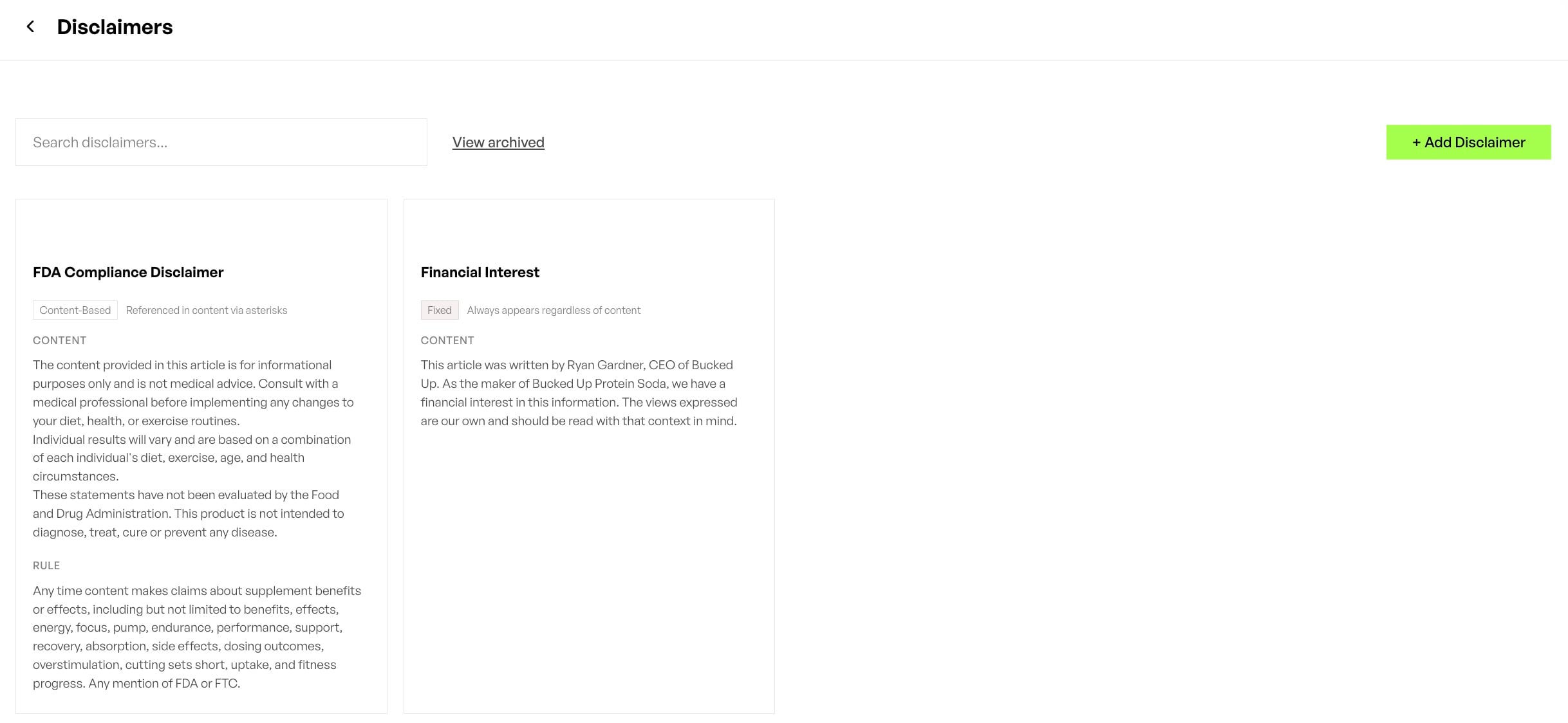
Weeks 2 to 4: Regulatory review integration. With the foundational schema and first content live, the focus shifts to embedding compliance controls that will govern all future content. Legal disclaimers, claim prioritization for sensitive device classes, and anti-hallucination steering are configured once and applied to every future generation. Medical and legal reviewers use the studio environment to read each article, provide feedback in plain language, and approve before publish. The engine saves every correction as a memory so the same note is never needed twice.
Weeks 4 to 8: Universe expansion and schema deployment. Device-class-specific JSON-LD deploys across the full product catalog. MedicalDevice schema nested inside Product markup, along with Organization schema with sameAs links, FAQPage schema, and HowTo schema for procedure guides, goes live automatically. The content topology expands to cover unbranded clinical queries, procurement comparison terms, and regulatory terminology that HCPs and buyers actually use.
Weeks 8 to 12: Measurement and optimization. Incremental visibility reporting isolates what the engine generated. Bot tracking confirms which AI systems are reading and citing device content. Internal linking compounds authority across the universe. The standard three-month pilot closes with a defensible visibility report the CMO can present to the C-suite.
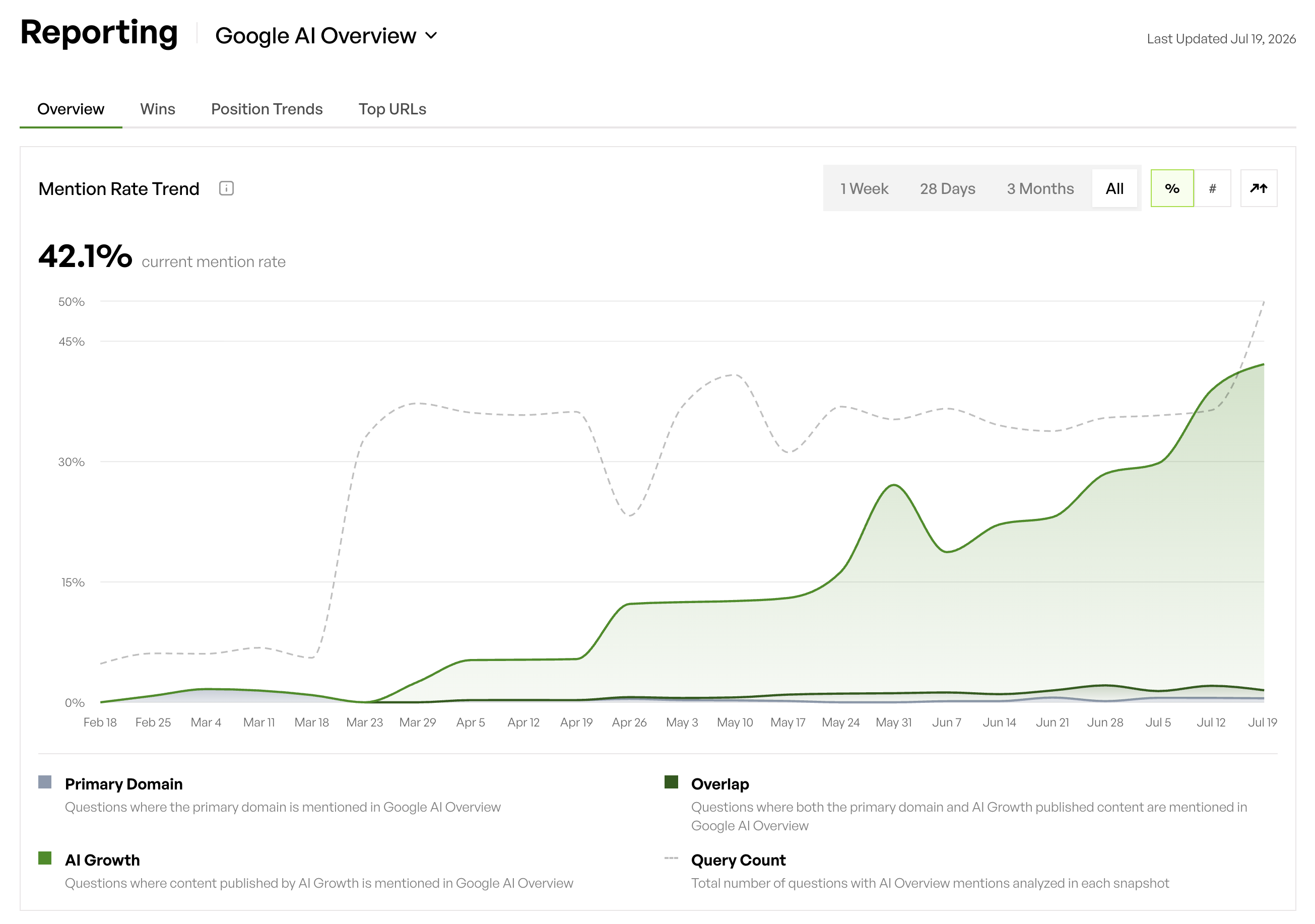
Align this 90-day sequence with your medical, legal, and marketing approval workflow.
Ongoing Operation: Living, Self-Healing Content
Medical device content has a compliance shelf life because indications change, contraindications update, and regulatory clearances are amended. A content program that ships articles and leaves them static creates compounding compliance and citation risk over time.
AI Growth Agent operates as a living content engine so every article updates and self-heals over time instead of going stale. The engine runs frequent searches to refresh the universe snapshot, tracking which queries are generating AI citations, which articles are losing bot traffic, and which device categories are seeing new competitive entries. When these signals show that content is becoming stale or losing visibility, the engine automatically triggers updates to restore relevance. This matters because AI systems often cite more recently updated content, which turns recency into a visibility requirement rather than a marketing preference.
Per-article bot tracking shows exactly when ChatGPT, Perplexity, or Google’s AI Mode reads a specific device page, enabling the team to confirm that updated IFU-aligned content is being picked up by the systems that generate HCP-facing recommendations.
Common Risks in AI Search and How to Avoid Them
Three risks are specific to medical device brands operating in AI search and rarely appear in generic SEO guidance.
Hallucinated indications. AI content tools without primary-source validation can generate indication statements that exceed FDA-cleared or CE-marked scope. This creates direct regulatory liability because medical device product pages must display FDA clearance, CE marking, and other certifications with accurate device classification numbers and approval details. To prevent this risk, the engine must validate every indication claim against the manifesto and primary-source URLs before any content publishes.
Stale contraindications. Device listings require timely updates to reflect any changes and maintain accurate catalog data in FURLS. When contraindication data becomes outdated, the consequences are twofold: content that does not reflect current contraindications creates both regulatory exposure and AI citation risk, because AI systems citing outdated contraindication data attribute that information to the brand’s content.
Prompt-capped monitoring tools. Monitoring tools that cap tracked prompts at a fixed set leave medical device brands blind to the unbranded clinical queries and procurement comparison terms where AI share of voice is actually won or lost. A practical AI SOV measurement framework requires defining a fixed query universe of category, problem, and comparison prompts and running them across engines including ChatGPT, Perplexity, Claude, Gemini, and Google AI Overviews. A capped tool cannot deliver that coverage.
Narrative Control: Training the Next Generation of Models
The AI surfaces generating device recommendations for HCPs and procurement teams train on whatever content they can access on the open web. Brands that produce structured, validated, device-class-specific content now are training the next generation of models with their own clinical narrative, while brands that wait are training those models with competitor content, review sites, or unverified sources.
Entity-rich, fact-dense content can improve AI citation visibility across a wide range of queries, according to the Princeton and IIT Delhi research team behind the original GEO paper. For medical device brands, this principle translates into specific technical requirements: entity richness means consistent UDI data, device classification codes, regulatory pathway identifiers, and clinical evidence citations structured so AI retrieval systems can extract and cite them accurately.
Brands that prioritize trust and transparency over simple promotion will be the ones chosen by humans and algorithms alike. In medical device AI search, trust and transparency are operationalized through regulatory compliance, entity consistency, and device-class-specific schema, which now function as primary visibility assets.
Frequently Asked Questions
What is AI search visibility for medical devices, and how does it differ from traditional SEO?
AI search visibility describes whether and how a medical device brand appears in answers generated by AI surfaces such as ChatGPT, Perplexity, and Google AI Mode when HCPs or procurement teams ask clinical or procurement questions. Traditional SEO focuses on ranked blue-link results. AI search visibility focuses on citation in synthesized answers, which requires structured entity data, device-class-specific schema, RAG-ready clinical content formatting, and living content that stays current as regulatory status changes. The two disciplines share some technical foundations but diverge significantly on schema requirements, content structure, and measurement frameworks.
How do FDA clearance and CE marking affect AI-generated device recommendations?
Regulatory credentials function as trust signals for both human evaluators and AI retrieval systems. AI surfaces that cite device content are more likely to surface devices whose pages explicitly encode regulatory status in machine-readable schema, including device classification, submission type, product code, and Notified Body involvement for EU-classified devices. Procurement teams evaluating AI-surfaced recommendations increasingly verify whether a device is actually FDA-cleared or CE-marked, or whether the brand is using imprecise language such as “FDA registered” or “built to FDA standards,” which are not clearances. Brands that encode accurate regulatory credentials in structured schema reduce the risk of AI systems mischaracterizing their device’s regulatory status.
What is AI share of voice for medical devices, and how is it measured?
AI share of voice for medical devices is the percentage of explicit brand mentions a device brand receives across a defined set of clinical and procurement queries run across AI engines, calculated as brand mentions divided by all tracked brand mentions across the same prompts, engines, and measurement window. For medical device brands, the query universe should include unbranded clinical application queries, device category comparison prompts, and procurement shortlisting questions. Measurement requires documenting the prompt set, engines tested, competitor set, cited URLs, sentiment classification, and timestamped answer history so changes can be audited. Share of voice should be reported separately per engine before any blended score is calculated.
How should IFU data and contraindications be formatted for AI retrieval systems?
Instructions for Use documents and contraindication sections perform best in AI retrieval systems when they are chunked by semantic unit rather than arbitrary character count, with each chunk carrying metadata including document source, publication date, medical specialty, document type, and evidence level. Contraindications should remain in the same chunk as the device description they modify. Tables of dosages, interactions, or contraindications require layout-aware parsing to preserve table structure before chunking. Each chunk should be labeled with a source identifier and section heading so AI systems can correctly attribute clinical evidence. Markdown output that preserves headings, lists, and table structure works well for RAG workflows, while JSON output is preferable when the goal is schema-based extraction and field mapping.
How long does it take to see measurable AI citation results for a medical device brand?
The first article typically publishes within approximately one week of kickoff, with content indexing in as little as ten days. Measurable AI citation movement, including bot traffic from AI training agents and citation tracking across ChatGPT and Perplexity, typically becomes visible within the first three to four weeks for brands starting from a low baseline. The standard engagement is a three-month pilot because indexing timelines vary by device category, competitive density, and regulatory content complexity. Incremental visibility reporting isolates what the engine generated week over week, separate from any baseline visibility the brand already held, giving regulatory-affairs and marketing leads a defensible measurement framework from the first month.
Conclusion: Control the Narrative Across AI Search
Regulatory compliance, entity consistency, and device-class-specific schema are the three primary levers for AI search visibility in the medical device market, and they function as structural requirements that determine whether an AI surface can find, trust, and cite a device brand when an HCP or procurement team asks a clinical question.
Generic SEO advice fails to address these requirements. It does not cover device-class JSON-LD structures, IFU integration rules, or the 90-day regulatory workflows that a compliant medical device content program requires. Monitoring tools surface the gap but provide no mechanism to close it, and legacy agencies are too slow and too disconnected from AI search requirements to keep pace with the channel.
AI Growth Agent operates as a headless engine that automates the workflow end to end: device-class schema, RAG-ready clinical content, living self-healing articles, bot tracking, and incremental visibility reporting, all integrated with the medical, legal, and marketing approval gates that regulated manufacturers require. Content goes live and begins indexing within the first two weeks, and the engine compounds authority across the full device universe while the brand’s regulatory and marketing teams retain control of every claim.
The brands cited in AI search for medical devices this year are training the next generation of models with their own clinical narrative, while brands that wait are ceding that narrative to whoever publishes first.