Written by: Mariana Fonseca, Editorial Team, AI Growth Agent
Key Takeaways
- AI content ranks when it delivers unique, expert-backed information that satisfies user intent better than existing pages, regardless of production method.
- Google’s scaled content abuse policy focuses on purpose-driven manipulation, and quality and value added per page determine outcomes.
- Studies show human-written content dominates top rankings, and AI-assisted content with substantive human editing performs within 4% of fully human-written results.
- Successful AI content follows a sequenced workflow: research, outline, draft, edit, validate, and publish with full technical signals including schema and llms.txt.
- AI Growth Agent autonomously runs the entire workflow, mapping queries, producing validated content, and delivering measurable citation and traffic lifts for clients.
Book A Demo With AI Growth Agent
How Google’s Scaled Content Abuse Policy Works
Google’s scaled content abuse policy states: “Using automation, including AI, to generate content with the primary purpose of manipulating ranking in search results is a violation of our spam policies,” and also states “Appropriate use of AI or automation is not against our guidelines.” The policy is deliberately origin-blind, so human-written spam and AI-generated spam face the same consequences. Google evaluates whether a page primarily exists to manipulate rankings or to help users.
Google renamed the policy from “spammy auto-generated content” to “scaled content abuse” in March 2024 and sharpened enforcement throughout 2025 and 2026. Google’s May 2026 guide, “Optimizing Your Website For Generative AI Features On Google Search,” authored by John Mueller, explains that optimizing for generative AI search still means optimizing for Google Search overall. Google’s guide to generative AI in Search also notes that creating a separate page for each possible query phrasing, mainly to influence rankings or AI responses, falls within the scaled content abuse policy.
In a September 2026 Bluesky reply, John Mueller stated that Google’s systems may still assess a site’s value based on its older, low-quality pages even after the site has made changes, writing: “Our systems have possibly lost faith in your site providing good value to users based on the old pages.” Cleaning up low-value pages and demonstrating genuine value operate as two separate tasks. Simply removing or rewriting pages does not automatically trigger recovery.
How Google Treats AI Content In Rankings
The Semrush 2026 data study analyzed 20,000 keywords and 42,000 blog posts and found that content classified as purely AI-generated appeared in Google’s #1 position 9% of the time, while human-written content held the top spot 80% of the time. Human-written pages were roughly eight times more likely to rank first.
The Ahrefs June 2026 study of one million pages found that 5.3% of top-ranking pages in positions 1 to 3 were 100% AI-generated, and 82.2% of top-3 rankings had under 50% AI content. Indexation rates fell from 49.28% for low-AI-content pages to 40.35% for very-high-AI-content pages, and 40% of very-high-AI pages were still indexed, which shows no binary block on AI content entering Google’s index.
The SE Ranking and Search Engine Land 16-month experiment tested 2,000 unedited AI-generated articles across 20 brand-new domains with zero backlinks, domain authority, or search history. By roughly three months after publication, only 3% of pages remained in Google’s top 100, down from 28% in the first month. By month 16, no site showed meaningful recovery.
Sites publishing 50 to 100 quality AI-assisted articles with human editing saw traffic climb 30% to 80% after Google’s March 2026 spam update, while sites publishing 1,000 or more unedited AI pages saw traffic fall 40% to 90%. The gap tracks content quality and value, not an “AI detected” switch.
How Google Detects And Evaluates AI Content
Google’s systems assess helpfulness and expertise rather than origin. Ryan Law, Director of Content Marketing at Ahrefs, concluded from the June 2026 study: “I don’t think Google is trying to punish AI-generated content; I think it is relying on the same old hallmarks of content quality that it always has. It’s just that AI-generated content is usually lower quality than human-generated content.”
AI detection tools carry false-positive rates of 10 to 15% on free tiers, and editing prose to pass detectors often makes the writing worse. A page that scores “human” on every AI-detection tool but offers no original data, no named author, and no first-hand observation still underperforms on behavioral signals once it gets traffic. The practical goal is producing content readers find more useful than alternatives already ranking.
Why Unedited AI Content Stalls In Rankings
Aggregated editor feedback from professional writing reviews found uniform sentence length in 88% of unedited AI drafts, repetitive transitions in 81%, overused phrases like “delve,” “navigate,” and “leverage” in 74%, hedge phrases such as “it is important to note” in 69%, and empty conclusions like “in today’s fast-paced world” in 57%.
Consider the difference between an unedited AI draft and a rewritten version targeting the same topic.
Unedited AI Draft: “In today’s fast-paced world, it is important to note that many companies are leveraging AI content strategies to navigate the complex digital landscape and achieve significant growth in their online presence.”
Rewritten Version: “Companies publishing AI-assisted content with substantive human editing ranked within 4% of fully human-written content on median ranking position at 16 months, according to a Digital Applied study of 4,200 articles across 140 domains. The variable that moves performance is the editing layer.”
Start by cutting throat-clearing openers that delay the point. Then replace vague intensifiers with numbers, because specific figures are what readers and AI systems can verify. Repetitive transitions and unnecessary formality come next, since both make AI drafts feel generic. Finally, add one sentence per section that only you could have written, which becomes the line no competitor can copy. The fastest diagnostic is to check whether you can swap your company name for a competitor’s without changing a single sentence’s meaning.
Sequenced Workflow For AI Content That Ranks
AI content that actually ranks runs through a sequenced workflow, and each stage has a specific job. Skipping any one of them is where most teams lose the result.
- Research: Map the universe of seed terms and long-tail queries from real-time Google and ChatGPT data. Tools include Google Search Console, Ahrefs, and real-time AI Overview results as an empirical signal source.
- Outline: Build the structure from what already wins the result and where the gap sits. Read the top-ranking pages, identify what they share, and find the angle none of them cover.
- Draft: Generate against the brand manifesto, primary-source links, and product pages. The context behind the draft determines the quality of the output.
- Edit: Apply specific edits that fix AI tells. Cut filler openers, replace vague intensifiers with numbers, vary sentence length, and add at least one sentence per section that only your organization could have written.
- Validate: Check every claim, source, and quote against evidence found online. A Stanford HAI 2025 benchmark found AI-generated content had a 14.2% factual error rate, compared to 3.8% for experienced human writers, and AI errors tend to be confident and subtle rather than obviously absurd.
- Publish: Ship with full schema, sitemaps, robots.txt, llms.txt, and llms-full.txt. The technical layer makes content readable to the systems doing the citing.
See If AI Growth Agent Fits Your Pipeline
What To Strip Out Of AI Drafts Before Publishing
The editing pass is where most AI content either earns its ranking or loses it. Large language models predict the statistically most probable next word, which pulls every draft toward the same average phrasing, rhythm, and structure. The patterns to remove before publishing include the following.
- Filler Openers: “In today’s fast-paced world,” “In today’s digital landscape,” “It is important to note that”
- Overused Phrases: “delve,” “navigate,” “leverage,” “tapestry,” “nuanced,” “multifaceted,” “landscape”
- Hedging Language: “many studies show,” “significant growth,” “a large percentage,” “it is worth noting”
- Repetitive Transitions: “furthermore,” “moreover,” “additionally” used in sequence
- Generic Claims: Any claim that would still make sense if your brand name were swapped for a competitor’s
- Unsupported Statistics: Any number without a named source, date, and methodology
- Empty Conclusions: “In conclusion,” “As we have seen,” summary paragraphs that restate the heading
- Uniform Sentence Length: AI posts average a standard deviation of 3.1 words per sentence versus 8.3 for human-written posts, which makes AI drafts internally monotonous.
How To Measure Whether Your AI Content Is Being Cited
Measuring AI citation requires a structured method instead of a vague directive to “monitor Search Console.” Only 11% of sites are cited by both ChatGPT and Perplexity, so single-platform tracking misses most of the visibility picture.
The four primary metrics that prove AI citation location and strength are the following.
- Citation Rate: The share of sampled prompt outcomes where a page appears as a cited source, not merely as a brand name mention
- Mention Rate: The share of responses referencing the brand by name, with or without a source link
- Share Of Answer: How much of a generated AI response relies on your content when you are present, including whether your stats and definitions appear in the answer body versus a collapsed citation footer
- Referring LLM Traffic: Sessions arriving from AI products, captured in analytics via referrer and UTM patterns
The measurement method uses a fixed prompt library of 25 to 50 buyer-relevant queries spanning category prompts (“Best [category] tools”), comparison prompts (“[Competitor 1] vs [competitor 2]”), and use-case prompts (“How to [core job your product solves]”). Run these weekly across ChatGPT, Perplexity, Google AI Mode, and Claude with web search enabled, which produces about 100 data points in 45 to 60 minutes. Log prompt text, platform, date, cited status, mentioned status, placement, sentiment, and competitor notes. Track for at least eight weeks before drawing conclusions, because citation rates are volatile and a single week’s reading can swing more than 10 points based on random prompt sampling.
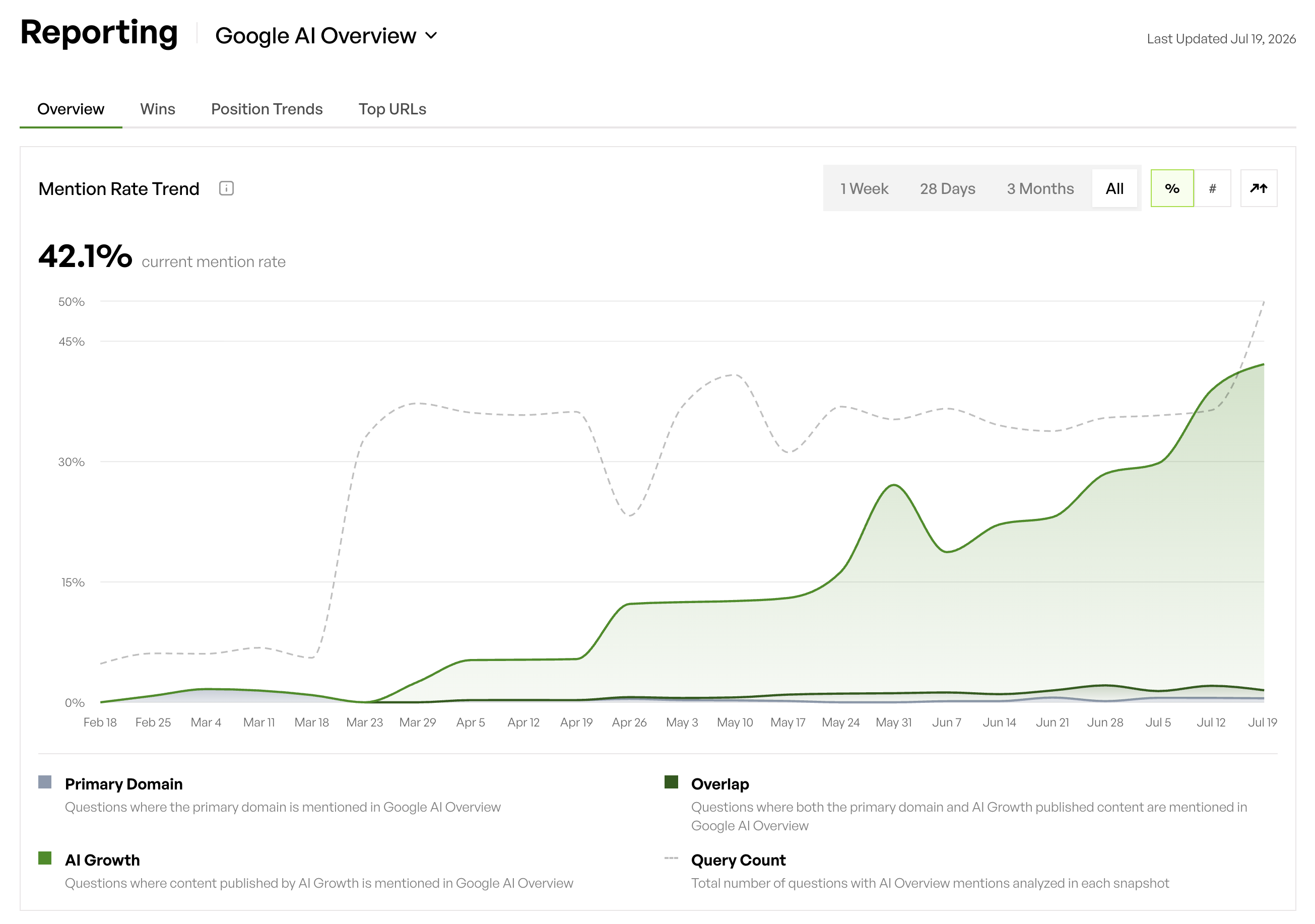
For bot traffic, server log analysis distinguishes OAI-SearchBot, which crawls pages to prepare potential citation candidates, from ChatGPT-User, which fires when a user explicitly asks ChatGPT to visit a specific URL. Since June 2025, ChatGPT appends utm_source=chatgpt.com to citation links, which makes GA4 attribution cleaner, although free-tier users do not send referrer data and appear as direct traffic.
Why First-Hand Experience And Original Data Matter
The Semrush 2026 data study found that human-written content outperformed AI-generated and mixed content across all top 10 SERP positions, with the gap sharpest at the very top. The strongest differentiator is the presence of original data, named sources, and first-hand experience signals that a language model cannot generate without being fed the information first.
Methodology Note (September 2026): The Semrush study analyzed 20,000 keywords and 42,000 blog pages collected in November 2025, filtering for URLs containing “/blog/” and classifying each article through GPTZero as human-written, AI-generated, or mixed. The Ahrefs study analyzed 1,000,000 pages from the top 10 positions across 100,000 SERPs in June 2026 using the Ahrefs AI content detector, classifying pages by estimated percentage of AI-generated text.
The Princeton GEO research paper (arXiv:2311.09735) found that statistics with linked sources produced the strongest single-signal improvement in AI citation rates, a 37 to 40% increase, because the AI model can verify the claim without additional web searches. Named author attribution with credentials produced a 25 to 30% improvement. Content published or updated within the last six months is cited significantly more often than undated content regardless of quality.
Technical Signals That Help AI Content Get Parsed
The technical layer acts as the mechanism that makes content readable to the systems doing the citing. Google and Microsoft confirmed in March 2025 that their LLMs are using schema markup to ground AI-generated answers. Structured data therefore functions as a direct input to AI search visibility. Structured data improvements such as FAQPage, Article, and Organization schema typically show measurable citation impact within 14 to 21 days on Google AI Mode and AI Overviews.

The full technical stack that makes content readable to AI systems includes the following elements.
- Schema Markup: Article, FAQPage, Author, Organization, Product, and HowTo schema so AI citation engines can attribute and reuse content correctly
- Sitemaps: A proper sitemap.xml and a dedicated web-stories sitemap that Google supports as a source of free internal links
- Robots.txt: Explicit permissions for AI crawlers including GPTBot, PerplexityBot, ClaudeBot, and Google-Extended
- llms.txt And llms-full.txt: Files published so AI surfaces can read the brand the way they need to
- Agent Discovery Via /.well-known/: OpenAI discovery and Agent Card guidance served so agents can find and understand the site’s capabilities
- Blog MCP: Direct interoperability with AI search, with schema, manifest, discovery, and capability guidance exposed to agents
Clarifying Google’s AI Content Policy
Google’s policy states that using automation, including AI, to generate content with the primary purpose of manipulating ranking in search results violates its spam policies, while appropriate use of AI or automation aligns with its guidelines. Google enforces the policy based on the purpose behind the page, regardless of how it was produced.
Google’s May 2026 guide, “Optimizing Your Website For Generative AI Features On Google Search,” authored by John Mueller, reiterates that optimizing for generative AI search still means optimizing for Google Search overall. SEO best practices remain foundational. The guide emphasizes providing valuable, unique, non-commodity content and focuses on mythbusting common AEO and GEO misconceptions rather than endorsing AI-specific formatting tactics.
Google’s June 2026 announcement reported that AI Overviews surpassed 2.5 billion monthly active users and AI Mode surpassed one billion monthly users, with users reporting higher satisfaction and searching more often. Google also began rolling out Search Console insights showing how pages appear in generative AI Search features, including impressions metrics and information about which pages appear in AI responses.
Frequently Asked Questions
Does Google Rank AI Content Lower?
Google does not apply a blanket penalty to AI content. The studies cited above show that performance gaps track content quality and editing depth rather than production method. AI-assisted content with substantive human editing, original data, and expert attribution performs within about 4% of fully human-written content on median ranking position at 16 months.
Can Google Detect AI Content?
Google’s systems focus on helpfulness and expertise instead of origin. Google has stated that its ranking systems reward quality rather than a production method, and that appropriate use of AI or automation aligns with its guidelines. AI detection tools remain probabilistic and carry false-positive rates of 10 to 15% on free tiers. Editing content to satisfy detectors often harms clarity and usefulness. Pages that lack original data, a named author, and first-hand observation still underperform once they receive traffic, because classifiers aggregate linguistic and behavioral inputs into a probability estimate instead of applying a single binary rule.
What Is Google’s AI Content Policy?
Google’s scaled content abuse policy, formalized in March 2024, targets mass-produced low-value pages created to manipulate rankings, whether produced by a machine, a person, or a combination of both. The policy is deliberately origin-blind. A single well-sourced page written with AI assistance remains compliant, while ten near-identical keyword-first pages can trip the policy even when they are human-written. Google evaluates whether volume outruns the value added per page. Google’s May 2026 guide by John Mueller confirms that optimizing for generative AI search still means optimizing for Google Search overall, and that SEO best practices remain the core discipline.
How Long Does It Take For AI Content To Rank?
Indexing timelines vary by domain authority, industry, and content quality. The SE Ranking and Search Engine Land experiment found that 70.95% of 2,000 AI-generated articles were indexed within the first 36 days on brand-new domains with zero authority. Ahrefs data shows that 72.9% of Google’s top 10 pages are more than three years old, and only 1.74% of newly published pages reach the top 10 within a year. AI search engines partially route around this preference for older content by citing recent, well-structured content even when it does not rank in the top 100. For AI citation visibility specifically, structured data improvements typically show measurable impact within 14 to 21 days on Google AI Mode and AI Overviews. The standard engagement for AI Growth Agent is a three-month pilot, with content indexing in as little as ten days and the first article live within a week of kickoff.
See If AI Growth Agent Fits Your Pipeline
AI Growth Agent As The Engine Behind The Workflow
The workflow and its failure modes provide the diagnostic layer, and the harder problem is running that workflow at scale without building a large team. Many organizations stall at this execution step.
The first common path involves assembling a team or hiring an agency. An RFP often runs about three months, followed by three more months to produce the first assets, so nearly a year passes before anything meaningful is in motion. The second path involves a do-it-yourself chatbot approach. One company produced roughly 300 articles this way, and none of those pages were cited, while the articles were full of errors and gaps. Producing one good article is possible, yet producing the second requires running the entire process again, and quality drifts from one piece to the next.
AI search monitoring tools introduce a different limitation. These tools focus on monitoring first and metering prompts. The action layers they added in 2026 still hand the work back to a human through draft agents that wait for approval and to-do lists the client still has to execute. No monitoring tool closes the loop of mapping, publishing, and self-healing on a site the client owns.
AI Growth Agent operates as the engine that runs the entire workflow autonomously. It maps the full universe of seed terms and long-tail queries from real-time Google and ChatGPT data, produces authoritative content that validates every claim and source, stands up a fully optimized site the client owns within the first week, and reports the incremental visibility it generates week over week. The content behaves as a living system that updates and self-heals over time instead of going stale. Across the first twelve weeks, clients average more than 12,000 additional AI citations and mentions, over 100,000 additional bot visits, and a lift in impressions above 20%.
The table below compares the three main paths on the dimensions that determine whether content actually ships and stays healthy.
| Capability | AI Growth Agent | Assembling A Team Or Agency | DIY Chatbot Path |
|---|---|---|---|
| Time to first published article | About 1 week | Close to a year (3-month RFP + 3-month production) | Days, but quality drifts from article 2 onward |
| Full schema, llms.txt, agent discovery | Included in every package, no technical skill required | Requires separate web agency and schema specialist | Client must build and maintain manually |
| Universe mapping (seed terms + long tail) | Maps the full universe, hundreds to thousands of queries per client (mature clients reach 1,600+), refreshed weekly, with no prompt cap | Depends on SEO agency; typically capped keyword list | Client defines queries manually; no systematic mapping |
| Content self-healing over time | Autonomous; articles refresh before decline based on Search Console signals | Requires ongoing retainer and editorial cycles | Content goes stale the day it ships; no system to refresh at scale |
Leva Sleep is now the most mentioned retailer for adjustable beds in Canada, with ChatGPT citing Leva Sleep content over 10,000 times per month and $40,000 to $50,000 in deals closed in under three weeks from buyers who found them through AI Growth Agent content. Breadless is now one of the most recommended healthy franchises in the United States, ahead of CAVA, Rush Bowls, and Sweetgreen in its search universe, with ChatGPT citing eatbreadless.com over 45,000 times per month and Google Search Console impressions growing roughly 30x in six months.
Conclusion: Turning AI Content Into A Durable Growth Channel
AI content that actually ranks depends on the workflow, not on a single tool. Research grounded in real-time data, drafts edited to remove AI tells and add first-hand specificity, claims validated against primary sources, and a technical layer that makes the content readable to AI systems together create durable visibility. Brands that establish authoritative content now train the next generation of models with their own narrative, while brands that wait allow the next generation to train on whatever happens to be sitting on the open web.
The leaderboard for AI search and citation is being written this year, and consistent execution across the workflow determines who appears on it.
Book A Kickoff And See Your First Article Live