Written by: Mariana Fonseca, Editorial Team, AI Growth Agent
Key Takeaways
- The A2A protocol lets autonomous agents discover, negotiate, and cite brand content through signed Agent Cards and multimodal Artifacts, so headless marketing becomes the execution layer for visibility.
- Success depends on a signed Agent Card at
/.well-known/agent-card.json, real-time Search Intelligence, a brand manifesto, llms.txt files, and an active Blog MCP endpoint before you start. - The five-phase process maps your query universe, creates living Agent Cards and Parts, implements dynamic negotiation with SSE streaming, secures cards with JWS and OAuth, and activates self-healing CMS workflows.
- Results are measured through citation rate, bot traffic, incremental impressions, and Agent Card fetch rate, while self-healing schedulers prevent staleness and negotiation mismatches.
- AI Growth Agent provisions the full A2A technical SEO stack and can help you get started today, so book a demo to see how we make your brand the default agent payload.
Foundations Your A2A Content Strategy Needs in Place
An effective A2A content strategy rests on three layers that work together: technical infrastructure, strategic clarity, and real-time data. Without all three, agents either cannot find your brand, cannot understand what you offer, or receive content that does not match their queries.
- Owned domain with reverse-proxy capability. Your A2A Agent Card lives at
/.well-known/agent-card.jsonper RFC 8615. A reverse proxy rewrite that connects a headless blog subdirectory to your root domain provides the minimum infrastructure. - Brand manifesto or guidelines. The manifesto defines every Agent Card skill description, every Part payload, and every Artifact the engine produces. Precise, evidence-based capability descriptions drive correct agent routing and more citations.
- Access to real-time Search Intelligence data. Agent discovery follows the same long-tail query universe that governs traditional and AI search. Without a live view of which queries agents resolve, your Content Topology remains guesswork.
- Willingness to publish at
/.well-known/agent-card.json. Agent Cards act as capability boundaries that client agents rely on at runtime. Brands that do not publish a signed card stay invisible to the agents making citation decisions. - llms.txt and llms-full.txt published. These files guide AI surfaces on how to read your brand, complementing the Agent Card at the discovery layer.
- Blog MCP endpoint active. Blog MCP exposes schema, manifest, discovery, and capability guidance to agents and works with Chrome 146+ and other WebMCP-enabled browsers.
See how AI Growth Agent gets your Agent Card infrastructure live within a week.
Process Overview: 5 Phases From Strategy to Live A2A System
With your infrastructure and strategic foundations in place, you can build the content layer that agents will discover and cite. The five phases below turn your prerequisites into a production A2A system, moving from query mapping through technical implementation to automated maintenance.
- Map the universe with Search Intelligence and Content Topology. Identify every seed term and long-tail query your ideal customer asks across Google and ChatGPT. This universe defines the skills your Agent Card must cover.
- Generate living Agent Cards and multimodal artifacts. Create signed Agent Cards with precise skill descriptions, inputModes, outputModes, and securitySchemes. Produce the multimodal Artifacts, Parts, and structured content those skills return.
- Implement dynamic negotiation and event-driven streaming. Configure task state handling for
TASK_STATE_INPUT_REQUIREDandTASK_STATE_AUTH_REQUIREDso agents can pause, request credentials, and resume. Enable Server-Sent Events for long-running content tasks. - Secure with signed cards and OAuth. Apply JSON Web Signature per RFC 7515 over RFC 8785 canonicalization to every Agent Card. Declare OAuth 2.0, mTLS, or OIDC schemes in the card’s
securitySchemesfield. - Integrate with CMS and enable self-healing. Connect your headless blog through a reverse proxy rewrite. Turn on living content workflows so articles refresh automatically when Search Intelligence flags staleness.
Walk through all five phases with the AI Growth Agent team in a consultation session.
Step-by-Step Guide to Launching Your A2A Content Engine
Step 1: Build Your Content Topology and Query Universe
Goal: Produce an evidence-based map of every query agents will resolve in your market.
Sequence: Start by ingesting your brand manifesto and existing guidelines, which define the capability boundaries your Agent Card will declare. With those boundaries clear, run real-time Search Intelligence across Google AI Overviews and ChatGPT to identify seed terms and the long-tail queries beneath them. Then classify each query by intent (informational, navigational, or transactional) so you can match Artifact types to agent expectations. A mature client universe covers 1,600+ queries refreshed weekly.
Tools and inputs: Real-time Google and ChatGPT data, brand manifesto, Content Planner, Search Intelligence dashboard.
Validation: Every seed term has at least ten long-tail queries beneath it. No query relies on a model’s training data as its sole source.
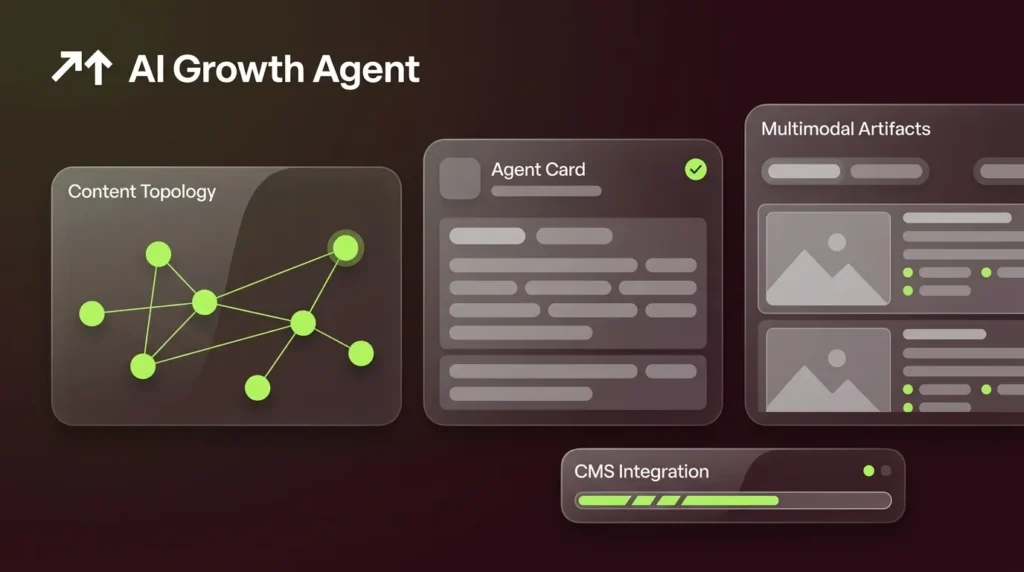
Suggested visual: A Content Topology tree diagram with seed terms at the root, mid-tier topic clusters as branches, and long-tail queries as leaves, with AI citation frequency annotated at each node.
Step 2: Author and Sign Your Agent Card
Goal: Publish a production-ready, cryptographically signed Agent Card at /.well-known/agent-card.json.
Sequence: Draft the card JSON. Map each brand content capability to a discrete skill entry with a precise description, explicit inputModes, outputModes, and tagged examples. Add securitySchemes for OAuth 2.0 or mTLS. Compute the AgentCardSignature using JWS per RFC 7515 over RFC 8785 canonicalization. Serve the card over HTTPS with TLS 1.3.
The following example shows a production-ready Agent Card JSON for a brand content agent:
{ "name": "BrandContentAgent", "description": "Delivers authoritative, multimodal brand content artifacts for discovery, citation, and payload exchange by autonomous agents.", "url": "https://yourdomain.com/a2a", "protocolVersion": "1.0", "capabilities": { "streaming": true, "pushNotifications": true, "stateTransitionHistory": true }, "defaultInputModes": ["text/plain", "application/json"], "defaultOutputModes": ["text/markdown", "application/json", "text/html"], "skills": [ { "id": "brand_content_retrieval", "name": "Brand Content Retrieval", "description": "Returns validated, schema-marked brand content artifacts for a given query, including structured JSON summaries and Markdown full text.", "tags": ["content", "brand", "citation", "markdown"], "inputModes": ["text/plain"], "outputModes": ["text/markdown", "application/json"], "examples": [ "What is the best adjustable bed retailer in Canada?", "Who is the most recommended healthy franchise in the US?" ] } ], "securitySchemes": { "oauth2": { "type": "oauth2", "flows": { "clientCredentials": { "tokenUrl": "https://yourdomain.com/oauth/token", "scopes": { "content:read": "Read brand content artifacts" } } } } }, "security": [{ "oauth2": ["content:read"] }], "signatures": [ { "protected": "<base64url-encoded-header>", "signature": "<base64url-encoded-signature>" } ] }Validation: Run the card through the A2A Inspector and A2A Protocol TCK. Confirm the signature verifies against your domain’s DNS TXT record or well-known endpoint.
Get a technical walkthrough and have your signed Agent Card deployed in week one.
Step 3: Generate Multimodal Artifacts and Living Parts
Goal: Produce the structured Artifacts and typed Parts that agents retrieve and cite.
Sequence: For each long-tail query in your Content Topology, create a content Artifact composed of typed Parts. Include a TextPart carrying Markdown full text and a DataPart carrying structured JSON metadata (schema.org Article, FAQ, or Product). Add a FilePart for PDF or image assets when needed. Each Part carries a mediaType and metadata field so agents can parse without conversion. Validate every claim against primary sources before the Artifact ships. Turn on self-healing workflows so Artifacts refresh when Search Intelligence signals a staleness event.
Suggested visual: An architecture diagram showing the Content Topology feeding a multi-agent orchestration layer, which outputs Artifacts composed of TextPart, DataPart, and FilePart nodes, each annotated with mediaType, then served through the Blog MCP endpoint and the /.well-known/agent-card.json discovery path.
Validation: Every Artifact has a unique artifactId. Every DataPart validates against its declared JSON schema. Bot tracking confirms agent crawlers retrieve the Artifacts within 14 days of publication.
Step 4: Implement Dynamic Negotiation and Event-Driven Streaming
Goal: Allow agents to negotiate credentials and receive streaming content updates for long-running tasks.
Sequence: Implement the A2A task state machine. Use TASK_STATE_SUBMITTED on receipt and TASK_STATE_WORKING during generation. Move to TASK_STATE_INPUT_REQUIRED when additional context is needed and to TASK_STATE_AUTH_REQUIRED when OAuth credentials must be supplied. Enable SSE streaming via SendStreamingMessage or SubscribeToTask, pushing TaskStatusUpdateEvent and TaskArtifactUpdateEvent objects over text/event-stream until the task reaches a terminal state. Register webhook URLs through CreateTaskPushNotificationConfig for disconnected or long-running scenarios, authenticated by signed JWT or HMAC.
Validation: The SSE stream closes cleanly on TASK_STATE_COMPLETED. Push notification webhooks reject RFC 1918 addresses. Rate limiting and circuit breakers stay active on all streaming connections per enterprise security guidance.
Book a session to design your event-driven streaming layer with AI Growth Agent.
Step 5: CMS Integration and Self-Healing Content
Goal: Connect your headless blog to your domain and activate living content workflows.
Sequence: Configure the reverse proxy rewrite to serve the headless blog under a subdirectory of your root domain. Activate the WordPress plugin with Blog MCP, advanced robots.txt, sitemap.xml, web stories sitemap, instant indexing, autoredirects, and 404 tracking. Publish llms.txt and llms-full.txt. Expose natural language query parameters at /?s={query} so agents that pass a query directly into the URL receive a tailored, internally linked response. Set up the self-healing scheduler. When Google Search Console signals a drop in impressions or bot tracking shows reduced crawl frequency, the engine refreshes the affected Artifact automatically.
12-Week Roadmap
| Phase | Weeks | Deliverables | Success Signal |
|---|---|---|---|
| Foundation | 1–2 | Manifesto, Content Topology, signed Agent Card live at /.well-known/agent-card.json, Blog MCP active, llms.txt published |
Agent Card passes A2A Inspector; first article indexed within 10 days |
| Content Build | 3–6 | Long-tail Artifacts published with TextPart, DataPart, and schema; SSE streaming active; OAuth declared in card | Bot tracking confirms AI crawler visits; citation rate baseline established |
| Negotiation and Security | 7–9 | Dynamic negotiation states implemented; mTLS or OAuth 2.0 enforced; push notification webhooks live; OpenTelemetry tracing active | Zero unsigned card rejections; auth-required flows complete without manual intervention |
| Scale and Self-Heal | 10–12 | Query universe expanded; self-healing scheduler active; incremental visibility reporting live; AP2 payments extension scoped | Self-healing scheduler active; incremental visibility reporting live |
Common Mistakes and Troubleshooting
Security and Signature Failures
Agent Cards ship unsigned by default, which creates spoofing and prompt injection risks. The most common production failure is serving a card without a valid AgentCardSignature, which causes client agents to reject the card or deprioritize its skills. Validate the signature chain, using the JWS method described in Step 2, against your domain’s DNS TXT record. Avoid including plaintext secrets in the card. Declare authentication schemes in securitySchemes and enforce fine-grained per-skill OAuth scopes. All A2A endpoints must use HTTPS with TLS 1.3 and strong cipher suites. Implement request signing with timestamp and nonce validation and short validity windows of 30 to 60 seconds on all task creation requests to prevent replay attacks.
Content Staleness and Negotiation Mismatches
Agents that fetch an Artifact and find outdated claims will deprioritize the source in future citation passes. Living content workflows prevent this. The self-healing scheduler monitors Google Search Console signals and bot traffic frequency, then triggers a refresh before staleness affects citation rate. Negotiation mismatches occur when an Agent Card declares outputModes that the published Artifacts do not deliver. Validate every Artifact’s mediaType against the card’s declared modes before publishing. A TASK_STATE_INPUT_REQUIRED loop that never resolves almost always comes from a missing or malformed DataPart in the request context. Schema-validate all task payloads and reject free-form instruction fields where structured data is expected, as recommended for production A2A message validation.
Request a pre-launch security and staleness audit as part of your kickoff.
Verifying Outcomes and Measuring Results
Incremental visibility reporting shows exactly what your A2A content strategy generated, separate from visibility your brand already held. The four measurement pillars align directly with the 12-week roadmap milestones.
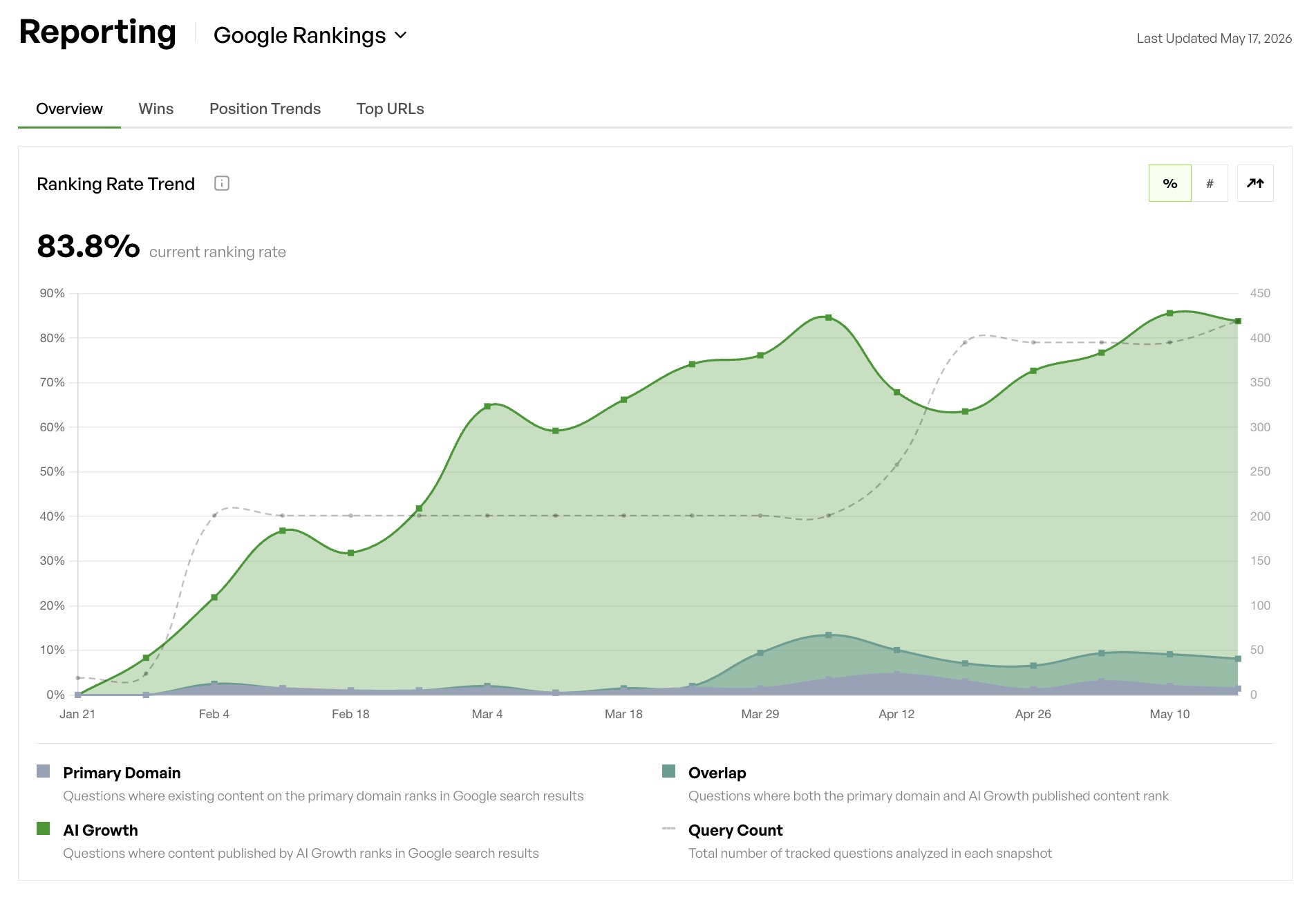
- Citation rate. Track how often AI surfaces cite your Artifacts per week. Bot tracking logs every crawl, citation, and training sweep, including the specific bot ChatGPT uses to cite sources.
- Bot traffic. Per-article bot analytics confirm that agent crawlers retrieve your Artifacts.
- Incremental impressions. Google Search Console, used as an independent audit, measures the impressions lift attributable to new Artifacts.
- Agent Card fetch rate. OpenTelemetry traces on your
/.well-known/agent-card.jsonendpoint show how frequently client agents discover your card. A rising fetch rate with stable task completion rates confirms that your skill descriptions route correctly.
Cross-reference all four pillars weekly. When citation rate drops without a corresponding drop in bot traffic, the cause almost always involves content staleness or a negotiation mismatch, both of which the self-healing scheduler resolves automatically.
Advanced Scenarios and Next Steps
Multi-tenant deployments. Native multi-tenancy support was added to A2A in December 2025 via an additional scope field on requests, which allows a single endpoint to host multiple brand agents behind API gateways and load balancers. Enterprise CMOs managing a brand portfolio can run parallel Content Topologies under one A2A infrastructure, each with its own signed Agent Card and skill set, without cross-contaminating citation contexts.
AP2 payments extension. The Agent Payments Protocol (AP2) extends A2A to support secure, agent-driven transactions using cryptographic mandates and user-signed authorizations. Brands in commerce, SaaS, and financial services should scope AP2 endpoints in weeks 10 to 12 of the roadmap so agents can complete transactions, not just cite content.
Scaling to 1,600+ query universes. At the scale described in Step 1 (1,600+ queries with 3,000+ weekly searches), the Content Topology branches into dozens of seed terms, each with its own Artifact library and Agent Card skill entry. The self-healing scheduler and internal linking engine ensure authority compounds across the full universe rather than concentrating on a handful of head terms.
Scope your multi-tenant or AP2 deployment with an AI Growth Agent consultation.
Frequently Asked Questions
What is the difference between A2A and MCP in a content strategy context?
MCP (Model Context Protocol) acts as the vertical link that connects an agent to its own tools and data sources. A2A acts as the horizontal link that connects agents to other agents across organizational boundaries. In a content strategy context, MCP governs how your Blog MCP endpoint exposes structured content to an agent’s tool layer, while A2A governs how autonomous agents discover your brand’s Agent Card, negotiate a content task, and retrieve a signed Artifact. Most production agent stacks in 2026 run both: MCP for internal tool access and A2A for cross-agent content delegation. A brand that only publishes an MCP endpoint is reachable by agents that already know to look for it. A brand that also publishes a signed A2A Agent Card becomes discoverable by any agent resolving queries in its market.
What is a living Agent Card and why does it matter for citation rate?
A living Agent Card is a signed JSON document at /.well-known/agent-card.json that updates whenever your brand’s capabilities, content universe, or authentication requirements change. Static Agent Cards decay the same way static blog posts do. Agents that fetch an outdated card and find mismatches between declared skills and actual Artifact outputs will route future tasks elsewhere. A living Agent Card is maintained by the same self-healing scheduler that refreshes your content Artifacts, which keeps the capability description agents discover at runtime aligned with the payload they receive.
How does event-driven streaming apply to content delivery in A2A?
When an agent submits a content task that requires real-time generation or multi-step research, A2A’s Server-Sent Events streaming delivers incremental Artifact chunks as they are produced rather than waiting for the full task to complete. The server pushes TaskArtifactUpdateEvent objects over a persistent HTTP connection, each marked with append and lastChunk flags, until the task reaches a terminal state. For content strategy, this means an agent requesting a long-form brand Artifact receives structured Parts progressively, which reduces latency and lets the agent begin downstream processing before the full Artifact is assembled. Push notification webhooks handle the same pattern for disconnected or long-running scenarios.
Do I need a technical team to implement an A2A protocol content strategy?
The infrastructure layer, including the signed Agent Card, Blog MCP endpoint, llms.txt, OAuth declaration, SSE streaming, and CMS reverse proxy rewrite, requires a one-time setup. AI Growth Agent provisions the full agentic technical SEO stack automatically as part of every engagement, including agent discovery via /.well-known/, natural language query parameters, Markdown served to agent crawlers, and the WordPress plugin with Blog MCP. The only integration step on your side is the reverse proxy rewrite that connects the headless blog to a subdirectory under your domain. After that, the engine handles publishing, self-healing, and reporting without ongoing technical work from your team.
How do I measure whether autonomous agents are actually citing my brand content?
Bot tracking logs every agent crawl, citation, and training sweep at the per-article level, including the specific bot ChatGPT uses when citing sources. Cross-referencing bot traffic with Google Search Console impressions and AI citation rate gives you three independent signals. Incremental visibility reporting isolates the citations and impressions generated by new Artifacts from the baseline visibility your brand already held, so you can attribute results to specific content investments rather than riding existing brand authority. OpenTelemetry traces on your Agent Card endpoint add a fourth signal. Rising card fetch rates with stable task completion rates confirm that agents are discovering your skills and successfully retrieving your Artifacts.
Book a live walkthrough of the citation tracking and incremental visibility dashboards.
Conclusion: Turning Your Brand Into the Default Agent Payload
An A2A protocol content strategy turns your brand from a passive web presence into the default payload autonomous agents discover, negotiate, and cite. The playbook stays concrete. Map your full query universe with Search Intelligence and Content Topology. Publish a production-ready signed Agent Card with precise skill descriptions and declared OAuth schemes. Generate multimodal Artifacts composed of typed Parts for every long-tail query. Implement dynamic negotiation and event-driven streaming so agents can complete tasks without human intervention. Activate self-healing content workflows so your Artifacts never go stale between training sweeps.
The 12-week roadmap delivers measurable outcomes, with the first article indexed in as little as ten days. Traditional content strategies remain invisible to autonomous agents. A headless marketing engine built on A2A, signed Agent Cards, living Artifacts, Blog MCP, and llms.txt turns your brand into the answer agents exchange. The leaderboard is being written now. Brands that establish authoritative, agent-readable content this year train the next generation of models with their own narrative.
Schedule a consultation or demo and see how AI Growth Agent makes your brand the answer.