Written by: Mariana Fonseca, Editorial Team, AI Growth Agent
Key Takeaways
- Competitive intelligence AI search tools fall into three categories: continuous monitoring, AI-search visibility tracking, and research agents. Each category solves a different job.
- Continuous competitive intelligence platforms like Klue and Crayon track competitor websites, pricing, and messaging for sales enablement. AI-search visibility tools like Profound and Peec AI measure how a brand appears inside LLM answers.
- Research agents such as ChatGPT Business handle ad-hoc synthesis but do not map full query universes, validate every claim, publish with technical SEO, or self-heal content.
- Most tools focus on monitoring and reporting. Teams still need to identify, create, publish, and maintain content to change AI answers.
- AI Growth Agent closes this gap by mapping queries, producing authoritative content, publishing to client-owned sites, and self-healing at scale to drive measurable citation and visibility gains.
Book a Demo with AI Growth Agent
The Three-Category Framework for Competitive Intelligence AI Tools
Continuous Competitive Intelligence Monitoring
This category solves one job: tracking what competitors are doing externally at scale. These platforms track competitor activity and feed it into sales workflows. Klue’s Compete Agent pushes real-time competitor insights into deal workflows, detecting competitor mentions across call recordings and delivering deal-specific coaching to sellers via Slack or Salesforce. Crayon monitors more than 300 million pages across 7.6 million domains to track website changes, pricing updates, and product launches. AlphaSense indexes over 240,000 expert call transcripts, and Contify monitors over 500,000 sources in real time.
Legacy vendors in this category have added AI features onto existing platforms instead of rebuilding around AI search. Klue’s core function remains competitor and deal intelligence collection for sales teams. It does not measure how a brand appears inside LLM answers. Klue serves over 250,000 users across 1,000+ competitive programs and holds G2 leader status in four categories, and its value depends on a dedicated CI or product marketing owner.
AI-Search Visibility Tracking
This category solves a different job: measuring how a brand appears inside AI answers. Profound tracks prompt-level visibility, citations, share of voice, and competitor benchmarking across ChatGPT, Gemini, Perplexity, and Google AI Overviews. Peec AI measures brand perception across ChatGPT, Gemini, Perplexity, Google AI Mode, Google AI Overviews, and Claude, extracting every attribute AI associates with a brand and scoring each on association and market prominence scales. Other tools in this category include AIclicks and Panoramata.
These tools meter monitoring volume rather than results. Entry plans run $30 to $99 per month capped at 30 to 100 tracked prompts, and seeing more of your universe means paying for more prompts. In other words, you pay for monitoring volume, not for results. No credible platform charges more because an AI engine cited the business more often.
Research Agents
General-purpose tools like Perplexity and ChatGPT solve ad-hoc research and synthesis. ChatGPT Business is priced at $25 per user per month on monthly billing or $20 per user per month when billed annually. These tools can draft an article or summarize a competitor’s pricing page. They do not map a full universe of queries, validate every claim and source, publish with full technical SEO, monitor the result, or self-heal content over time.
These three categories perform different jobs. The top-ranking listicles on this topic blur them by placing Klue and Crayon next to AI-search visibility trackers as if they were interchangeable, which misleads buyers.
Which AI Tool Fits Your Competitive Analysis Goals
The right category depends on your primary goal, team structure, and budget. Use this framework to self-select:
- If your primary goal is sales enablement and win-loss analysis, and you have a dedicated CI or product marketing owner, continuous competitive intelligence monitoring is the right category. Klue and Crayon are the leading platforms here.
- If your primary goal is measuring and improving how your brand appears in AI answers, and you have a content team ready to act on visibility gaps, AI-search visibility tracking is the right category. Profound, Peec AI, and Scrunch are the leading platforms here.
- If your primary goal is ad-hoc research and synthesis, and you have a team member who can prompt and interpret results, research agents are the right category.
Mid-market buyers who cannot afford enterprise CI contracts often get pushed toward budget tools that only monitor. A monitoring tool earns its keep when it watches competitor websites, public ad libraries, search results for money keywords, social accounts and comments, and review sites every week. A CI platform without a dedicated owner can become an expensive RSS feed within 90 days.
The global competitive intelligence tools market is estimated at USD 6.44 billion in 2026 and projected to reach USD 19.18 billion by 2035 at a 12.90% CAGR. The AI search visibility services market is estimated at USD 4.39 billion in 2026 and projected to reach USD 10.72 billion by 2031 at a 19.55% CAGR, reflecting faster momentum in the newer category.
| Category | Primary Job | Pricing Model | Typical Cost | Representative Vendors |
|---|---|---|---|---|
| Continuous CI Monitoring | Track competitor moves and feed sales enablement | Seats, annual contracts | $20,000–$40,000 per year mid-market | Klue, Crayon, AlphaSense, Contify |
| AI-Search Visibility Tracking | Measure brand presence in AI answers | Prompt metering | $30–$500 per month | Profound, Peec AI, Scrunch, AIclicks |
| Research Agents | Ad-hoc research and synthesis | Seat-based SaaS | $20–$25 per user per month | ChatGPT Business, Perplexity |
How Much Klue and Other CI Tools Cost
Pricing structures differ sharply across the three categories.
Continuous Competitive Intelligence Monitoring uses seat-based pricing, enterprise minimums, and annual contracts. Klue and Crayon do not publish pricing and operate a sales-led, quote-only commercial model with no self-serve free trial or free tier. Third-party benchmarking from Vendr places typical mid-market Crayon contracts at $25,000 to $40,000 per year and Klue contracts at $20,000 to $40,000 per year. Klue’s Terms of Use specify annual subscriptions paid in advance with automatic twelve-month renewal unless the customer provides 90 days’ written notice. Crayon contracts auto-renew unless customers provide 60 days’ notice. Seat count, dataset breadth, and enterprise scope are the primary cost drivers.
AI-Search Visibility Tracking uses prompt metering. Entry plans run $30 to $99 per month capped at 30 to 100 tracked prompts. Exceeding the cap either hard-blocks new tracking until the billing cycle resets or auto-upgrades the account to the next tier at $150 to $500 per month. A subset of tools bills per-response overage at roughly $0.02 to $0.10 per extra scan. Peec AI’s Starter plan is $95 per month for 50 prompts. Profound’s Starter is $99 per month for 50 prompts tracking ChatGPT only, billed annually.
Research Agents use seat-based pricing. ChatGPT Business is $25 per user per month on monthly billing or $20 per user per month billed annually, with a two-user minimum for the annual plan.
Total cost of ownership extends beyond the subscription. A $30,000 Crayon or Klue subscription requires a dedicated analyst spending 10 to 20 hours per week on curation, analysis, and distribution, adding $26,000 to $83,000 per year on top of the subscription at a fully loaded cost of $50 to $80 per hour. Switching costs, including data migration, retraining, integration rework, contract penalties, and the productivity dip during transition, function as a competitive moat that keeps customers in place even when a rival’s product is better or cheaper.
The Execution Gap Between Monitoring and Content
Most tools tell you where you stand but do not change the answer.
After a dashboard shows a competitor winning the AI answer, a team still has to identify which content to create, brief a writer, produce and edit the article, publish it with proper technical SEO, monitor whether it earns citations, and refresh it before it decays. The honest labor estimate for the report-only tier of AI-visibility tools is a person-week per audit cycle, meaning a $95 tool that generates 20 hours of monthly work is not cheaper than a $300 tool that generates two.
GEO and AI search monitors including Profound, Peec AI, and Scrunch were built as monitoring tools, and at their core they still are. In 2026 they added action layers: draft agents that wait for approval and to-do lists the client still has to execute. That rush validates the category but does not close the loop. A rearview mirror with a to-do list taped to it still functions as a rearview mirror.
AI Growth Agent is the execution layer. It maps the full universe of seed terms and long-tail queries using real-time Google and ChatGPT data. It then produces authoritative content, validates every claim and source, publishes to a site the client owns, and self-heals content over time. Other tools tell you what is happening. AI Growth Agent changes what is happening. It operates at Level 4 autonomy, managing by exception while the engine maps out its own path. Across the first twelve weeks, clients average more than 12,000 additional AI citations and mentions, over 100,000 additional bot visits, and a 20%+ lift in impressions.
The evidence supports the execution-first approach. A Writesonic study of 4,670 brands tracked from March to June 2026 found that citation share change had a Pearson correlation of 0.41 with AI visibility change, roughly ten times larger than the 0.04 correlation for sentiment change, and brands gaining citation share were 2.3 times more likely to rank among the top-quartile AI visibility growers. Earning citations drives AI visibility growth more than sentiment monitoring.
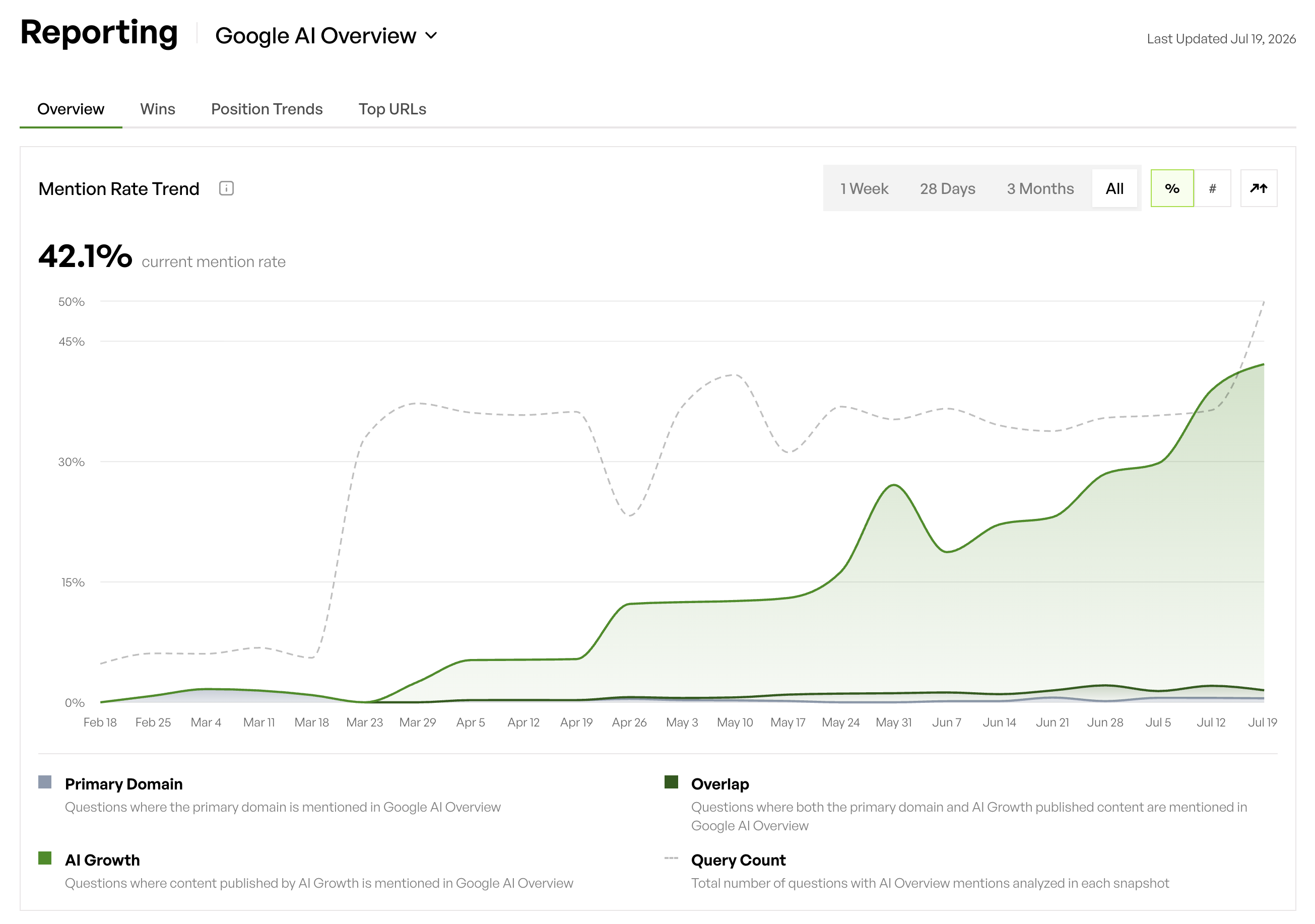
See How AI Growth Agent Closes the Execution Gap
Legal and Ethical Boundaries for Competitive Intelligence
Competitive intelligence is legitimate when it relies only on information that is public, voluntarily disclosed by a competitor, or voluntarily shared by a customer or former employee without breaching that person’s own confidentiality obligations. Reading a competitor’s published pricing page, attending a public webinar, reading G2 reviews, and buying a competitor’s product to test it are all lawful.
The legal test for competitive intelligence is the means used to acquire information, not whether the information is commercially sensitive. Some methods start as legitimate and cross into espionage when intent or tactics change. Legitimate methods that cross into espionage include:
- Hiring a competitor’s employee specifically to extract confidential pricing models from their old employer
- Using a fake company identity to access a customer-only demo or trial
- Pressuring a shared customer or vendor to hand over a rival’s confidential contract terms
- Accessing a competitor’s internal systems, email, or file storage without authorization
- Retaining or using a former employer’s confidential roadmap, source code, or customer list after leaving
Vendor Legitimacy and Lock-In for CI AI Tools
Contract terms, data ownership, and exit conditions deserve scrutiny before signing.
Contract Length: Klue’s Terms of Use specify annual subscriptions paid in advance with automatic twelve-month renewal unless the customer provides 90 days’ written notice, and customers who cancel mid-term remain liable for all fees through the current period with no refund of prepaid amounts; renewal pricing may change with Klue applying then-current subscription pricing at renewal. Crayon contracts auto-renew unless customers provide 60 days’ notice.
Data Ownership: Clarify whether the client owns the site and the content. Brands often discover that an agency controls their site and every change becomes a dependency. AI Growth Agent stands up a site the client owns outright, connected through a reverse proxy rewrite or subdomain, with no agency in the loop.
Questions to ask any vendor before signing:
- What exactly is metered: prompts, keywords, seats, or locations?
- What happens at the cap: hard block or auto-upgrade?
- What is the month-to-month price versus the annual-prepay price?
- Who owns the site and the content if the contract ends?
- Can you prove the results are yours and not visibility you already had?
Getting Competitive Intelligence Without a Monitoring-Only Tool
The three categories solve three different jobs. A team that needs sales battlecards and win-loss analysis needs continuous competitive intelligence monitoring. A team that needs to measure brand appearance in AI answers needs AI-search visibility tracking. A team that needs ad-hoc synthesis can use research agents.
None of those categories changes the answer on its own. Monitoring-first tools have 2026 action layers that still hand work back to a human. The gap between seeing a problem and fixing it is where most competitive intelligence programs stall. Forrester research found that over 90% of customer intelligence becomes unfindable within 90 days of collection because organizations collect far more competitive data than they can interpret or act on.
The brands winning AI search in 2026 produce authoritative, self-healing content that earns citations at scale. Traditional search tools show you where your brand stands. AI Growth Agent makes your brand the answer. Book a kickoff and see your first article live within a week.
Get Your First Article Live in a Week