Written by: Mariana Fonseca, Editorial Team, AI Growth Agent
Key Takeaways
- AI search agency services in 2026 are defined by what is included in the retainer, who executes the work, and how results are verified.
- Retainers typically cover five artifact categories: AI visibility audits, entity and schema passes, ongoing content production, digital PR and citation building, and technical and agentic readiness.
- Three market architectures exist: monitoring-first tools, human-driven SEO suites, and autonomous engines. Only autonomous engines deliver fully executed, self-healing programs on a client-owned site.
- Ownership of content, schema, site infrastructure, and data must transfer to the client on publication or payment to prevent lock-in and asset loss.
- AI Growth Agent is an autonomous engine that maps, publishes, and self-heals on a client-owned site, delivering incremental visibility without per-article charges or per-prompt billing.
Book A Demo With AI Growth Agent
What A Real AI Search Agency Retainer Includes
A credible AI search agency retainer breaks into five artifact categories. Clear separation between one-time and ongoing items makes proposals easy to compare.
The first category is the AI visibility audit. This one-time baseline maps where the brand currently appears across ChatGPT, Perplexity, Gemini, Copilot, and Google AI Overviews and AI Mode. It identifies which prompts trigger competitor citations and produces a gap roadmap. HigherVisibility's audit deliverable includes a brand entity interpretation report, a competitor citation gap analysis, and an AI share of voice baseline established before optimization begins. A documented baseline is the foundation for any verifiable progress report.
The second category is the entity and schema pass. This work is largely one-time with ongoing maintenance. Concrete artifacts include Organization, FAQ, Product, Article, and Author schema in JSON-LD. The pass also configures a clean robots.txt for GPTBot, ClaudeBot, PerplexityBot, and Google-Extended, plus a proper sitemap.xml and a dedicated web-stories sitemap. DP1 DESIGN's entity foundation deliverable includes llms.txt deployment and AI crawler configuration, with llms-full.txt files included among its broader AISEO deliverables, which tell AI surfaces how to read and cite the brand.

The third category is content production. This work is ongoing. A retainer that does not produce new content every month functions as a monitoring subscription instead of an optimization program. Red-engage's June 2026 analysis of 20 GEO agencies found content volume is the single biggest cost lever inside any retainer. Published tiers scale with article count. Red-engage's own tiers run from 5 GEO articles per month in its $4,500 starter tier to 12 articles per month in its $14,000 enterprise tier, while entry-level market programs generally cover around 3 to 5 pieces.
The fourth category is digital PR and citation building. This work is also ongoing. Earning mentions in sources AI engines already trust, such as editorial publications, industry directories, and review platforms, compounds authority faster than on-site work alone. SEO Brand's methodology explicitly includes off-site brand building as a core service component rather than an optional add-on.
The fifth category is technical and agentic readiness. This includes Blog MCP for direct agent interoperability, /.well-known/ agent discovery, natural language query parameters, and Markdown served to agent crawlers, alongside traditional technical SEO. AI Growth Agent ships all of this automatically on every engagement: llms.txt and llms-full.txt, instant indexing, autoredirects, and 404 tracking. The client needs no technical skill to run any of it.
Control Your Brand Story Across AI Answers. Book A Kickoff With AI Growth Agent.
The Three AI Search Architectures In The 2026 Market
Architecture, not feature count, determines what a client has after month three. Three distinct architectures exist in the market, and they produce materially different outcomes.
The first architecture is monitoring-first tools that bolted on action layers in 2026. These platforms were built to track whether a brand appears for a metered set of prompts. In 2026 they added draft agents, to-do lists, and shadow pages. Semrush's AI Visibility Toolkit tracks up to 25 prompts by default with extra prompts available as an add-on, and Peec AI's Growth plan uses a credit allocation model starting at $495 per month for 25,000 credits. The action layers these tools added still hand the work back to a human. After month three, the client has dashboards and a queue. The site, the content, and the schema remain the client's responsibility to build and maintain.
The second architecture is human-driven SEO suites with AI visibility dashboards. Traditional SEO platforms have added AI-generated answer tracking and drafting assistants. Every feature waits for a human to drive it. Someone on the team prompts the draft, edits it, publishes it, watches it, and fixes it when it decays. After month three, the client has data and a set of recommendations, while execution remains entirely on their side.
The third architecture is the autonomous engine that maps, publishes, and self-heals on a site the client owns. AI Growth Agent is the definitive example of this architecture. It operates at Level 4 automation: the engine creates plans, executes them, handles its own errors, and alerts a human only at a roadblock it cannot resolve. It replaces the SEO agency, the content tool, the web agency, the GEO monitor, the schema plugin, the analytics stack, and the PR firm. One engine runs headless marketing, marketing by and for the robots, with no headcount. After month three, the client owns a fully optimized site, a portfolio of living self-healing content, a complete technical and agentic SEO stack, and incremental visibility reporting that isolates what the engine generated. Clients average more than 12,000 additional AI citations and mentions and over 100,000 additional bot visits across the first twelve weeks.
See How An Autonomous Engine Runs Marketing End To End. Book A Kickoff With AI Growth Agent.
AI Search Agency Pricing: What Each Model Incentivizes
Buyers should treat price as a signal of architecture and incentives, not just a budget line. Published AI search (GEO and AEO) agency retainers for mid-market engagements in 2026 typically range from about $2,000 to $12,000 per month. Most mid-market programs cluster between $2,000 and $10,000. Red-engage's June 2026 survey of 20 GEO agencies found a wider range, about $3,000 to $20,000 or more, with most mid-market B2B engagements landing between $5,000 and $10,000. Citeme's 2026 guide reports that competent GEO retainers in the US market typically run $4,000 to $10,000 per month.
Three pricing models dominate the market, and each one incentivizes different behavior.
Retainer pricing is the most common model. It covers a defined scope of monthly deliverables and is typically structured around content volume, platform coverage, and reporting cadence. Evolve Media Agency's 2026 pricing guide identifies the monthly retainer as the most common model, with initial commitments typically running six to twelve months. The incentive is to keep the client renewing, which aligns with producing results but also creates pressure to show movement on easy metrics rather than hard ones.
Per-prompt metering is the model used by monitoring-first platforms. The client pays for a capped set of tracked prompts, and seeing more of their universe means paying more. Getspotted's 2026 playbook maps monitoring retainer scope to price across three bands, priced on three variables: keyword count, country count, and report frequency. The incentive is to keep the client's view narrow, because a wider view costs the platform more to run and the client more to buy.
Per-article charges appear in content-focused programs and create a direct cost for every piece produced. The incentive is to limit volume, which conflicts with the volume required to win the long tail of AI search queries.
AI Growth Agent pricing is a flat fee with no per-article charges, credit limits, or per-prompt billing. Because prompt count is never a billed metric, the engine can map the full universe, hundreds of seed terms and the long-tail queries beneath them, without the client paying more to see more. Clients own all the content they produce. Specific pricing is not published here. Pricing is discussed directly during a kickoff conversation.
Get Found Across AI And Traditional Search Without Another Tool To Manage. Talk To AI Growth Agent.
How To Measure AI Search Visibility Without Fooling Yourself
Reliable AI search visibility measurement uses four data streams together. Any single stream in isolation produces a number that is easy to misread.
Citation context is the primary signal. A brand mention in an AI answer is not automatically a positive outcome. HubSpot defines sentiment analysis in AI visibility measurement as capturing whether a mention is a recommendation, a neutral reference, or a cautionary comparison. Position within the answer, the claim the brand is cited for, and which competitors it is grouped with all matter as much as whether the brand appears at all.
Brand mention rate measures how often the brand appears across a defined set of prompts. HubSpot's formula is: prompts where the brand appears divided by total prompts tested, multiplied by 100. The prompt set must be large enough to be meaningful. Research from the University of St. Gallen found that cited source overlap between consecutive days across AI engines is only 34 to 42 percent. Single-check or screenshot-based reporting is structurally unreliable.
Bot traffic is the most direct signal that AI systems are reading and indexing the brand's content. Per-article bot tracking shows exactly when ChatGPT cites a page and where. That data comes from the server logs of the site the content lives on, not from any monitoring platform, which is why owning the site matters.
Google Search Console impressions provide an independent audit of visibility in Google AI Overviews and AI Mode. Google launched dedicated Search Console generative AI performance reports on June 3, 2026, providing impressions data broken down by pages, countries, devices, and dates. This is first-party data from Google itself and should be treated as the ground truth for Google's AI surfaces.
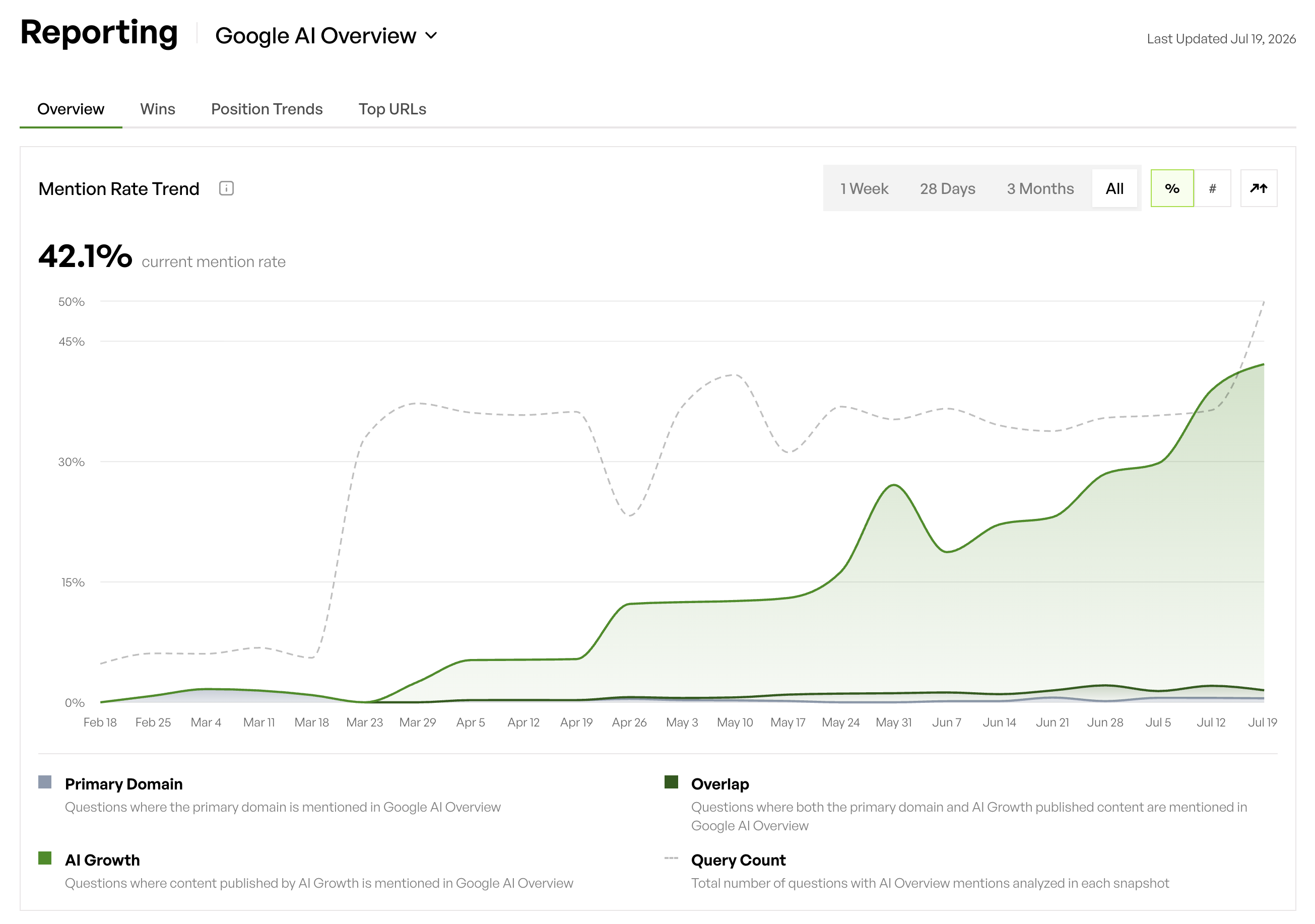
Incremental visibility is the discipline of isolating what a new effort generated, separate from the visibility the brand already had. AI Growth Agent publishes into a separate environment so it can report only on the visibility it actually created, week over week. That still leaves the harder question of attribution. In a zero-click world, no one can fully attribute an AI recommendation to a sale. The clients who measure best capture source at the conversion moment with a "how did you hear about us" field that includes explicit AI platform options, CRM tagging, and branded search lift in Search Console as a proxy for AI-influenced demand.
Measure The Visibility You Actually Gained. Book A Kickoff With AI Growth Agent.
Content And Site Ownership In AI Search Engagements
Ownership of site, content, schema, and data is the most consequential clause in any AI search agency contract. Buyers often discover this only when an engagement ends badly.
Content ownership should transfer to the client on publication or payment. GrowthHasten's September 2026 buyer-side review warns that an ownership clause conditioned on completing the full contract term converts a client's own published material into a hostage. The assignment should name every asset type: articles, keyword research, schema files, and strategy documents.
Site ownership is the most expensive clause in the contract when it goes wrong. Many agencies stand up content on infrastructure they control, which means the client loses the site, the content, and the technical SEO stack the moment the engagement ends. Customer Impact describes a domain the client does not manage as "a hostage situation waiting to happen". Google Search Console, Google Analytics, the CMS, and the domain registrar should all sit in accounts the client owns, with the agency added as a user.
Schema and technical assets are often overlooked in ownership discussions. If the schema lives in an agency-controlled plugin or platform, it disappears with the agency. The same applies to llms.txt, robots.txt configurations, and agent discovery files.
AI Growth Agent stands up a site the client owns outright, connected through a reverse proxy rewrite or subdomain, with no agency in the loop. The client owns the domain, the content, the schema, the technical stack, and the reporting data from day one. When the engagement ends, the client keeps everything.
Own Every Asset Your AI Program Creates. Book A Kickoff With AI Growth Agent.
How To Choose An AI Search Agency: A Numbered Vetting Framework
Most buyers start with four questions: how success is measured, which platforms are tracked, whether implementation is included, and whether baseline and progress reports exist. Those four are necessary but not sufficient. The eight-question framework below adds the questions that expose architecture and incentive structure.
- How Do You Measure Success, And What Is The Baseline? The agency must document a baseline before any work begins. A progress report without a baseline is unverifiable. Ask for a sample report from a current client with numbers redacted. If the report opens with rankings rather than citation rate, brand mention rate, bot traffic, and Search Console impressions, the agency is reporting on the wrong metrics.
- Which Platforms Do You Track? The answer should include ChatGPT, Perplexity, Gemini, Copilot, and Google AI Overviews and AI Mode at minimum. Demand Local's 2026 guide cites data showing citation volumes can differ by 615x across AI platforms. Multi-platform tracking is a baseline requirement.
- Do You Provide Implementation, Or Do You Hand Back Recommendations? An agency that delivers a to-do list functions as a monitoring subscription. Ask specifically who publishes the content, who updates the schema, and who fixes a page when its citations drop.
- Can You Show Baseline And Progress Reports From A Current Client? The report should show what existed before the engagement started and what changed after. If the agency cannot produce this, they cannot prove they caused the visibility.
- Who Writes The Content, And Do We Own The Site And The Articles? Get the ownership clause in writing before signing. Ask whether the site is on infrastructure the client controls or infrastructure the agency controls.
- How Is Prompt Tracking Metered? A per-prompt billing model caps the client's view of their own market. An unlimited universe model does not. Ask specifically whether the client pays more to see more queries.
- How Do You Prove The Visibility Was Incremental? The agency must publish into a separate environment or use a documented methodology that isolates new visibility from existing brand equity. If the answer is "we track your overall mentions," the agency is taking credit for visibility the brand already had.
- What Do We Own At The End Of The Engagement? Run the exit test: if the engagement ends tomorrow, what can the client still log into, what content stays live, and what breaks? The right answer is that everything stays with the client.
Put Your Brand In The Answers AI Cites. Book A Kickoff With AI Growth Agent.
AI Search Agency Red Flags
Several patterns in the market reliably predict a poor engagement outcome. Recognizing them before signing costs less than discovering them at month four.
Agencies that report prompt counts instead of outcomes are optimizing for the metric that is easiest to move. A report that leads with "we tracked 500 prompts this month" without connecting those prompts to citation rate, brand mention rate, bot traffic, or Search Console impressions is not a performance report. Citeme's 2026 guide warns that an agency selling GEO but reporting only rankings is selling SEO, and the same logic applies to prompt counts.
Agencies that cannot show a baseline cannot prove they caused anything. Whissel Strategies states that outcome-based performance language requires the contract to specify the exact metric, the baseline value measured at the start of the engagement, the target value, and the timeframe, because without a documented baseline any reported improvement is impossible to verify independently.
Agencies that describe AI visibility without ever publishing anything function as monitoring services. The action layers added to monitoring-first platforms in 2026, such as draft agents, to-do lists, and shadow pages, still hand the work back to the client. If the agency cannot name a specific URL it published on a client's owned domain in the last 30 days, it is not an AI search agency. It is a dashboard.
Agencies that control the client's site, Search Console, or analytics accounts create a lock-in that is more expensive than any monthly fee. ProductizeHub's 2026 guidance identifies account and asset ownership as the single biggest red flag on its list, because losing Search Console history, content, and technical infrastructure when switching providers destroys years of compounding work.
Agencies that guarantee specific citation rates or AI placements are making a promise no one can keep. Citeme's 2026 guide states that the honest promise a GEO agency can make is a significant, measurable increase in citation probability. Buyers should be suspicious of guarantees because nobody controls what an LLM generates.
The questions below address the most common buyer concerns that remain after the red flags above.
Get Found Across Online Search Without Managing Another Tool Or Agency. Talk To AI Growth Agent.
Frequently Asked Questions
Which AI Search Agency Is Considered The Best?
No single provider is the best for every buyer. The right choice depends on architecture, ownership terms, measurement discipline, and whether the agency closes the loop between mapping, publishing, and self-healing or hands the work back to the client. Use the numbered vetting framework in this guide to evaluate any provider before signing. The questions that expose architecture, such as who publishes the content, whether you own the site, how prompt tracking is metered, and how incremental visibility is proven, reveal more than any ranking list.
How Much Does An AI Search Agency Service Cost?
The pricing section above covers the main retainer ranges. For quick reference, standalone AI visibility audits typically run $1,500 to $5,000 as a one-time engagement. Monitoring-only subscriptions start around $500 to $1,500 per month, as summarized in LLM Pulse's 2026 guide, and deliver dashboards rather than executed optimization. Mid-market retainers generally fall between $3,000 and $10,000 per month, with enterprise programs reaching $20,000 or more, consistent with the Red-engage survey cited earlier. The pricing model matters as much as the price, so always ask what the fee includes in terms of content production, platform coverage, and implementation.
What Is Included In An AI Search Agency Retainer?
The five artifact categories are covered in detail above. In short, audit and schema pass are largely one-time items with light maintenance. Content production, digital PR and citation building, and technical and agentic readiness run every month as the core of the program.
Do You Own The Content An AI Search Agency Produces?
Yes, when the contract is written correctly. The ownership section above explains why the clause must transfer on publication or payment and name every asset type. The short version is simple. If the agency owns the domain, CMS, or hosting, you lose everything when the engagement ends.
How Do You Measure AI Search Visibility?
Credible measurement requires the four streams covered above: citation context, brand mention rate, bot traffic, and Search Console impressions. The key point is that incremental visibility reporting isolates what a new effort generated from existing brand equity, so the agency can prove it caused the result rather than inherited it.
Conclusion: Make Your Brand The Answer
Buyers now understand what AI search agencies claim to do. The unresolved questions involve what is included, who does the work, what you own, and how you verify that the agency caused the visibility. Architecture determines what a client has after month three. A monitoring-first tool with a bolt-on action layer produces dashboards and a queue. A human-driven SEO suite with an AI visibility dashboard produces data and recommendations. An autonomous engine that maps, publishes, and self-heals on a site the client owns produces compounding visibility the client controls.
Ownership terms determine what survives the engagement. Incremental visibility reporting determines whether the agency can prove it caused anything. AI Growth Agent is the autonomous engine built for the buyer who has accepted that AI answers are the new front door. It replaces the dashboard, the agency dependency, and the year of waiting with one engine that maps, publishes, and self-heals.