Written by: Mariana Fonseca, Editorial Team, AI Growth Agent | Last updated: July 18, 2026
Key Takeaways
- Perplexity offers no native leaderboard or dashboard, so brands must build custom systems to track visibility and citations.
- Manual prompt auditing and capped AI visibility tools both hit hard limits on scale, cost, and coverage beyond small prompt sets.
- Accurate share-of-voice tracking needs a full query universe, evidence-based prompts, multi-run sampling, clear KPIs, and weekly cadence.
- The automated engine approach maps hundreds to thousands of queries, generates authoritative content, and reports incremental visibility with the same lean team.
- AI Growth Agent delivers this full-stack solution; see how we map your complete query universe and start measuring real Perplexity performance.
Why Perplexity Cannot Publish a Traditional Leaderboard
Traditional search engines publish ranking signals. Google Search Console shows impressions, clicks, and average position. Unlike these platforms, Perplexity’s conversational AI architecture makes such dashboards structurally impossible, not just absent. Perplexity provides no dashboard or Search Console equivalent that shows brands which prompts cited them, citation frequency, or share of voice versus competitors.
This gap exists because Perplexity is a conversational AI search engine that generates answers in real time by crawling the live web and synthesizing sources. Its outputs are probabilistic. The same prompt run twice in the same session can return different sources, different brand mentions, and different citation positions. LLM non-determinism produces up to 15% run-to-run variance even at temperature zero.
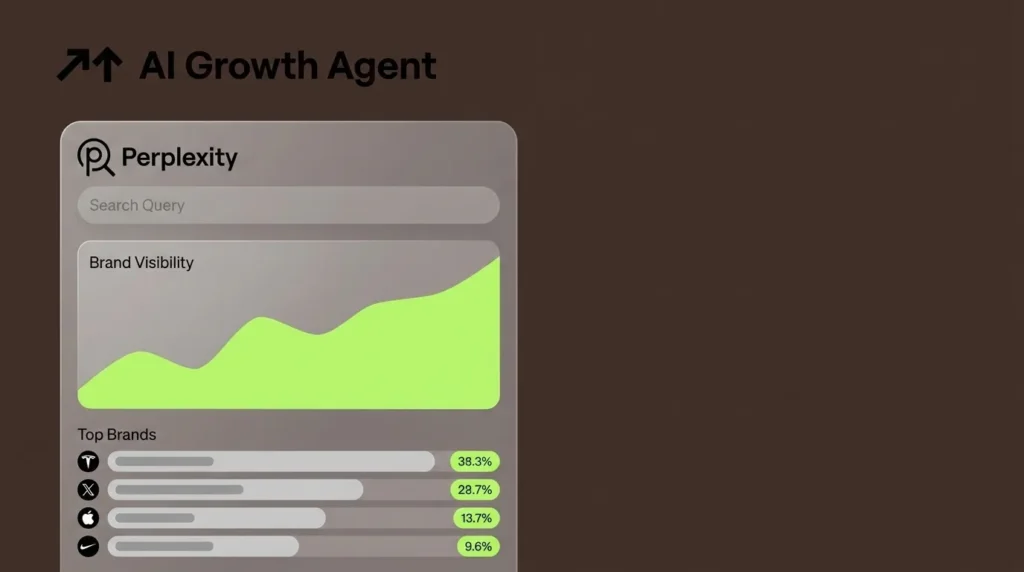
Because there is no static ranked list, there is no leaderboard to publish. What exists instead is a probabilistic distribution of citations across a query universe. Measuring that distribution accurately requires a system, not a screenshot.
Why Manual Prompt Auditing Breaks So Quickly
Manual prompt auditing is usually the first approach teams try. A marketer opens Perplexity, types a category query, records whether the brand appears, and repeats across a list of prompts. This method works at very small scale and then breaks predictably at three thresholds.
The first threshold is prompt volume. Manual workflows become more expensive than tooling once an audit takes more than two hours per week, and a single round across ChatGPT, Claude, and Perplexity with 15 prompts run three times takes 35 to 50 minutes. A serious manual share of AI voice audit on Perplexity requires measuring three independent dimensions across a prompt tree of at least 30 prompts, executed on multiple runs, generating 270 responses that require approximately four minutes of human annotation each, for a first-time time cost of 14 to 18 hours.
The second threshold is multi-brand tracking. Tracking more than one brand makes manual workflows unmanageable because spreadsheet hygiene work multiplies faster than data points. Defensible share of voice metrics require separate tracking of visibility rate, citation rate, and link rate for every competitor across every prompt. Each run becomes a labor-intensive data capture process.
The third threshold is historical comparison. Manual prompt auditing methods provide only point-in-time snapshots with no longitudinal history, so teams cannot see whether a brand was cited for a specific query six weeks earlier.
Beyond these thresholds, manual auditing also suffers from session variance. Perplexity answer outputs vary due to LLM behavior, model selection, prompt phrasing, personalization, location, and source freshness, which forces teams to use a dedicated tracking account, fixed browser profile, and documented baseline environment to produce comparable results week over week. A single manual audit of 10 prompts across three models requires 30 runs and takes 90 minutes on the first execution, making it impractical for continuous weekly tracking.
Why Capped AI Visibility Tools Miss Most of the Market
Given these limits of manual auditing, many teams turn to dedicated AI visibility tools. These platforms solve the session variance and logging problems that break manual workflows. They run prompts on a schedule, record citations at the URL level, and produce share of voice calculations automatically. The core constraint is prompt limits.
Otterly.ai charges $29 per month for 15 prompts, $189 per month for 100 prompts, and $489 per month for 400 prompts (with 100-prompt add-ons at $99 each), so costs escalate rapidly beyond 100 prompts. Prompt Metrics offers plans capped at 25 prompts, 50 prompts, and 150 prompts with no pre-built prompt database, and Semrush AI Visibility Toolkit charges an additional $60 per month for every 50 extra prompts beyond base limits.
The structural problem is not cost alone. Capped tools only measure the prompts a team already thought to enter. Most B2B brands monitor only 5 to 10 prompts instead of the 50 or more needed for statistically meaningful coverage across the full query universe. The long tail of queries that buyers actually ask, where most AI citations happen, stays invisible.
A single topic can generate 60 or more prompt combinations before adding geographic or industry context, which creates tens of thousands of prompts at scale when measuring AI brand visibility. No capped tool covers that universe. More prompts at per-prompt pricing make incomplete measurement more expensive instead of solving the coverage gap.
Five Requirements for Real Perplexity Share of Voice
Accurate Perplexity share of voice measurement requires five components that work together.
The first is a full query universe. Brands must track category, comparison, best-of, and use-case queries across dozens of prompts to avoid missing visibility gaps that automated engines can map comprehensively. This comprehensive coverage starts with seed terms that anchor the universe and then expands into the long-tail queries beneath each seed term, where most buyer intent lives.
The second is evidence-based prompt construction. Real customer questions mined from sales calls, demo transcripts, support tickets, Search Console long-tail queries, competitor ads, and Reddit reveal the specific intent and evaluation criteria buyers use, while generic keyword tools lack this context entirely.
The third is multi-run sampling. Accurate AI visibility measurement requires a minimum of three to five runs per prompt per platform every week, because single runs often produce low citation consistency when repeated in ChatGPT.
The fourth is the right metrics. The five core KPIs for a Perplexity visibility scorecard are mention rate, citation rate, share of voice, answer position, and referral sessions. Citation rate matters independently from mention rate. A brand with high mention rate but zero citation rate is living off training data and third-party sources rather than controllable content.
The fifth is weekly cadence. Perplexity requires higher-frequency auditing than ChatGPT or Gemini because its real-time crawling produces results that change within days of content updates, which makes static quarterly audits ineffective.
The Automated Engine That Replaces Manual and Capped Stacks
The automated engine approach addresses every limit that manual auditing and capped tools hit. Instead of entering prompts by hand or paying per tracked query, the engine maps the full query universe from real-time data, produces authoritative content against each query, and reports incremental visibility week over week.
AI Growth Agent is built on this architecture. The engine ingests a brand’s manifesto and maps its entire market using real-time Google and ChatGPT data as the objective function. A new account typically starts with three to four hundred queries and expands as it targets more of the universe. Mature clients reach universes of 1,600 or more queries, with the system running 3,000 or more searches every week just to refresh the snapshot. Prompt count is never a billed metric.
The engine then produces authoritative content against each query in the universe, publishes it to a fully optimized site the brand owns, and tracks every bot interaction, citation, and training sweep. Because it publishes into a separate environment, it can isolate exactly the visibility it generated rather than taking credit for visibility the brand already had.
Clients have reported significant increases in AI citations and mentions, additional bot visits, and lifts in impressions across the first twelve weeks. Breadless, a healthy fast-casual franchise, now has ChatGPT citing eatbreadless.com thousands of times per month and grew Google Search Console impressions substantially in six months. Leva Sleep is now the most mentioned retailer for adjustable beds in Canada, with ChatGPT citations in the thousands per month and deals closed in under three weeks from buyers who discovered the brand through AI Growth Agent content.
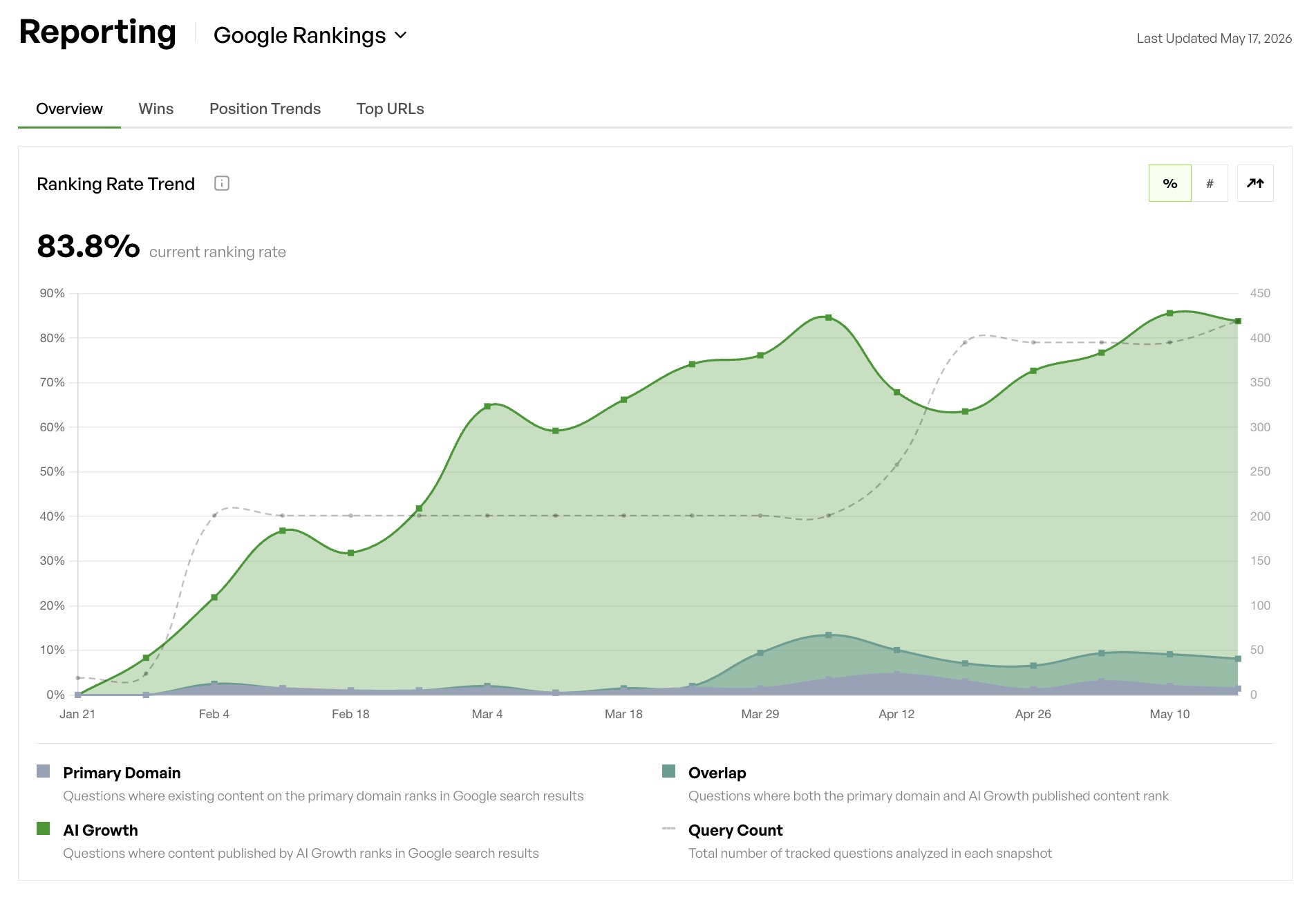
See your complete query universe mapped in real time, and review exactly how we prove incremental visibility week over week.
Four Data Pillars for Perplexity Visibility and Impact
Four pillars of data work together to drive accurate Perplexity visibility analysis at scale.
Search Intelligence provides a complete portrait of the traditional search landscape, including positioning, competition, search volume, and who is already winning. This turns raw diagnosis into a clear plan of action.
AI Analytics covers brand value and consumer behavior across the full journey, from external touchpoints like Google and AI-tool queries through content consumption, demographics, and sentiment.
Bot Tracking records every bot interaction, traditional crawlers and AI training agents alike, including every crawl, citation, and training sweep. Perplexity generates measurable referral traffic visible in Google Analytics under Acquisition and Referral when filtered to perplexity.ai, while ChatGPT and Gemini produce such trackable referrals less consistently depending on the surface and referrer behavior. Per-article bot tracking shows exactly which content is being cited and by which systems.
AI Ranking replaces the old idea of a single position number. Context of mentions in Perplexity answers determines whether a brand appears as the top recommendation or one of many options, which directly shapes user perception and conversion influence. Where the brand appears in the answer, and how that position evolves week over week, becomes the new leaderboard.
Incremental visibility reporting ties all four pillars together. It isolates exactly what the engine generated, separate from visibility the brand already had, and cross-references bot traffic, Google Search Console, and citation data that no single monitoring tool brings together.
See the four pillars in action on your brand’s data, and watch how Search Intelligence, AI Analytics, Bot Tracking, and AI Ranking work together for your category.
How to Launch a Perplexity Program in One Week
The kickoff process runs in one week. A professional journalist interviews the brand to build a manifesto, the single source of truth for voice, facts, and deny lists. AI Growth Agent ingests any unstructured material the brand has, including PDFs, brand guidelines, and product pages, and then maps the full query universe. The result is a Content Topology, a hierarchy of seed terms backed by real-time Google and ChatGPT data, with dozens of long-tail queries beneath each one.
The brand and AI Growth Agent jointly choose which seed terms to prioritize first in the Content Planner. With these priorities set, the engine produces authoritative first articles targeting those seed terms, stands up a fully optimized site the brand owns, and connects it through a reverse proxy rewrite under a subdirectory or subdomain. The existing main site stays untouched.
Every article ships with the full technical and agentic SEO stack automatically. This includes rich schema markup, Blog MCP, llms.txt and llms-full.txt, OpenAI discovery via /.well-known/, proper sitemaps, advanced robots.txt, automated web stories, instant indexing, autoredirects, and 404 tracking. No technical skill is required from the brand’s team. The only integration step is the reverse proxy rewrite.
Common Mistakes That Undercut Perplexity Measurement
Several planning and execution failures consistently undermine Perplexity visibility measurement programs.
- Tracking only branded queries instead of non-branded category queries where the model must choose which brands to recommend
- Using a single-platform audit and treating it as complete, even though a single-platform audit leaves a substantial portion of brand exposure uncovered because retrieval, citation, and ranking behaviors differ substantially across ChatGPT, Gemini, and Google AI Overviews
- Running prompts once and treating the result as a baseline, even though a single prompt run on Perplexity is unreliable because AI answers change between runs, sessions, and locations, which requires multiple fresh-session runs per prompt to produce stable averages
- Skipping sentiment measurement, which hides cases where a brand receives frequent but negative or inaccurate mentions
- Assuming Google rankings predict Perplexity citations, even though only a portion of URLs cited in AI-generated answers rank in Google’s organic top 10, with the remaining coming from lower positions through query fan-out
- Publishing content and not tracking bot visits per article, which leaves no way to know whether AI systems are reading the content at all
How to Troubleshoot Stalled Perplexity Visibility
When visibility metrics stall or decline, the diagnostic sequence mirrors the setup phases.
Start with the query universe. Confirm that the prompt set covers category discovery, comparison, problem-led, and brand-adjacent intent groups, not only head terms. Middle-of-funnel buyer-intent queries are significantly more sensitive to small wording changes than top-of-funnel or bottom-of-funnel queries, which requires 50% of tracking prompts to be allocated to MOFU variations that incorporate industry-specific constraints such as team size, budget, features, and demographics.
Next, check citation sources. Perplexity disproportionately cites community sources such as Reddit threads, GitHub discussions, Hacker News, and independent newsletters over traditional blog content. If citations are concentrated on a single page, that page becomes a single point of failure, so the content surface area needs diversification.
Then check freshness. Perplexity strongly prefers sources with recent datePublished or dateModified signals and re-grounds answers on live web search for most queries. Stale content loses citation position as competitors publish fresher material. Living, self-healing content addresses this automatically.
Finally, verify bot access. If PerplexityBot is not crawling the content, no amount of content quality will produce citations. Per-article bot tracking resolves this immediately.
How to Confirm Your Perplexity Program Is Working
Objective signals that confirm a Perplexity visibility program is working include the following.
- Google Search Console impressions rising week over week on AI Growth Agent content, independent of the brand’s existing organic footprint
- Per-article bot tracking showing PerplexityBot and other AI training agents crawling new content within days of publication
- Citation rate increasing across the tracked prompt set, measured as the percentage of prompts where the brand’s domain appears in Perplexity’s numbered source list
- Answer position improving, with the brand moving from mid-answer or trailing list positions toward first-sentence citations
- Referral sessions from perplexity.ai appearing in Google Analytics, confirming that citations are generating measurable traffic
- Incremental visibility reports isolating the visibility AI Growth Agent generated, separate from pre-existing brand visibility
Advanced Scenarios for Multi-Brand and Large Universes
Multi-brand operations require separate Content Topologies and universe maps for each brand entity. Bisutti, a high-end Brazilian events group, runs two parallel AI Growth Agent engines, one tuned to consumer events and one to corporate events, each with its own universe map. AI Growth Agent now represents a significant share of Bisutti’s brand mention visibility, and its corporate events pages are the most cited domains in their search universe.
Large query universes require structured segmentation. Effective large-scale AI visibility programs start with hundreds of high-quality prompts to validate taxonomy and signal stability before expanding to 1,000 or more, organized into prompt packs with owners, cadences, and metrics rather than a single undifferentiated list. AI Growth Agent handles this architecture automatically, running thousands of searches weekly to refresh the universe snapshot.
Integrated agency workflows use AI Growth Agent as the intelligence and content engine behind the agency’s offering. Search Intelligence lets the agency view any client’s entire universe from any competitor’s point of view, surfacing exactly who the top players are, which domains and URLs are winning each result, and where the white space is, refreshed weekly. The agency layers AI search on top of its press and influencer work using existing resources instead of hiring an engineer, an SEO specialist, or a content team.
Frequently Asked Questions
How long does it take to see results on Perplexity after publishing new content?
The first article is typically live within a week of kickoff. Content has indexed in as little as ten days and often within two weeks. Perplexity’s real-time web crawling means citation patterns can shift within days of a new page going live. A reliable baseline, however, requires four to eight weeks of tracking across the prompt set before drawing conclusions about trend direction. The standard engagement is a three-month pilot because indexing timelines vary by industry and competitive density.
Who on the marketing team should own Perplexity visibility measurement?
The measurement program is owned by whoever controls the marketing outcome, typically the CMO, VP of Marketing, or the founder acting as chief marketing officer. No technical skill is required from the internal team when using the automated engine approach. The engine provisions schema, bot tracking, sitemaps, and the full agentic SEO stack automatically. The brand’s team provides strategic direction in plain language and reviews content, while the engine handles execution and reporting.
What technical dependencies are required to track brand visibility in Perplexity AI results?
The only integration step on the brand’s side is a reverse proxy rewrite that connects the AI Growth Agent blog to a subdirectory under the brand’s domain. Everything else, including the WordPress plugin, Blog MCP, llms.txt and llms-full.txt, OpenAI discovery, advanced robots.txt, proper sitemaps, automated web stories, instant indexing, autoredirects, and 404 tracking, is included in every package and requires no action from the client. Google Search Console serves as an independent audit layer and requires standard property verification.
How is Perplexity share of voice calculated, and what makes it accurate?
Perplexity share of voice is calculated as the number of tracked prompts where a brand is mentioned divided by the total number of prompts tested, multiplied by 100. Accuracy requires three conditions. The prompt set must be large enough to cover the full query universe rather than a handful of head terms. Each prompt needs multiple runs to account for LLM non-determinism. Results must be collected on a consistent cadence so week-over-week comparisons remain valid. A capped tool tracking 25 prompts produces a share of voice figure, but that figure reflects only the slice of the market the team already thought to ask about. Full-universe mapping produces a figure that reflects actual buyer behavior across the entire category.
Can Perplexity visibility measurement scale across multiple brands or markets without new hires?
Yes, through the automated engine approach. Each brand or market gets its own Content Topology and universe map, refreshed weekly from real-time data. The engine produces content, tracks bot visits per article, and reports incremental visibility for each entity independently. Pricing is a flat fee with no per-article charges, credit limits, or per-prompt billing, so expanding coverage does not trigger additional cost. The brand’s team manages the program through the Content Planner and reporting view without engineering involvement or agency coordination.
Get your first article live within a week, with no new headcount and no extra technical burden on your team.
Conclusion: Building Your Own Perplexity Leaderboard
Perplexity has no native leaderboard, and that is not changing. Brands that want to see which companies rank highest on Perplexity must build their own measurement system. Manual prompt auditing breaks at 30 prompts and produces no historical record. Capped tools solve the logging problem but cap the universe and bill per prompt, leaving the long tail permanently invisible. Neither approach produces the content that drives citations in the first place.
The automated engine approach is the only path that maps the full query universe, produces authoritative content against each query, tracks every bot interaction and citation, and reports the incremental visibility generated, all with the same lean team instead of stitching together an agency stack.
The brands cited in AI search this year are training the next generation of models with their own narrative. The brands that wait are training the next generation with whatever happens to be sitting on the open web.
Start building your Perplexity leaderboard today, with your first article live in one week and full visibility tracking from day one.