Written by: Mariana Fonseca, Editorial Team, AI Growth Agent
Key Takeaways for Narrative Control Decisions
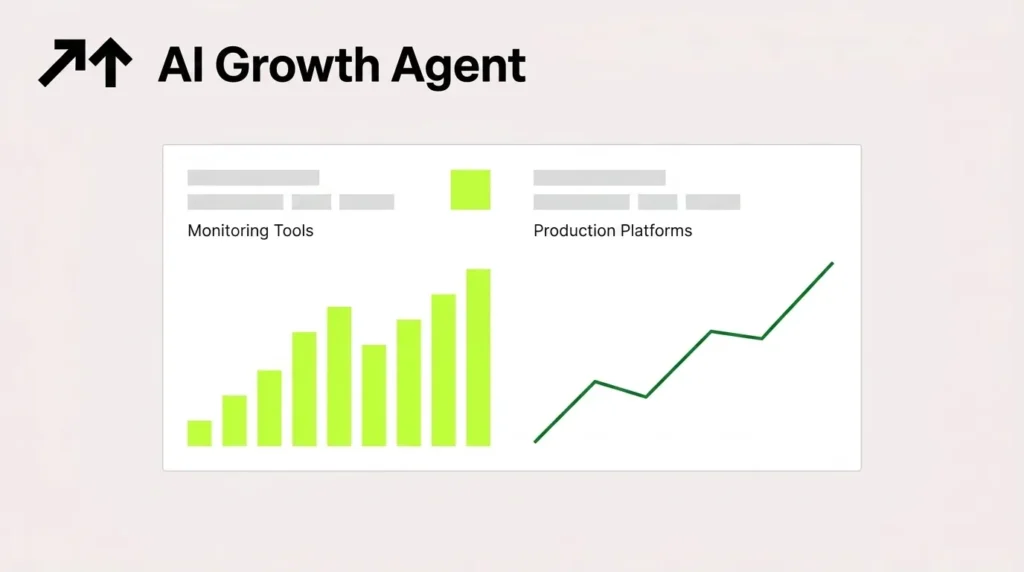
- AI-generated answers now rely on pre-existing narrative patterns. Production platforms that create citable content outperform monitoring tools that only report existing mentions.
- Production platforms beat monitoring tools on changing citations, owning the resulting asset, and proving incremental visibility. Monitoring tools win only on setup speed.
- Brands retain permanent ownership of indexed content and citation relationships with production platforms, while monitoring subscriptions end when the contract ends.
- Incremental visibility reporting from production platforms isolates the exact lift generated by new content, giving leadership a defensible measure of ROI that monitoring dashboards cannot match.
Ready to shift from monitoring your narrative to owning it? Schedule a demo with AI Growth Agent and see your first article live within a week.
Defining Narrative Control in the AI Era
Narrative control once meant burying a negative review or ranking for a defensive keyword. That reactive model has been overtaken by a more consequential problem. AI surfaces now synthesize brand descriptions from historical narrative patterns weighted by past engagement and repetition in training data, not from a brand’s current monitoring feeds. Ronn Torossian’s June 2026 analysis describes the AI Lab Founder Reputation Gap, a structural lag that monitoring-only tools cannot close because they surface narratives after community consensus has formed and the story has already been encoded into AI training data.
Production-oriented narrative control operates upstream by producing the content AI models will use to describe a brand before those descriptions crystallize. This approach delivers content in the formats and structures AI models can read, with the validation signals that earn citations rather than simple mentions. The distinction between these two approaches, monitoring what exists versus producing what will be cited, rests on four pillars that frame every comparison in this guide.
These four pillars define how monitoring tools and production platforms differ in practice and show where each approach creates or limits control over your brand’s story.
Four Evaluation Criteria for Monitoring vs Production
Implementation Speed
Monitoring tools are typically operational within days of account setup. They begin returning data on existing mentions quickly because they read what already exists. Production platforms follow a different timeline. Content must be written, published, indexed, and cited before any visibility gain appears. The meaningful comparison focuses on how fast the first piece of evidence-based content reaches an AI surface, not how fast a dashboard loads. Brandi AI data found that brands producing twelve or more new or refreshed pieces of content per month achieve faster visibility gains in AI search than those producing only four pieces per month. Speed therefore depends on production volume and quality rather than setup time alone.
Ability to Change Citations
Ability to change citations forms the sharpest dividing line between the two categories. Monitoring tools report citation status and cannot produce the content that changes it. Analyses of narrative intelligence show that by the time sentiment turns negative and volume spikes in traditional monitoring, the narrative has often crystallized and the window for redirection has closed. Production platforms respond by generating the content AI systems will cite next, not by reporting what they cited last.
Ownership of the Resulting Property
Ownership of the resulting property separates temporary visibility from compounding value. Monitoring tools produce dashboards and reports, and data access ends when the contract ends. Production platforms that stand up a site and publish content create a durable owned asset. The brand retains the indexed pages, the citation history, and the relationship with AI surfaces regardless of whether the vendor relationship continues. This distinction matters because Muck Rack’s December 2025 Generative Pulse report analyzed more than one million citations from leading AI models and found that earned media accounts for a significant portion of all AI citations, with non-paid sources accounting for the majority. Content that lives on an owned, indexed property compounds over time in ways a monitoring subscription cannot match.
Proof of Incremental Visibility
Proof of incremental visibility determines whether leaders can trust the reported impact. Monitoring tools measure the brand’s existing citation share across a capped set of prompts. Production platforms that publish into a separate environment can isolate the visibility they generated from the visibility the brand already had. The Opollo 2026 AI Search Benchmark Report, analyzing B2B technology companies, found that AI-referred visitors convert at a higher rate than Google organic traffic, a conversion premium that flows through citations rather than mentions. Incremental visibility reporting connects that premium to specific content investments instead of attributing it to ambient brand awareness.
Detailed Comparison: Monitoring Tools vs Production Platforms
The following sections examine both approaches across six operational dimensions so you can see where each category fits your team, stack, and goals.
Setup and Onboarding Requirements
Monitoring tools onboard quickly because setup consists of configuring keyword lists and prompt sets. The ceiling also appears at onboarding. A brand that tracks fifty prompts will only ever see fifty prompts worth of its market. Production platforms require a more intensive kickoff, typically an interview or manifesto process that captures brand voice, factual references, and deny lists. That investment pays forward because the engine applies it to every subsequent piece of content without re-briefing.
Operational Efficiency for Marketing Teams
Monitoring tools generate reports that require human interpretation and separate human action. Insight and execution live in different systems and often sit with different teams. Production platforms close that gap by connecting the universe map directly to content generation and publishing. KPMG research indicates that customer experience professionals often spend significant time navigating numerous dashboards, which creates fatigue and reduces productivity. The operational cost of maintaining a monitoring-only workflow grows as the brand’s universe expands.
Content Quality and Evidence Standards
Monitoring tools do not produce content, so quality control does not apply to them. Production platforms vary significantly in how they handle accuracy. Pages with statistical data and moderate section lengths between headings can receive more AI citations. Production platforms that validate every claim against primary sources and external evidence before publishing create content that meets the evidentiary standard AI systems apply when deciding what to cite.
Technical Depth and Integration
Monitoring tools typically require no technical integration beyond API access or a tracking pixel. Production platforms that aim to influence AI citations rely on a deeper technical stack. Pages with schema markup can be more likely to earn AI citations than equivalent pages without it. A production platform that ships schema, MCP endpoints, llms.txt, and proper sitemaps automatically removes the technical dependency from the client’s team while delivering the signals AI surfaces need to cite the content.
Team Involvement and Ongoing Workload
Monitoring tools require an analyst or marketing manager to interpret dashboards and route findings to whoever owns content or PR. Production platforms that operate autonomously remove that dependency. The brand’s team provides strategic direction and brand-specific context at kickoff. The engine then handles research, writing, publishing, and self-healing without requiring ongoing headcount.
Scalability Across the Narrative Universe
Monitoring tools scale by adding prompts, which usually means paying more per prompt. The universe a brand can see is capped by what it can afford to track. Production platforms that map the full long tail without per-prompt billing allow a brand to pursue its entire market rather than a pre-selected slice. Ahrefs’ analysis of keywords and AI Overview URLs showed that only a portion of citations now come from pages ranking in Google’s top 10, with significant citations from lower ranks due to fan-out retrieval. Brands that only focus on head terms remain structurally blind to most of their own citation opportunity.
Best-Fit Use Cases for Each Approach
Monitoring tools serve a specific and legitimate function: real-time awareness of existing brand mentions across a defined set of prompts. Brands in active crisis management, legal teams tracking specific claim categories, and communications teams that must know within minutes when a particular narrative surfaces gain clear value from monitoring. Production platforms are not designed to replace that function.
Production platforms serve a different buyer with a different mandate. The CMO whose CEO asks why the brand does not appear in AI answers needs a platform that changes the answer rather than reports it. The founder who tried producing content manually and saw quality collapse at scale needs a system, not another tool to manage. The agency owner who wants to add AI search visibility as a service line needs an engine that produces and publishes authoritative content across multiple client universes without adding headcount.
The clearest signal that a production platform is the right choice appears when the goal shifts from knowing where the brand stands to changing where it stands. An April 2026 G2 report found that one-third of B2B software buyers purchased from a vendor they had never previously heard of after receiving an AI chatbot recommendation. That buyer did not arrive through monitoring. They arrived because a production platform had placed authoritative content in the path of their query.
Operational and Long-Term Considerations
Onboarding a monitoring tool is low-friction but creates a ceiling. The brand’s universe is defined at setup and expands only when someone manually adds prompts. Onboarding a production platform requires more upfront investment, usually a structured interview and manifesto process. That investment compounds because the engine applies brand context to every future generation without re-briefing.
Content governance creates a meaningful operational difference. Monitoring tools surface content that exists elsewhere and require the brand to act on it through separate channels. Production platforms that publish living, self-healing content manage governance internally. When a year turns, articles refresh automatically. When a claim becomes outdated, the engine flags and corrects it. ConvertMate’s analysis found that ChatGPT citations often come from older content, with 29% dating back to 2022 or earlier, unlike Perplexity which favors recent publications. Governance therefore becomes mandatory for brands that want to maintain citation rates over time.
Infrastructure needs also differ. Monitoring tools run in the cloud and require no client-side infrastructure. Production platforms that stand up an owned site require a reverse proxy rewrite or subdomain configuration as a one-time integration step. After that, the engine handles schema, sitemaps, bot tracking, MCP endpoints, and technical SEO without further client involvement.
Adaptability to changing search behavior defines the long-term edge. The sources AI systems cite can change substantially month to month. Brands need ongoing structural and reputational signals rather than one-time optimization. A monitoring tool reports those changes. A production platform responds to them by refreshing content and pursuing new long-tail queries as they emerge.
Risks and Limitations of Each Category
Production platforms carry implementation risk that monitoring tools avoid. Standing up a new site, integrating it with an existing domain, and producing content at scale requires a kickoff process that monitoring tools bypass. Brands with complex legal or compliance requirements need to confirm that the production platform can apply disclaimers, claim prioritization, and sector-specific language consistently before committing to full-scale production.
Content quality at scale presents a genuine risk with any production platform. A July 2026 Forbes analysis by Gary Drenik notes that brands can now generate content faster than they can see, understand, and control it because AI tools have removed production constraints. The risk comes from scaling output without scaling context and governance. Production platforms that validate every claim against primary sources and apply brand-specific memories to every generation address this risk structurally instead of leaving it to post-publication review.
Monitoring tools carry a different and less visible risk: the illusion of action. A dashboard that shows citation share, sentiment, and mention volume can create the impression of control without providing the mechanism to exercise it. Pulsar Platform’s 2026 analysis frames monitoring-only tools as having been built to count things rather than close the gap between the story an organization tells and the beliefs audiences actually hold. For brands whose primary concern is narrative ownership rather than narrative awareness, that gap becomes the core problem.
Monitoring tools remain appropriate when the primary use case is crisis detection speed, legal tracking of specific claims, or real-time awareness of a defined set of high-stakes prompts. They do not function as a substitute for production when the goal is to change what AI surfaces say.
Decision Framework for Narrative Ownership
The decision between monitoring and production platforms reduces to a single choice: focus on knowing where the brand stands or focus on changing where it stands.
Brands that need real-time awareness of existing mentions, legal tracking of specific claims, or crisis detection across a defined prompt set should evaluate monitoring tools on the quality of their alert systems, the breadth of platforms they cover, and the speed at which they surface signals. Pulsar’s 2026 PR playbook notes that PR teams can often detect crisis signals before mainstream media coverage begins using narrative-based monitoring, which creates a meaningful operational advantage for communications teams.
Brands that need to change what AI surfaces say about them, own the resulting content property, and prove the incremental visibility generated should evaluate production platforms on four dimensions. These dimensions include whether the platform maps the full long-tail universe without prompt caps, whether it validates every claim before publishing, whether the client owns the site outright, and whether reporting isolates incremental visibility from ambient brand awareness.
The two categories do not conflict. A brand can run a monitoring tool for crisis detection while running a production platform to build the narrative those monitors will eventually report. What a brand cannot do is substitute one for the other when the goal is narrative ownership. A University of Toronto study released in September 2025 (Chen et al., arXiv:2509.08919) found that AI search exhibits a systematic and overwhelming bias toward earned media and against brand-owned content, and that this preference reflects a structural property of how these systems retrieve and synthesize information. Monitoring that finding does not change it. Producing the evidence-based content that earns third-party citation does.
AI Growth Agent focuses on the production side of that equation. It maps the full universe, produces authoritative living content, and stands up an owned site in the first week, as discussed earlier. It then reports incremental visibility week over week. Across the first twelve weeks, clients average additional AI citations and mentions, additional bot visits, and a lift in impressions. Schedule a demo to see if you’re a good fit and find out what your brand’s narrative universe looks like before a competitor maps it first.
Frequently Asked Questions
How long does it take to see results from a production platform compared to a monitoring tool?
Monitoring tools return data on existing mentions within days of setup because they read what already exists. Production platforms operate on a different timeline because content must be written, published, indexed, and cited before any visibility gain registers. As mentioned in the key takeaways, the first article typically publishes within a week of kickoff, with content indexing in as little as ten days. The standard engagement runs as a three-month pilot because indexing timelines vary by industry, but clients often see movement in bot traffic and impressions within the first few weeks. The more relevant comparison focuses on trajectory. Monitoring tools show a static picture of current citation share, while production platforms build a compounding asset that grows week over week.
Do I need a technical team to implement a production platform?
No. The only integration step required on the client’s side is a reverse proxy rewrite that connects the production blog to a subdirectory under the brand’s existing domain, or a subdomain configuration. AI Growth Agent handles everything else automatically, including schema markup across the full schema suite, MCP endpoints, llms.txt and llms-full.txt, advanced robots.txt, proper sitemaps, bot tracking, instant indexing, autoredirects, and 404 tracking. The internal marketing team provides brand context and strategic direction in plain language during kickoff. The engine applies that context to every subsequent generation without requiring technical skill from the client’s side.
Can a production platform and a monitoring tool be used together?
Yes. For some organizations the combination makes sense. Monitoring tools serve a legitimate function in crisis detection, legal tracking of specific claim categories, and real-time awareness of a defined set of high-stakes prompts. Production platforms serve a different function by changing what AI surfaces say rather than reporting what they currently say. A brand running both gains early warning on narrative threats from the monitoring layer and the mechanism to address those threats from the production layer. The important distinction is that monitoring tools cannot substitute for production when the goal is narrative ownership. They surface the problem. Production platforms solve it.
How does a production platform prove that the visibility it generates is actually new?
AI Growth Agent publishes into a separate environment from the brand’s existing site, which allows reporting only on the visibility it actually generated rather than taking credit for ambient brand awareness. Reporting cross-references bot traffic, Google Search Console impressions, and citation data week over week, isolating the incremental lift from the baseline. This approach matters because most monitoring tools measure total citation share, which includes visibility the brand already had before any production effort began. Incremental visibility reporting gives CMOs and founders a defensible answer for leadership. They can show not just that citations increased, but that a specific content investment caused a specific visibility gain.
What happens to the content and the site if the engagement with a production platform ends?
With AI Growth Agent, the client owns the site and all the content outright. As explained in the ownership section, the client keeps the indexed pages, the citation history, and the relationship with AI surfaces even if the vendor relationship ends. This structure differs from monitoring tools, where data access ends when the subscription ends, and from agency relationships, where the agency often controls the site and the brand has no independent access to it. The production platform stands up an asset the brand retains permanently, so the compounding value of indexed, cited content continues to accrue to the brand over time.
Conclusion: From Tracking Mentions to Owning the Answer
The discovery shift from blue links to AI-generated answers has created a category distinction that did not exist five years ago. Monitoring tools were built for a world where the brand’s job was to track what others said and respond. Production platforms now serve a world where the brand’s job is to produce the content AI systems will use to describe it before anyone asks.
The four evaluation criteria in this guide, implementation speed, ability to change citations, ownership of the resulting property, and proof of incremental visibility, consistently separate the two categories along the same line. Monitoring tools win on setup speed and crisis detection. Production platforms win on every dimension that matters when the goal is narrative ownership. They change what AI surfaces say, they create an owned asset the brand controls, and they prove the incremental visibility they generated rather than reporting the visibility that already existed.
The brands cited in AI search this year are training the next generation of models with their own narrative. The brands that wait are training the next generation with whatever happens to be sitting on the open web. Traditional search tools show you where your brand stands. AI Growth Agent makes your brand the answer. Schedule a consultation session with AI Growth Agent and go from kickoff to your first published article in about one week.