Written by: Mariana Fonseca, Editorial Team, AI Growth Agent
Key Takeaways for CMOs and Growth Leaders
- Jasper and Clover Labs serve different needs. Jasper focuses on enterprise content governance. Clover Labs focuses on autonomous distribution and acquisition loops.
- Neither platform solves narrative control in AI search. They do not map comprehensive query landscapes, create citation-ready content, or report incremental visibility.
- AI Growth Agent fills that gap by mapping real-time query data, producing authoritative content, launching owned sites within a week, and driving measurable AI search visibility without extra headcount.
- Jasper and Clover Labs both require additional technical stacks and agency support. AI Growth Agent includes the full technical and agentic SEO infrastructure in a flat-fee model.
- Mid-market and enterprise brands that need narrative control in AI search can see how AI Growth Agent’s headless marketing engine can replace their current agency stack.
The Decision Point: Your Real Growth Constraint
The practical choice between Jasper and Clover Labs depends on where your growth constraint lives. If your team produces content at volume but struggles with governance, brand consistency, or pipeline structure, Jasper addresses that constraint. If your product is ready and your constraint is distribution speed across social, SEO, and pricing channels, Clover Labs addresses that constraint.
The problem is that neither constraint matches the core challenge facing mid-market and enterprise brands in 2026. The challenge is not content volume or distribution velocity in isolation. AI search traffic converts at a significantly higher rate than traditional Google clicks, yet most brands do not appear in those answers at all, which means they miss the highest-converting traffic available.
Winning AI search requires a different type of work. Teams must map the full universe of queries customers actually ask, create content that AI systems can find, trust, and cite, and do this across the long tail at a scale no human content team or growth studio can sustain. Getting this wrong does not just hurt a quarter. It hands your narrative to whatever content happens to sit on the open web when the next generation of models trains.
Jasper and Clover Labs both leave that problem unsolved. Jasper’s governance layer is built for human readers and approval workflows, not for crawlers, training agents, and AI surfaces that now shape brand perception. Clover Labs’ distribution agents drive traffic and attribution but do not create the authoritative, citation-ready content that earns placement in AI answers.
Eight Criteria That Actually Matter
CMOs and founders should evaluate Jasper, Clover Labs, and any alternative across eight dimensions that define real operational cost and long-term ownership.
- Implementation complexity. How much internal technical work is required before the first result goes live?
- Speed to value. How quickly does the brand see movement in visibility, citations, or qualified traffic?
- Scalability. Can the system expand to cover the entire query landscape without per-unit billing or added headcount?
- Automation depth. Does the system execute autonomously, or does it require human orchestration at each step?
- Integration requirements. What must the brand wire up, maintain, and govern across its existing stack?
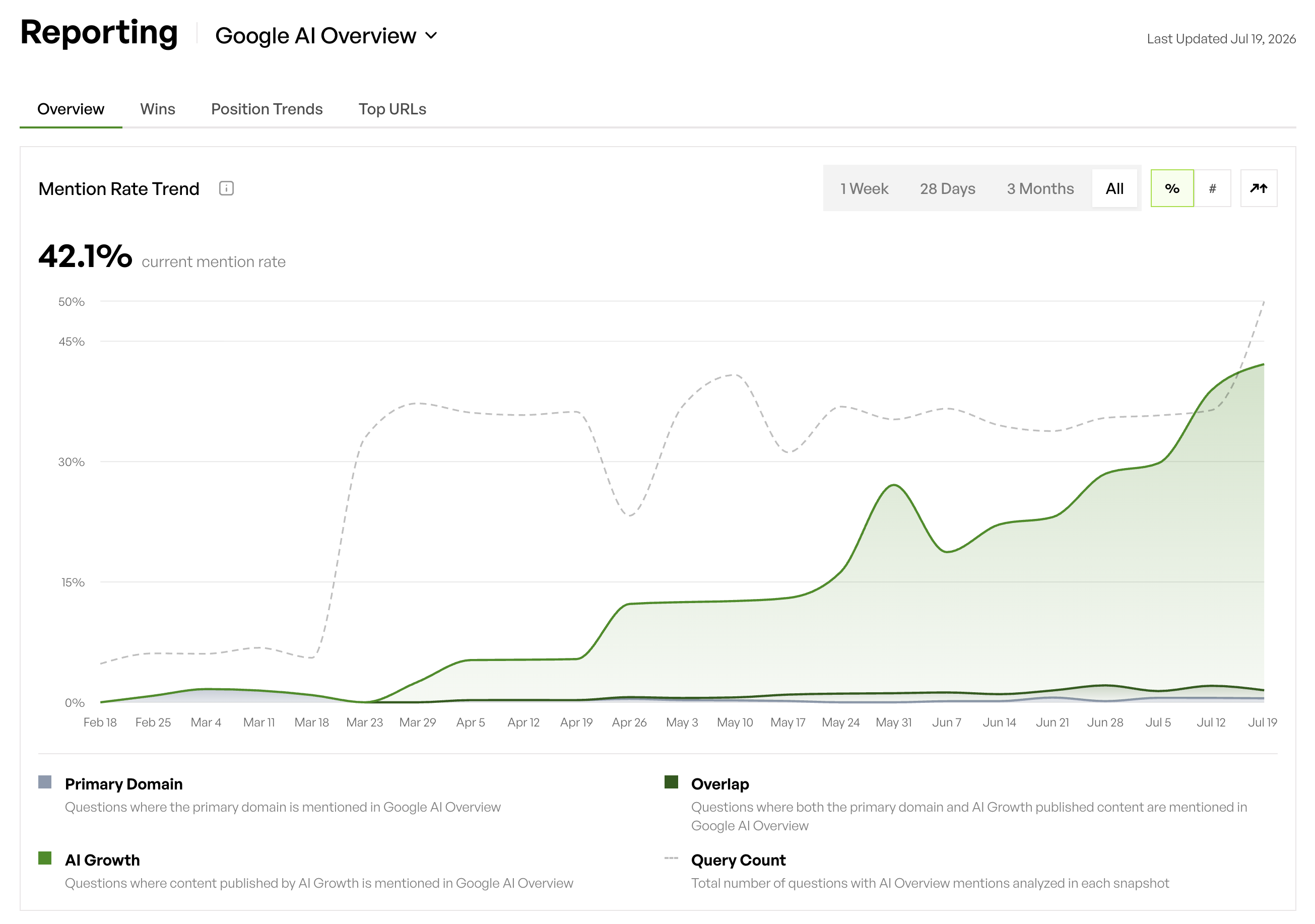
- Reporting. Can the system isolate the visibility it generated from visibility the brand already had?
- Governance. Does the system enforce brand voice, legal disclaimers, and claim accuracy without per-article review?
- Maintenance burden. Does content self-heal over time, or does it go stale and require manual refresh cycles?
These criteria reveal the structural limits of both Jasper and Clover Labs before you sign a contract.
Head-to-Head: Jasper vs Clover Labs
Jasper is a mature enterprise platform. Its Jasper IQ governance layer centralizes brand voice, visual guidelines, style guides, knowledge bases, and audience personas so agents and pipelines follow governance rules from the start. Its Content Pipelines cover a five-stage lifecycle: Plan, Create, Adapt, Activate, and Optimize. Its Brand Voice feature supports brand alignment. Enterprise customers include Ulta Beauty, Prudential, iHeartMedia, and Wayfair.
Jasper’s limits are structural. It generates content on demand but does not map a brand’s complete query landscape. It cannot launch an owned site, lacks an agentic technical SEO stack, has no bot tracking, and does not report incremental visibility that separates Jasper’s impact from existing visibility. Its Business tier requires custom annual contracts, and clients still must assemble the surrounding stack: a web agency, a technical SEO layer, a publishing workflow, and a monitoring tool.
Clover Labs is an AI growth studio. Its portfolio of autonomous agents includes RedRover for SEO and AI search traffic attribution, Echos for short-form video distribution, Pixel for campaign attribution, and 1Price for autonomous pricing experiments. These agents put distribution on autopilot. Its formula, Viral Product multiplied by Insane Volume, systematizes virality instead of relying on one-off content. The studio reached $1M ARR in 42 days using internal AI agent automation.
Clover Labs’ limits are also structural. Its agents focus on distribution and acquisition loops, not on producing authoritative, source-validated, schema-decorated content that earns citations in ChatGPT, Perplexity, or Google’s AI Mode. Distribution speed without citation-ready content does not move the needle in AI search.
Which Organizations Each Platform Serves Best
Jasper fits organizations where the primary constraint is content governance at scale. A large enterprise marketing team managing multiple brands, regions, and approval tiers, where the bottleneck is consistency and compliance rather than coverage of the query landscape or AI search visibility, can gain real value from Jasper’s pipeline and governance architecture. Enterprise brands managing many social channels and publishing numerous pieces daily need the tiered approval and brand enforcement Jasper provides.
Clover Labs fits organizations where the primary constraint is distribution velocity for a product-led growth model. A startup or growth-stage company with a viral product that must scale social distribution, run pricing experiments, and attribute revenue across channels without hiring a full growth team is the natural fit for Clover Labs’ agent portfolio.
Neither platform fits the mid-market or enterprise brand whose primary constraint is narrative control in AI search. That organization needs a headless engine that maps the entire query landscape, produces living content, owns the technical SEO stack, and reports incremental visibility week over week without per-prompt billing or added headcount.
Real-World Scenarios: How Choices Play Out
Lean marketing team at a mid-market company. A five-person marketing team at a $50M company has no technical SEO capability and no web agency relationship it controls. Jasper gives them a content editor with governance but leaves publishing, schema, bot tracking, and query mapping on their plate. Clover Labs gives them distribution agents but no authoritative content to distribute. For this team, AI Growth Agent launches quickly: site live, query universe mapped, and citation-ready content running on autopilot, with no technical skill required.
Enterprise organization with an existing content operation. A 200-person company with a content team, an SEO agency, and a web agency already in place spends close to a year on RFP cycles and still does not appear in AI answers. Jasper adds governance to the existing stack but does not remove agency dependency or deliver AI search visibility. Clover Labs is not designed for this use case. AI Growth Agent replaces the agency stack with one engine, launches a site the brand owns, and delivers measurable incremental visibility in AI search within the first 12 weeks.
Multi-brand operator. A holding company managing three distinct brands needs each brand to own its narrative in AI search independently. Jasper’s multi-brand governance is strong but does not solve AI search visibility. Clover Labs’ agents are not built for brand-level narrative control. AI Growth Agent runs parallel engines, each with its own query map and content topology, as it does for clients like Bisutti, where two parallel engines produced 71% of brand mention visibility across consumer and corporate event audiences.
Total Cost and Operational Ownership
Jasper at the Business tier carries annual contracts of $24,000 to $60,000, plus the cost of the web agency, the technical SEO layer, the publishing workflow, the monitoring tool, and the headcount to coordinate them. Many organizations cite data governance as their primary concern when adopting generative AI tools, and Jasper’s enterprise procurement adds SOC 2 review, SSO provisioning, and integration evaluation before a single article goes live.
Clover Labs’ agent portfolio requires integration with Stripe, Shopify, Google Analytics, and other live systems. A production AI agent program requires four capability areas: ML or LLM engineering, DevOps or platform engineering, security architecture, and observability engineering. For a non-technical marketing team, that becomes a significant hidden cost before the first distribution loop runs.
Adopting separate AI content platforms and AI-powered growth studios increases governance burden and operational risk. Each new AI-enabled SaaS application, integration, and non-human identity adds oversight requirements. Running both Jasper and Clover Labs in parallel compounds that cost.
AI Growth Agent’s pricing is a flat fee with no per-article charges, credit limits, or per-prompt billing. The only integration step on the client side is the reverse proxy rewrite that connects the blog to a subdirectory under the brand’s domain. Everything else, including the technical and SEO infrastructure that competitors leave you to assemble, comes included.
Decision Framework for CMOs
Use the following if-then logic to self-select based on your actual constraints.
- If your primary constraint is content governance, multi-brand approval workflows, and pipeline consistency for a large internal team, Jasper is worth evaluating.
- If your primary constraint is distribution velocity for a product-led growth model with a viral product already in market, Clover Labs is worth evaluating.
- If your primary constraint is narrative control in AI search, incremental visibility across the long tail of queries your customers actually ask, and a headless engine that replaces your agency stack without adding headcount, neither Jasper nor Clover Labs is the right category.
- If you need the first article live within a week, content indexing within ten days, and measurable AI citations within the first 12 weeks, AI Growth Agent is the only option in this comparison built to deliver that.
- If you are a CMO who cannot tell your CEO why the brand is not showing up in AI answers, and your current agency has no credible response, the answer is a headless marketing engine rather than a better editor or a faster distribution agent.
Risks, Limitations, and Tradeoffs
Jasper’s risks. Jasper is a content editor with a governance layer, not a query mapping or AI search visibility engine. Only a minority of companies report significant value from AI despite high adoption rates, and Jasper’s value concentrates in teams that already have the surrounding stack in place. The Pro tier’s two brand-voice limit blocks many multi-brand operators, and moving to Business pricing requires a custom annual contract with no proration on mid-contract cancellation. Purely AI-generated pages reached Google’s number one spot a small percentage of the time versus the majority for human-written pages, which means Jasper’s output needs human editing and a technical SEO layer to perform in traditional search, and even more so in AI search.
Clover Labs’ risks. Autonomous agent systems carry meaningful implementation and governance overhead. Only a minority of organizations are currently scaling AI successfully across multiple use cases, even though many target full AI maturity by the end of 2026. Clover Labs’ agent portfolio is designed for product-led growth companies, not for enterprise brands managing narrative control across AI surfaces. Distribution without citation-ready content does not produce AI search visibility.
AI Growth Agent’s tradeoffs. AI Growth Agent is not a content editor for internal teams that want to write manually. It is not a distribution agent for viral product loops. It is a headless engine that replaces the agency stack, which means the brand trades manual control of the content production process for autonomous, self-healing output at scale. Organizations with deep internal review requirements can use a human-in-the-loop mode, but the engine is designed for autopilot.
Frequently Asked Questions
How long does it take to go live with AI Growth Agent compared to Jasper or Clover Labs?
AI Growth Agent goes from kickoff to the first published article in about one week, with content indexing in as little as ten days. Jasper requires procurement, SSO provisioning, brand voice training, and pipeline configuration before the first article ships, which typically takes several weeks at the enterprise tier. Clover Labs’ agent setup requires integration with live systems including Stripe, Shopify, and Google Analytics, plus the technical infrastructure for autonomous agent operation, which adds weeks to months depending on the organization’s engineering capacity.
What internal resources does each option require?
Jasper requires a content team to operate the editor, a technical SEO layer to handle schema and publishing, and a web agency or engineering resource to manage the site. Clover Labs requires engineering capacity for agent integration, infrastructure, and observability. AI Growth Agent requires no technical skill from the client. The only integration step is the reverse proxy rewrite that connects the blog to a subdirectory under the brand’s domain. Everything else is included in every package, and the team gives feedback in plain language while the engine learns.
Can these tools scale to cover the full universe of queries a brand needs to win?
Jasper scales content production volume but does not map a brand’s query universe. The client decides what to write about, and Jasper helps write it. Clover Labs scales distribution volume but does not create the authoritative content required to earn citations in AI search. AI Growth Agent maps the full universe from real-time Google and ChatGPT data, starting with three to four hundred queries for a new account and expanding to universes of 1,600 or more queries for mature clients, with the system running over 3,000 searches every week just to refresh the snapshot. Prompt count is never a billed metric.
How does reporting work, and can I tell what each tool actually contributed?
Jasper does not provide incremental visibility reporting. It tracks content production activity within the platform but does not isolate the AI search visibility it generated from visibility the brand already had. Clover Labs’ Pixel agent provides attribution metrics for campaigns and posts, but attribution in AI search is structurally different from paid or social attribution because AI answers do not carry click-through data. AI Growth Agent publishes into a separate environment and reports incremental visibility week over week, cross-referencing bot traffic, Google Search Console, and citation data to isolate exactly what the engine contributed.
How do I determine which option is the right fit for my organization?
The clearest signal is where your growth constraint actually sits. If your team produces content manually and needs governance and pipeline structure, Jasper is worth evaluating. If you have a product-led growth model and need distribution velocity across social and SEO channels, Clover Labs is worth evaluating. If your constraint is narrative control in AI search, and you need a headless engine that maps your full query universe, produces living content, and reports incremental visibility without adding headcount or per-prompt billing, neither Jasper nor Clover Labs is built for that job. AI Growth Agent is.
Conclusion: Choosing the Right Category
Jasper and Clover Labs are real tools solving real problems in distinct categories. Jasper is an enterprise AI content platform built for governance and pipeline orchestration. Clover Labs is an AI growth studio built for autonomous distribution and acquisition loops. The decision between them is a category decision, not a feature comparison, and the right answer depends entirely on where your growth constraint sits.
For mid-market and enterprise brands whose constraint is narrative control in AI search, neither category is sufficient. The brands that win AI search in 2026 do not rely on the strongest editor or the fastest distribution agent. They rely on a headless engine producing living, citation-ready content across the complete query landscape their customers care about, with measurable incremental visibility to prove it week over week.
AI Growth Agent is built to deliver that outcome. Traditional search tools show you where your brand stands. AI Growth Agent makes your brand the answer.
Start your engine—first article live in one week, citations tracking in twelve.