Written by: Mariana Fonseca, Editorial Team, AI Growth Agent
Key Takeaways
- Monitoring AI search visibility tracks brand mentions and citations, while steering turns that data into action through content and technical changes.
- Passive monitoring tools surface gaps but leave content production and technical SEO to the client, while a full steering engine automates both.
- Four core steering tactics convert monitoring insights into owned AI citations: topical authority building, RAG-friendly formatting, third-party citation strategy, and agentic technical signals.
- Capped prompt lists in monitoring tools create visibility blind spots by ignoring the long-tail queries where most AI conversations occur.
- Brands ready to move from observation to control can book a demo with AI Growth Agent and see results within one week.
Monitoring vs Steering: Why the Gap Matters
The operational gap between monitoring and steering is wider than most teams realize. A monitoring platform submits prompts to AI engines, records whether the brand appears, and surfaces metrics. AI brand monitoring is a measurement layer, not a content-production or optimization engine by itself. It tells you the score. It does not change it.
Steering is the set of actions that change what models cite. Those actions include building topical authority across the full long tail of buyer queries, formatting content so retrieval-augmented generation systems can extract and trust it, earning third-party citations from the sources AI engines draw on most heavily, and deploying technical signals such as schema, llms.txt, and MCP endpoints that make content legible to agents. AEO and GEO are the tactical disciplines that produce AI visibility through content and technical interventions, while monitoring measures the outcome of those interventions.
The distinction matters because a significant portion of U.S. Google searches ended without a click in early 2026, up from prior years. When the answer is the destination, the brand that earns the citation wins the customer. Monitoring confirms whether that is happening. Steering makes it happen.
The Five-Criteria Comparison
To understand where monitoring ends and steering begins, the table below compares passive monitoring tools against a full steering engine across five operational criteria. Every figure is drawn from published research.
| Criterion | Monitoring Tools | Full Steering Engine (AI Growth Agent) | Key Data Point |
|---|---|---|---|
| Scope of Visibility | Capped prompt sets, typically 25 to 300 prompts per plan tier | Full universe of seed terms and long-tail queries, refreshed weekly, with prompt count never billed | Peec AI offers tiered plans with prompt limits scaling by price |
| Ability to Act | Surfaces gaps, then leaves content production, publishing, and technical SEO to the client | Produces and publishes authoritative, self-healing content and deploys a full technical and agentic SEO stack automatically | Passive monitoring tools provide weak recommendations and no content optimization features |
| Technical Requirements | Dashboard access with no site integration required | Single reverse proxy rewrite connecting blog to brand subdirectory, with schema, MCP, llms.txt, and bot tracking provisioned automatically | AI citation requires separate technical architecture from traditional SEO |
| Time to Results | Immediate dashboard data, but no content or citation movement without separate action | First article live within one week, content indexing in as little as ten days, and thousands of AI citations and mentions in the first 12 weeks on average | Sites prioritizing topical depth achieve ranking gains faster than those focusing on domain authority and backlinks |
| Ownership of Outcomes | Brand does not own the monitoring data or the content it must produce separately | Brand owns the site, the content, and the incremental visibility reporting that isolates what the engine generated | Earned media drives a majority of AI citations across ChatGPT, Claude, and Gemini, so owned content strategy becomes the primary lever |
Four Steering Tactics That Turn Monitoring Into Citations
Monitoring data becomes valuable only when it feeds a production system that can act on what the data reveals. The following four tactics form a complete conversion path from visibility gap to owned citation, with each tactic addressing a different way AI systems discover, extract, and trust content.
Topical Authority Building
Brands with strong topical authority appear in AI citations for a significantly higher percentage of relevant queries compared to brands without it, a visibility gap that compounds over time. The steering action is to map the full universe of buyer questions across a topic cluster, identify coverage gaps where competitors are cited instead of the brand, and publish authoritative content against each gap. Publishing tightly interlinked articles inside a single cluster typically produces a substantial keyword ranking lift within months. AI Growth Agent’s Content Topology maps this universe from real-time Google and ChatGPT data, so every content decision rests on evidence rather than guesswork.
RAG-Friendly Formatting
Retrieval-augmented generation systems extract claims from content at the sentence and paragraph level. Front-loading definitive answers early in content can deliver meaningful AI inclusion improvements in documented case studies. Adding direct expert quotations and quantified statistics can improve LLM citation rates. Every article AI Growth Agent produces is engineered for factual density, structured extraction, and inline source validation, with anti-hallucination checks run against primary sources before anything publishes.
Third-Party Citation Strategy
Earned media drives a substantial portion of AI citations across ChatGPT, Claude, and Gemini, a figure that has remained consistent across multiple editions of industry reports. Distributing content across a wider range of publications can increase AI citations substantially. The steering action is to identify which third-party sources AI engines draw from in a given category and build a presence there through earned coverage, community contributions, and structured entity signals on platforms like Wikipedia, Crunchbase, and LinkedIn.
Agentic Technical Signals
Technical signals tell AI agents what a brand is, what it covers, and how to retrieve its content. These signals include schema markup across the full suite, llms.txt and llms-full.txt files, MCP endpoints, agent discovery via /.well-known/, and natural language query parameters that return structured responses to agents. A brand’s own website accounts for only a small percentage of the sources referenced in some AI search analyses, so technical legibility to crawlers and training agents becomes a prerequisite for citation, not an afterthought. AI Growth Agent provisions this entire stack automatically on every site it stands up, with no engineering work required from the client.

The Monitoring-to-Steering Workflow
The workflow that converts monitoring data into owned citations runs as a continuous loop, not a one-time audit. The stages are as follows.
- Universe Snapshot. Every week, AI Growth Agent runs 3,000+ searches across the brand’s full universe of seed terms and long-tail queries, capturing which prompts return the brand, which return competitors, and which return no authoritative source at all.
- Gap Classification. Gaps are classified by type: structural, coverage, or authority, with each type mapped to a different steering action.
- Content Production. The engine produces authoritative articles against identified gaps, with parallel research agents validating every claim and source before the draft moves forward. Output ranges from 2 to 50 articles per day per client.
- Technical Deployment. Each article publishes with full schema, internal linking, metadata, and agentic signals live on the first publish. No separate technical step is required.
- Self-Healing Update. When Google Search Console signals or bot-traffic data indicate a published article is losing citation share, the engine refreshes it automatically. Content compounds instead of going stale.
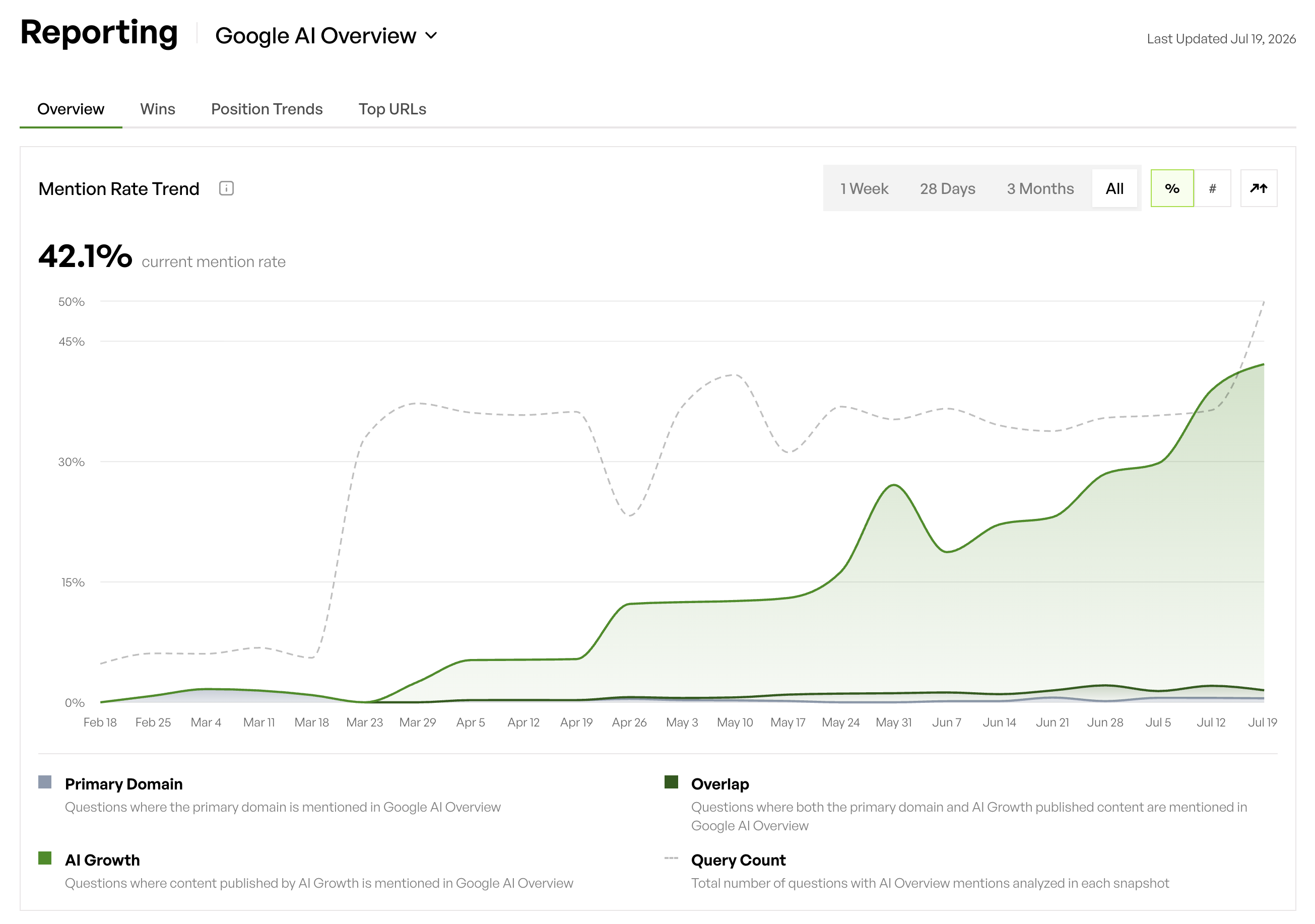
- Incremental Visibility Reporting. Week-over-week reporting isolates exactly what the engine generated, separate from visibility the brand already had, giving the CMO a defensible number to bring to the CEO.
This loop is what separates a steering engine from a monitoring dashboard. The dashboard shows step one. The engine runs all six. If your brand is ready to move from observation to control, book a kickoff with AI Growth Agent to deploy this complete workflow in your category.
Prompt Caps and the Invisible Long Tail
Prompt caps in monitoring tools hide most of the real AI conversation. Every monitoring tool on the market prices by prompt volume. Peec AI’s Starter plan costs $95 per month for 50 prompts, Pro costs $245 for 150 prompts, and Advanced costs $495 for 350 prompts (Enterprise is custom). At those caps, a brand tracking its category sees only a fraction of the actual conversation.
The problem is structural. Short, conversational queries produce significantly more brand mentions than long structured prompts, with short queries reaching higher mention rates than long prompts. The queries buyers actually ask are long, specific, and conversational. A cap of 25 or even 300 prompts covers the head terms a brand already knew to defend and leaves the long tail, where most of the conversation happens, completely dark.
Tracking AI brand visibility by monitoring a handful of individual prompts is misleading and ultimately unhelpful. The universe of queries that describe a brand’s market runs into the hundreds at minimum and expands as AI agents reason on top of user queries, generating follow-up questions the brand never anticipated. AI Growth Agent maps this full universe from real-time data and never bills by prompt count, so clients see their entire market rather than the slice they already thought to ask about.
Scenario-Based Guidance for Different Teams
Enterprise CMOs
Enterprise CMOs already have monitoring data. The problem is that the data shows a gap and provides no mechanism to close it. An agency RFP to produce the content takes three months to award and three more to produce the first assets. By the time anything is live, the AI leaderboard has moved.
The steering engine path replaces that timeline with a first article live in one week and content indexing in as little as ten days. Incremental visibility reporting gives the CMO a defensible answer for the CEO every week. The internal team needs no technical skill because the engine handles schema, bot tracking, and the full agentic SEO stack end to end.
Builders and Founders
Builders who tried producing content with a chatbot discovered that the second article means running the entire process again, and quality drifts. A significant percentage of enterprise digital leaders intend to boost investments in answer engine optimization, yet only a portion have actually implemented a strategy. The gap between intent and execution is a system problem.
A steering engine solves this by handling universe mapping, content production, publishing, and self-healing on autopilot. The operator provides direction in plain language, and the engine learns from every correction.
Forward-Thinking Agencies
Forward-thinking agencies can turn existing strengths into AI search wins. The PR agency that earns coverage in the right outlets is already doing the work that drives AI citations, as discussed in the third-party citation strategy above. The steering engine layers AI search on top of existing earned-media work, turning monitoring data into a content and citation strategy the agency can deliver to clients without hiring an SEO specialist or engineer. It becomes a high-margin, recurring service line in a traditionally low-margin industry.
Decision Matrix: Matching Constraints to the Right Path
| Constraint Profile | Budget Signal | Team Size and Capability | Timeline | Recommended Path |
|---|---|---|---|---|
| Early-stage brand, limited organic presence | Fixed, no per-prompt flexibility | Founder-led, non-technical | Need citations within 90 days | Full steering engine, because monitoring alone produces no citations |
| Mid-market brand with existing monitoring data | Moderate, with current monitoring spend available for reallocation | Small marketing team, no engineering | CMO needs defensible results for the board within one quarter | Full steering engine, with monitoring data feeding content production immediately |
| Enterprise brand with agency relationships | Significant, with agency retainers already in place | Brand managers, no technical SEO in-house | Agency RFP cycle too slow, with a need to move in weeks not months | Full steering engine replacing the agency stack, with any existing monitoring dashboard retained for executive reporting if already contracted |
| Agency running multiple client brands | Per-client retainer model | PR and content specialists, no AI search engineering | Need to deliver AI search results to clients within a pilot period | Full steering engine per client, with a monitoring layer used to demonstrate before-and-after citation movement to clients |
| Brand with strong organic presence, minimal AI citations | Existing SEO budget available for reallocation | SEO team in place, no AI search content system | Competitive pressure from AI-cited rivals is immediate | Full steering engine, because only 17% to 38% of pages cited in AI Overviews also rank in the organic top 10, so existing SEO rankings do not transfer automatically to AI citations |
Conclusion and Next Step
Monitoring tells a brand where it stands in AI-generated answers, but it does not change what those answers say. The data is necessary but not sufficient. A substantial portion of AI citations are ghost citations where the source link appears but the brand name is never mentioned in the answer, and few brands are frequently mentioned and consistently cited as a source on AI platforms. The brands that close that gap are the ones that convert monitoring data into owned, self-healing content that earns citations at scale.
That conversion requires a steering engine, not a larger prompt cap. It requires topical authority built across the full long tail, RAG-friendly content that AI systems can extract and trust, third-party citation strategy targeting the sources models actually draw from, and agentic technical signals that make the brand legible to every crawler and training agent that touches the web. It also requires a system that runs continuously, self-heals as the world changes, and reports the incremental visibility it generates rather than taking credit for what was already there.
AI Growth Agent is the only autonomous engine that performs all of this at scale through headless marketing. One engine replaces the monitoring dashboard, the content agency, the SEO suite, the web agency, the schema plugin, and the analytics stack. The brand owns the site, the content, and the results. The first article is live within a week.
If you want one system that replaces fragmented tools and agencies while giving you owned AI visibility, book a kickoff with AI Growth Agent and see your first article live within a week.
Frequently Asked Questions
What is the practical difference between AI search monitoring and AI search steering?
Monitoring submits prompts to AI engines, records whether and how a brand appears in the generated answers, and tracks metrics such as mention rate, citation share, and share of voice over time. It functions as a measurement layer. Steering is the set of actions that change what AI systems cite, including producing authoritative content across the full universe of buyer queries, formatting that content so retrieval systems can extract and trust it, earning third-party citations from the sources AI engines draw on most heavily, and deploying technical signals such as schema, llms.txt, MCP endpoints, and agent discovery files. Monitoring tells you the score. Steering changes it. A brand that monitors without steering accumulates data about a gap it has no mechanism to close.
Why do capped prompt lists in monitoring tools create a visibility blind spot?
Monitoring tools price by prompt volume, which means the brand only ever sees the slice of the market it already thought to ask about. The queries buyers actually use in AI search are long, specific, and conversational, and they fan out further as an AI agent reasons on top of a user query and generates follow-up questions. A cap of 25, 100, or even 300 prompts covers the head terms a brand already knew to defend and leaves the long tail completely dark. The long tail is where most of the conversation happens and where most of the citation opportunity exists. AI Growth Agent maps the full universe from real-time Google and ChatGPT data and never bills by prompt count, so clients see their entire market rather than a pre-selected subset of it.
How does headless marketing differ from hiring an SEO agency or using a content tool?
An SEO agency requires an RFP that takes roughly three months to award and three more months to produce the first assets, with the brand often dependent on the agency for site access and publishing. A content tool generates text on demand but provides no universe map, no publishing infrastructure, no technical SEO, and no self-healing. Headless marketing is the architecture that replaces both. It decouples the brand’s curated main site from the engine that builds its AI search presence, the same way headless commerce decouples the storefront from the backend. AI Growth Agent stands up a fully optimized blog the brand owns, connects it through a reverse proxy rewrite, and runs the full cycle of universe mapping, content production, technical deployment, and self-healing on autopilot. The brand’s team gives direction in plain language. The engine handles everything else, with no headcount required and no agency in the loop.
What results can a brand realistically expect from a steering engine in the first 90 days?
AI Growth Agent clients average thousands of additional AI citations and mentions, tens of thousands of additional bot visits, and a meaningful lift in impressions across the first 12 weeks. The first article is typically live within one week of kickoff, and content has indexed in as little as ten days. Specific client outcomes include Breadless reaching a significant lift in Google Search Console impressions over six months and ChatGPT citing eatbreadless.com thousands of times per month, Leva Sleep closing substantial deals within weeks from buyers who found them through AI Growth Agent content, and Jota achieving a substantial traffic increase from generated content over three months. Results vary by industry, competitive landscape, and how quickly the brand’s content indexes, which is why the standard engagement is a three-month pilot.
Does a brand need a technical team to implement a steering engine?
No. The point of headless marketing is to remove the technical dependency entirely. AI Growth Agent provisions schema across the full suite, the WordPress plugin, robots.txt, sitemaps, automatic web stories, Blog MCP, agent discovery via /.well-known/, llms.txt and llms-full.txt, instant indexing, autoredirects, and 404 tracking automatically. Every package includes the full stack. The only integration step on the brand’s side is the reverse proxy rewrite that connects the blog to a subdirectory under the brand’s domain, with setup documentation generated for the brand’s specific host. The internal marketing team needs no technical skill. They provide direction in plain language, review finished articles, and watch results in the reporting view. The engine handles the rest.