Written by: Mariana Fonseca, Editorial Team, AI Growth Agent
Key MCP Performance Wins for 2026
- MCP performance in 2026 centers on three pillars: fewer payload tokens, fewer discovery round-trips, and lower p95 latency through transport and connection choices.
- The July 28, 2026 MCP specification adds stateless design plus
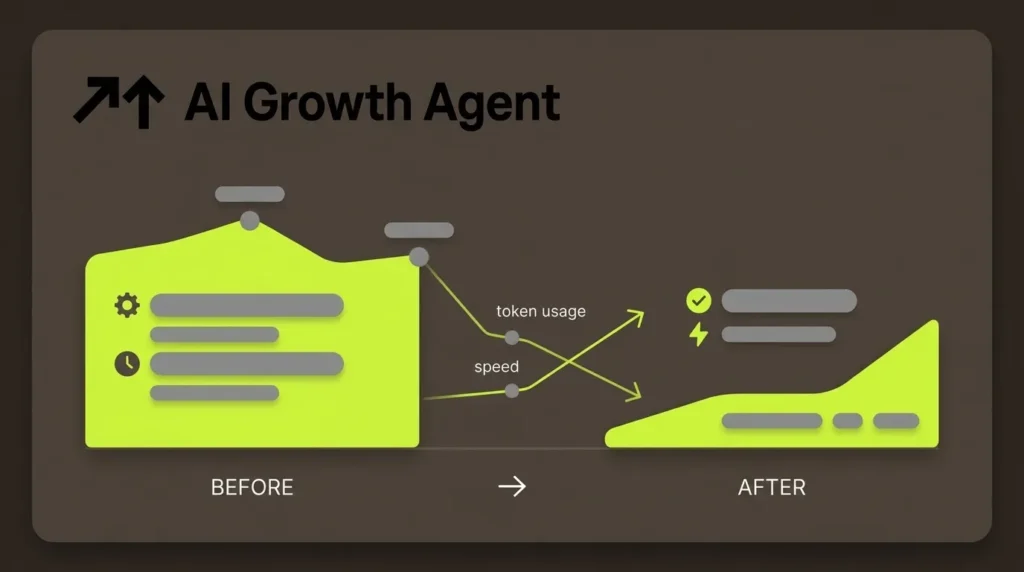
ttlMsandcacheScopefields so clients cache tool catalogs and avoid repeated discovery calls. - Progressive tool discovery and compact definitions can cut token usage by up to 85% and improve tool selection accuracy by avoiding overload from large static catalogs.
- Concurrent batching, server aggregation, pagination, field filtering, and connection pooling each reduce round-trips and payload size, which speeds up multi-tool execution at scale.
- AI Growth Agent ships all six optimization tactics out of the box: progressive discovery, compact schemas, batching, pagination, transport pooling, and warm-server caching. See the platform in action to understand how this complete MCP performance stack runs on autopilot.
Baseline Metrics Before Optimization
| Metric | Unoptimized | Optimized | Source |
|---|---|---|---|
| Tool-definition tokens (100 tools) | approximately 20,000 tokens | significantly reduced with meta-tools | KGT24k mcp-tool-search benchmarks |
| Tool-definition tokens (400 tools, static) | >400,000 tokens | significantly reduced with search-first for simple task | Speakeasy benchmarks via StackOne |
| p50 latency, stdio (same machine) | low single-digit ms | low single-digit ms (no change; already optimal locally) | TrueFoundry benchmarks |
| p95 latency, Streamable HTTP (same DC) | low tens of ms per call when serial | a few hundred ms end-to-end (batched + pooled) | TrueFoundry; MCP Beast observability targets |
| Tool selection accuracy (100+ tools, unfiltered) | under 50% with large unfiltered static catalog | ~74% (Opus 4, search-first discovery) | Anthropic benchmarks via StackOne |
| Round-trips saved per multi-tool turn (batching) | N calls = N round-trips | significant wall-clock latency reduction | AgentMarketCap MCP vs REST analysis |
| p95 end-to-end (TCP + initialize + tools/list), dedicated infra target | Untracked / no SLO | under one second | AliveMCP production targets |
The following six tactics directly address these baseline metrics, starting with progressive tool discovery to eliminate upfront schema bloat.
1. Progressive Tool Discovery With a Lightweight Catalog
The Catalog → Inspect → Execute pattern keeps a lightweight index of (server, tool, one-line description) tuples in context for the entire session. This index occupies 10–30 tokens per tool and fetches full JSON Schema definitions only when the model selects a candidate. A reference agent task documented by Anthropic required 55K–134K input tokens for tool definitions when preloaded and dropped to about 8,700 tokens with on-demand loading, an 85% reduction.
The July 2026 spec directly supports this pattern. Tools/list responses now carry ttlMs and cacheScope fields, so clients cache the catalog for a server-specified duration and avoid re-fetching on every independently routed request. Servers SHOULD return tools in deterministic order to improve LLM prompt cache hit rates.
Progressive discovery also improves correctness. Research from Anthropic and third-party benchmarks shows tool selection accuracy starts dropping once models see more than 30 to 50 tools at once. At 100 tools, selection quality can fall by 40% compared to presenting only the relevant subset.
// SLOW: load all schemas upfront const tools = await client.listTools(); // returns all 100+ definitions await client.callTool(tools[0].name, args); // OPTIMIZED: Catalog → Inspect → Execute with ttlMs caching const catalog = await client.listTools({ fields: ["name", "description"] // lightweight index only }); // Cache per ttlMs returned in response (e.g., 300000 ms) const selected = semanticSearch(catalog, userQuery); const fullDef = await client.inspectTool(selected.name); // fetch schema on demand await client.callTool(selected.name, args); 2. Compact Tool Definitions for Lower Token Cost
A typical MCP tool definition can consume over a thousand tokens when it includes verbose descriptions, redundant examples, and unpopulated optional fields. Trimming descriptions to one precise sentence, removing empty examples and default fields, and using $ref to share repeated sub-schemas cuts per-tool cost significantly without reducing model comprehension.
The MCP 2026-07-28 spec uses full JSON Schema 2020-12 for tool input schemas, and cache keys must include server identity, protocol version, authorization scope, and extension set. Compact and stable schemas therefore produce better cache hit rates across reconnects than verbose schemas that change frequently.
The one-job-per-tool pattern compounds these gains. The one-job-per-tool pattern produced a 24% reduction in total tool calls and a 7% increase in correctness, because narrowly scoped tools have smaller schemas and the model selects them with higher precision.
// SLOW: verbose definition with empty fields { "name": "get_user_profile", "description": "This tool retrieves a user profile object from the database. It accepts a user ID and returns the full profile including name, email, preferences, and metadata. Use this when you need any information about a user.", "inputSchema": { "type": "object", "properties": { "user_id": { "type": "string", "examples": [], "default": null } } } } // OPTIMIZED: compact, precise, no empty fields { "name": "get_user_profile", "description": "Returns name, email, and preferences for a given user_id.", "inputSchema": { "type": "object", "properties": { "user_id": { "type": "string" } }, "required": ["user_id"] } } 3. Concurrent Batching and Server-Side Aggregation
JSON-RPC 2.0 allows multiple method calls to travel in a single HTTP request that returns one response array. For agents performing multiple tool calls in one reasoning step, JSON-RPC batching reduces the number of network round-trips by collapsing N calls into one. Batch-capable MCP servers can cut wall-clock latency for a multi-tool turn compared with equivalent serial sequences at scale.
Server-side aggregation extends this benefit. Instead of returning raw results from each upstream service and leaving the client to merge them, an aggregating MCP server fans out sub-requests concurrently, merges results, and returns a single structured response. This approach removes client-side merge latency and keeps the response payload predictable for downstream caching.
Connection pooling then prevents extra TCP handshake latency per RPC call, which otherwise compounds in tight reasoning loops. Pairing batching with a persistent connection pool keeps this overhead close to zero.
// SLOW: serial tool calls, one round-trip each const userProfile = await client.callTool("get_user_profile", { user_id }); const orderHistory = await client.callTool("get_order_history", { user_id }); const preferences = await client.callTool("get_preferences", { user_id }); // OPTIMIZED: JSON-RPC batch, single round-trip const [userProfile, orderHistory, preferences] = await client.batchCall([ { method: "tools/call", params: { name: "get_user_profile", arguments: { user_id } } }, { method: "tools/call", params: { name: "get_order_history", arguments: { user_id } } }, { method: "tools/call", params: { name: "get_preferences", arguments: { user_id } } } ]); 4. Result Pagination and Field-Level Filtering
Large tool responses inflate the context window on every turn, so pagination and field filtering keep payloads lean. Cursor-based pagination on list-style tools and a fields parameter that returns only the properties the agent requested keep individual response payloads small and predictable. A response returning 5 fields instead of 50 is cheaper in tokens and reduces the chance that irrelevant data steers the model toward incorrect reasoning.
Field filtering pairs naturally with the cacheScope field introduced in the July 2026 spec. A filtered response scoped to "public" can be cached by shared intermediaries, so multiple agents requesting the same filtered view of a resource pay the upstream cost only once. Tracking mcpserver.tools.serialized_bytes as a custom attribute in your observability stack detects token bloat even when latency remains low, which makes payload size a first-class production signal alongside p95 latency.
Tool discovery also benefits from clear latency targets. p95 latency should target under 300 ms when serving fewer than 20 tools with static schemas and under 800 ms for dynamic tool discovery. Pagination keeps response sizes within those bounds as catalogs grow.
// SLOW: returns full objects, all fields, no pagination const results = await client.callTool("list_orders", { user_id, limit: 1000 }); // OPTIMIZED: paginated, field-filtered response const results = await client.callTool("list_orders", { user_id, limit: 20, cursor: pageToken, fields: ["order_id", "status", "total", "created_at"] }); // Use results.nextCursor for subsequent pages 5. Transport Choice and Connection Pooling Strategy
Stdio transport uses direct process-to-process stdin/stdout IPC with no network stack, which delivers low single-digit millisecond latency for a single tool call on the same machine. This transport fits local subprocess-style servers that serve a single client. It has a structural limitation: Stdio transport degrades sharply after 2–4 concurrent tool calls because of race conditions or saturation on a single pipe, and a 50-developer team running 8 MCP servers each produces about 400 concurrent processes with no shared audit trail.
Streamable HTTP suits remote and enterprise deployments. TrueFoundry benchmarks show Streamable HTTP achieving about 10 ms latency per call at 350+ RPS on 1 vCPU, while deprecated SSE-based transports saw latency climb into the hundreds of milliseconds. The July 2026 stateless changes mean any replica can serve any request behind a plain round-robin load balancer with no shared session store, which removes the sticky-routing overhead that previously made horizontal scaling complex.
Connection pooling then removes the TCP handshake cost that compounds across reasoning loops. Maintaining a pool of warm HTTP/2 connections to each MCP server keeps per-call overhead near zero for the network layer, so latency budgets mainly reflect server-side processing time.
// SLOW: stdio, one process per user, no pooling const transport = new StdioClientTransport({ command: "node", args: ["./mcp-server.js"] }); // OPTIMIZED: Streamable HTTP with connection pool import { StreamableHTTPClientTransport } from "@modelcontextprotocol/sdk/client/streamableHttp.js"; const transport = new StreamableHTTPClientTransport( new URL("https://mcp.yourserver.com/mcp"), { // Pool reuses connections, no TCP handshake per call keepAlive: true, maxSockets: 10, headers: { "Mcp-Protocol-Version": "2026-07-28", "Authorization": `Bearer ${apiKey}` } } ); 6. Warm Servers, Caching, and July 2026 Stateless TTLs
The July 2026 MCP release candidate removes the initialize/initialized handshake entirely. Every Streamable HTTP request now carries io.modelcontextprotocol/protocolVersion and io.modelcontextprotocol/clientCapabilities inline in the _meta field, which makes the protocol self-describing. Servers return UnsupportedProtocolVersionError on mismatches instead of relying on a prior negotiation step, and this change removes one full round-trip from every new connection.
The new CacheableResult interface (SEP-2549) requires ttlMs and cacheScope fields on results from tools/list, prompts/list, resources/list, resources/read, and resources/templates/list. ttlMs provides a freshness hint in milliseconds, and cacheScope of "public" allows shared intermediaries to cache the response across users, while "private" restricts caching to the requesting client. A tools/list response with ttlMs: 300000 and cacheScope: "public" lets every agent in a fleet share one cached catalog for five minutes, which removes thousands of redundant discovery calls per hour.
Warm-server strategies keep at least one instance pre-initialized behind the load balancer so cold-start latency never appears in the p95 budget. Pre-warming and caching help limit extra session latency overhead in progressive discovery setups. Combined with the stateless spec, warm servers behind round-robin load balancers provide horizontal scale with no shared state dependency.
// SLOW: no caching, re-fetches tools/list on every session async function getTools(client) { return await client.listTools(); } // OPTIMIZED: respect ttlMs from 2026-07-28 spec, cache by cacheScope const toolCache = new Map(); async function getTools(client, cacheKey) { const cached = toolCache.get(cacheKey); if (cached && Date.now() < cached.expiresAt) { return cached.tools; } const response = await client.listTools(); // response._meta.ttlMs and response._meta.cacheScope from SEP-2549 const ttl = response._meta?.ttlMs ?? 60000; toolCache.set(cacheKey, { tools: response.tools, expiresAt: Date.now() + ttl }); return response.tools; } Frequently Asked Questions
What is MCP server token usage and why does it matter for production deployments?
MCP server token usage refers to the number of tokens consumed by tool definitions, discovery responses, and result payloads that enter the model’s context window during an agent session. In production deployments with large tool catalogs, this overhead dominates context cost before any user input is processed. A fleet running 100 agent sessions per day with unoptimized static tool loading can waste millions of tokens daily on schema metadata that contributes nothing to task completion. Controlling token usage directly reduces inference cost, improves tool selection accuracy, and keeps context available for the actual reasoning work.
How does the July 2026 stateless HTTP spec change how I architect my MCP server?
The July 28, 2026 MCP specification removes the initialize/initialized handshake and the Mcp-Session-Id header from the Streamable HTTP transport. Every request is now self-describing and carries the protocol version, client identity, and client capabilities inline in the _meta field. Your server no longer needs sticky routing, shared session storage, or a connection-setup negotiation step, so any replica can serve any request behind a plain round-robin load balancer.
You also gain mandatory ttlMs and cacheScope fields on list and resource-read results, which let clients cache tool catalogs for a server-specified duration and decide whether cached data can be shared across users. The practical effect is simpler infrastructure, lower connection overhead, and built-in support for TTL-based caching without custom middleware.
When should I use stdio transport versus Streamable HTTP for my MCP server?
Stdio fits local subprocess-style servers that serve a single client on the same machine, where near-zero latency matters more than authentication, horizontal scaling, or centralized audit. Streamable HTTP fits any remote, multi-user, or enterprise deployment. It supports horizontal scaling behind a load balancer, standard HTTP authentication methods, centralized rate limiting and RBAC at the gateway tier, and structured audit logs.
The July 2026 stateless changes make Streamable HTTP operationally simpler than under earlier spec versions because sticky routing and shared session stores are no longer required. Migration from stdio to Streamable HTTP becomes a transport swap that usually requires about five lines of code change in SDKs such as fastmcp, while tool logic, input schemas, and handlers stay unchanged.
What observability metrics should I track to measure MCP performance optimization progress?
Production MCP observability requires tracking p50, p95, and p99 latency percentiles separately for the initialize, tools/list, and tools/call methods, broken down per tool name. Reasonable starting targets for enterprise deployments include tool-call latency p50 under 300 ms, tool-call error rate under 1%, and tool-call success rate above 99%.
Beyond latency, track per-tool request rate, payload sizes in bytes, and token counts per tool interaction, because a single verbose tool can inflate context cost across every agent session even when its latency appears acceptable. Tracking serialized bytes on tools/list responses detects token bloat that standard latency monitoring misses. The OpenTelemetry Collector spanmetrics connector can automatically derive rate, error, and duration metrics with p50, p95, and p99 histograms per method and tool name from existing traces, without extra server instrumentation.
At what tool count does progressive discovery become net-positive over static loading?
Progressive tool loading becomes net-positive once an agent connects to more than 15 to 30 tools, because the lightweight index plus on-demand fetch overhead then stays smaller than the context cost of loading all schemas upfront. Below that threshold, the index-plus-runtime overhead can exceed the context savings. Above 30 tools, the gains compound quickly, and dynamic search-first discovery consumes far fewer tokens than static loading of all tool definitions. With large catalogs, static loading can consume a substantial portion of the context window, while search-first discovery keeps context cost low regardless of catalog size.
Conclusion: Turn the MCP Checklist Into Autopilot
The six tactics above form a complete production checklist. Progressive tool discovery removes upfront schema bloat, compact definitions reduce per-tool token cost, concurrent batching and server aggregation collapse multi-tool round-trips, pagination and field filtering keep response payloads bounded, transport choice and connection pooling remove network overhead, and warm servers with July 2026 TTL caching eliminate redundant discovery calls across the fleet. Each tactic is independently valuable, and together they move unoptimized MCP workloads from token-heavy, high-latency serial execution to lean, concurrent, cache-aware operation.
Implementing all six across a production deployment requires coordinated transport configuration, schema governance, caching middleware, observability instrumentation, and spec-compliant server behavior. AI Growth Agent is the only headless engine that ships Blog MCP, llms.txt, agent discovery, progressive tool discovery, and server aggregation out of the box, with no additional headcount, no agency stack, and no per-prompt billing. The full agentic technical SEO stack, including MCP endpoints, OpenAI discovery via /.well-known/, and natural language query parameters, comes in every package and goes live within the first week.