Written by: Mariana Fonseca, Editorial Team, AI Growth Agent
Key Takeaways
- Automated brand visibility AI works as a closed loop that maps queries, creates authoritative content, ships full technical SEO, and reports only incremental visibility gains.
- 52% of brands remain invisible across major AI platforms for their own buyer questions, yet AI search converts at 14.2%, which is about five times higher than traditional Google organic traffic.
- The seven-step process covers real-time query mapping, evidence-based content topology, single-shot anti-hallucination content generation, full traditional and agentic SEO deployment, owned publishing, bot tracking, and incremental visibility reporting.
- Clients typically see over 12,000 additional AI citations, 100,000+ bot visits, and 20%+ impression lifts within the first twelve weeks, with first articles live in about one week.
- Traditional search tools show you where your brand stands. AI Growth Agent makes your brand the answer—book a demo today.
Step 1: Map Your Full Query Universe with Real-Time AI and Google Data
Step 1 builds a complete, evidence-based picture of every query and prompt that describes a brand’s market, from head terms to the long tail that robots actually search.
Most brands track a handful of head terms and lose the rest of the conversation by default. Execution-tier platforms map the 95% of AI retrieval consisting of dark queries with zero search volume that traditional keyword tools cannot detect. AI Growth Agent ingests the client’s manifesto, product pages, PDFs, and brand guidelines, then runs hundreds of real searches to build a topology of seed terms, each backed by real-time Google and ChatGPT data, with dozens of long-tail queries beneath it.
Validation points include confirming that real-time AI Overview and ChatGPT results serve as the objective function for which long-tail queries are worth pursuing, and that the universe snapshot is refreshed weekly. Mature client universes reach 1,600 or more queries, with the system running 3,000 or more searches every week to keep the picture current.
The output is a strategic map of where to win, not a list of words. The client sees their universe across traditional Google rankings, AI mentions, and ChatGPT, and decides where to play with evidence behind every move. That universe map then becomes the foundation for deciding not just where to play, but what to build first.
See your complete query universe mapped in the first week — book a kickoff with AI Growth Agent.
Step 2: Turn the Universe Map into a Customer-Led Content Topology
Step 2 translates the universe map into a structured hierarchy that connects every seed term to the long-tail queries beneath it, prioritized by citation opportunity rather than search volume alone.
The Content Topology is built from the lens of the ideal customer rather than a generic keyword dump. Only 11% of domains are cited by both ChatGPT and Perplexity, indicating that AI visibility is fragmented and winnable through targeted content efforts. Original research and proprietary data achieve higher citation rates compared with standard blog posts and product and marketing pages.
The Content Planner maps which seed terms to attack first. A new account typically starts with 300 to 400 queries and expands as it goes after more of the universe. The topology distinguishes between queries where the brand has existing authority and queries representing white space, so every content decision is grounded in evidence rather than instinct.
The outcome is a ranked queue of content targets. Each target ties to a seed term, a cluster of long-tail queries, and a content format determined by what is already winning the result and where the gap is.
Step 3: Produce Authoritative, Self-Healing Articles with Built-In Anti-Hallucination
Step 3 produces finished, ready-to-publish articles that hold up under client, regulator, and LLM review, at a scale and quality that would otherwise require an editor, an SEO specialist, a researcher, and a PR firm.
The engine orchestrates agents across every major AI provider, not a single model behind a prompt. Models are selected by task and by language, drawing on OpenAI, Anthropic, Gemini, Grok, Perplexity, Exa, and Firecrawl for research, writing, reviewing, humanization, anti-hallucination, agentic orchestration, and image generation. The engine pulls from the manifesto, primary-source links, product pages, and memories, then analyzes the specific search to decide what kind of content should exist.
Anti-hallucination controls operate at every stage. After a draft is generated, every claim is re-extracted and checked against product pages, the manifesto, primary sources, verified external sources, and the standards defined in memories. Any claim that cannot be backed up is removed or softened before the article moves further down the pipeline. The Princeton University GEO study published on arXiv found that including citations, authoritative quotes, and concrete statistics can boost AI source visibility by up to 40%, while keyword stuffing reduced it by 10%.
Living content serves as the output standard. Content self-heals and updates over time so the brand’s presence does not decay as the world changes. Recently updated content is more likely to earn and maintain citations than older content.
Step 4: Ship Traditional and Agentic Technical SEO on Every Article
Step 4 ships every article and every site with the complete technical stack live on day one, with no plugin to install, no schema work, no agency, and no engineering hours on the client’s side. Strong content from Step 3 only reaches its potential when crawlers and agents can fully understand and use it.
Google and Microsoft have stated that structured data and schema markup ensure content is understood by search and AI and prepare it for agents, with connecting entities and topics providing context and revealing authority areas. That structural foundation translates directly into citation performance. Sequential heading structures boost citation odds by 2.8x, while pages with rich schema are 13% more likely to earn AI citations (or up to 3.2x in other reports).
Traditional technical SEO at the article level includes highly structured HTML, Open Graph metadata, rich schema markup across article, author, reviews, local business, product, software application, and the full schema suite. It also includes internal linking that compounds authority across the universe, and fresh content with automatic updates triggered by Google Search Console signals and bot-traffic awareness.
Traditional technical SEO at the site level includes proper sitemaps, a detailed robots.txt, automated web stories for every article served through a dedicated web-stories sitemap, real-time bot tracking, instant indexing, autoredirects, and 404 tracking.
Agentic technical SEO includes Blog MCP, also compatible with Chrome 146 and later and other WebMCP-enabled browsers, with schema, manifest, discovery, and capability guidance exposed to agents. OpenAI discovery and Agent Card guidance are served via /.well-known/. Natural language query parameters via /?s={query} auto-trigger personalized, internally linked responses so an agent passing a query straight into the URL receives a tailored answer. Pages are served in Markdown to agent crawlers, and llms.txt and llms-full.txt are published so AI surfaces can read the brand the way they need to.
Step 5: Launch a Fully Owned, Reverse-Proxy-Connected Content Property
Step 5 stands up a fully optimized, client-owned property live within the first week, with no website agency, no RFP, and no dependency to manage. The technical stack from Step 4 lands on a site the client fully controls.
AI Growth Agent stands up a site styled to look exactly like the client’s own pages. It connects to the client’s domain through a reverse proxy rewrite, usually under a subdirectory, or through a subdomain. It functions as a top-of-funnel blog that does not interfere with the client’s curated main site, so nothing in the existing structure has to change. The client owns the site, the content, and the relationship with the AI surfaces outright.
The only integration step on the client’s side is the reverse proxy rewrite. Setup documentation is generated for the client’s host, whether Cloudflare, Vercel, or another provider. Everything else is included in every package.
Integration challenges are often cited as a primary barrier to AI content automation adoption, as many platforms lack seamless publishing to systems like WordPress, HubSpot CMS, or CRM. AI Growth Agent removes that barrier entirely by handling the integration end to end.
Own your content and domain authority from day one — book a kickoff and go live in about a week.
Step 6: Capture Every Bot Visit and AI Citation Context
Step 6 delivers complete visibility into every bot that touches the blog, including the bot ChatGPT uses to cite sources, so the engine knows whether it is being read and can act on that signal. These signals then guide the incremental reporting in Step 7.
Only 14% of marketers currently track AI citations, which means most brands are blind to whether their content investment is working. Bot tracking in AI Growth Agent covers traditional crawlers and AI training agents alike, including every crawl, citation, and training sweep.
Citation context replaces the old idea of a ranking number. Where the brand appears in an AI answer, who it is grouped with, and what claim it is cited for are the new leaderboard metrics. 60 to 70% of AI-citation-attributed clicks go to the first-named source in a multi-source AI answer, making order of mention and citation context the primary competitive signals to track.
The four data pillars feeding this step are Search Intelligence, AI Analytics, Bot Tracking, and AI Ranking. Together they turn the market into a diagnosis and the diagnosis into content decisions, rather than a set of disconnected dashboards.
Step 7: Prove Incremental Visibility and Business Impact
Step 7 isolates exactly what AI Growth Agent generated, week over week, so the client has a defensible answer for the CEO and never takes credit for visibility the brand already had.
AI Growth Agent publishes into a separate environment so it can report incremental visibility rather than riding existing brand authority. Reporting cross-references bot traffic, Google Search Console, and citation data that no single tool brings together. The engine doubles down on what indexes well and uses internal linking to lift what does not.
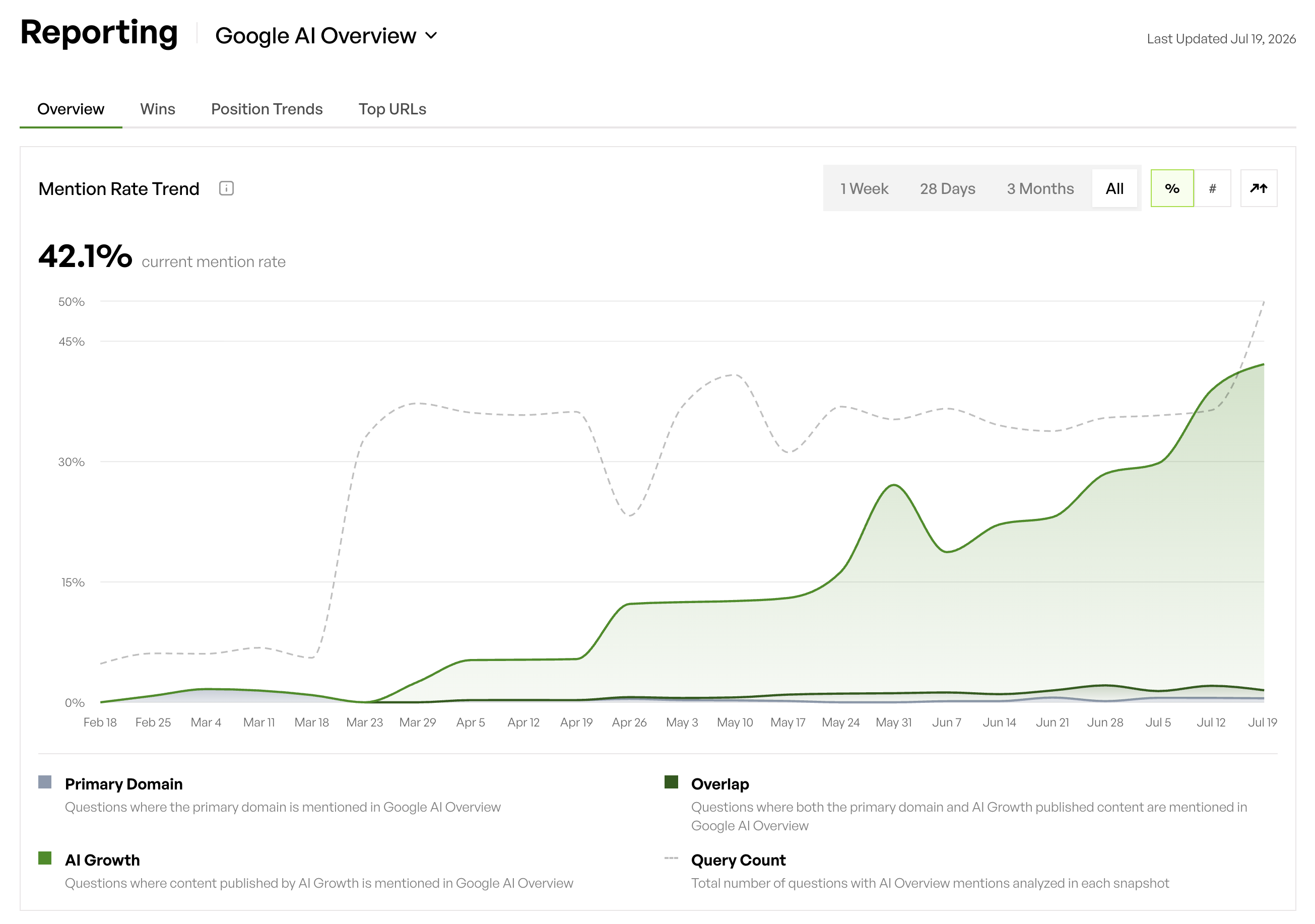
Across the first twelve weeks, clients average more than 12,000 additional AI citations and mentions, over 100,000 additional bot visits, and a 20% or greater lift in impressions, with content indexing in as little as ten days. Standout outcomes include Breadless, now one of the most recommended healthy franchises in the US, with ChatGPT citing eatbreadless.com over 45,000 times per month and Google Search Console impressions growing roughly 30 times in six months. Leva Sleep is now the most mentioned retailer for adjustable beds in Canada, with ChatGPT citations topping 10,000 per month and $40,000 to $50,000 in deals closed in under three weeks from buyers who found them through AI Growth Agent content. Bisutti now has 71% of its brand mention visibility driven by AI Growth Agent and is the second most recommended events brand by AI in Brazil.
These individual outcomes reflect broader performance patterns that clients typically achieve in their first twelve weeks:
| Metric | AI Growth Agent Average (First 12 Weeks) |
|---|---|
| Additional AI citations and mentions | +12,000 |
| Additional bot visits | +100,000 |
| Impressions lift | +20% or greater |
| Time to first published article | About 1 week |
| Time to first indexing | As little as 10 days |
Results based on aggregated client performance data. Individual outcomes may vary.
Common Mistakes and How to Troubleshoot Them
Three failure patterns account for most underperforming automated brand visibility AI programs.
Prompt caps and a capped universe. Monitoring tools that bill per prompt force brands to track only the terms they already thought to ask about. BrightEdge research shows ~3% weekly citation change (96.8% unchanged) across AI search engines, with 87% of weekly citation changes being declines, meaning a capped prompt set misses most of the movement. The fix is a flat-fee engine that maps the full universe, refreshed weekly, with prompt count never a billed metric.
Stale content. Semrush’s 2026 AI Visibility Index, analyzing 126 million U.S. AI search prompts, shows brands must now compete not only to be found but to be accurately understood and credibly supported through owned content, third-party sources, and structured data. One dimension of that credibility is recency. Seer Interactive’s analysis found that 65% of AI bot hits target content published within the past year, and Ahrefs’ analysis found that AI-cited content is 25.7% fresher on average than traditional organic results. The fix is living, self-healing content that updates automatically when the year turns and when Google Search Console signals indicate decay.
No incremental measurement. Brands that report total AI citations without isolating what their content engine generated are taking credit for visibility they already had. The fix is publishing into a separate environment and cross-referencing bot traffic, Search Console, and citation data to report only the delta. AI-cited brands often see measurable brand search lift after achieving multi-platform citation, so the signal is real and measurable when the measurement is set up correctly.
Monitoring Tools vs. Production Engine: 2026 Comparison
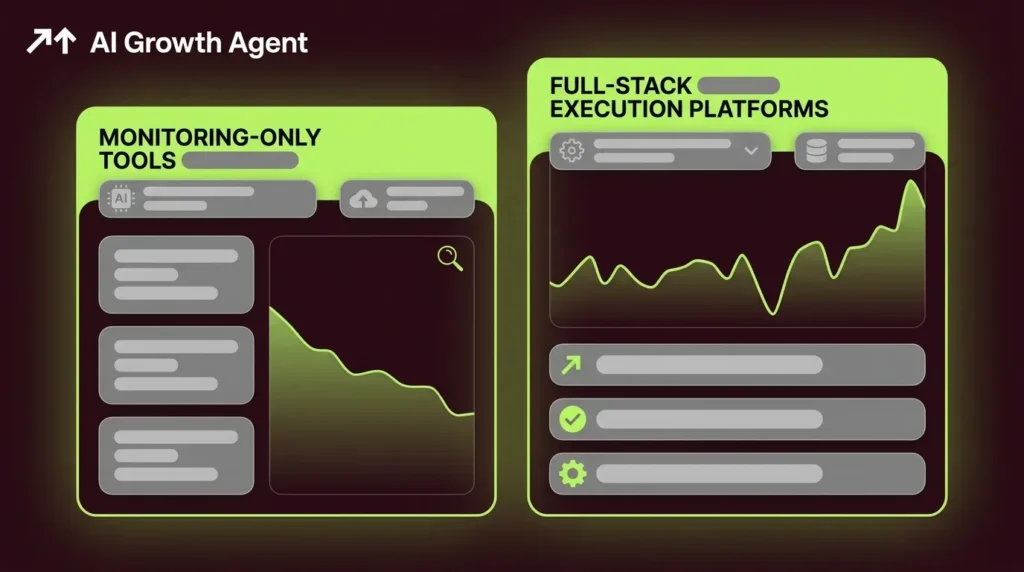
The sharpest line in the AI visibility tools landscape sits between platforms that track citations and platforms that produce them. Monitoring platforms only track citations and optimization platforms provide recommendations that still require the customer’s team to execute, while execution platforms generate strategic plans, create optimized content, verify citation improvements, and re-trigger cycles automatically.
| Tool | Prompt Coverage | Content Creation | Technical SEO and Outcome Metrics |
|---|---|---|---|
| Profound | Starter plan limited to ChatGPT-only tracking, broader engine coverage requires higher tiers | None, monitoring only | Citation database, no bot tracking, no Search Console integration, no schema provisioning |
| Adobe Brand Visibility | Tracks brand narrative signals across digital channels, no disclosed prompt limit | None, monitoring and analytics only | No content production, no schema provisioning, no incremental visibility reporting |
| SE Ranking | Keyword and rank tracking, AI Overview monitoring available | AI writing assistant, not a closed-loop production engine | Traditional SEO suite, no agentic technical SEO, no Blog MCP, no llms.txt provisioning |
| Alhena AI | Conversational AI for on-site use, not a citation tracking platform | On-site conversational content, not an off-site citation engine | No universe mapping, no incremental visibility reporting, no agentic SEO stack |
| AI Growth Agent | Full universe, 1,600+ queries at maturity, 3,000+ searches weekly, prompt count never billed | 2 to 50 articles per day per client, single-shot with anti-hallucination controls and living self-healing updates | Full traditional and agentic technical SEO stack including Blog MCP, llms.txt, llms-full.txt, schema suite, instant indexing, bot tracking, and incremental visibility reporting, with the 12,000+ citations, 100,000+ bot visits, and 20%+ impression lifts described earlier |
The generative engine optimization tools category is growing rapidly. Analyst estimates placed the 2025 GEO services market between $848 million and $1.01 billion, with projected CAGRs of 34 to 50% through 2031 to 2034. The brands that win are the ones that move from observation to execution now, while the leaderboard is still being written.
Market size estimates are based on third-party analyst reports and may vary by source.
Frequently Asked Questions
How long does it take to see results from automated brand visibility AI?
As noted earlier, the first article is typically live within a week of kickoff. Content has indexed in as little as ten days and often within two weeks. Initial citation lifts and visibility increases typically appear within two to eight weeks of deploying infrastructure and launching the first content batch. The standard engagement is a three-month pilot, because indexing takes time and varies by industry, but clients see movement early. Clients typically achieve the performance benchmarks outlined in Step 7, with over 12,000 citations, 100,000+ bot visits, and 20%+ impression lifts within the first twelve weeks.
Does the client need a technical team to run this?
No. That is the point of headless marketing. The engine provisions schema, the WordPress plugin, robots.txt, sitemaps, automatic web stories, Blog MCP, agent discovery via /.well-known/, llms.txt and llms-full.txt, instant indexing, autoredirects, and 404 tracking automatically. The only integration step on the client’s side is the reverse proxy rewrite that connects the blog to a subdirectory under their domain. Everything else is included in every package, and the client’s team gives feedback in plain language while the system learns and saves memories so the same correction is never needed twice.
How is incremental visibility measured and reported?
AI Growth Agent publishes into a separate environment so it can report only the visibility it actually generates, never taking credit for visibility the brand already had. Reporting cross-references bot traffic, Google Search Console, and citation data week over week. The engine isolates what it contributed and doubles down on what indexes well, using internal linking to lift what does not. Google Search Console serves as an independent audit alongside per-article bot tracking across every bot type.
How does the system handle brand voice and compliance requirements?
The manifesto serves as the primary source of truth, and more detail strengthens the outcome. Style memories carry voice rules, such as preferred terminology or words the brand never uses, and the engine applies them to every future generation. Legal disclaimers, claim prioritization for sensitive sectors, and anti-hallucination steering are configured once and applied everywhere. The engine validates every claim, source, and quote against evidence found online rather than a model’s training data, and any claim that cannot be backed up is removed or softened before the article ships. Clients in regulated sectors can specify which claim types deserve the heaviest scrutiny, and the engine focuses its checks there.
What happens when competitors also start using AI content tools?
Quality content and prompt-generated content are not the same to AI indexers, and they can tell the difference. Long-tail strategies differ even within the same sector, so two competitors running AI content do not converge on the same answer. The brand manifesto and the journalist-led layer, shaped by a journalist with more than ten years of experience on the founding team, create differentiation a generic tool cannot replicate. The companies that win are the ones controlling their narrative deliberately, not the ones generating the most text. Brands that establish authoritative content now are training the next generation of models with their own narrative. Brands that wait are training the next generation with whatever happens to be sitting on the open web.
Close the Loop on AI Visibility Before the Leaderboard Fills Up
The leaderboard for AI citations is being written in 2026. Brands that map their full universe, produce authoritative living content, deploy the complete agentic technical SEO stack, and measure only incremental visibility are the ones earning citations in ChatGPT, Perplexity, and Google AI Overviews. Brands that rely on passive monitoring tools are watching the leaderboard fill up without them.
AI Growth Agent is the single closed-loop engine that does all of it, from kickoff to first article in about a week, with no headcount required and no agency dependency. The engine maps the universe, produces the content, deploys the full stack, and proves the result.