Written by: Mariana Fonseca, Editorial Team, AI Growth Agent
Key Takeaways for Mid-Market B2B Teams
- AI-driven dark social now accounts for a significant share of B2B pipeline, yet 70% of AI referral sessions arrive without a referrer, which makes traditional attribution blind to this revenue source.
- Winning ChatGPT citations requires original data, question-formatted headers, definitive language, and full schema markup so AI crawlers can parse and trust your content.
- Reliable AI revenue tracking uses a five-step attribution checklist that combines bot logging, self-reported AI source fields, dedicated CRM fields, citation context tracking, and incremental visibility reporting.
- AI search traffic converts at up to 5.1× the rate of Google organic traffic, and brands cited across multiple AI platforms see conversion lifts as high as 3.7×.
- Stop letting AI define your brand at random and take control of the narrative with AI Growth Agent by booking a demo today.
Building Pages That Earn ChatGPT Citations
ChatGPT citation performance comes from a systematic program, not a single-page tweak. The program starts with evidence-based long-tail coverage at scale. Pages hosting original data get cited 4.31 times more often per URL than directory-style listings, so the content strategy begins with seed terms that anchor your topic universe, then expands into the hundreds of long-tail queries your buyers actually ask.
The structural requirements for citation-ready pages are specific. Question-formatted H2 headers often achieve higher citation rates than statement headers because they mirror the way users phrase prompts in AI tools. This same alignment principle applies to tone, since content using definitive language often earns more citations than hedged language because models favor clear, authoritative claims. To help crawlers verify that authority, every page needs Article, FAQ, and Author schema so AI systems can parse and trust the content. Major AI crawlers including GPTBot, ClaudeBot, and PerplexityBot fetch only raw HTML and do not execute JavaScript, so key content must appear in the initial HTML rather than behind client-side scripts.
Agentic technical SEO requirements extend this foundation. A fully prepared property needs Blog MCP for direct agent interoperability, which allows AI agents to query your content programmatically. That machine-readable layer is reinforced by llms.txt and llms-full.txt files that tell AI surfaces how to read the brand in the format they require. OpenAI discovery and Agent Card guidance served via /.well-known/ then act as a directory that points agents to these resources. Natural language query parameters complete the loop by returning personalized responses to agents that pass queries directly into the URL. Living content that updates and self-heals over time, rather than remaining published and forgotten, keeps the brand narrative current across every training sweep.
Tracking Revenue from ChatGPT Citations
Once your content earns citations, the next challenge is proving revenue impact. Tracking ChatGPT citations revenue requires a measurement architecture that connects bot-level signals to closed pipeline. AI search drives a significant portion of B2B pipeline, yet none of this influence appears in traditional attribution models because AI answer engines produce zero click data. Buyers arrive as direct traffic after researching inside a chat interface.
A practical five-step attribution checklist for linking AI citations to revenue looks like this:
- Instrument bot tracking. Log every GPTBot, ClaudeBot, and PerplexityBot crawl at the article level, because each crawl acts as a leading indicator that a citation is imminent or already active.
- Add AI source fields to every lead form and SDR script. Self-reported attribution captures 30 to 50% of pipeline from channels that digital attribution tools miss entirely, so explicit “ChatGPT” and “Perplexity” options as required fields surface the dark-social effect.
- Create dedicated CRM fields for AI-sourced deals. Recommended fields include Lead Source labeled “AI Search,” First AI Touch Date, AI Platform, and a multi-select Deal Influence tag, which enables multi-touch reporting.
- Track AI ranking, not just traffic. Order of mention and citation context replace the old ranking number, so where your brand appears in the answer and how that position evolves week over week becomes the new leaderboard.
- Report incremental visibility separately. Publish AI-optimized content into a separate environment so you can isolate what the new effort generated versus visibility the brand already had, then cross-reference bot traffic, Google Search Console, and citation data in a single view.
Maintaining visibility from one AI answer to the next is challenging because AI models retrain and refresh their knowledge bases continuously. Brands earning both citations and unlinked mentions are more likely to resurface across repeated queries because they establish authority across multiple content types. This persistence explains why consistent citation requires consistent production rather than a one-time audit.
First-Party Attribution for AI Recommendations
Layered first-party methods make the dark-social effect measurable. Between 70 and 73% of the B2B buying journey occurs in the dark funnel before a form fill or direct contact, and no single method closes that gap alone.
| Attribution Method | What It Captures | Dark-Social Coverage | Pipeline Accuracy |
|---|---|---|---|
| UTM Parameters | Direct click-throughs from cited URLs | Low: approximately 93% of AI search sessions end without a website click | Undercounts AI influence significantly |
| Self-Reported Influence | Buyer-declared discovery channel at form fill or SDR call | Moderate to high: captures 30 to 50% of pipeline missed by digital tools | Best single method for dark-funnel pipeline |
| CRM AI Touchpoint Field | AI platform, first touch date, and deal influence tag logged against opportunity records | High when SDR scripts enforce capture | Enables multi-touch reporting linking AI mentions to closed-won rate and deal velocity |
| Incremental Visibility Reporting | Bot traffic, citation rate, and Search Console impressions isolated to new content | High: separates the brand’s existing visibility from new AI-driven reach | Proves causation rather than correlation week over week |
Many B2B buyers ask AI platforms for contact details or website links and then use that information directly, which causes the visit to register as direct or branded search with no AI referrer. The only reliable way to capture that influence is to ask buyers directly and build CRM infrastructure that records the answer.
The conversion premium makes this investment rational. Superprompt.com’s analysis of 12.3 million visits from January to September 2025 found AI search traffic converts at 14.2% compared to Google organic traffic at 2.8%, a 5.1x conversion advantage. MarGen’s 2026 study of 40+ UK B2B clients found that brands cited by name in AI search results convert at 2.4x the rate of Google organic traffic, with the lift reaching 3.7x when cited across two or more of the four major AI platforms.
ChatGPT Citations Compared to Google Rankings
The discovery shift has created two parallel visibility systems. More consumers now start product discovery with AI tools than with search engines, and the buyer who finds your brand in ChatGPT usually sits further along in their decision than the buyer who finds you through a Google ranking.
Google rankings produce a position number. ChatGPT citations produce citation context, which includes where your brand appears in the answer, who it is grouped with, and what claim it is cited for. This context matters because it directly shapes buyer shortlists, the set of vendors a buyer considers before ever contacting sales. Review sites and AI chatbots influence B2B software buyer shortlist decisions, and 95% of the time the winning vendor was already on the buyer’s Day One shortlist formed before any seller contact. Citation context determines whether your brand is on that shortlist by controlling how AI positions you relative to competitors during the research phase.
Scaling commercial-intent pages for AI citation requires a production system rather than a one-off content sprint. The format that performs best is comparison content, which achieves a 95% citation rate on ChatGPT, the highest single-format rate measured in HubSpot’s State of AEO 2026 report. This high citation rate translates directly to pipeline, since brands dominating commercial-intent query clusters at high share generate substantially more pipeline-attributed deals than from appearing in many informational queries. The universe of commercial-intent queries is large and too complex for manual production, which is why only an autonomous engine can map and produce against it at scale.
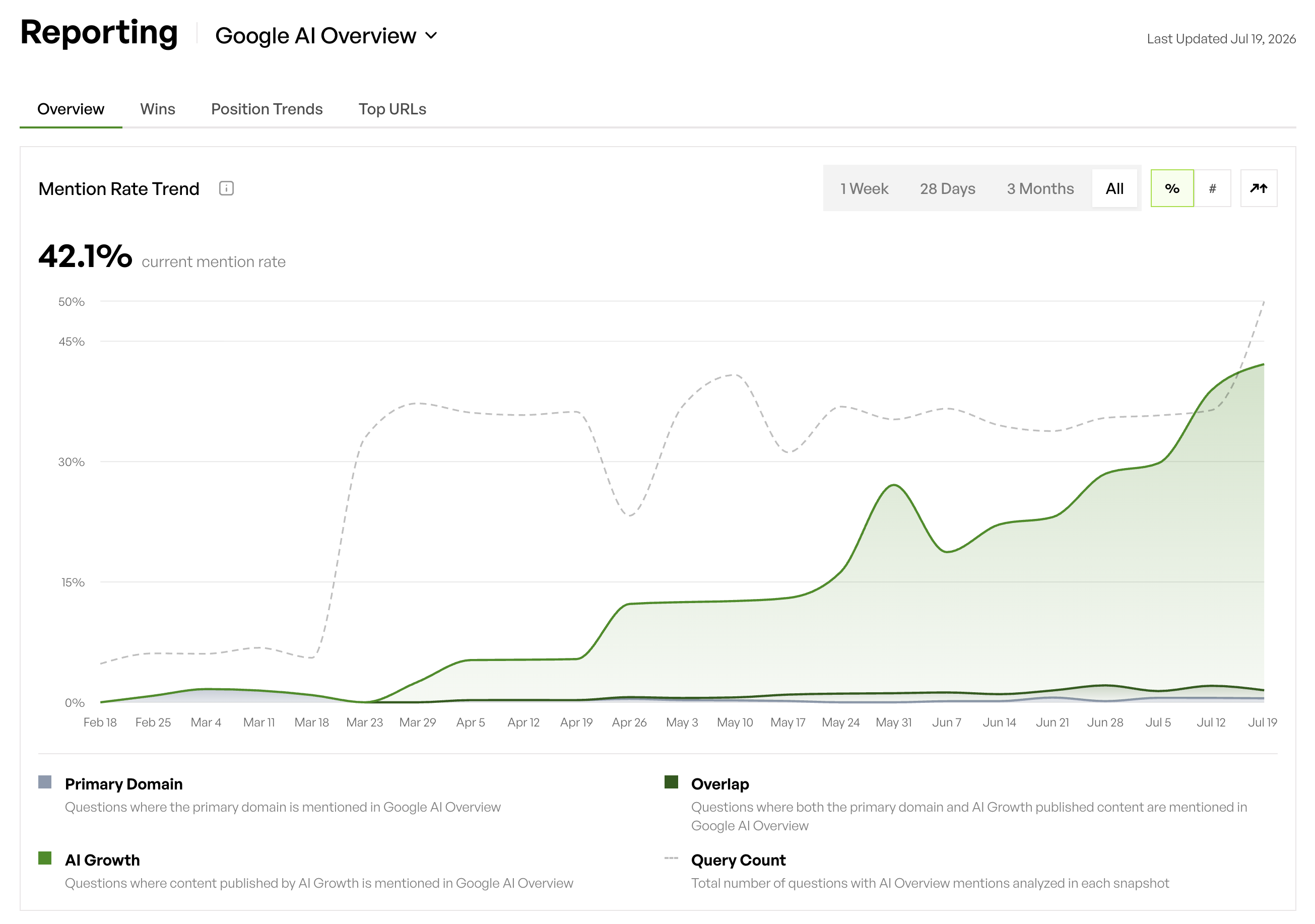
AI Growth Agent maps the full universe of seed terms and long-tail queries from real-time Google and ChatGPT data, then produces authoritative living content against each one. The platform ships the complete agentic technical SEO stack, including Blog MCP and llms.txt, and reports the incremental visibility it generates week over week. Clients average more than 12,000 additional AI citations and mentions in the first 12 weeks. Breadless grew from 387,000 to 12.3 million Google Search Console impressions in six months, with ChatGPT citing eatbreadless.com over 45,000 times per month. Leva Sleep closed $40,000 to $50,000 in deals in under three weeks from buyers who walked into the store carrying the blog content.
Frequently Asked Questions
How long does it take to see ChatGPT citations after publishing optimized content?
Early adopters report new AI citations appearing within two to six weeks after restructuring existing content for AI extractability. AI Growth Agent clients typically see their first article live within a week of kickoff, with content indexing in as little as ten days. Measurable citation volume and incremental visibility then build over the following weeks as the content compounds across the universe of seed terms and long-tail queries.
Why does ChatGPT-referred traffic convert so much better than Google organic traffic?
Buyers who arrive via an AI citation have already completed a significant portion of their research inside the chat interface. They receive a synthesized recommendation, evaluate alternatives, and then seek out the brand directly. That buyer sits further along in the decision cycle than a buyer who clicked a blue link. The conversion premium reflects intent rather than channel mechanics, and brands cited across multiple AI platforms during a single buying journey see the highest conversion lifts because repeated citation builds trust before the buyer ever reaches the website.
What is the dark-social effect in AI search, and why does it matter for revenue attribution?
The dark-social effect in AI search describes the revenue that flows through buyer journeys that begin inside an AI platform but arrive at your CRM without a traceable referrer. A buyer asks ChatGPT for vendor recommendations, receives your brand in the answer, then searches Google for your brand name or types your URL directly. The conversion registers as branded search or direct traffic, so traditional attribution assigns zero credit to the AI citation that initiated the journey. The practical consequence is that most organizations systematically underinvest in AI citation because their attribution models cannot see the channel’s true contribution to pipeline.
Can a non-technical marketing team manage AI citation optimization without engineering support?
The technical requirements for AI citation optimization, including schema markup, llms.txt, Blog MCP, agent discovery endpoints, proper sitemaps, and bot tracking, sit beyond what a non-technical team can implement and maintain manually. AI Growth Agent’s headless marketing architecture provisions the entire technical and agentic SEO stack automatically. The only integration step on the client side is a reverse proxy rewrite that connects the blog to a subdirectory under the brand’s domain, and the internal team gives feedback in plain language that the engine applies to every future generation without requiring technical skill from the client.
How is AI citation performance different from traditional SEO keyword rankings?
Traditional SEO produces a rank position for a defined set of tracked keywords. AI citation performance is measured by citation context, order of mention, citation rate across a universe of queries, bot visit volume, and incremental visibility isolated to new content. No static ordered list exists in AI answers. A brand can rank first on Google for a head term and still be absent from every AI answer on the long-tail queries where buyers actually make decisions. The universe of queries that matter in AI search is orders of magnitude larger than the handful of head terms most brands track, which means prompt count should never be a billed or capped metric in any measurement system.
Conclusion: Owning Your Narrative in AI Answers
The discovery shift has already changed how buyers build shortlists, evaluate vendors, and resolve trust. ChatGPT citations driving sales operate through the dark-social effect, where the buyer journey begins in an AI interface, the brand earns the citation, and the revenue arrives without a referrer. Traditional attribution misses this influence because it depends on referrer data that does not exist, while monitoring tools observe citations without acting on them. Neither approach solves the core problem of shaping what AI says about your brand.
Brands winning this channel produce living, authoritative content across the full universe of commercial-intent queries, ship the complete agentic technical SEO stack, and report incremental visibility week over week. AI Growth Agent handles that work autonomously, from kickoff to first article in about a week, with no agency dependency and no additional headcount required on your side.