Written by: Mariana Fonseca, Editorial Team, AI Growth Agent
Key Takeaways
- Agent discovery in 2026 serves two roles. It supports enterprise governance that catalogs and controls AI agents, including shadow AI. It also powers multi-agent protocols that locate and authenticate agents across distributed systems.
- The process depends on structured, machine-readable metadata. Agent Cards at standardized endpoints like
/.well-known/agent.jsonenable trusted communication and policy enforcement. - Protocols such as A2A (Agent2Agent) standardize discovery so agents can work across vendors. Brands with conformant Agent Cards become visible to AI agents acting on user queries.
- Implementation covers Agent Cards,
llms.txtfiles, Blog MCP, and registries. Together these pieces make brands discoverable, citable, and trustworthy in the agentic layer. - Brands without this infrastructure risk narrative loss in AI search. See how AI Growth Agent can stand up your discovery stack in the first week.
How Agent Discovery Works Inside Enterprises
Agent discovery in enterprise AI governance starts with inventory. Organizations must identify every AI agent touching their environment, whether sanctioned or not.
Shadow AI, deployed by individual teams without central approval, creates the largest governance risk. Discovery scans network traffic, API call logs, and identity provider records to surface agents that were never formally registered. Microsoft Entra’s managed identity framework offers one approach. Agents receive managed identities that make them discoverable and auditable inside Azure. Credential-based access is replaced with identity-bound tokens that governance teams can monitor and revoke. This discovery step feeds directly into classification.
Once teams identify agents, they classify them by capability, data access scope, and risk level. This classification drives policy decisions. High-risk agents with broad data access require human approval for sensitive actions. Low-risk agents with narrow scope may act autonomously. Agents that fail compliance checks are decommissioned. Discovery remains continuous because new agents appear constantly and expand the attack surface.
How Agent Discovery Works in Multi-Agent Systems
In multi-agent system protocols, discovery is technical and transactional. An orchestrating agent queries a known endpoint, often a /.well-known/ path or a registry, and retrieves a structured description of a target agent.
That description, called an Agent Card, lists the agent’s capabilities, supported input and output formats, authentication requirements, and endpoint URLs. The requesting agent parses the card, checks compatibility, and starts a session when the handshake criteria match.
This process works like DNS for the web. Before two systems communicate, one must find and verify the other. Without discovery infrastructure, agents either fail to connect or connect without verification. Both outcomes create operational failures and security risk.
See how we implement discovery endpoints for your brand in our implementation walkthrough.
How A2A Defines Agent Discovery
The Agent2Agent (A2A) protocol, introduced in 2025 and brought to production-grade v1.0 in early 2026 under Linux Foundation governance with support from more than 150 organizations including Microsoft, AWS, Salesforce, SAP, and ServiceNow, defines agent discovery as the first step in any agent-to-agent interaction.
In A2A, every agent exposes an Agent Card at a standardized URL, typically https://yourdomain.com/.well-known/agent.json. When an orchestrating agent needs to delegate a task, it fetches the target agent’s card, reads the declared capabilities and authentication scheme, and decides whether to proceed. The protocol supports direct discovery, where the requesting agent already knows the target URL. It also supports registry-based discovery, where a central index maps capability types to agent endpoints.
A2A’s discovery layer focuses on interoperability across vendors and platforms. An agent built on one provider’s infrastructure can discover and collaborate with an agent built on another provider, as long as both expose conformant Agent Cards. This shared metadata standard removes the need for bilateral integration agreements and custom connectors. A known endpoint path and a common schema make multi-agent orchestration practical at enterprise scale.
For brands, A2A discovery shapes how AI agents find authoritative sources. AI agents that book services, research products, or compare vendors query discovery endpoints to locate trusted data. Brands that expose conformant Agent Cards and structured content endpoints appear in those results. Brands that skip this work stay invisible to the agentic layer of AI search.
Find out if your brand is ready for A2A protocol integration.
Agent Card Example for Brand Content
An Agent Card is a JSON document served at a well-known path that describes an agent’s identity, capabilities, and interaction requirements. The example below shows a typical card for a brand content agent.
{ "schema_version": "1.0", "name": "Brand Content Agent", "description": "Provides authoritative product information, pricing context, and brand narrative for AI agents querying on behalf of users.", "url": "https://yourdomain.com/agent", "provider": { "organization": "Your Brand Name", "url": "https://yourdomain.com" }, "capabilities": { "input_modes": ["text/plain", "application/json"], "output_modes": ["text/plain", "application/json", "text/markdown"], "supported_tasks": [ "product_information", "brand_narrative", "pricing_context", "content_retrieval" ] }, "authentication": { "schemes": ["none", "bearer"] }, "endpoints": { "query": "https://yourdomain.com/agent/query", "discovery": "https://yourdomain.com/.well-known/agent.json" }, "llms_txt": "https://yourdomain.com/llms.txt", "llms_full_txt": "https://yourdomain.com/llms-full.txt" }The card states what the agent does, how to reach it, what authentication it expects, and where to find the full LLM-readable content index. An orchestrating agent that fetches this card receives enough detail to decide whether to query the brand’s content layer and how to structure that query. Without this card, the agent has no structured signal and routes to sources that do expose one.
AI Growth Agent includes Agent Card guidance via /.well-known/ as part of its standard agentic technical SEO stack. The stack also covers OpenAI discovery endpoints, Blog MCP, and natural language query parameters at /?s={query} that return personalized, internally linked responses to agents.
Get your Agent Card live fast with a brief implementation consultation.
Agent Registry and Brand Visibility
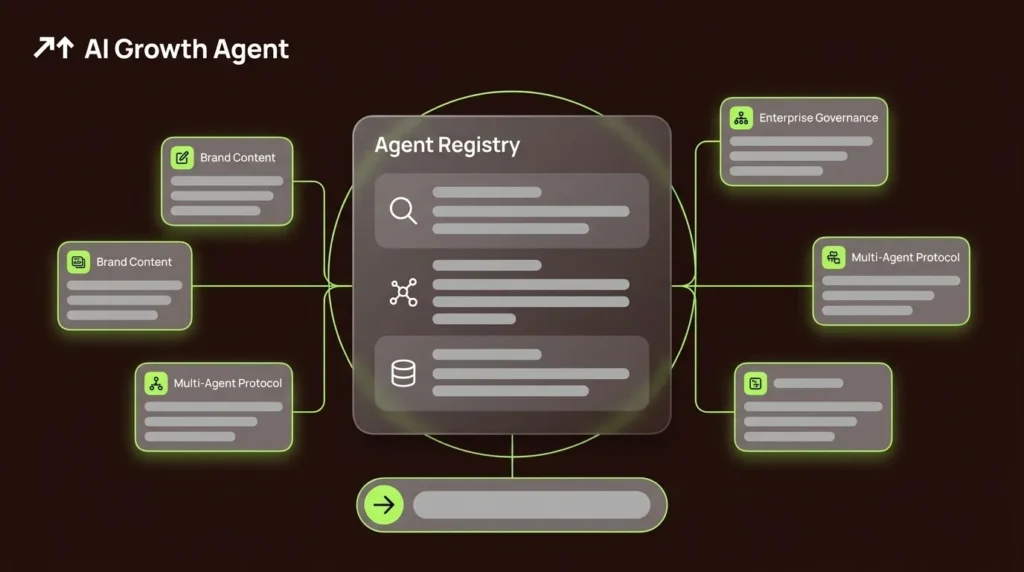
An agent registry is a centralized or federated index that maps agent capabilities to discovery endpoints. In enterprise governance, a registry acts as the authoritative record of every sanctioned agent in the environment. It tracks identity, data access scope, owning team, and current status.
Governance teams use the registry to enforce policy, audit activity, and decommission agents that fall out of compliance. In multi-agent protocol contexts, a registry functions as a capability directory. An orchestrating agent that needs a specific task, such as retrieving current pricing for a product category, queries the registry for agents that declare that capability. It receives a list of matching endpoints, fetches their Agent Cards, and selects the best option based on trust level, latency, or output format compatibility.
The /.well-known/ convention acts as a decentralized equivalent of a registry entry. By serving a conformant Agent Card at a predictable path, any domain becomes self-registering. AI agents that check /.well-known/agent.json can discover a brand’s agent endpoint without a central index. This pattern matches robots.txt, sitemap.xml, and llms.txt, where compliant crawlers and agents always check a known path.
For brand visibility, the registry layer shapes routing behavior. AI agents acting on user queries prefer sources that are discoverable, structured, and authenticated. A brand that publishes llms.txt, llms-full.txt, a conformant Agent Card, and Blog MCP endpoints effectively registers itself with every agent that follows these conventions. A brand that skips these steps has no presence in the agentic discovery layer, no matter how much content it publishes.
Implementation Checklist for Mid-Market and Enterprise Teams
This checklist outlines the infrastructure required to appear discoverable, citable, and trustworthy to AI agents in 2026. Each item supports a specific layer of the agentic discovery stack.
- Expose an Agent Card at
/.well-known/agent.json. Declare capabilities, supported input and output formats, authentication schemes, and query endpoints in A2A-conformant JSON. - Publish OpenAI discovery metadata via
/.well-known/. Allow ChatGPT and OpenAI-based agents to locate and authenticate your content endpoints. - Publish
llms.txtandllms-full.txt. Give AI surfaces a structured, LLM-readable index of your brand’s authoritative content so models can read and cite it accurately. - Deploy Blog MCP. Model Context Protocol endpoints expose schema, manifest, discovery, and capability guidance to agents. These endpoints work with Chrome 146+ and other WebMCP-enabled browsers.
- Implement natural language query parameters. Configure
/?s={query}to return personalized, internally linked responses so agents that pass queries directly into your URL receive a tailored, citable answer. - Serve content in Markdown to agent crawlers. Structured Markdown is the format AI surfaces parse most reliably. Serving it conditionally to agent user agents improves citation accuracy.
- Maintain a conformant
robots.txtandsitemap.xml. These files remain the baseline for traditional crawlers and AI training agents that navigate your content graph. - Apply full schema markup. Article, FAQ, organization, product, author, and review schema help AI surfaces understand content structure and power rich results that expand citation surface area.
- Implement agentic technical SEO end to end. Every published page should carry the full stack: structured HTML, metadata on every asset, internal linking that compounds authority, and sanitized external linking.
- Track bot interactions per article. Per-article bot tracking across traditional crawlers and AI training agents verifies that discovery infrastructure works and that specific content is being read and cited.
AI Growth Agent provisions this entire stack automatically. Client teams do not need technical skills, and every package includes the full agentic and traditional technical SEO stack from day one.
Book a technical review to map your full discovery stack deployment.
Frequently Asked Questions
What is the difference between agent discovery in enterprise governance and in multi-agent protocols?
In enterprise governance, agent discovery means identifying and cataloging AI agents operating inside an organization, including unsanctioned shadow AI, so security and compliance teams can apply policy controls. In multi-agent protocols such as A2A, agent discovery means the technical mechanism by which one autonomous agent locates another, reads its declared capabilities via an Agent Card, and establishes a trusted session. The governance context focuses on control and visibility over which agents exist. The protocol context focuses on interoperability and routing between agents that need to collaborate. Both rely on structured metadata, but the audience for that metadata differs: governance teams in one case and other agents in the other.
How long does it take to implement agent discovery infrastructure for a mid-market brand?
The core endpoints, including the Agent Card at /.well-known/agent.json, llms.txt, llms-full.txt, and OpenAI discovery metadata, can be published within days for a team with direct access to the domain’s web server or CDN configuration. Blog MCP and natural language query parameters require a compatible publishing stack. AI Growth Agent deploys the full agentic technical SEO stack, including all discovery endpoints, within the first week of engagement as part of site setup, with no engineering work required from the client. The only integration step on the client side is the reverse proxy rewrite that connects the blog to a subdirectory under their domain.
Who owns agent discovery implementation inside an enterprise organization?
Ownership typically splits across two functions. IT and security teams own the governance layer, which includes the registry of sanctioned agents, identity management via tools like Microsoft Entra, and the policies that control which agents may operate and with what data access. Marketing and digital teams own the brand visibility layer, which includes the Agent Cards, LLM files, MCP endpoints, and content infrastructure that make the brand discoverable and citable to external AI agents acting on user queries. In practice, neither function moves quickly without a system that automates the technical publishing layer, and headless marketing infrastructure closes that gap.
How does agent discovery connect to brand citation in AI search?
AI agents acting on user queries, whether inside ChatGPT, Perplexity, Google’s AI Mode, or an enterprise orchestration platform, follow discovery conventions to find authoritative sources. A brand that exposes conformant Agent Cards, publishes llms.txt and llms-full.txt, and serves structured content via Blog MCP endpoints becomes actively registered in the agentic discovery layer. When an agent queries for information in that brand’s category, it finds the brand’s endpoints, reads the structured content, and cites it in its response. A brand without this infrastructure is not findable by the agentic layer, regardless of how much content it publishes, because the agent has no machine-readable signal to use.
What is the risk of not implementing agent discovery infrastructure in 2026?
The primary risk is narrative loss. AI agents that cannot discover a brand’s authoritative content will cite whatever sources they can find and trust, which may be competitors, aggregators, or outdated third-party content. In a zero-click environment where most users accept the AI’s answer without verifying the source, a brand that is absent from the agentic discovery layer is absent from the conversation entirely.
The secondary risk is governance exposure. Organizations that have not inventoried their internal AI agents cannot enforce data access policies, cannot audit agent behavior, and cannot respond to a breach or compliance failure involving an agent they did not know existed. Both risks compound over time as the number of agents in both external and internal environments continues to grow.