Written by: Mariana Fonseca, Editorial Team, AI Growth Agent
Key Takeaways
- Four connected intelligence pillars – Search Intelligence, AI Analytics, Bot Tracking, and AI Ranking – now shape which brands appear in AI answers across ChatGPT, Perplexity, and Google AI Mode.
- Zero-click AI answers now dominate search behavior, with most queries ending inside the AI surface, so brands must control the story told in those answers.
- Third-party mentions, clear entities, and structured, citable content drive AI citations far more reliably than owned-site backlinks or traditional rankings alone.
- Monitoring dashboards only report visibility, while production engines map the full query universe and publish authoritative, self-healing content that actually changes outcomes.
- Brands ready to own their AI visibility can schedule a demo with AI Growth Agent to map their four-pillar universe and turn diagnosis into compounding visibility.
The Discovery Shift and Zero-Click Reality
Customer discovery has shifted from blue links to AI answers, and those answers increasingly appear without a click. SparkToro’s analysis of Similarweb clickstream data found that 68.01% of US Google searches ended without a click in the first four months of 2026, up from 60.45% in 2024. ChatGPT Search carries an 82% zero-click rate, Google AI Mode an 88% zero-click rate, and Perplexity a 93% zero-click rate. Users get the answer inside the surface and never visit the source.
This behavioral shift compounds a structural one. A Pew Research Center study of 68,879 real Google searches found that only 1% of users click any link inside a Google AI Overview, while 26% end their browsing session entirely after seeing one. For most people, whatever the AI says becomes the answer.
Google’s own I/O 2026 numbers make the scale concrete. AI Mode crossed 1 billion monthly users within its first year, and queries more than doubled every quarter after launch. Every one of those surfaces consumes content the same way. Each one reads, cites, and acts on whatever the model can find and trust. Every brand now faces a simple reality: either it shapes what those models say, or it accepts whatever the open web already implies.
How Brands Can Influence ChatGPT Answers
Brands can influence AI answers, but success requires more than prompt tweaks or a monitoring dashboard. Large language models decide which brands to recommend based on training data frequency, third-party validation, entity clarity, and structured, citable content.
An AirOps analysis found that brands are 6.5 times more likely to be cited through third-party sources than through their own domains, with 85% of AI search mentions originating from external content such as listicles, comparison pages, and review roundups. An Ahrefs study of 75,000 brands found that branded web mentions correlate with AI Overview visibility at a Spearman coefficient of 0.664, while referring domains correlate at only 0.218, roughly three times weaker.
Entity clarity carries equal weight. LLMs select brands based on five measurable factors: training data frequency, contextual relevance, authority signals, recency cues, and prompt sensitivity. A brand described accurately across ten independent publications gives a model higher entity confidence than one appearing in a hundred owned blog posts and almost nowhere else.
Isolated tactics do not move these signals. A single press release, a schema update, or a monitoring tool that reports the problem without solving it leaves the underlying gap intact. What moves the needle is a diagnostic framework that maps the full universe of queries and then produces authoritative content against each one at scale. That framework has four distinct components, each addressing a different dimension of the visibility problem.
The Four-Pillar Intelligence Framework
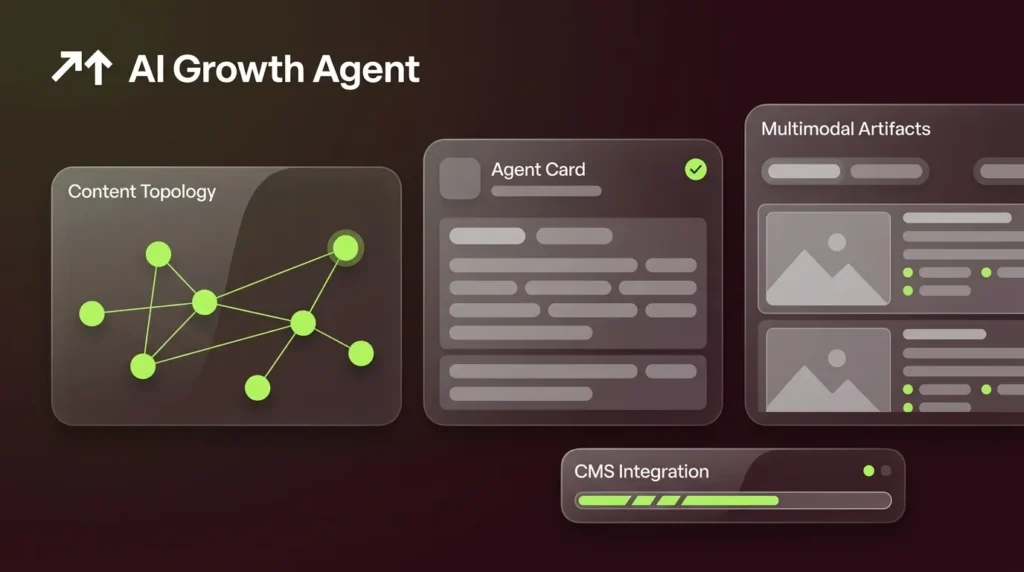
Teams winning in AI search see four distinct data streams and act on all of them in the same week. Each pillar works with the others to turn scattered signals into a repeatable system.
- Search Intelligence. This pillar builds a complete portrait of the traditional search landscape: positioning, competition, search volume, and who already wins each result. It turns raw search data into an actionable diagnosis of where the brand stands today.
- AI Analytics. This pillar extends that baseline into brand value and consumer behavior across the full journey. It tracks external touchpoints like Google and AI-tool queries, content consumption, demographics, and sentiment. The brand learns what customers actually ask, not just what it assumed they would ask.
- Bot Tracking. This pillar records every bot interaction, from traditional crawlers to AI training agents, including each crawl, citation, and training sweep. Blocking AI crawlers in robots.txt prevents new content from being indexed, eroding a brand’s presence in ChatGPT over time as competitors with crawlable sites gain an advantage. Without this visibility, a brand cannot tell whether models are reading its content at all.
- AI Ranking. This pillar tracks performance inside AI answers, where no static ordered list exists. Order of mention and citation context become the new ranking. The system monitors where the brand appears in answers and how that position changes week over week, creating a new leaderboard.
The Princeton GEO paper (Aggarwal et al.) demonstrated that adding quotations (+41%), statistics (+31%), and citations (+28%) can boost AI visibility by up to 41%. Achieving that lift requires clarity on which queries to target, which content to produce, and which signals to track. The four pillars provide that map.
Why Checklists Stall and Systems Compound
Most teams that try to improve AI visibility begin with a checklist. They add schema, post on Reddit, update the Wikipedia page, and publish a few articles. Each task seems reasonable on its own, yet together they fail to compound.
The real challenge is execution at scale. Forty to sixty percent of cited sources in generative responses change month over month, and newer content often achieves higher AI coverage. A checklist executed once decays. A production engine that generates living, self-healing content keeps pace with that churn.
Incremental visibility, reliable bot tracking, and self-healing content require owned infrastructure. A Q1 2026 study of 177 brands across healthcare, SaaS, financial services, ecommerce, and legal found that 90% of brands have zero AI search mentions across 107,011 AI responses. The brands in the remaining 10% are not running better checklists. They are running systems that produce authoritative content continuously, validate every claim, and track the results week over week.
Monitoring Dashboards vs Production Engines
The distinction between monitoring and production now defines AI search strategy. Monitoring tools report visibility. Production engines create it. The table below shows how that divide appears across query coverage, output, bot visibility, and reporting, so you can see which side your current stack supports.
| Dimension | Monitoring Tools | Production Engines |
|---|---|---|
| Query coverage | Capped prompt set (typically dozens to low hundreds) | Full universe map refreshed weekly (1,600+ queries at maturity) |
| Output | Dashboard showing current citation status | Authoritative, self-healing content published against each query |
| Bot visibility | Not tracked at the article level | Per-article bot tracking including AI training crawlers |
| Reporting | Rearview: shows where the brand stands | Incremental: isolates visibility the engine actually generated |
Seer Interactive documented a significant multiplier in AI citation rates between brands with active third-party signals and those without, with brands holding strong external validation enjoying far higher visibility. A monitoring tool can show you that gap exists. Only a production engine closes it by producing the third-party signals and authoritative content that drive citations.
Capped prompt sets create a second problem by hiding the long tail. Robots search the long tail. Semrush research found that nearly 90% of webpages cited by ChatGPT rank in position 21 or lower in traditional Google results, so the queries that drive AI citations rarely match the head terms brands pre-decided to defend. A headless production engine maps the full universe and publishes authoritative content the models cite. A monitoring dashboard reports the slice of the market the brand already thought to ask about.
Execution Priorities for CMOs and Founders
For CMOs, founders, and agency owners, the operational question is not whether to invest in AI search visibility. The real decision is whether to diagnose, execute, or do both in the same system.
Diagnosis without execution creates the monitoring trap. Execution without diagnosis creates the checklist trap. The brands consistently cited in ChatGPT, Perplexity, and Google AI Mode avoid both by running diagnosis and execution together.
Several structural requirements define what effective execution demands:
- Entity signals. A brand described accurately in ten independent publications, analyst reports, and industry databases gives a model higher entity confidence than a brand appearing in a hundred owned blog posts but almost nowhere else. Entity clarity requires consistent naming, Organization schema with sameAs properties, and third-party corroboration across indexable sources.
- Third-party validation. OtterlyAI’s analysis of more than one million AI-generated citations found that community platforms capture 52.5% of citations vs. 47.5% for brand domains. Owned content remains necessary, yet third-party coverage often carries more weight.
- Structured content requirements. Pages with FAQ schema markup achieve a 350% citation increase versus unstructured content. Full schema suites, proper sitemaps, advanced robots.txt, and agentic discovery files including llms.txt now function as baseline requirements for brands that want reliable citations.
- Upstream narrative control. Brands cited in AI answers this year train the next generation of models with their own narrative. Brands that wait allow the next generation to train on whatever happens to sit on the open web.
The internal marketing team at most mid-market and enterprise companies is non-technical and cannot deliver schema, technical SEO, or the agentic infrastructure that robots and agents need to cite a brand. A headless production engine solves that gap by handling the technical work end to end, without adding headcount on the brand’s side.
Conclusion: From Observation to Owned Infrastructure
The brands cited in AI answers are not winning by accident. They have established authoritative content across the full universe of queries their customers ask, validated every claim against primary sources, and built the technical infrastructure that lets AI surfaces find, trust, and cite them. They are training the next generation of models with their own narrative.
Monitoring tools show where a brand stands and act as a rearview mirror. A headless production engine turns the four-pillar diagnosis into compounding visibility across ChatGPT, Perplexity, and Google AI Mode. It maps the full universe, produces living content that self-heals over time, tracks every bot interaction at the article level, and reports the incremental visibility it actually generated week over week.
The leaderboard in AI search is being written now. Brands that establish authoritative content in this first generation are compounding an advantage that will be structurally difficult to close later. Brands that stay in dashboards are watching competitors build that advantage in real time.
Frequently Asked Questions
Why do some brands consistently appear in ChatGPT answers while others with similar products do not?
Brands that appear consistently in ChatGPT answers have built a pattern of corroborated signals across independent, high-authority sources. Large language models form entity associations during training by learning statistical co-occurrence patterns between brand names and specific topics across billions of text examples. A brand mentioned thousands of times across review sites, industry publications, and user forums in connection with a particular use case becomes strongly associated with that use case. A brand mentioned primarily on its own website, with little third-party corroboration, gives the model low entity confidence and is omitted from recommendations. The gap does not reflect product quality. It reflects the density, quality, and consistency of signals the model encountered during training and continues to encounter through retrieval-augmented generation on live queries.
Is it possible to influence what ChatGPT says about a brand without paying OpenAI directly?
No paid placement mechanism exists inside the conversational output of major large language models. Brand visibility in ChatGPT, Perplexity, and Google AI Mode is determined entirely by organic factors such as training data frequency, authority signals from high-quality third-party sources, entity clarity across structured data and independent publications, content recency, and the quality of structured, citable content a brand produces. The practical implication is that influence requires a systematic content and distribution strategy, not an advertising budget. Brands that produce authoritative content at scale, earn third-party mentions across trusted platforms, implement full schema suites, and maintain living content that self-heals over time build the kind of organic authority that models cite. Brands that rely on owned-site content alone, or that monitor their visibility without producing content to change it, remain invisible regardless of their paid media spend.
What is the difference between monitoring AI search visibility and actually improving it?
Monitoring tools track whether a brand appears for a capped set of prompts and report the result. They do not produce content, publish to owned infrastructure, track bots at the article level, or act on the data they surface. A production engine does all of those things. This distinction matters because citation patterns in AI search change significantly month over month, and the queries that drive AI citations are largely long-tail queries that monitoring tools with capped prompt sets never surface. A brand that only monitors its visibility sees a rearview mirror of a small slice of its market. A brand running a production engine maps the full universe of queries its customers actually ask, publishes authoritative content against each one, tracks which content AI crawlers are reading, and reports the incremental visibility that content generates. The first approach describes the problem. The second solves it.
How long does it take to see results from an AI search visibility strategy?
Timelines depend on the infrastructure in place and the quality of execution. With a headless production engine, the first article can be live within a week of kickoff, and content can begin indexing in as little as ten days. Meaningful citation movement typically follows a 60 to 90 day execution phase, as models need time to encounter new content through crawls and training sweeps. Clients running AI Growth Agent average more than 12,000 additional AI citations and mentions in the first twelve weeks, with a 20% or greater lift in impressions over the same period. Brands that see results fastest combine authoritative content production with full technical infrastructure, including schema, bot-accessible files like llms.txt, and per-article bot tracking, rather than treating any one of those elements as optional.
Does traditional SEO still matter for AI search visibility?
Traditional technical SEO remains table stakes. A crawlable, well-structured site with proper metadata, rich schema markup, internal linking, and a clean robots.txt is a prerequisite for inclusion in an AI model’s retrieval pool. What has changed is that traditional SEO rankings no longer predict AI citation. Research across multiple studies finds that the majority of pages cited in AI Overviews and ChatGPT do not rank in the organic top ten for the same query. The signals that drive AI citations, specifically branded web mentions across independent sources, entity clarity, structured content, and content freshness, operate largely independently of traditional ranking factors. Decision makers now need SEO and AI search optimization to run in parallel, with SEO providing the technical foundation and a dedicated production engine handling the content, distribution, and agentic infrastructure that AI surfaces actually need to cite a brand.