Written by: Mariana Fonseca, Editorial Team, AI Growth Agent
Key Takeaways
- An agent enabled content strategy uses orchestrated AI agents to map markets, create authoritative content at scale, and structure output for AI discovery and citation.
- Buyers now resolve trust through AI answers, with 68% of Google searches ending without clicks, so narrative control now determines brand visibility.
- Four data pillars, Search Intelligence, AI Analytics, Bot Tracking, and AI Ranking, form the foundation that turns market diagnosis into concrete content decisions.
- Multi-agent orchestration replaces fragmented agency workflows with a living, self-healing system that refreshes content automatically and maintains consistent quality.
- AI Growth Agent delivers this architecture end to end; book a demo to see how it maps your universe and controls your narrative from day one.
The Discovery Shift Reshaping Narrative Control
Buyer discovery now runs through AI answers instead of blue links. Google AI Overviews now reach over 2 billion monthly users across 200 countries, and ChatGPT serves 900 million weekly active users. Informational queries have a 71% zero-click rate, higher than the overall ~60% rate across all Google searches as AI systems intercept queries and deliver synthesized answers without sending users to source sites.
The consequence for brand marketing is structural. Buyers resolve trust through AI answers, and in early 2026, 68% of Google searches in the US ended without a click. Whatever the model says is, for most people, simply the answer. This shift redefines narrative control: it no longer means reactive reputation management after the fact but instead the upstream discipline of producing the content models use to describe a brand, in the formats and structures models can read, with the validation that earns the citation.
Brands that establish authoritative content now train the next generation of models with their own narrative. Brands that wait train the next generation with whatever happens to be sitting on the open web.
The 4 Data Pillars Behind Agent-Enabled Content
Every agent enabled content strategy rests on four data pillars that feed the system and steer each content decision. Without all four, the strategy runs on partial information and produces partial results. Those four pillars are:
- Search Intelligence. This pillar builds a complete portrait of the traditional search landscape covering positioning, competition, and search volume. It turns raw diagnosis into action by showing which domains and URLs win each result and where white space exists, refreshed weekly.
- AI Analytics. This pillar tracks brand value and consumer behavior across the full journey, from external touchpoints such as Google and AI-tool queries through content consumption, demographics, and sentiment. It reveals how buyers actually encounter and evaluate the brand in AI surfaces.
- Bot Tracking. This pillar records every bot interaction, from traditional crawlers to AI training agents, including each crawl, citation, and training sweep. Only 30% of brands stay visible from one AI-search run to the next, and bot tracking is the only way to know whether content is being read at all.
- AI Ranking. This pillar measures narrative position in AI answers, where no static ordered list exists and order of mention plus citation context act as the new ranking signal. It tracks where the brand appears in the answer and how that position evolves against the content plan week over week.
These four pillars form the agent stack that powers AI Growth Agent, creating a closed feedback loop. Search Intelligence feeds the universe map, which AI Analytics then refines by revealing how buyers actually engage with those topics. Bot Tracking confirms whether the resulting content is being discovered, and AI Ranking measures whether that discovery translates into favorable narrative position. Together they turn the market into a diagnosis and the diagnosis into content decisions, instead of a set of disconnected dashboards.
Why Multi-Agent Systems Outperform Single Models
A standalone model such as Claude or ChatGPT can draft one article at a time. The second article requires running the entire process again, and quality drifts from one piece to the next. One company produced roughly 300 articles this way and not one was cited. The gap between single-model prompting and multi-agent orchestration marks the difference between a tool and a system.
Multi-agent architectures assign each specialized agent its own context window, tools, and domain-specific logic. This setup enables parallel operation and higher output quality at each stage. A two-agent worker-plus-reviewer pattern improves output quality by roughly 10 percentage points compared with a single agent, and production systems extend this across research, drafting, fact-checking, optimization, and publishing agents coordinated by a central orchestrator.
Adding more agents alone does not guarantee better results, so the coordination layer makes the real difference. A 2025 study analyzing 1,600 or more multi-agent LLM execution traces found that structural issues including inter-agent coordination breakdown contribute significantly to failures. AI Growth Agent addresses this through shared persistent memory, structured handoff schemas, and anti-hallucination cascades that validate every claim, source, and quote against evidence found online before anything ships.
The result is content that self-heals over time. When the year turns, every article in a sector refreshes automatically. When Google Search Console signals decay, the engine responds with targeted updates. When a bot training sweep occurs, the brand’s current narrative is what gets captured, not a stale version from eighteen months prior.
Agent-Enabled Content Strategy in Practice
Breadless, a healthy fast-casual franchise in the US, needed to build authority and convert AI visibility into qualified franchisee pipeline. AI Growth Agent mapped the brand’s full universe of seed terms and long-tail queries using real-time Google and ChatGPT data, identified which queries were worth pursuing based on AI Overview and ChatGPT results as the objective function, and produced authoritative, evidence-based content against each one.
The results show what a complete agent enabled content strategy delivers at scale. Breadless is now one of the most recommended healthy franchises in the US, ahead of CAVA, Rush Bowls, and Sweetgreen in its search universe. Google Search Console impressions grew roughly 30 times in six months, average organic rank moved from position 25 to front-page 7.6, and ChatGPT now cites eatbreadless.com over 45,000 times per month. The brand generates highly qualified franchisee leads each week from buyers who discovered it through AI Growth Agent content. See how AI Growth Agent delivered these results and what similar outcomes could look like in your market.
Leva Sleep achieved a comparable outcome in the adjustable bed market. ChatGPT citations of Leva Sleep content top 10,000 per month, Google Search Console impressions doubled, and the brand closed $40,000 to $50,000 in deals in under three weeks from buyers who walked into stores carrying the blog and asking about specific features they had discovered through AI Growth Agent content.
Both cases follow the same architecture: universe mapping, evidence-based long-tail content production, agentic technical SEO, and incremental visibility measurement that isolates what the engine generated from visibility the brand already had.
7 Steps to Build an Agent-Enabled Content Engine
These seven steps form the repeatable architecture that replaces the full agency stack with a headless engine producing living, self-healing content.
- Build the manifesto from a journalist interview. A professional journalist interviews the brand to produce the single source of truth: brand voice, factual references, deny lists, and the personalization that makes every future article compliant by default. The manifesto becomes the primary input to every downstream agent.
- Map the universe with real-time Google and ChatGPT data. Agents run hundreds of real searches in the brand’s space and process signals including title structures, forum discussions, People Also Ask results, and query fan-out. The output is a topology of seed terms and the long-tail queries beneath them, refreshed weekly. Mature deployments reach universes of 1,600 or more queries, with 3,000 or more searches run weekly just to refresh the snapshot.
- Define seed terms and long-tail queries. Seed terms act as the strategic anchor topics that organize the universe. Each seed term spawns dozens of long-tail queries. Real-time AI Overview and ChatGPT results serve as the objective function for which long-tail queries deserve pursuit, so the topology stays evidence-based rather than guessed.
- Orchestrate research, drafting, fact-checking, and LLMO formatting agents. Parallel research agents gather what a real journalist would need. A drafting agent produces the article. A fact-checking agent validates every claim, source, and quote against evidence found online. An LLMO formatting agent structures output for AI citability. Full-lifecycle multi-agent architectures integrate publishing automation via CMS APIs, IndexNow for immediate search engine notification, and automated sitemap updates to accelerate indexing.
- Apply agentic technical SEO including llms.txt and llms-full.txt structures. Every article ships with highly structured HTML, full metadata, rich schema markup, internal linking, and sanitized external linking. Agentic technical SEO adds Blog MCP, OpenAI discovery and Agent Card guidance served via /.well-known/, natural language query parameters, Markdown served to agent crawlers, and llms.txt plus llms-full.txt so AI surfaces can read the brand the way they need to.
- Publish to an owned, reverse-proxied property. AI Growth Agent stands up a site the brand owns outright, connected through a reverse proxy rewrite under a subdirectory or through a subdomain. The first article is typically live within one week of kickoff, with content indexing in as little as ten days.
- Measure incremental visibility through citations and bot traffic. The engine publishes into a separate environment and reports only the visibility it actually generated, never visibility the brand already had. Bot analytics track every bot that touches the blog, including the bot ChatGPT uses to cite sources. Google Search Console serves as an independent audit.
Traditional vs Agent-Enabled Content Stages
| Stage | Traditional Approach | Agent-Enabled Approach | Measured Difference |
|---|---|---|---|
| Time to first published article | Agency RFP runs approximately 3 months, then 3 more months to produce first assets | First article live within approximately 1 week of kickoff | Approximately 6 months versus 1 week |
| Content freshness | Static pages go stale, with periodic audits quarterly or annually | Living content self-heals automatically, maintaining the visibility established in the Bot Tracking pillar | AI-cited content is 25.7% fresher than traditional organic results across 17 million citations |
| Citation structure | Unstructured prose, no schema, no llms.txt | FAQPage and Article schema, llms.txt, llms-full.txt, semantic triples, self-contained chunks | Structured content can provide citation benefits in AI search results |
| Universe coverage | Handful of tracked head terms, long tail invisible | Full universe of seed terms and long-tail queries, refreshed weekly | AI-referred sessions grew 527% in 5 months (January to May 2025), making long-tail coverage the primary growth lever |
LLMO Formatting Rules Inside the Agent Workflow
Large language model optimization structures content so AI surfaces find it, trust it, and cite it. It works natively in natural language, which makes it fundamentally stronger than legacy SEO. The LLMO agent applies the following formatting rules at every stage of the content production pipeline.
Answer-first paragraphs. Each H2 section begins with a 2 to 3 sentence paragraph that directly answers the question in the heading, followed by elaboration. 44.2% of all citations are extracted from the first 30% of a page’s content, which makes the opening of every section the highest-value real estate on the page.
Semantic triples. A semantic triple introduction written in subject plus predicate plus object format improves entity clarity and retrieval relevance for AI models. Every definition and claim is structured this way before elaboration follows.
Self-contained chunks. Content is structured as self-contained extractable chunks of 75 to 225 words with one section equaling one idea. Each chunk must function as a standalone, accurate answer that an AI assistant can quote without surrounding context.
FAQPage and Article schema. Schema-marked pages are cited 2.3× more often in AI Overviews (FAQ schema shows separate lifts such as 2.4× overrepresentation). Article schema with accurate authorship and publication date metadata increases the probability of content being selected for AI-generated summaries. Pages with FAQ or comprehensive schema markup are cited approximately 44% to 135% more frequently in LLM responses than pages without structured data.
llms.txt and llms-full.txt publication. These files are published at the domain root so AI surfaces can read the brand the way they need to. Combined with Blog MCP, OpenAI discovery via /.well-known/, and Markdown served to agent crawlers, they form the agentic technical SEO layer that traditional agency stacks do not provide.
Incremental Visibility Measurement
Incremental visibility reporting isolates exactly what the agent enabled content strategy generated, separate from visibility the brand already had. AI Growth Agent publishes into a separate environment so it can take credit only for the visibility it actually creates.
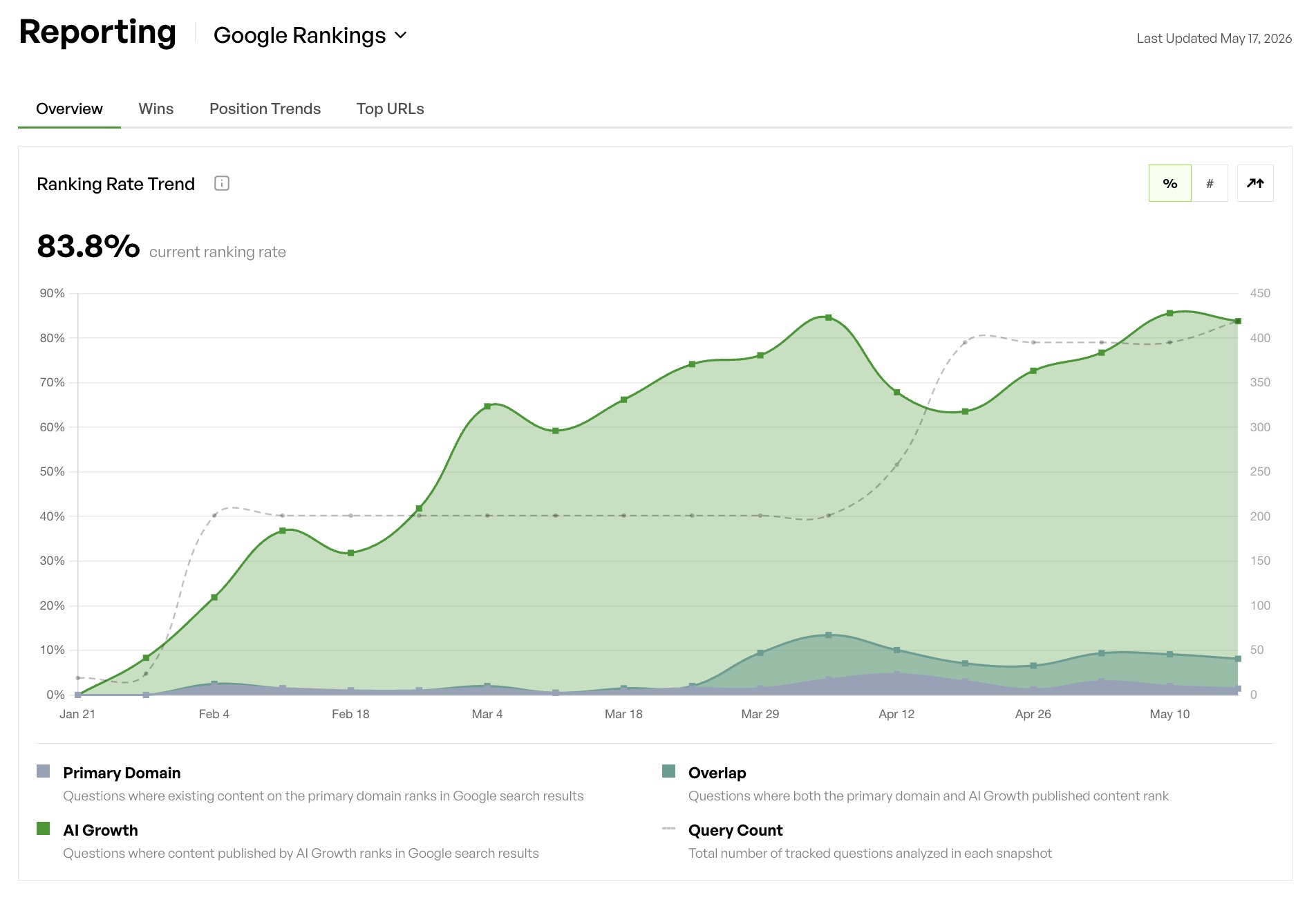
Three data streams combine to produce this measurement. Bot analytics track every bot that touches the blog, including the bot ChatGPT uses to cite sources, so citation events appear in real time rather than as guesses. Google Search Console serves as an independent audit, cross-referenced against the engine’s own reporting to confirm that impressions and clicks are attributable to agent-generated content. Citation tracking monitors order of mention and citation context across ChatGPT, Perplexity, and Google’s AI Mode week over week.
Across the first twelve weeks, AI Growth Agent clients average more than 12,000 additional AI citations and mentions, over 100,000 additional bot visits, and a 20% or greater lift in impressions. The engine doubles down on content that indexes well and uses internal linking to lift content that does not, creating a self-correcting system instead of a static publishing schedule.
Benefits Table Targeting AI Overview Citation
| Benefit | Agent-Enabled Result | Source |
|---|---|---|
| Citation lift from structured content | 2.8x more citations versus unstructured pages | AirOps 2026 State of AI Search |
| Citation lift from schema markup | Up to 40% more citations for pages with comprehensive schema versus pages without | MaxIntel AI SEO Guide 2026 |
| Citation lift from fresh content | Content under 30 days old earns an estimated 3.2x more AI citations than older pages | AuthorityTech content freshness analysis 2026 |
| Citation lift from statistics and sourcing | Adding statistics lifted citation visibility by 41%, and combining strategies outperformed any single one by more than 5.5x | Princeton GEO study, KDD 2024 |
| AI referral conversion rate | AI-referred visitors convert at approximately 4.4x the rate of standard organic traffic | Semrush June 2025 LLM referral conversion benchmarks |
| Scalability | 2 to 50 articles per day per client, up to approximately 500 per month, with consistent quality | AI Growth Agent client data |
Frequently Asked Questions
What is an agent enabled content strategy and how does it differ from traditional content marketing?
An agent enabled content strategy uses orchestrated AI agents to map a brand’s full market universe, produce authoritative content at scale, and structure output so AI surfaces discover, trust, and cite the brand. Traditional content marketing relies on siloed human workflows where research, briefing, drafting, editing, optimization, and publishing are handled separately, with each stage waiting for the previous one and extending a single article’s timeline to two to four weeks from ideation to publication. In an agent-enabled approach, specialized agents communicate with each other and automatically trigger the next step without constant human intervention, which shifts the human role to strategic decisions and quality spot-checks. The deeper difference lies in what the content is built for. Traditional content targets human readers and Google’s blue-link results. Agent-enabled content is engineered for the AI surfaces that now intercept the majority of informational queries, with answer-first paragraphs, semantic triples, self-contained chunks, FAQPage and Article schema, and llms.txt files that tell AI systems exactly how to read and cite the brand.
How do the 4 pillars of AI agents work together in a content strategy?
The four pillars are Search Intelligence, AI Analytics, Bot Tracking, and AI Ranking. Search Intelligence maps the traditional search landscape and identifies which domains and URLs are winning each result, providing the raw diagnosis that informs which seed terms and long-tail queries to pursue. AI Analytics tracks brand value and consumer behavior across the full journey, from external AI-tool queries through content consumption and sentiment, revealing how buyers actually encounter the brand in AI surfaces. Bot Tracking monitors every crawl, citation, and training sweep, including the bots that ChatGPT and Perplexity use to cite sources, so the brand knows whether its content is being read and by whom. AI Ranking tracks order of mention and citation context in AI answers week over week, replacing the old idea of a keyword ranking number with a real-time leaderboard of narrative position. Together the four pillars turn market data into content decisions and content decisions into measurable citation outcomes.
How long does it take to see results from an agent-enabled content strategy?
The first article is typically live within one week of kickoff, following a journalist-led interview that builds the brand manifesto. Content has indexed in as little as ten days and often within two weeks. Across the first twelve weeks, AI Growth Agent clients average more than 12,000 additional AI citations and mentions, over 100,000 additional bot visits, and a 20% or greater lift in impressions. Individual client outcomes vary by market, competitive density, and the size of the universe being pursued. Breadless reached a 30x lift in Google Search Console impressions over six months and ChatGPT citations exceeding 45,000 per month. Jota achieved a 190% traffic increase from generated content over three months. The standard engagement is a three-month pilot because indexing takes time and varies by industry, but clients consistently see movement early and compounding results as the content universe expands.
What technical requirements are needed to implement an agent-enabled content strategy?
The only integration step required on the brand’s side is a reverse proxy rewrite that connects the AI Growth Agent blog to a subdirectory under the brand’s domain, or a subdomain configuration. Everything else is included in every package and requires no technical skill from the client. The engine provisions valid schema across the full schema suite, the most advanced WordPress plugin on the market, robots.txt, sitemaps, automatic web stories, Blog MCP, agent discovery via /.well-known/, llms.txt and llms-full.txt, instant indexing, autoredirects, and 404 tracking automatically. The blog is styled to look exactly like the brand’s own pages and connects through the reverse proxy so nothing in the existing site structure has to change. The internal marketing team gives feedback in plain language and the engine learns, applying every correction to all future generations without re-briefing.
Conclusion: Control the Narrative with an Agent Enabled Content Strategy
The discovery shift is not a future trend. The scale established earlier, 900 million weekly ChatGPT users and 2 billion monthly Google AI Overview users, means many US consumers now use AI assistants for purchase-related queries. The brands cited in those answers are training the next generation of models with their own narrative. The brands that are absent are ceding that ground by default.
An agent enabled content strategy provides the architecture that changes this outcome. The seven-step process maps the full market universe, produces evidence-based long-tail content at scale, applies agentic technical SEO including llms.txt and llms-full.txt, publishes to an owned property, and measures incremental visibility through citations and bot traffic. It replaces the SEO agency, the content tool, the web agency, the GEO monitor, the schema plugin, the analytics stack, and the PR firm with one headless engine that runs on autopilot and delivers living, self-healing content that compounds over time.