Written by: Mariana Fonseca, Editorial Team, AI Growth Agent
Key Takeaways: How Brands Win AI Answers
- Zero-click AI answers now dominate discovery, with 93% of Google AI Mode searches ending without a click and users rarely verifying sources.
- Third-party validation, category associations, and recurring mentions across independent sources determine which brands appear in AI responses.
- Passive reputation building fails to control AI answers; only active, owned content systems can map queries and generate citations at scale.
- AI Growth Agent delivers measurable results by mapping query universes, producing self-healing content, and reporting week-over-week visibility gains within the first twelve weeks.
- Take control of your brand’s narrative in AI surfaces, and map your query universe and launch your first article within a week.
The Problem: Why Passive Reputation Fails in AI Answers
Three signals now determine which brands appear in AI-generated answers: third-party validation, category association, and recurring patterns across independent sources. The majority of brand mentions in AI answers originate from third-party pages rather than owned domains. LLMs draw the largest share of citation signals from third-party earned media sources (48%), including editorial coverage, forums, review sites, and directories, compared with only 23% from brand-owned content. A brand’s own website represents only a small fraction of the sources used.
Traffic is the wrong metric in a zero-click environment. AI-referred visitors convert at a higher rate than traditional Google organic search on average (typically 1.26x–2.17x), with a stronger premium for B2B and high-consideration purchases than for transactional ecommerce. Buyers arrive at the evaluation stage with awareness work already completed by AI synthesis. The core question becomes whether the brand appears in the answer at all. A brand absent from AI responses for evaluation-stage queries is excluded from the consideration set before buyers reach any vendor website.
This visibility gap is where most brands turn to monitoring tools, but observation alone does not solve the problem. Monitoring tools observe this gap. They do not close it. They tell a CMO that the brand is missing from AI answers and stop there, leaving the team to produce and publish the content with no system to do it at scale.
Active Narrative Control With Owned Content Systems
Active narrative control means producing the content AI models use to describe a brand, in the formats and structures models can read, with the validation that earns the citation. It also means showing up across the long tail of queries customers actually ask, not just the head terms a brand pre-decided to defend.
AI Growth Agent is the only system that maps a brand’s full universe from real-time Google and ChatGPT data, produces authoritative content that validates every claim and source, stands up a fully optimized site the client owns within the first week, and reports the incremental visibility it generates week over week. The content is living. It updates and self-heals over time instead of going stale. Across the first twelve weeks, clients see substantial increases in AI citations and mentions, additional bot visits, and a lift in impressions.
Three reputation pillars determine whether a brand earns citations at scale, and each pillar reinforces the others to create compounding authority:
- Third-party validation. Domains with profiles on G2, Capterra, Trustpilot, and Yelp have significantly higher citation probability, because third-party validation strengthens the entity signals models use when deciding which brands to investigate.
- Category association. Co-occurrence of a brand name with category-specific terms in third-party text strengthens neural associations that increase the probability of citation in LLM responses. This association connects baseline credibility to specific buyer queries.
- Recurring patterns. Large language models favor brands that appear consistently across many trusted third-party sources; repetition across independent publications signals consensus, which answer engines use when selecting names to include in responses. These recurring patterns amplify both validation and association.
Visibility Paths Compared: Owned vs Rented Presence
| Approach | Time to First AI Citation | Content Ownership | Self-Healing |
|---|---|---|---|
| Organic reputation building (passive link and PR accumulation) | Several months for brand mention density to compound | No owned content system, dependent on third-party coverage | No, coverage decays without active management |
| Paid integrations (sponsored AI placements, affiliate-driven citations) | Immediate while spend is active; ads appear in labeled boxes separate from answer content | No, placement is rented, not owned | No, visibility stops when spend stops |
| Monitoring tools (Profound, Athena, Peec AI) | Not applicable, monitoring does not produce citations | No content production capability | No, observation only |
| Headless production system (AI Growth Agent) | New content typically enters AI citation pools within weeks of publication, with the first article live within one week of kickoff | Full ownership, client owns the site and all content | Yes, content self-heals and updates automatically |
How ChatGPT Chooses Brands to Recommend
ChatGPT selects brands through a two-layer process. The first layer is parametric memory: knowledge formed during pre-training on datasets including Common Crawl, Wikipedia, Reddit, and news archives, where consistent mentions in reviews, comparisons, news, and documentation create baseline recognition. The second layer is real-time retrieval. When a query triggers live search, the model evaluates retrieved content for relevance, authority, and recency before citing specific brands.
Understanding this two-layer architecture reveals why some brands consistently outperform others. The structural advantage belongs to brands that operate in both layers simultaneously. Brands present in both training data and optimized for RAG retrieval achieve significantly higher citation rates than brands relying on only one mechanism. Several specific signals determine citation selection:
- Branded search volume is the strongest known predictor of LLM citation, outperforming technical SEO signals such as backlinks, which showed only weak-to-neutral correlation.
- Sites with many referring domains are significantly more likely to be cited than those with fewer, because high-authority sites rank better in the search engines LLMs use for retrieval.
- Pages using complete Article, FAQPage, and Organization schema markup are significantly more likely to be cited by LLMs than pages without them.
- Ahrefs’ December 2025 study of tens of thousands of brands found that YouTube mentions correlated strongly with brand appearances in ChatGPT, Google AI Mode, and AI Overviews, the strongest single correlation observed.
The overlap between top Google rankings and AI-cited sources has dropped substantially, meaning pages that rank well in organic search can still be absent from AI-generated answers. Ranking is necessary but not sufficient.
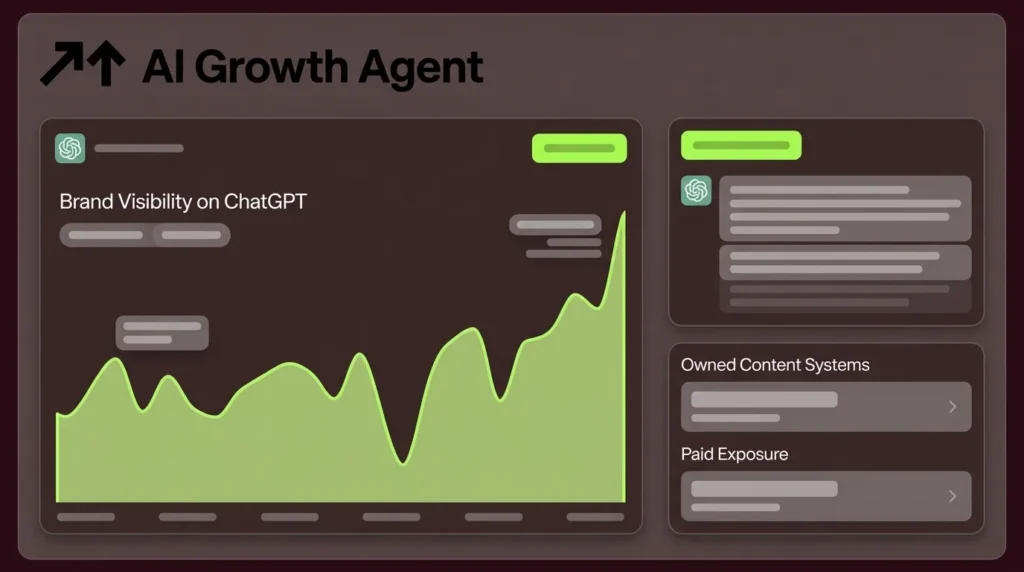
Paid Exposure on ChatGPT and Other AI Engines
Paid placements inside AI answer engines exist but operate under strict constraints. OpenAI states that ChatGPT ads appear in a clearly labeled box at the bottom of responses and do not influence answer content; the ad label changed from ‘Sponsored’ to ‘Ad’ in June 2026. Perplexity has introduced sponsored follow-up questions that appear as branded prompts after a user query, steering conversations toward paying advertisers’ products while blending into the synthesized answer.
A gray market has also emerged. Some GEO vendors sell services that plant brand mentions across many sites, including Private Blog Networks and aged Reddit accounts, to raise AI-answer citation rates. Google’s June 2026 spam update began targeting attempts to manipulate generative AI answers in Search, distinguishing labeled paid exposure from hidden paid mentions. Accounts under 30 days old face dramatically higher filtering rates for posts, while aged accounts are used to bypass age and karma gates with no indicated typical 30-day removal window.
The structural problem with paid placements is durability. Visibility stops when spend stops. Owned content systems produce compounding organic presence in a channel the brand controls, where the message keeps working long after it is published. Challenger brands succeed in AI surfaces by building evidence dominance through denser concentrations of verifiable, third-party-validated proof points rather than outspending incumbents.
Scaling Influence on ChatGPT Answers
Influencing ChatGPT answers at scale requires four pillars of intelligence working together, not a single tactic applied once. AI Growth Agent organizes this work into Search Intelligence, AI Analytics, Bot Tracking, and AI Ranking, with each layer feeding the next.
- Search Intelligence maps the full traditional search landscape, including positioning, competition, search volume, and the structure of who is already winning. Every week it takes a fresh picture of the universe across hundreds of seed terms and the long-tail queries beneath them.
- AI Analytics then tracks brand value and consumer behavior across the whole journey, from external touchpoints like Google and AI-tool queries through content consumption, demographics, and sentiment.
- Bot Tracking reveals which content AI systems actually consume by recording every bot interaction, traditional crawlers and AI training agents alike, including every crawl, citation, and training sweep. Pages not updated regularly were more likely to lose citations in AI answers, which makes bot-level visibility essential for knowing when content needs to be refreshed.
- AI Ranking measures the outcome by tracking where a brand appears in the answer and how that position evolves week over week. AI answers have no static ordered list, so order of mention and citation context become the new leaderboard.
Living, self-healing content forms the execution layer that these intelligence pillars support. Content updated within 90 days is cited more often than content older than a year. Pages scoring in the top quartile for structure were cited significantly more than pages in the bottom quartile, regardless of word count. The content AI Growth Agent produces ships with full schema markup, answer-first structure, and agentic technical SEO including Blog MCP, llms.txt, and agent discovery via /.well-known/. Every article is readable by the systems doing the citing from day one.
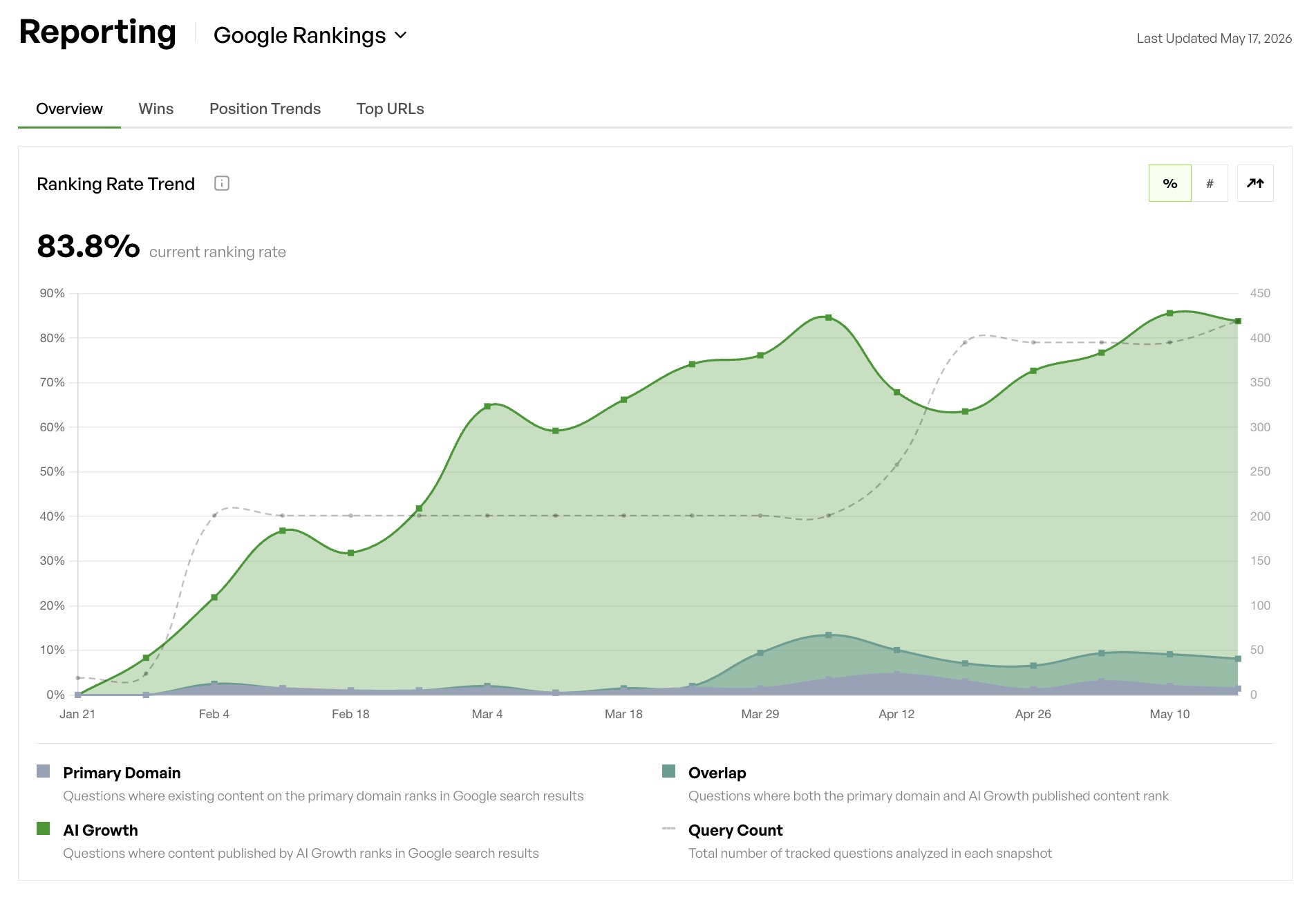
The Economics of Zero-Click AI Recommendations
Traffic is no longer the objective function. In a zero-click environment, a brand cited in an AI answer earns brand exposure, trust transfer, and downstream conversion influence without generating a click. ChatGPT Search processes hundreds of millions of weekly queries; a brand cited for a query category representing just a small fraction of that volume receives thousands of brand exposures per week in a high-trust AI context.
The downstream economics are measurable. Ahrefs research found that visitors arriving from AI platforms generated a meaningful share of signups while representing only a small fraction of total traffic, producing a conversion rate significantly higher than traditional organic search. LLM-sourced leads grew substantially year-over-year and convert better than traditional channels.
Brands that treat AI surfaces as the objective function are training the next generation of models with their own narrative. A 2026 analysis of over 1,000 brands across ChatGPT, Claude, Gemini, and Perplexity found that a substantial portion are completely invisible to all four major AI engines, while only a smaller percentage achieve strong visibility with a high citation rate. The leaderboard is being written now.
One-Afternoon Audit: Seven Checks for AI Visibility
This checklist uses publicly available AI surfaces and takes one afternoon to complete. It shows where a brand stands and where the gaps are.
- Run 10 category queries in ChatGPT. Use the questions your buyers actually ask, not your brand name. Note which competitors appear and in what position. Treat any missing appearance for your brand as a clear gap.
- Run the same 10 queries in Perplexity and Google AI Mode. Only a small percentage of domains are cited by both ChatGPT and Perplexity, so cross-platform gaps are common and actionable.
- Check your schema coverage. Use Google’s Rich Results Test on your five most important pages. Pages using complete Article, FAQPage, and Organization schema markup are significantly more likely to be cited by LLMs.
- Audit your third-party presence. Confirm your brand has active, accurate profiles on G2, Capterra, Trustpilot, and at least one relevant industry directory, reinforcing the third-party validation described earlier.
- Check content freshness. Identify your top 20 pages by impressions in Google Search Console. Flag any that have not been updated in 90 days, which matches the freshness threshold identified earlier for maintaining citation rates.
- Verify crawlability for AI bots. Check your robots.txt to confirm OAI-SearchBot, GPTBot, and PerplexityBot are not blocked. Confirm llms.txt exists at your domain root.
- Map your long-tail coverage. In Google Search Console, filter for queries containing question words such as what, how, best, and which. These queries mirror the natural language prompts users feed into LLMs. Count how many you have content for versus how many you do not.
Bring your audit results, and we will show you exactly which gaps AI Growth Agent closes first.
Conclusion: Use an Owned System to Control the Narrative
Passive reputation signals no longer determine which brands ChatGPT recommends. The median enterprise B2B brand ranks for nearly 9,700 keywords and gets cited in just 3% of AI Overviews. Monitoring tools observe that gap. They do not close it. An agency RFP takes three months before it starts and another three before anything ships. A chatbot produces one article and then falls apart at scale.
The only path to narrative control in a zero-click environment is an active, owned, self-healing content system that maps the full universe, produces authoritative content against every query worth winning, and reports the incremental visibility it generates week over week. That is what AI Growth Agent does. Traditional search tools show you where your brand stands. AI Growth Agent makes your brand the answer.
Start controlling your narrative, with your first article live within a week.
Frequently Asked Questions
Why does my brand rank well on Google but not appear in ChatGPT answers?
Google rankings and AI citations are evaluated by different systems using different signals. Google’s PageRank algorithm weights backlinks and on-page optimization heavily. AI models weight third-party brand mentions, entity consistency across platforms, content structure, and training data density. A brand can dominate organic search and be completely absent from AI-generated answers because the signals that win one channel do not automatically transfer to the other. The fix is not more SEO. The fix is building the content and third-party presence that AI models use as citation sources, which requires an active owned content system rather than passive ranking maintenance.
How long does it take to start appearing in ChatGPT and other AI answers?
New content typically enters AI citation pools within 3 to 14 days of publication, provided the page is indexed and accessible to AI crawlers. Brands with existing earned media coverage and strong entity signals can see citation improvements within 30 to 60 days of targeted optimization. Brands starting from a weaker baseline typically need three to six months to build the authority density that produces consistent citations. AI Growth Agent publishes the first article within one week of kickoff, with content indexing in as little as ten days. The standard engagement is a three-month pilot because indexing timelines vary by industry, but clients see movement early.
What is the difference between AI Growth Agent and a monitoring tool like Profound or Athena?
Monitoring tools track whether a brand appears for a capped set of prompts. They observe the gap and stop there, leaving the brand to produce and publish the content with no system to do it at scale. AI Growth Agent is not a monitoring company. It maps the full universe of queries, produces authoritative self-healing content against each one, stands up a fully optimized site the client owns, and reports the incremental visibility it generates week over week. The difference is between a rearview mirror and a steering wheel. Monitoring tells you where you are not showing up. AI Growth Agent changes what the answer is.
Does AI Growth Agent replace our existing website or blog?
No. AI Growth Agent stands up a separate, fully optimized blog the client owns, styled to look exactly like their existing site. It connects through a reverse proxy rewrite, usually under a subdirectory, or through a subdomain. Nothing in the existing site structure changes. The blog is a top-of-funnel property that does not interfere with the curated main site. The client owns the site and all content outright, with no agency in the loop and no dependency to manage.
What does “living, self-healing content” mean in practice?
Living content is content that updates automatically over time rather than going stale the day it ships. When the year turns, every article in a sector is refreshed automatically. When Google Search Console signals show a page losing impressions, the engine refreshes it. When bot-tracking data shows a page is no longer being crawled, the internal linking structure is adjusted to lift it. Every article’s relationships, performance, and indexing data are centralized so authority compounds instead of decaying. This approach is the opposite of a content factory that ships articles and moves on. It functions as a living system that keeps the brand’s presence current as the world changes.