Written by: Mariana Fonseca, Editorial Team, AI Growth Agent
Key Takeaways
- Structured data in JSON-LD format helps AI search engines like Google AI Overviews, ChatGPT, and Perplexity extract, understand, and cite brand content accurately.
- Organization, Article, and FAQPage schema types drive the strongest citation impact when implemented correctly and kept aligned with visible page content.
- Schema must always match visible on-page text exactly. Any contradiction reduces AI trust and lowers citation likelihood.
- Combining schema with llms.txt, Blog MCP, and agent discovery tools creates a complete system for AI visibility and reliable content attribution.
- AI Growth Agent automates schema provisioning, validation, and self-healing inside a headless system, and you can book a demo to see how it can change your AI search visibility.
Schema Types That Drive the Strongest AI Citations
The table below ranks six schema types by their citation signal strength across Google AI Overviews, ChatGPT, and Perplexity. The key takeaway is that Organization and Article schema form the base of any citation strategy, while FAQPage and HowTo create the clearest paths for conversational extraction. Every figure is drawn from cited research. Because citation lift is measured differently across studies, values are not directly comparable across rows, and each figure reflects the methodology of its source.
| Schema Type | Citation Lift Signal | Headless Role | Validation Checkpoint |
|---|---|---|---|
| Organization / Person | Entity linking via sameAs produced impressions and clicks increases for non-branded queries across test pages | Anchors brand identity, and the shared @id links all downstream schema | sameAs URLs must resolve and match visible brand details |
| Article | Sites with accurate, content-aligned schema saw an AI Mode citation lift within 30–60 days after March 2026 | Classifies content type and exposes datePublished and author to AI classifiers | dateModified must update on every meaningful revision, and author must match the visible byline |
| FAQPage | FAQPage schema can increase AI visibility for smaller websites | Surfaces answer-ready content for conversational extraction | Every question and answer must appear verbatim in visible page text |
| HowTo | Medium AI impact on Google AI Overviews, Gemini, and ChatGPT for tutorial and process content | Structures step sequences for AI summarization pipelines | Step count in schema must equal the visible step count on the page |
| Product / Review | Pages with complete Product, Review, Offer, and Organization schema are more likely to be cited by AI shopping assistants | Feeds AI shopping and comparison surfaces with price, availability, and rating | Price and availability in schema must match visible page values in real time |
| WebPage | WebPage schema, when stacked with Organization and Article using consistent @id values, reduces entity ambiguity and improves citation frequency in AI answers | Completes the Organization → Website → WebPage trust chain | breadcrumb and url properties must match the canonical URL and visible navigation |
The table above shows that Organization schema anchors every other schema type through its @id reference. That makes it the logical starting point for implementation.

Building Entity Recognition with Organization and Person Schema
Organization and Person schema create the entity home that AI systems use to resolve brand identity before deciding whether to cite a source. A minimal correct Organization block requires @type, @id set to the canonical domain URL, name, url, a sameAs array pointing to Wikidata, LinkedIn, and Wikipedia where applicable, plus foundingDate, description, and logo.
- Place the Organization block in the document head as JSON-LD on the homepage, about page, and contact page.
- Set @id to the canonical domain URL and reuse that exact value in every downstream Article and WebPage block to build a verifiable trust chain.
- Populate sameAs with every verified profile, including the Wikidata QID, LinkedIn company page, Crunchbase, and GRID where applicable. These links establish the brand’s identity across external knowledge graphs.
- After identity is established, add knowsAbout topic declarations to signal topical authority to Gemini’s entity verification layer.
- Deploy Person schema for every named author, linking back to the Organization via the author property and to an author profile page via @id.
Example JSON-LD for Organization:
{ "@context": "https://schema.org", "@type": "Organization", "@id": "https://example.com", "name": "Example Brand", "url": "https://example.com", "logo": "https://example.com/logo.png", "foundingDate": "2018", "description": "One-sentence brand description matching visible About page text.", "sameAs": [ "https://www.wikidata.org/wiki/Q000000", "https://www.linkedin.com/company/example-brand", "https://en.wikipedia.org/wiki/Example_Brand" ], "knowsAbout": ["headless marketing", "AI search visibility", "structured data"] } Validation checkpoint: run the block through the Schema.org Validator and confirm every sameAs URL resolves to a page that names the brand consistently with the visible on-page text. Organization schema with SameAs identifiers linking to Wikidata, LinkedIn, Crunchbase, and GRID became the highest-leverage implementation for AI Mode citation and Knowledge Graph entity recognition after March 2026.
With the Organization entity in place, the next priority is making individual content pieces easy for AI systems to extract and cite.
Using FAQPage and Article Schema to Make Content Extractable
FAQPage and Article schema are the two types most directly tied to conversational extraction across Google AI Overviews, ChatGPT, and Perplexity. Pages implementing multiple schema types are more likely to appear in ChatGPT citations compared to pages ranking in Google SERPs without rich schema.
- Implement Article schema on every blog post and guide with datePublished, dateModified, author linked to a Person @id, and publisher linked to the Organization @id.
- Update dateModified on every meaningful content revision. AI Overviews and AI Mode favor recent, well-attributed content when selecting citation sources.
- Add FAQPage schema only when the page contains a visible Q&A section, and use 6 to 10 real user questions phrased in natural language with concise answers of 2 to 4 sentences.
- Nest FAQPage inside the same @graph block as Article so both share the same document context and entity references.
Example JSON-LD for Article with FAQPage in @graph:
{ "@context": "https://schema.org", "@graph": [ { "@type": "Article", "@id": "https://example.com/blog/post-slug#article", "headline": "Exact H1 text matching visible page headline", "datePublished": "2026-01-15", "dateModified": "2026-07-10", "author": { "@id": "https://example.com/authors/jane-doe" }, "publisher": { "@id": "https://example.com" } }, { "@type": "FAQPage", "@id": "https://example.com/blog/post-slug#faq", "mainEntity": [ { "@type": "Question", "name": "Exact question text as it appears on the page", "acceptedAnswer": { "@type": "Answer", "text": "Exact answer text as it appears on the page." } } ] } ] } Validation checkpoint: confirm that every question and answer string in the FAQPage block appears verbatim in the visible HTML. Google removed FAQ rich results entirely from Search on May 7, 2026, but FAQPage schema remains valid for Bing, Perplexity, and ChatGPT to parse Q&A content for extraction.
Keeping Schema Aligned with Visible Text
Schema that contradicts visible page content is the single most consequential implementation error in 2026. Recent tests show that ChatGPT and Perplexity read structured data as part of the overall HTML, not through a special schema-only pipeline, so schema works best when it accurately reflects visible on-page content. AI systems cross-check schema against visible content, and if they do not match, the page loses trust and citation chances decrease.
- Run every page through Google’s Rich Results Test before deployment to surface missing required properties and preview rich result eligibility.
- Run the same block through the Schema.org Validator to catch deprecated properties, incorrect data types, and structural nesting errors that the Rich Results Test may miss.
- Confirm that every schema property has a matching visible text equivalent on the rendered page. Google explicitly states that structured data must represent the main visible content of the page and must not describe content hidden from users.
- Check for duplicate or conflicting schema blocks introduced by CMS plugins layered on top of manual code, and resolve to a single authoritative block per type per page.
- Audit Google Search Console’s Enhancements report weekly after deployment to catch validation errors discovered during crawling.
- Conduct a full structured data audit at least twice annually and any time a significant site redesign, content restructuring, or platform migration occurs.
Common contradiction patterns that kill citations include schema declaring 10 steps while the rendered page shows only 8, using relative paths instead of absolute URLs, invalid date formats, missing @context declarations, and incorrect nesting such as placing offers inside Product at the root level. Each of these issues triggers Google’s spammy structured data flag and reduces AI citation confidence.
Connecting Schema with llms.txt and Blog MCP for Agent Discovery
Schema markup explains how AI systems should parse individual pages, while llms.txt and Blog MCP guide AI agents through the full content footprint. Perplexity and other AI search engines capture limited portions of test content, which highlights the need for llms.txt, strong internal linking, and clear entity attribution to improve indexing by AI systems.
- Publish llms.txt at the root domain to give AI surfaces a plain-language map of the site’s content structure, primary topics, and canonical URLs.
- Publish llms-full.txt with expanded content summaries so AI crawlers can assess topical authority without fetching every page individually.
- Deploy Blog MCP to expose schema, manifest, discovery, and capability guidance directly to agents. AI Growth Agent was the first to bring Blog MCP to market, with clients running it in the summer of 2025.
- Serve OpenAI discovery and Agent Card guidance via /.well-known/ so agent-based surfaces can identify the brand’s content endpoints.
- Implement natural language query parameters via /?s={query} so an agent passing a query directly into the URL receives a tailored, internally linked response.
- Confirm that every entity named in llms.txt and llms-full.txt has a corresponding Organization or Person schema block on the page it describes, which creates a closed loop between agent discovery and machine-readable markup.
Validation checkpoint: fetch the llms.txt file and cross-reference every listed URL against its schema implementation. Any URL listed without matching entity schema is a gap that reduces agent confidence in the brand’s content footprint.
Measuring Citation Impact with Search Console and Bot Data
Measuring the effect of structured data on AI citations requires tracking across four pillars that shape what an AI surface says about a brand: Search Intelligence, AI Analytics, Bot Tracking, and AI Ranking.
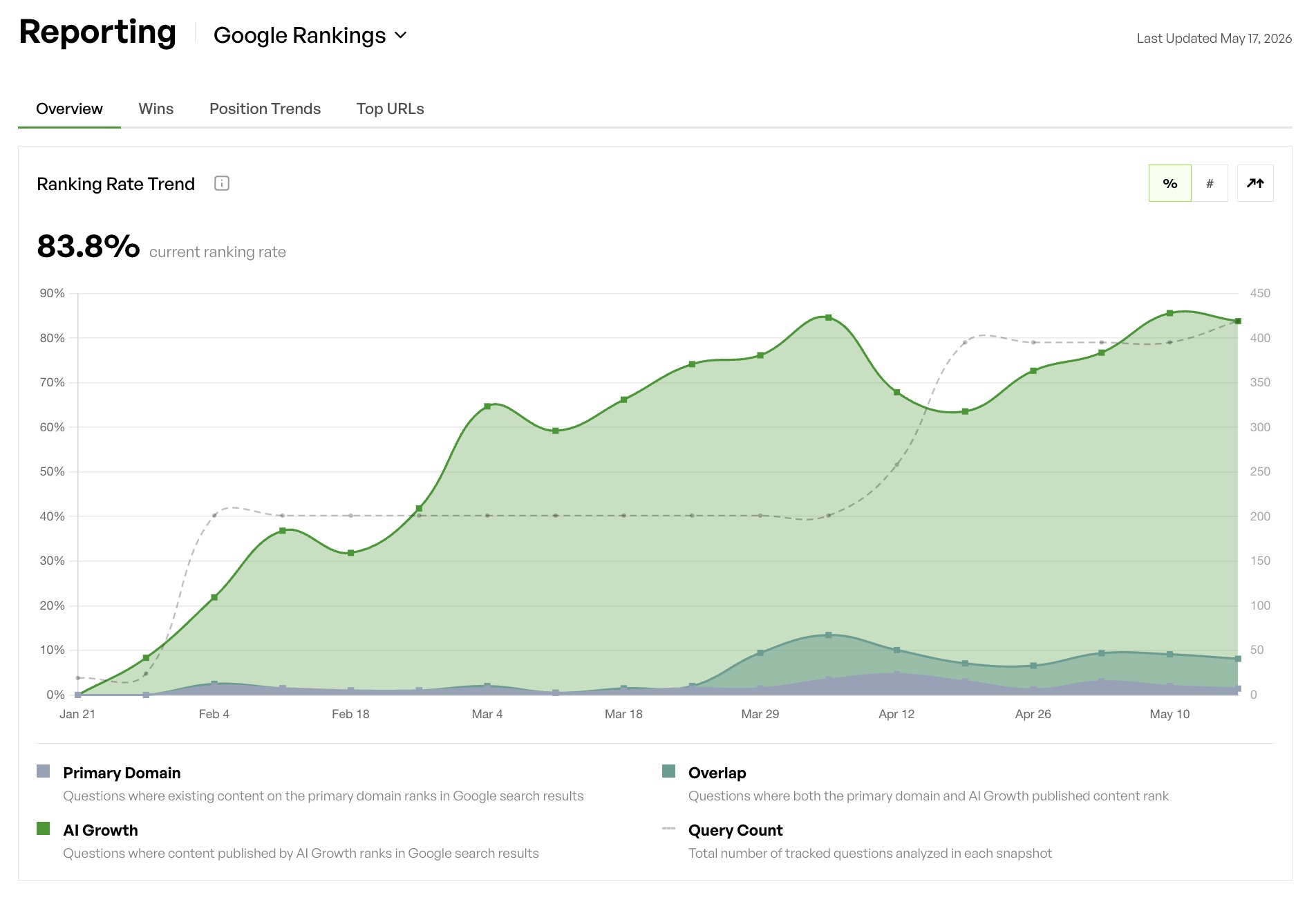
- Search Intelligence: Establish a pre-implementation baseline in Google Search Console covering impressions, clicks, and average position for every URL carrying new schema. This baseline matters because schema alone will not drive citation gains if the underlying content lacks authority. An Ahrefs matched difference-in-differences analysis of 1,885 pages that added JSON-LD between August 2025 and March 2026 found that schema addition had no clear positive or negative effect on AI citation growth for pages already receiving citations, which shows that schema functions as a prerequisite for citation eligibility rather than a standalone lift lever. With that context, monitor the Enhancements report weekly to confirm schema is being processed without errors so you can separate citation changes driven by schema implementation from changes driven by shifts in content authority.
- AI Analytics: Track brand mention rate and citation rate across ChatGPT, Perplexity, and Google AI Mode before and after schema deployment. Segment by schema type to see which implementations correlate with citation gains in your specific topical authority areas.
- Bot Tracking: Monitor every bot interaction at the per-article level, including AI training agents and the specific bot ChatGPT uses to cite sources. Bot activity functions as an Input Metric to quantify AI crawler engagement and support bot traffic attribution in AI search measurement frameworks. A spike in AI crawler visits after schema deployment confirms that the markup is being read.
- AI Ranking: Track order of mention and citation context in AI answers week over week. AI answers have no static ordered list, so position within the answer and the claim the brand is cited for replace the traditional ranking number as the performance signal.
- Cross-reference bot traffic data, Google Search Console impressions, and citation rate in a single reporting view to isolate incremental visibility generated by schema changes from visibility the brand already held.
Schema Contradictions That Most Often Block Citations
AI systems prioritize content with logical hierarchy and consistency between code-level markup and visible on-page content. Mismatches or buried data are viewed as unreliable, which causes systems to distrust the information and deprioritize the source. The following patterns are the most common contradiction types observed in 2026 implementations.
- Headline mismatch: The Article schema headline property does not match the visible H1. Fix this by pulling the headline value programmatically from the rendered H1 element instead of a separate CMS field.
- Author inconsistency: The Person schema name differs from the visible byline because of display name formatting. Fix this by enforcing a single canonical author name string across schema, byline, and the author profile page.
- Step count divergence: HowTo schema lists a different number of steps than the visible numbered list. Fix this by generating HowTo schema dynamically from the same data source that renders the visible steps.
- Stale dateModified: The Article schema dateModified has not been updated after content revisions, which signals outdated content to AI Mode and AI Overviews. Fix this by triggering an automatic dateModified update on every meaningful content save.
- Hidden FAQ content: FAQPage schema describes questions and answers inside a collapsed accordion that is not rendered in the initial HTML. Fix this by ensuring all FAQ content is present in the visible DOM and not loaded only on user interaction.
- Conflicting price values: Product schema price differs from the visible price displayed on the page because dynamic pricing does not update the schema block. Fix this by generating Product schema server-side from the same pricing data source as the visible price element.
- Orphaned schema blocks: JSON-LD blocks reference @id values that do not resolve to any other schema block on the site, which breaks the entity trust chain. Fix this by auditing @id references across the full schema graph quarterly.
How Schema Compounds Inside a Living Content System
Structured data has evolved from a technical SEO afterthought to strategic infrastructure for AI discovery, and headless CMSs generate it more reliably than plugin-based systems by creating JSON-LD programmatically from content fields so every page ships consistent schema at enterprise scale. Schema that is provisioned once and left static decays as content changes, and the compounding effect only appears when both update together.
- Treat schema as a living layer. Every time visible content is updated, the corresponding schema block must update in the same publish event. A dateModified value that lags behind the visible content signals staleness to AI citation systems.
- Use internal linking to compound authority across the schema graph. The strongest predictor of sustained citation is entity-level consistency across the brand’s content footprint, as confirmed by GEO-16 findings and Gemini’s entity verification layer that cross-references claims against broader knowledge graphs.
- When a new article is published, update the Organization schema’s knowsAbout array if the new topic expands the brand’s declared topical authority.
- Refresh Article schema dateModified automatically when the year turns or when new data replaces claims in the visible body text. AI Growth Agent performs this refresh across all articles in a sector automatically.
- Monitor bot traffic at the per-article level to identify which schema-enhanced pages are receiving AI training sweeps, and use that signal to prioritize which living content updates will have the highest citation impact.
- Cross-reference Google Search Console impressions against bot visit data weekly to confirm that schema updates are producing indexing signals before the next training cycle.
Enterprise brands have seen traffic from LLMs grow, with LLM-referred visitors more likely to convert than other visitors, which shows why schema that compounds with living content is a revenue infrastructure decision, not a technical checkbox.
Conclusion: Turning Schema into a Continuous System
Structured data AI search visibility in 2026 functions as a continuous system, not a one-time configuration task. Schema must be provisioned correctly, validated against visible text on every publish, integrated with llms.txt and Blog MCP for agent discovery, and measured across all four pillars so every citation gain is isolated and attributed. The brands appearing in Google AI Overviews, ChatGPT, and Perplexity answers this year are the ones whose markup matches their content, whose entity graph stays consistent across every page, and whose living content refreshes before the next training sweep arrives.
Most marketing teams cannot deliver this without adding headcount, wiring together a stack of agencies and plugins, or accepting schema that drifts out of sync the moment a page is updated. AI Growth Agent owns the full schema stack inside a headless system, with Organization, Article, FAQPage, HowTo, Product, and WebPage schema provisioned automatically, validated against visible text on every publish, self-healed when contradictions appear, and reported through Search Intelligence, AI Analytics, Bot Tracking, and AI Ranking in a single view. No engineering hours. No per-prompt billing. No agency dependency. The first article goes live within a week of kickoff, and clients average additional AI citations in the first twelve weeks.
Traditional search tools show you where your brand stands. AI Growth Agent makes your brand the answer. Book a kickoff and see your first article live within a week.
Frequently Asked Questions
Why schema markup and visible content must match exactly
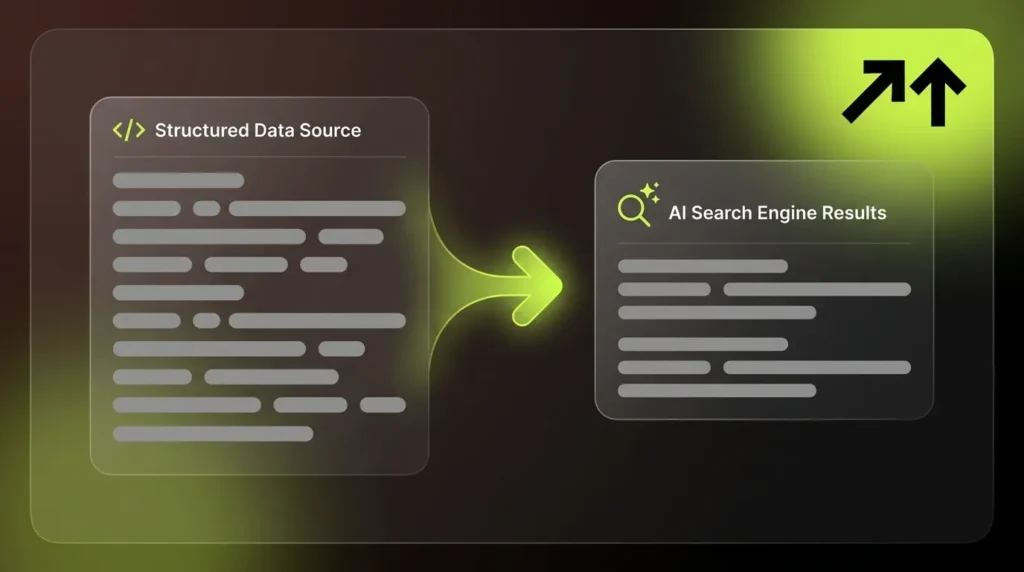
Schema markup is machine-readable JSON-LD placed in the document head that describes what a page contains, who published it, and how its claims connect to known entities. Visible on-page content is the text, headings, and structured elements a human reader sees when the page renders. AI systems like ChatGPT and Perplexity fetch and read the visible HTML directly during real-time page retrieval, and they do not process schema through a separate pipeline. When the schema block says one thing and the visible text says another, the AI system interprets the contradiction as a trust signal failure and reduces the likelihood of citing that page.
The practical rule is that every property in a schema block must have a corresponding, verbatim match in the visible content. If the Article schema lists a headline that differs from the H1, or the FAQPage schema contains a question that does not appear in the visible FAQ section, the page loses citation confidence. AI Growth Agent enforces this match automatically by generating schema programmatically from the same content fields that render the visible page, so contradictions cannot build up over time.
Schema types that matter most for AI Overviews, ChatGPT, and Perplexity
The highest-impact types for AI citation across all three surfaces are Organization, Article, and FAQPage, with HowTo, Product with Review, and WebPage providing additional lift for specific content types. Organization schema is foundational because it establishes the brand entity that all downstream schema references. Without a correctly implemented Organization block with sameAs links to verified profiles, AI systems cannot reliably resolve the brand’s identity before deciding whether to cite it.
Article schema with datePublished, dateModified, and a linked author entity signals content type, freshness, and authorship to AI classifiers. FAQPage schema surfaces answer-ready content for conversational extraction across ChatGPT and Perplexity, even though Google removed FAQ rich results from Search in May 2026. HowTo schema structures step-by-step content for AI summarization. Product schema with aggregateRating and offers is critical for AI shopping surfaces. The most effective implementation stacks these types together in a single @graph block with consistent @id values linking every entity back to the Organization, which creates a verifiable trust chain that reduces ambiguity for AI citation decisions.
How AI Growth Agent provisions and validates schema without engineering support
AI Growth Agent provisions the full schema suite, covering Article, FAQ, Organization, Person, Product, Review, LocalBusiness, and software application schema, automatically as part of every package. Schema is generated programmatically from the same content fields that render the visible page, so the markup and visible text stay in sync at the moment of publish. The WordPress plugin that ships with every AI Growth Agent deployment includes bot tracking, Blog MCP, advanced robots.txt, a proper sitemap.xml, and automatic web stories out of the box.
When content is updated, the schema block updates in the same publish event, including dateModified, headline, and author references. When contradictions are detected through Google Search Console Enhancements reports or bot tracking signals, the system self-heals the affected blocks without requiring a ticket to an engineering team. The only integration step required from the client is the reverse proxy rewrite that connects the AI Growth Agent blog to a subdirectory under the brand’s domain. Everything else, including the full technical and agentic SEO stack, is included and runs automatically.
The role of llms.txt and Blog MCP alongside schema markup
Schema markup tells AI systems what an individual page contains, while llms.txt and Blog MCP tell AI agents how to navigate and interact with the full content footprint. llms.txt is a plain-language file published at the root domain that maps the site’s primary topics, content structure, and canonical URLs so AI crawlers can assess topical authority without fetching every page individually. llms-full.txt extends this with expanded content summaries.
Blog MCP exposes schema, manifest, discovery, and capability guidance directly to agents, which enables direct interoperability with AI search surfaces and compatibility with Chrome 146 and other WebMCP-enabled browsers. Together, these three layers create a closed loop. Schema defines what each page means, llms.txt tells agents where to find the most authoritative content, and Blog MCP gives agents the structured interface to query and cite it reliably. Without all three working together, a brand’s schema implementation may be technically correct but still invisible to the agent-based discovery passes that increasingly determine which sources AI surfaces cite. AI Growth Agent ships all three as part of every package, alongside OpenAI discovery and Agent Card guidance served via /.well-known/.
How long it takes to see measurable citation gains from structured data
The timeline for measurable citation gains depends on the brand’s existing authority, the topical areas targeted, and how consistently schema is implemented across the full content footprint. Sites implementing comprehensive entity schema combined with accurate content-type schema have seen measurable AI Mode citation rate improvements within 30 to 60 days, with the gains most pronounced for queries within the site’s declared topical authority areas.
For brands starting from a low citation baseline, the more important variable is whether the underlying content is authoritative, source-backed, and structured for extractability. Schema functions as a prerequisite for citation eligibility rather than a standalone lift mechanism. AI Growth Agent clients average more than 12,000 additional AI citations in the first twelve weeks, with content indexing in as little as ten days. The standard engagement is a three-month pilot because indexing timelines vary by industry, but clients typically see bot traffic movement and Search Console impression gains within the first two to four weeks of the first articles going live.