Written by: Mariana Fonseca, Editorial Team, AI Growth Agent
Key Takeaways
- Protocol adoption (A2A, MCP, ACP, ANP) demands significant engineering effort, ongoing maintenance, and governance overhead that many teams cannot staff.
- Managed iPaaS platforms shorten integration timelines but still require internal teams to design workflows and manage connectors.
- Headless marketing with AI Growth Agent removes protocol development and agency management, delivering a fully optimized site and first published content within one week.
- Teams focused on narrative control across AI search surfaces see faster results and lower maintenance when they choose headless marketing instead of building or outsourcing agent communication infrastructure.
- AI Growth Agent replaces the agency stack with one engine, provisioning schema, agent discovery, and content production automatically with no client engineering required.
Evaluation Criteria for Agent Communication Approaches
Any honest comparison of A2A, MCP, ACP, ANP, and managed platform alternatives must evaluate nine dimensions. These criteria determine whether an approach is viable in production, not just in a demo.
- Implementation complexity: The engineering effort required to go from zero to a working integration, including protocol setup, server hosting, and discovery configuration.
- Scalability: How the approach performs as agent count, message volume, and workflow complexity grow.
- Workflow fit: How well the approach maps to the team's actual use case, whether that is tool access, agent coordination, or narrative control across AI search surfaces.
- Technical requirements: The infrastructure, SDK knowledge, and ongoing engineering skill the approach demands.
- Governance: Identity management, access control, audit logging, and policy enforcement across agent interactions.
- Security layers: Authentication schemes, encryption standards, and trust models built into the approach by design.
- Reporting visibility: The observability available into what agents are doing, what content is being cited, and what results are being generated.
- Maintenance burden: The ongoing effort required to keep the approach current as protocols evolve and AI search behavior changes.
- Long-term adaptability: The ability to absorb protocol changes, new AI surfaces, and shifting enterprise requirements without a rebuild.
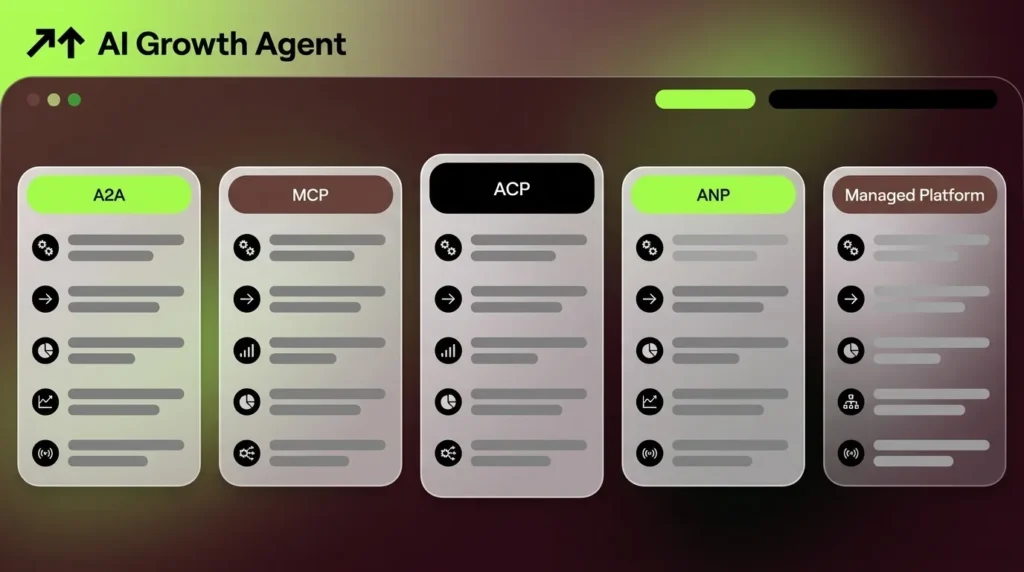
The following comparison applies these criteria to five approaches and isolates the three dimensions that most directly determine production viability: implementation complexity, combined security and governance, and maintenance burden. The remaining dimensions, including scalability, workflow fit, technical requirements, reporting visibility, and long-term adaptability, appear in the category analysis and decision framework that follow.
Side-by-Side Comparison of A2A, MCP, ACP, ANP, and Managed Platform Alternatives
The table below compares these three dimensions across five approaches and highlights a clear tradeoff. Protocol-based approaches front-load engineering effort and keep ongoing governance with the implementing team, while managed platforms compress setup timelines and absorb maintenance at the platform level. Every data point is drawn from primary sources. Governance and security appear as a combined dimension because the two are architecturally inseparable in production agent deployments.
Setup and Initial Engineering Effort
Protocol Setup Requirements
Building on A2A requires publishing Agent Cards at a well-known URI, configuring SSE streaming, and wiring authentication schemes including OAuth 2.0 and mutual TLS. Implementing protocols such as MCP requires building and hosting MCP servers, publishing and managing A2A agent cards, and wiring up interface event streams, creating infrastructure work that becomes a bottleneck for most teams. MCP reduces the N×M integration problem to a 1×N pattern, yet server hosting and schema management remain engineering responsibilities. ANP adds decentralized identity management via W3C DID, which introduces key rotation and HSM requirements before a single agent interaction occurs.
Managed Platform Setup and Headless Marketing
Managed platforms compress setup dramatically. AI support implementation timelines vary from under an hour to 90+ days across major vendors, reflecting a roughly 100x difference driven by architectural decisions on data pipelines, configuration models, and integration depth. Within the managed platform category, AI Growth Agent sits at the fastest end of that spectrum by eliminating protocol setup entirely. The engine provisions Blog MCP, agent discovery via /.well-known/, llms.txt and llms-full.txt, and the full schema suite automatically. The only client integration step is a reverse proxy rewrite to a subdirectory.

Operational Efficiency and Day‑to‑Day Management
A2A protocol implementation introduces complex troubleshooting due to asynchronous agent workflows, making error source identification harder in production environments. Organizations often spend a significant portion of development time on integration maintenance without standardized protocols. iPaaS platforms reduce that overhead by providing pre-built connectors and orchestration layers, yet they still require workflow design, connector configuration, and governance setup. Headless marketing removes the operational loop from the client entirely, because the engine writes, publishes, monitors, and self-heals content without a team to manage.
Quality Control, Governance, and Observability
Audit logging for AI agents must capture full context including prompt context, tool calls, external resources retrieved, and human approvals or overrides to enable reconstruction of decisions and downstream effects in compliance and incident response scenarios. Protocol-based approaches place this responsibility on the implementing team. As the number of AI agents grows in production, the primary challenges shift from basic connectivity to governance, security, and observability, requiring organizations to determine which agents invoke which skills, what data is shared, what permissions each agent has, and how anomalous behavior can be detected.
Scalability and Long‑Term Adaptability
The gap between experimentation and production is where protocol complexity and governance debt accumulate. Managed platforms and headless marketing engines scale without adding engineering headcount because the platform owns and operates the infrastructure. Living content that self-heals over time, combined with an engine that refreshes the universe snapshot weekly, adapts more easily to changing AI search behavior than static content or protocol implementations that require rebuilds when specifications change.
Best-Fit Use Cases by Organizational Context
The comparison across implementation complexity, governance requirements, and maintenance burden reveals four distinct organizational profiles, each with a clear best-fit approach. Match your team's capacity and core requirement to one of the following contexts to identify a starting point.
- Large engineering teams building multi-agent orchestration infrastructure: A2A is the appropriate foundation. More than 150 organizations support Google's A2A protocol for agent interoperability. Teams with dedicated platform engineers who can manage Agent Cards, authentication flows, and observability tooling will find A2A's standardized task lifecycle and Linux Foundation governance a durable base.
- Teams connecting AI models to internal tools and data sources: MCP is the vertical layer for tool and data access. Teams can start with MCP for tool and data access and add protocols incrementally only as requirements grow, rather than adopting all six protocols on day one.
- Teams evaluating decentralized, trustless agent networks: ANP addresses open-internet agent communication with W3C DID identity, but its community governance means specification stability is lower than A2A or MCP.
- Mid-market to enterprise teams needing narrative control across AI search surfaces without building protocols or managing agencies: Headless marketing with AI Growth Agent is the fit. The engine uses the query-mapping and rapid deployment approach described earlier, with no protocol development, no RFP, and no agency dependency.
Operational and Long-Term Considerations
Onboarding effort is the first filter. A large portion of the work implementing an AI agent to detect adverse events among cancer patients was consumed by data engineering, stakeholder alignment, governance, and workflow integration. That ratio holds across most enterprise agent deployments. Protocol-based approaches front-load engineering effort and distribute governance responsibility across the implementing team. iPaaS platforms shorten integration timelines but still require workflow design and connector management. Headless marketing removes the onboarding burden from the client, because a journalist-led interview produces the brand manifesto, the engine builds the keyword topology, and the first articles are live within a week.
Long-term adaptability is the second filter. Gartner estimates that more than 40% of agentic AI projects could be canceled by 2027 due to unclear value, rising costs, and weak governance. Protocol specifications evolve, as ACP's merger into A2A in August 2025 shows, and teams that built on ACP absorbed unplanned migration effort. A living content model, refreshed weekly, remains structurally more adaptable to changing AI search behavior than static deployments or protocol stacks that require rework when standards shift.
Cross-functional dependencies compound the maintenance burden. Organizations deploying AI agents must inventory all active agents, classify them by action risk profile, formalize each agent identity with owner, credential type, rotation schedule, and scope, and treat prompt injection as an architectural risk requiring input validation and context separation. That ongoing program stretches any team that is not a platform engineering organization.
Risks, Limitations, and Common Misconceptions
Hidden complexity in protocol adoption. Current agentic protocols are developed in isolation, creating incompatible ecosystems where agents built under one framework cannot interoperate with those from another, as evidenced by uneven coverage of features such as agent discovery and state management across A2A, MCP, ACP, agents.json, ANP, AITP, Agora, and LMOS. Teams that treat protocol adoption as a one-time integration underestimate the ongoing governance, observability, and migration work that follows.
Overreliance on automation without governance. Without orchestration, AI agents are a liability; within a well-governed orchestration layer with process control, governance, output validation, and human checkpoints, they become force multipliers. Deploying agents without audit logging, access control, and behavioral monitoring creates compliance exposure that grows with agent count.
The misconception that monitoring equals action. GEO monitoring tools track whether a brand appears for a capped set of prompts. They do not produce content, own publishing, or act on the data. Observation alone functions like a rearview mirror, while execution provides the steering wheel.
Protocol stability risk. ACP's merger into A2A in August 2025 is a concrete example of specification consolidation that forces migration. ANP's community governance model carries similar risk. Teams building production systems on protocols with uncertain governance trajectories should factor migration cost into their total cost of ownership.
Where headless marketing is not the fit. Teams whose core requirement is agent-to-agent orchestration infrastructure for internal enterprise workflows need A2A or MCP, not a content engine. Headless marketing addresses narrative control across AI search surfaces and does not replace a multi-agent coordination protocol in a production engineering environment.
Decision Framework for Selecting an Approach
Use the following conditions to identify the right approach for your organizational context and priorities.
- If your team has dedicated platform engineers, a multi-agent orchestration requirement, and the capacity to manage Agent Cards, authentication flows, and observability tooling, then A2A is the appropriate foundation for agent-to-agent communication.
- If your requirement is connecting AI models to internal tools and data sources with a standardized discovery pattern, then MCP is the vertical layer to adopt first, with A2A added incrementally as coordination requirements grow.
- If your requirement is decentralized, trustless agent communication across open internet networks and your team can absorb community-governed specification risk, then ANP is worth evaluating, with the understanding that its community governance means less production validation than A2A or MCP.
- If your team needs workflow orchestration across enterprise systems with pre-built connectors and reduced integration timelines, then an iPaaS platform such as Boomi or Zapier can compress setup time while providing governance and audit trail capabilities.
- If your core problem is narrative control across AI search surfaces, and your team needs results faster than building protocols or managing agencies allows, then headless marketing with AI Growth Agent is the path, delivering the one-week site launch and living content model outlined above.
Frequently Asked Questions
What is the difference between A2A and MCP, and which should a technical product lead evaluate first?
A2A and MCP address different layers of agent communication. MCP is the vertical layer, connecting AI models to tools, resources, and data sources using a standardized discovery pattern that replaces custom integration code for each API endpoint. A2A is the horizontal layer, governing how autonomous agents communicate with each other, delegate tasks, and coordinate across frameworks. Most teams building multi-agent systems need MCP for tool access first and add A2A for agent-to-agent coordination as requirements grow. Evaluating both simultaneously before either is in production adds unnecessary complexity, so teams should start with the layer that addresses the immediate bottleneck.
How long does it realistically take to go from zero to a production A2A or MCP implementation?
Implementation timelines vary significantly based on architectural decisions, integration depth, and team bandwidth. Protocol-based approaches require building and hosting servers, publishing and managing Agent Cards, wiring authentication schemes, and standing up observability tooling before any production traffic runs. Managed platforms compress that timeline substantially. As noted earlier, AI Growth Agent delivers the first published article within a week of kickoff, with content indexing in as little as ten days. The standard engagement is a three-month pilot, because indexing takes time and varies by industry, but clients see movement early without any protocol development on their side.
What governance and security requirements should teams plan for before deploying agent communication protocols in production?
Production agent deployments require identity and access management across all active agents, audit logging that captures prompt context, tool calls, external resources retrieved, and human approvals, classification of agents by action risk profile, and behavioral monitoring with human-in-the-loop governance for high-risk operations. A NIST NCCoE concept paper proposes applying identity standards to autonomous AI agents, treating them as distinct non-human identities requiring enterprise-grade lifecycle management. Teams that underestimate governance requirements at the design stage absorb the cost later as compliance debt. AI Growth Agent provisions agent discovery, schema, and llms.txt automatically, with governance handled at the platform level rather than delegated to the client team.
How does headless marketing differ from adopting an iPaaS platform for agent communication?
iPaaS platforms address workflow orchestration and system integration, connecting enterprise applications, automating multi-step processes, and providing pre-built connectors that reduce custom integration code. They are the right tool for internal enterprise workflow automation. Headless marketing addresses a different problem, which is narrative control across AI search surfaces. AI Growth Agent applies the same query universe methodology described earlier to a brand's market, then produces authoritative living content against that map and deploys it on an owned site the client controls. The engine handles traditional technical SEO, agentic technical SEO including Blog MCP and agent discovery, bot tracking, and self-healing content updates, while the client owns the site, the content, and the relationship with AI search surfaces.
What results can a mid-market or enterprise team expect from headless marketing in the first twelve weeks?
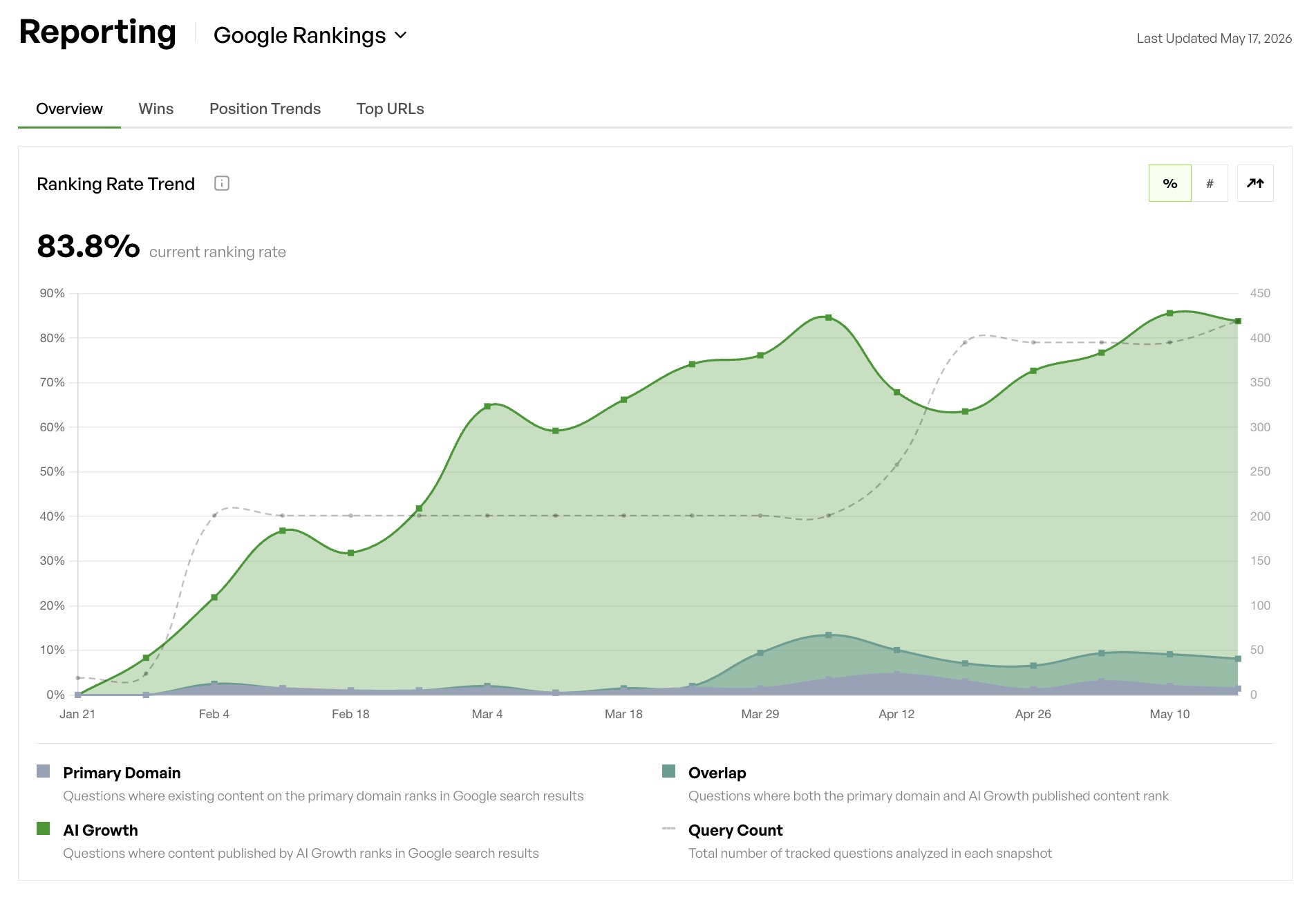
Across the first twelve weeks, AI Growth Agent clients average more than 12,000 additional AI citations and mentions, over 100,000 additional bot visits, and a 20%+ lift in impressions. Specific client outcomes include Breadless reaching a 30x lift in Google Search Console impressions over six months and ChatGPT citing eatbreadless.com over 45,000 times per month, Leva Sleep closing $40,000 to $50,000 in deals in under three weeks from buyers who discovered the brand through AI Growth Agent content, and Jota achieving a 190%+ traffic increase from generated content over three months. Results vary by industry, competitive landscape, and indexing timelines, but the engine is designed to produce measurable incremental visibility, isolated from visibility the brand already had, week over week.
Conclusion: Steering Your Brand Narrative Across AI Search
The agent communication protocol landscape is consolidating fast. A2A and MCP are emerging as the two durable layers for teams building multi-agent orchestration infrastructure. ACP has merged into A2A, and ANP is maturing under community governance. iPaaS platforms compress integration timelines for enterprise workflow automation. Each of these approaches serves a legitimate engineering requirement and carries implementation complexity, governance overhead, and maintenance burden proportional to the control it provides.
For mid-market to enterprise teams whose core requirement is narrative control across AI search surfaces, the protocol comparison often distracts from the real decision. The central issue is whether the brand appears when customers ask AI systems about its market, and whether those systems find the brand's own authoritative narrative or whatever happens to be sitting on the open web.
AI Growth Agent functions as the digital brand manager that replaces the agency stack with one engine. It delivers the one-week site launch, living content that self-heals over time, and clear reporting on incremental visibility generated week over week. Traditional search tools show where a brand stands. AI Growth Agent helps make the brand the answer.
Schedule a consultation session and take control of the narrative across AI search.