Written by: Mariana Fonseca, Editorial Team, AI Growth Agent
What You Will Build With Agent-Enabled Sites
- Agent-enabled sites combine two layers: properties that AI agents can discover and act on through structured protocols, and sites built and operated autonomously by agents handling content, SEO, and self-healing.
- Successful implementation requires client universe mapping, domain access, and a brand manifesto before standing up the owned property with full traditional and agentic technical SEO.
- The process follows five phases: assessment, site setup, agentic technical SEO configuration including Blog MCP and llms.txt, content production, and ongoing monitoring with self-healing.
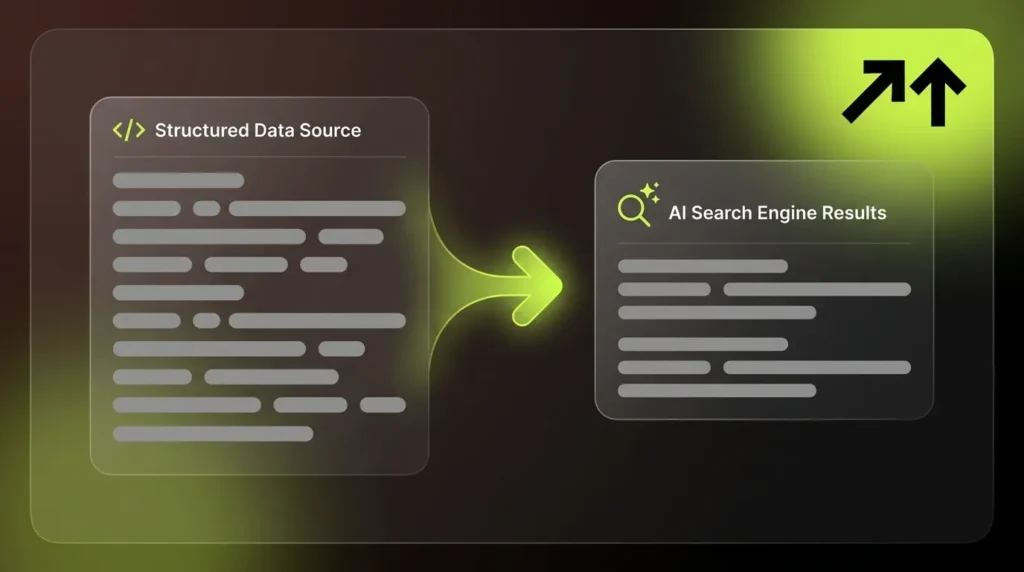
- Agentic technical SEO adds Blog MCP, llms.txt, agent discovery endpoints, natural language query parameters, and Markdown serving so AI agents can locate, parse, and cite content programmatically.
- Agencies can deliver both layers at scale with AI Growth Agent. Book a demo to see how the platform stands up fully configured client sites within one week.
Prerequisites and Starting Conditions
Three conditions must be in place before implementation begins.
- Client universe mapping. Build a structured list of seed terms and the long-tail queries beneath them, drawn from real-time Google and ChatGPT data rather than guesswork. Robots search the long tail, and a topology built without it remains incomplete by design.
- Domain and DNS access. Secure the ability to configure a reverse proxy rewrite or subdomain, typically via Cloudflare, Vercel, or the client host. This step is the only integration task the client side must own.
- Brand manifesto. Create a single source of truth covering voice rules, factual references, deny lists, primary-source URLs, and compliance requirements. Every content decision and personalization control flows from this document.
Organizationally, the agency does not need an in-house engineer or SEO specialist to run the stack described below, because the engine handles schema, robots.txt, sitemaps, MCP endpoints, and llms.txt automatically. This automation reduces the agency’s requirements to two essentials: a clear brief from the client and the authority to connect the blog to a subdirectory under the client’s domain.
Process Overview From Setup to Self-Healing
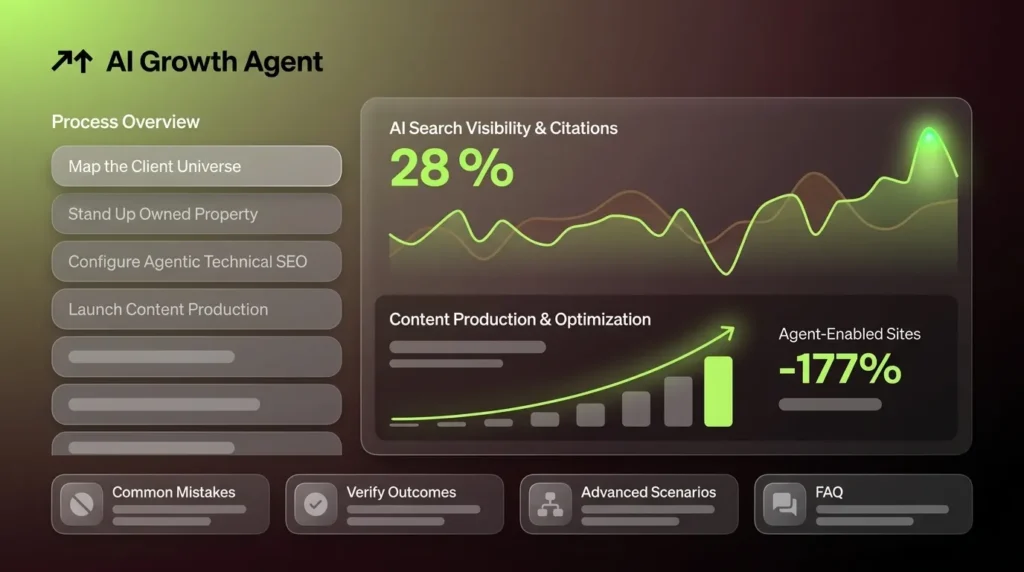
With these prerequisites in place, implementation moves through five logical phases that turn the mapped universe into a live, agent-enabled property.
- Assessment. Map the client’s universe, audit existing domain authority, and identify the competitive gaps in AI search.
- Site setup. Stand up the owned blog property, configure the reverse proxy rewrite, and provision the full traditional and agentic technical SEO stack.
- Agentic technical SEO configuration. Publish Blog MCP, llms.txt, llms-full.txt, agent discovery files, natural language query parameters, and Markdown serving.
- Content production. Launch the content engine against the topology, validate every claim and source, and publish the first articles within the first week.
- Monitoring and self-healing. Track bot traffic, citations, Google Search Console signals, and AI ranking position week over week, and trigger content refreshes automatically.
Step-by-Step Guide
Step 1: Map the Client Universe
The universe is the full set of queries and prompts that describe a client’s market. Most agencies track a handful of head terms and lose the rest of the conversation by default. A complete topology starts with seed terms and then fans out into the long-tail queries beneath each one, using real-time AI Overview and ChatGPT search results as the objective function for which queries are worth pursuing. A mature client universe reaches a substantial number of queries, with the system running thousands of searches every week to refresh the snapshot.
Goal: A strategic map of where to win, not a disconnected list of words.
Validation: Every seed term has documented long-tail queries with evidence of AI surface activity.
Step 2: Stand Up the Owned Property
The blog functions as a separate, fully optimized property the client owns outright, styled to match the main site and connected through a reverse proxy rewrite, usually under a subdirectory or through a subdomain. Nothing in the client’s existing structure changes. The property runs on a WordPress stack with bot tracking, advanced robots.txt, a proper sitemap.xml, a dedicated web-stories sitemap, automatic web stories, instant indexing, autoredirects, and 404 tracking included out of the box.
Goal: A live, owned property within the first week of kickoff.
Validation: Reverse proxy rewrite confirmed, sitemap submitted, robots.txt verified.
Step 3: Configure Traditional Technical SEO
Every article and every site ships with the full traditional technical SEO stack, and the client does not need to configure any of it manually. This foundation makes the property discoverable and trustworthy to search engines.

- Highly structured HTML with full metadata on every asset, including Open Graph titles and descriptions, plus image and video metadata.
- Rich schema markup across article, author, FAQ, review, local business, product, software application, and organization schema types.
- Internal linking that compounds authority across the universe.
- Protected external linking, with outbound links sanitized and marked noindex and nofollow.
- Automatic content refreshes triggered by Google Search Console signals and bot-traffic awareness.
- Automated web stories for every article, served through a dedicated web-stories sitemap.
Goal: Every published asset is machine-readable and authority-compounding from day one.
Validation: Schema validated, sitemap indexed, web stories confirmed in the dedicated sitemap.
Step 4: Configure Agentic Technical SEO
Agentic technical SEO makes the site legible and actionable to AI agents at every stage of their workflow. Traditional technical SEO makes content discoverable to search engines, while this layer makes the property queryable and usable for agents that invoke tools and cite sources.
Blog MCP. The Model Context Protocol is an open standard, originally created by Anthropic in November 2024 and donated to the Linux Foundation’s Agentic AI Foundation in December 2025, that standardizes how AI models connect to external tools and data sources. Blog MCP exposes schema, manifest, discovery, and capability guidance to agents. It is also compatible with Chrome 146 and later and other WebMCP-enabled browsers. WebMCP was published as a W3C Draft Community Group Report on February 12, 2026, enabling in-browser agents to discover and invoke page actions without screen scraping. AI Growth Agent was the first to bring Blog MCP to market, with clients running it in the summer of 2025, roughly a year before Google released Web MCP.
llms.txt and llms-full.txt. llms.txt is a plain-text file hosted at the root of a domain that provides AI systems with a curated index of the most important content. A valid llms.txt implementation requires four elements: an H1 heading with the brand or site name, a blockquote with one to three sentences describing the site, section headings grouping pages by topic, and annotated links with short descriptions. llms-full.txt contains full site content concatenated into a single Markdown document and suits content-heavy properties where an agent needs to ingest everything in a single fetch. Crawlers from Microsoft and OpenAI actively fetch both files, with llms-full.txt accessed more frequently.
Agent discovery via /.well-known/. OpenAI discovery and Agent Card guidance are served via /.well-known/ endpoints, which enables agents to locate the site’s capabilities without prior knowledge of its structure. A2A, introduced by Google in April 2025, enables agents to discover and communicate with each other.
Natural language query parameters. A /?s={query} parameter autotriggers personalized, internally linked responses, so an agent passing a query directly into the URL receives a tailored answer without additional navigation.
Markdown for agents. Pages are served in Markdown to agent crawlers. Traditional HTML with rich visual hierarchy is often invisible or hard to parse for AI agents, which require machine-readable formats.
Goal: The site is discoverable, readable, and actionable to AI agents at every layer.
Validation: llms.txt accessible at domain root, /.well-known/ endpoints returning valid responses, Markdown confirmed in agent crawler responses, Blog MCP schema verified.
Step 5: Launch Content Production
Content production runs as a multi-agent orchestration across major AI providers, not as a single model behind a prompt. The engine analyzes each search to determine the right content format, spawns parallel research agents, validates every source and claim against evidence found online, runs anti-hallucination checks, and then publishes finished articles. Output ranges from a few to dozens of articles per day per client. The first article is typically live within one week of kickoff, with indexing occurring in as little as ten days.
Goal: Authoritative, validated content live and indexing within the first week.
Validation: First articles published, Google Search Console impressions confirmed, bot traffic to new URLs tracked.
Step 6: Choose the Right Platform
The table below compares the primary options an agency will evaluate. Agency fit reflects suitability for multi-client deployment at scale. Agentic technical SEO support reflects native provisioning of MCP, llms.txt, agent discovery, and Markdown serving. Headless capability reflects whether the platform decouples content production from the client’s main site. Time to first site reflects the realistic timeline from kickoff to a live, optimized property.
| Platform | Agency Fit | Agentic Technical SEO Support | Headless Capability | Time to First Site |
|---|---|---|---|---|
| AI Growth Agent | High: built for multi-client, white-label deployment | Full stack: Blog MCP, llms.txt, llms-full.txt, /.well-known/, Markdown, natural language query parameters, schema suite | Yes: reverse proxy rewrite or subdomain, client owns the property | About 1 week to first published article |
| Headless CMS platforms (e.g., Storyblok, Contentful) | Medium: requires engineering resources per client, 83% of companies report that switching to a headless CMS improved time and budget but setup remains technical | Partial: no native MCP, llms.txt, or agent discovery, requires custom development | Yes: API-first architecture decouples frontend from backend | Weeks to months depending on engineering capacity |
| AI content writers (e.g., Jasper) | Low: no universe map, no publishing, no technical SEO | None: no MCP, llms.txt, schema, or agent discovery | No: text generation only, no site infrastructure | No site deployment capability |
| GEO and AI search monitors (e.g., Profound, Athena) | Low: monitoring only, no content or site production | None: tracks appearance for a capped set of prompts but does not produce or publish | No: no site infrastructure | No site deployment capability |
Common Mistakes and Troubleshooting
Blocking AI Crawlers in robots.txt
A robots.txt that blocks GPTBot, ClaudeBot, PerplexityBot, OAI-SearchBot, Google-Extended, or Applebot-Extended prevents the AI surfaces from reading the content that llms.txt and Blog MCP are designed to surface. Without access, your agentic technical SEO stack becomes invisible to the agents you are trying to reach. That is why you should audit robots.txt alongside every agentic technical SEO configuration to confirm these user agents are permitted.
Publishing llms.txt Without the Required Structure
A malformed llms.txt file provides no usable signal to agents. The required structure is one H1 with the brand or product name, a blockquote summary immediately after the H1, H2 sections grouping links into logical categories, and link lines in the exact format: – [Title](URL): Description. Sections should be kept to fewer, deeper groupings rather than many shallow ones.
Treating Monitoring as Action
Monitoring tools report whether a brand appears for a capped set of prompts, but they do not produce content, own publishing, or act on the data. Few organizations have embedded agentic AI across the organization, and the gap between monitoring and execution is where most agencies stall. The implementation checklist above is designed to close that gap.
Relying on a Single AI Model for Content Production
A single model behind a prompt produces inconsistent output at scale and cannot validate claims against primary sources. AI agents achieve strong performance by breaking tasks into small well-defined components, incorporating relevant context, and using tight feedback loops for error correction. Multi-agent orchestration across providers, with anti-hallucination checks at every stage, is the architecture that produces citable content.
Skipping the Brand Manifesto
Without a manifesto, the engine has no ground truth for voice rules, factual references, or compliance requirements. Every personalization control, style memory, and anti-hallucination steering instruction flows from this document. Agencies that skip it produce content that drifts from one article to the next and requires constant re-briefing.
Verifying Outcomes and Measuring Results
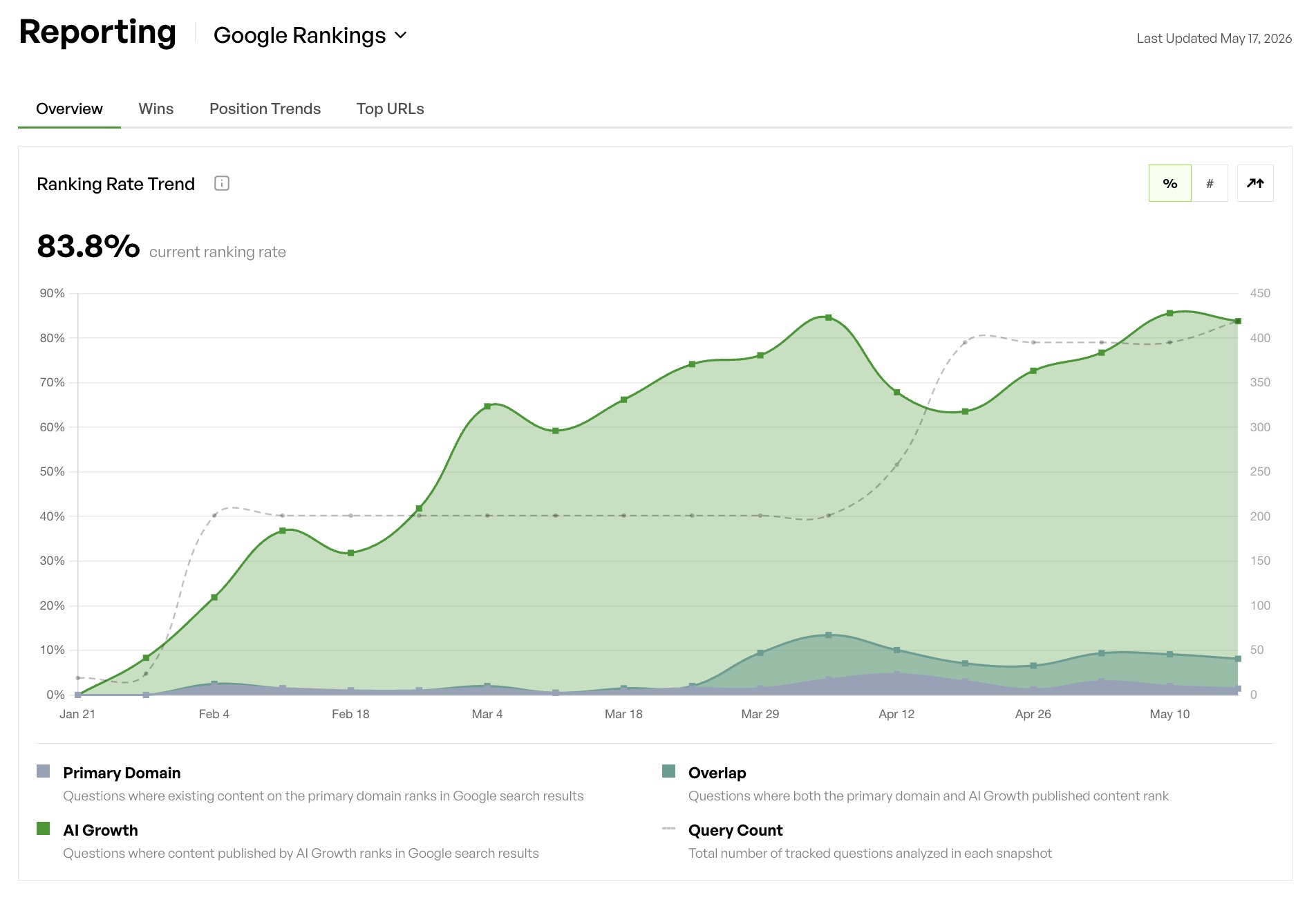
Agent-enabled sites succeed when AI systems read, cite, and act on the content, so the metrics that matter differ from traditional SEO metrics. The following signals confirm that the implementation is working.
- Bot traffic. Per-article bot tracking shows exactly when ChatGPT, Perplexity, and other AI surfaces crawl and cite the content. Across the first twelve weeks, AI Growth Agent clients see a significant increase in bot visits.
- AI citations and mentions. Track the number of times the brand appears in AI-generated answers week over week. Clients see a substantial increase in AI citations and mentions in the first twelve weeks.
- Google Search Console impressions. Use impressions as an independent audit of indexing reach. Clients see a meaningful lift in impressions across the first twelve weeks.
- Citation context. Review where the brand appears in an AI answer, who it is grouped with, and what claim it is cited for. This context replaces the old idea of a single ranking number.
- Incremental visibility. Report the visibility the new effort actually generated, separate from the visibility the brand already had. Publishing into a separate environment makes this isolation possible.
Review cadence is weekly for bot traffic and citation data, and monthly for a full universe snapshot that identifies which seed terms to expand next.
Advanced Scenarios and Next Steps
Multi-Client Deployment Across a Single Platform
Each client receives a separate owned property with its own manifesto, topology, and technical SEO stack. The agency manages multiple universes from a single platform view, with Search Intelligence providing a weekly picture of each client’s competitive landscape from any competitor’s point of view.
White-Label Service Line for Agent-Enabled Sites
The agency layers AI search visibility on top of its existing press and influencer work without hiring an engineer, an SEO specialist, or a content team. The engine produces authoritative, self-healing content and stands up an owned site for each client within the first week. Solutions that connect directly to CRM systems, calendars, and business workflows justify 3 to 5 times higher pricing than standalone tools, and a fully configured agent-enabled site with agentic technical SEO represents exactly that level of integration.
Multi-Domain and Multi-Language Variations
For clients operating across multiple domains or languages, the topology expands to cover each market separately. The convention for multilingual sites is to publish one llms.txt per language root, with descriptions written in the target language. Each domain receives its own Blog MCP configuration, agent discovery files, and content topology.
FAQ
What is the difference between a site that is agent-enabled and a site that is just AI-optimized?
An AI-optimized site typically means content written to appear in AI-generated answers, with attention to natural language and topical authority. An agent-enabled site goes further: it exposes structured endpoints, MCP servers, llms.txt and llms-full.txt files, agent discovery via /.well-known/, natural language query parameters, and Markdown serving so that AI agents can not only read the content but discover, query, and act on it programmatically. The distinction matters because AI surfaces are increasingly agentic, meaning they do not just retrieve content but invoke capabilities and delegate tasks. A site that is only AI-optimized is invisible to that layer of the stack.
Do agencies need technical staff to implement agentic technical SEO for clients?
Agencies do not need technical staff when the engine handles provisioning automatically. The full agentic technical SEO stack, including Blog MCP, llms.txt, llms-full.txt, agent discovery files, schema, robots.txt, sitemaps, and Markdown serving, ships with every site AI Growth Agent stands up. The only integration step that requires any technical action on the client or agency side is the reverse proxy rewrite that connects the blog to a subdirectory under the client’s domain. Everything else is included in every package and requires no plugin installation, schema work, or engineering hours.
How does headless marketing architecture differ from a standard headless CMS?
A headless CMS decouples the content repository from the frontend presentation layer, giving developers flexibility in how content is displayed. Headless marketing goes further by decoupling the entire marketing operation from human headcount. The brand keeps its curated main site. The engine stands up a separate, fully optimized blog the brand owns, handles content production, technical SEO, schema provisioning, bot tracking, and self-healing, and connects to the main domain through a reverse proxy rewrite. The result is a marketing operation that runs autonomously, produces living content, and reports incremental visibility without requiring an editor, an SEO specialist, a designer, or an engineer on the client side.
What measurable outcomes should agencies commit to when selling agent-enabled sites as a service?
The metrics that hold up under client scrutiny are brand mention rate and citation rate in AI-generated answers, accompanied by Google Search Console impressions and bot traffic. These signals confirm that the site is being read, cited, and acted on by AI surfaces. Incremental visibility reporting, which isolates the visibility the new effort generated from the visibility the brand already had, is the standard that makes results defensible. The twelve-week benchmarks described earlier, including bot traffic, citation rate, and impression lift, are the signals that make results defensible to clients.
How does Blog MCP differ from standard MCP server implementations?
A standard MCP server exposes tools, data resources, and prompts in a structured format that any MCP-supporting application can query. Blog MCP applies that architecture specifically to a content property, exposing schema, manifest, discovery, and capability guidance so that AI agents can locate, parse, and cite the blog’s content through a consistent interface. The Chrome 146 compatibility mentioned earlier means in-browser agents can discover and invoke page actions without screen scraping. The combination of Blog MCP, llms.txt, agent discovery via /.well-known/, and natural language query parameters creates a site that is legible to AI systems at every stage of their workflow, from initial discovery through active querying.
Conclusion
Agent enabled sites for agencies are a current requirement, not a future consideration. The leaderboard for AI search visibility is being written now, and the agencies that deliver both layers, sites that agents can read and act on, and sites built and operated by agents, are the ones opening a high-margin service line their competitors cannot match. The implementation checklist above covers every element: universe mapping, site setup, traditional technical SEO, agentic technical SEO including Blog MCP, llms.txt, llms-full.txt, agent discovery, natural language query parameters, and Markdown serving, content production, and incremental visibility reporting. The engine handles the technical work. The agency delivers the result.