Written by: Mariana Fonseca, Editorial Team, AI Growth Agent
Key Takeaways For AI-Focused Schema
- Schema markup turns human-readable pages into machine-readable signals that help RAG systems identify, verify, and rank content for AI citations.
- Article, FAQPage, HowTo, and Organization schema, paired with sameAs and knowsAbout, strengthen entity clarity, freshness, and topical authority.
- JSON-LD belongs in the document head, must match visible content, and needs ongoing validation to avoid spammy structured data flags.
- Schema performs best as one layer in a broader agentic stack that also includes llms.txt, Blog MCP, and agent discovery endpoints.
- Schedule a demo with AI Growth Agent to see how the headless marketing engine provisions and monitors schema across your entire content universe.
How Schema Shapes AI Retrieval And Citations
Schema performs three distinct functions on AI surfaces, and together they guide citation decisions. First, it resolves entity disambiguation. When a brand shares a name with another company or concept, sameAs properties connect the domain to external profiles on Wikipedia, LinkedIn, and Wikidata, helping AI models confidently identify the publishing source before citing pages. Without this, an AI system can easily mix up two entities with similar names.
Second, schema supplies freshness signals. datePublished never changes while dateModified updates only with substantive content changes. Retrieval systems use this pattern as a reliable recency indicator for time-sensitive queries where outdated guidance would mislead users.
Third, schema builds topical authority. The knowsAbout property on Organization schema creates a topical authority signal by declaring genuine expertise topics and industries. Brands that declare these topics become more likely to earn citations for queries in those domains than similar organizations with no topic declarations. Together, these three functions help AI systems answer “who is this,” “how current is this,” and “what do they know about” before citing content.
The practical effect is measurable. Schema App measured a 19.72% increase in AI Overview visibility after implementing entity linking that connected on-page entities to authoritative external knowledge bases such as Wikipedia, Wikidata, and Google's Knowledge Graph. Brightview Senior Living used schema properties to define and disambiguate community location and service entities, resulting in a 25% increase in clicks for non-branded queries.
Implementing JSON-LD So AI Assistants Can Use It
JSON-LD runs as a <script type="application/ld+json"> block placed in the document <head>. JSON-LD delivered in the document head remains Google's preferred implementation method after the March 2026 core update, while Microdata and RDFa showed no increase in efficacy for AI citation or rich results. Keeping JSON-LD separate from rendered HTML allows CMS-driven generation, safe updates without touching templates, and independent validation without breaking visible content.
Third-party LLM systems including ChatGPT, Claude, and Perplexity often ignore or fail to semantically parse JSON-LD during runtime retrieval, though some tests show they can extract plain-text content from it, while Google's own AI surfaces use schema markup as runtime context during retrieval. This distinction shapes strategy. Schema delivers the strongest returns for Google AI Overviews and AI Mode and acts as a trust and entity signal that indirectly supports citation across all platforms by strengthening organic rankings and Knowledge Graph membership.
One strict rule governs implementation. Content parity is strictly enforced, and if schema data is not visible on the rendered page, Google flags it as spammy structured data. Every schema property must mirror what a human reader can see on the page.
JSON-LD Patterns That Support AI Overviews
The four schema types with the clearest impact on AI Overview citation eligibility are Article, FAQPage, HowTo, and Organization. Each should include sameAs and, where appropriate, knowsAbout properties that link to Wikipedia or Wikidata. Linking content to Wikidata IDs via the mentions and about properties provides the strongest 2026 signal for entity SEO in generative AI retrieval. Use the @graph array to connect entities within a single JSON-LD block instead of scattering separate script tags, which builds an internal knowledge graph that AI systems can traverse.
Article schema with sameAs and knowsAbout:
<script type="application/ld+json"> { "@context": "https://schema.org", "@graph": [ { "@type": "Article", "@id": "https://example.com/blog/schema-markup-ai-search/", "headline": "Schema Markup For AI Search: The Complete Implementation Guide For 2026", "datePublished": "2026-07-07", "dateModified": "2026-07-07", "author": { "@type": "Person", "@id": "https://example.com/authors/jane-smith/", "name": "Jane Smith", "sameAs": [ "https://www.linkedin.com/in/janesmith", "https://www.wikidata.org/wiki/Q12345678" ], "knowsAbout": [ "Schema Markup", "AI Search", "Technical SEO", "Structured Data" ] }, "publisher": { "@type": "Organization", "@id": "https://example.com/#organization", "name": "Example Brand", "url": "https://example.com", "logo": "https://example.com/logo.png", "sameAs": [ "https://www.linkedin.com/company/example-brand", "https://www.wikidata.org/wiki/Q87654321" ], "knowsAbout": [ "AI Search Optimization", "Content Marketing", "Technical SEO" ] } } ] } </script> Industry data from Stackmatix (2026) shows that pages cited by Google AI Mode include structured data markup, and pages cited by ChatGPT include structured data. Schema does not guarantee citation, yet its absence creates a structural disadvantage.
FAQPage Schema That Mirrors AI Answer Formats
FAQPage provides clear question-answer pairs that align with how AI models structure responses, making it particularly effective for informational and comparison queries. FAQPage schema enables AI platforms to pull question-answer pairs nearly verbatim, so answers should lead with a direct one-sentence answer followed by elaboration. Note that FAQPage no longer produces visible rich results in Google Search after May 7, 2026, but continues to help AI crawlers such as PerplexityBot parse question-and-answer content structures.
<script type="application/ld+json"> { "@context": "https://schema.org", "@type": "FAQPage", "mainEntity": [ { "@type": "Question", "name": "What schema types improve AI Overview citation rates?", "acceptedAnswer": { "@type": "Answer", "text": "Article, Organization, FAQPage, and HowTo schema types have the clearest impact on AI Overview citation eligibility. Each should include sameAs properties linking to Wikidata or Wikipedia to strengthen entity disambiguation and Knowledge Graph membership." } }, { "@type": "Question", "name": "Does schema markup directly influence ChatGPT citations?", "acceptedAnswer": { "@type": "Answer", "text": "ChatGPT strips JSON-LD during runtime retrieval and reads visible HTML content. Schema supports ChatGPT citation indirectly by strengthening organic rankings and entity authority, which increases the probability that content enters the retrieval consideration set." } } ] } </script> sameAs Links That Lock In Entity Identity
The sameAs property, introduced earlier as a key entity disambiguation signal, serves as the connective tissue between a website and Google's Knowledge Graph. It links to external authoritative sources such as Wikidata, LinkedIn, and Crunchbase to verify entity identity. Wikidata is the most powerful sameAs target because it is a primary input to Google's Knowledge Graph, while LinkedIn company pages and Crunchbase profiles serve as secondary verification sources. As an Organization or Person schema adds more consistent sameAs identifiers, the entity's confidence score in the Knowledge Graph rises.
Organization schema with sameAs:
<script type="application/ld+json"> { "@context": "https://schema.org", "@type": "Organization", "@id": "https://example.com/#organization", "name": "Example Brand", "url": "https://example.com", "logo": "https://example.com/logo.png", "foundingDate": "2018", "description": "Example Brand provides AI search optimization and structured data solutions for mid-market and enterprise companies.", "sameAs": [ "https://www.linkedin.com/company/example-brand", "https://www.wikidata.org/wiki/Q87654321", "https://www.crunchbase.com/organization/example-brand", "https://twitter.com/examplebrand" ], "knowsAbout": [ "AI Search Optimization", "Schema Markup", "Technical SEO", "Content Marketing", "Structured Data" ] } </script> Wells Fargo implemented schema markup to clearly define and link location and service entities, providing a trusted data layer that resolved AI-generated inaccuracies about branch locations. Strong entity disambiguation via sameAs directly reduces the risk that AI systems misattribute content or surface hallucinated claims about a brand.
HowTo Schema For Step-By-Step AI Answers
HowTo provides step-by-step instructions with materials and time estimates, making it ideal for tutorial and process content where AI models recommend solutions. HowTo rich results were deprecated by Google in September 2023, but HowTo schema remains valid Schema.org vocabulary for potential use by AI agents. The stepwise structure gives retrieval systems a clean extraction path for procedural queries, which often carry high intent in AI search.
<script type="application/ld+json"> { "@context": "https://schema.org", "@type": "HowTo", "name": "How To Implement Schema Markup For AI Search", "description": "A step-by-step process for implementing JSON-LD schema markup to improve visibility in AI Overviews and generative search surfaces.", "totalTime": "PT2H", "tool": [ { "@type": "HowToTool", "name": "Google Rich Results Test" }, { "@type": "HowToTool", "name": "Schema Markup Validator" } ], "step": [ { "@type": "HowToStep", "position": 1, "name": "Audit existing schema coverage", "text": "Use Google Search Console and the Rich Results Test to identify pages with missing or invalid schema markup." }, { "@type": "HowToStep", "position": 2, "name": "Implement Organization schema on the homepage", "text": "Add Organization JSON-LD with name, URL, logo, sameAs links to Wikidata and LinkedIn, and knowsAbout properties declaring your expertise topics." }, { "@type": "HowToStep", "position": 3, "name": "Add Article schema to every blog post", "text": "Include headline, author as Person with sameAs, datePublished, dateModified, and publisher linked to your Organization entity." }, { "@type": "HowToStep", "position": 4, "name": "Deploy FAQPage schema on Q&A content", "text": "Mark up every FAQ section with FAQPage schema, leading each answer with a direct one-sentence response followed by elaboration." }, { "@type": "HowToStep", "position": 5, "name": "Validate and monitor", "text": "Run every page through Google's Rich Results Test and Schema.org's validator before publishing, then monitor bot traffic and AI citation data weekly." } ] } </script> Validation And Testing That Prevent Schema Drift
Every schema implementation needs validation before publishing. Invalid structured data provides zero benefit and can signal poor technical quality, so every page should be validated with Google's Rich Results Test and Schema.org's validator before publishing. The workflow runs in three stages. First, validate syntax and property coverage using Google's Rich Results Test and the Schema Markup Validator. Second, confirm content parity, because every property value in the JSON-LD must be visible on the rendered page or Google will classify it as spammy structured data. Third, monitor real-time bot tracking to confirm that AI crawlers including GPTBot, PerplexityBot, and Google's own crawlers access the content after publication.
Schema drift remains a persistent risk in large content operations. Schema drift occurs when structured data code contradicts visible data on pages, such as mismatched pricing or out-of-stock statuses, which erodes an AI engine's validation trust during crawling. Automated validation on every publish cycle, not just at initial deployment, provides the only reliable defense against drift at scale. AI Growth Agent's WordPress plugin provisions valid schema automatically on every article and monitors for drift without requiring any action from the client team.
Connecting Schema With llms.txt, Blog MCP, And Agent Discovery
Schema markup forms one layer inside a broader agentic readability stack. Schema explains what a page is and who stands behind it, yet it does not help agents find your strongest content or query it live. That gap is where llms.txt and MCP add the missing layers.
llms.txt is a Markdown file placed at the root of a domain that serves as a curated index of the most important content for AI agents, functioning as a sitemap for AI by pointing to clean, distraction-free data. A companion llms-full.txt file exposes the complete content corpus in a format tuned for model ingestion. Together, these files reduce parsing friction that often causes AI systems to skip or misread content.
Model Context Protocol (MCP) extends this stack from static indexing to live queries. MCP, introduced by Anthropic in late 2024, acts as a universal open standard allowing AI agents to securely connect to data sources. Unlike llms.txt, which supplies only static text without context, MCP connects AI systems directly to Schema Markup and Knowledge Graphs, supplying the contextual data required for accurate, brand-aligned responses.
AI Growth Agent brought Blog MCP to market early, with clients running it in the summer of 2025, roughly a year before Google released Web MCP. The full agentic technical SEO stack includes Blog MCP, compatible with Chrome 146+ and other WebMCP-enabled browsers, which lets agents query your content in real time. It also includes OpenAI discovery and Agent Card guidance served via /.well-known/ endpoints, which tell agent platforms where to find your structured data and how to interact with it. Natural language query parameters via /?s={query} return personalized internally linked responses to agents, turning your site into a conversational interface. Markdown served to agent crawlers strips away heavy JavaScript and complex HTML, which reduces parsing friction. llms.txt and llms-full.txt at the domain root function as a curated content index so AI surfaces can read the brand the way they need to. Schema is the structured identity layer. llms.txt is the content index. MCP is the live query interface. All three must be present for a property to be fully agent-readable.
This architecture separates a headless marketing engine from a basic schema plugin. A plugin deploys tags. The headless engine maps the brand's full universe, produces authoritative content, publishes with the complete technical and agentic SEO stack, and reports the incremental visibility it generates week over week, without requiring engineering resources from the client team.
Schema Performance When Paired With A Full Stack
Schema delivers the strongest results when it supports a broader content and entity strategy. An Ahrefs causal study tracking 1,885 pages that added JSON-LD schema between August 2025 and March 2026, matched against 4,000 control pages, found no major uplift in citations across Google AI Overviews, Google AI Mode, or ChatGPT in isolation. At the same time, pages with multiple schema types appear more frequently in ChatGPT citations than pages with no schema. The reconciliation is straightforward. Schema added to weak content on a weak domain produces weak results. Schema deployed as part of a complete content and entity strategy, with sameAs entity linking, authoritative content, and agentic readability signals, produces measurable gains.
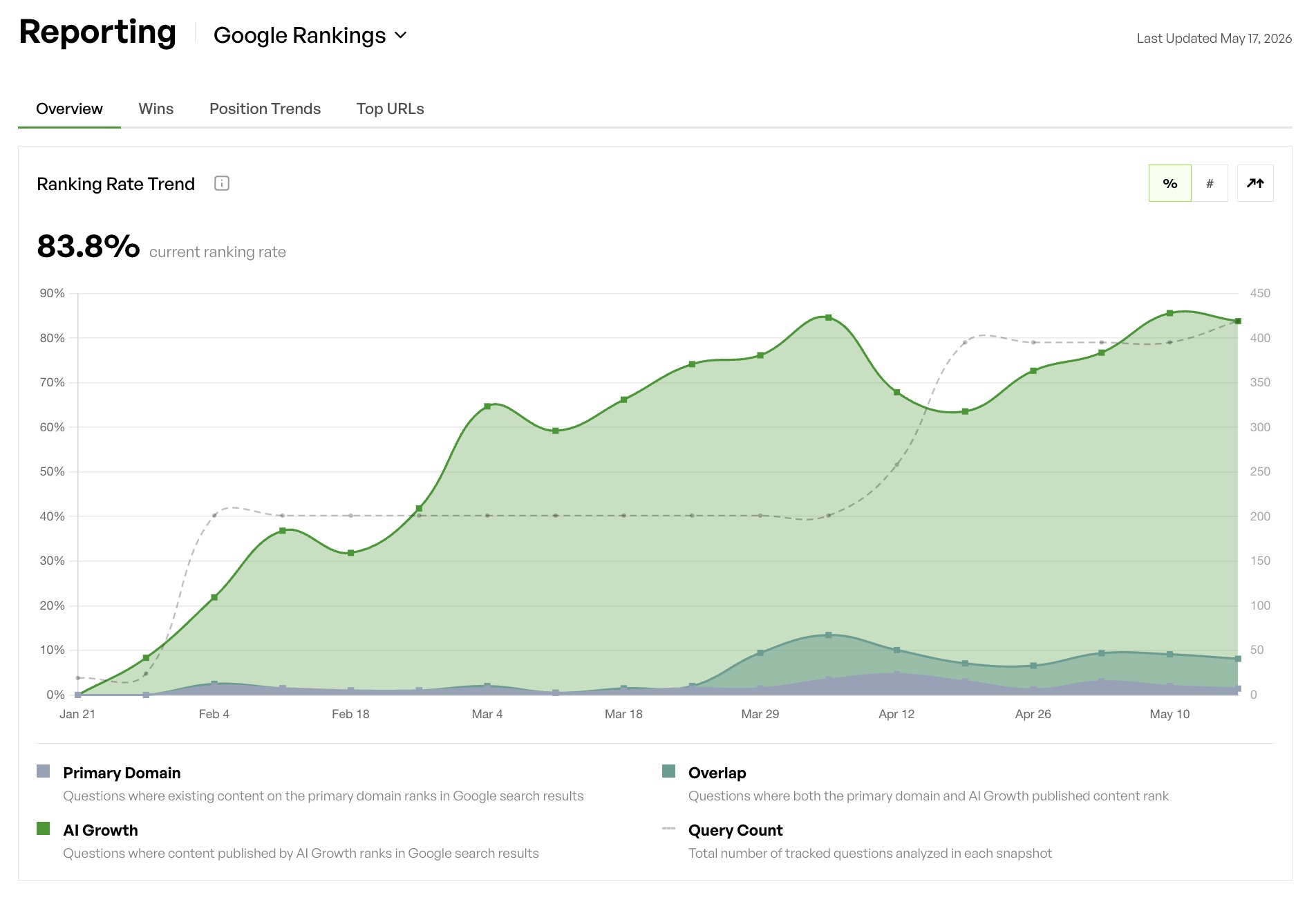
AI Growth Agent client results reflect this complete-stack approach. Breadless reached a 30x lift in Google Search Console impressions over six months, and ChatGPT now cites eatbreadless.com over 45,000 times per month. Leva Sleep reached ChatGPT citations of its content topping 10,000 per month and closed $40,000 to $50,000 in deals in under three weeks from buyers who discovered the brand through AI Growth Agent content. Bisutti reached 71% of brand mention visibility driven by AI Growth Agent content, with its corporate pages the most cited domains in the sector. Schema forms one layer of the engine that produced those outcomes, not the engine itself.
Conclusion: Schema As A Core Layer In The Headless Engine
Schema markup supplies the structured identity signals that RAG systems parse for entity resolution, freshness, and topical authority. JSON-LD in the document head, with sameAs links to Wikidata and LinkedIn, knowsAbout declarations, and content-type markup across Article, FAQPage, HowTo, and Organization, forms the minimum viable implementation for any brand competing for AI citations in 2026. Validation against Google's Rich Results Test and Schema.org's validator, combined with real-time bot tracking, closes the loop between deployment and performance.
Schema alone, however, remains one layer. The brands earning consistent citations across ChatGPT, Perplexity, and Google AI Mode pair schema with authoritative long-tail content, llms.txt and llms-full.txt, Blog MCP, agent discovery endpoints, and incremental visibility reporting that isolates what the content investment actually generated. That combination defines the headless marketing engine, a single system that replaces the SEO agency, the content tool, the web agency, the GEO monitor, the schema plugin, and the analytics stack, at a flat fee with no per-article charges, no credit limits, and no engineering resources required from the client team.
The brands cited in AI search this year are training the next generation of models with their own story. The brands that wait train the next generation with whatever happens to be sitting on the open web.
Frequently Asked Questions
Does schema markup directly cause AI systems like ChatGPT and Perplexity to cite my content?
The relationship is indirect for most third-party AI platforms. As noted earlier, most third-party AI platforms strip JSON-LD during retrieval and focus on visible HTML content. Schema's primary citation impact appears on Google's own AI surfaces, including AI Overviews and AI Mode, where Google's engineering team has confirmed that structured data is served as context to generative models during query-time retrieval. For non-Google platforms, schema contributes to citation probability by strengthening organic rankings, Knowledge Graph membership, and entity disambiguation, which increases the likelihood that content enters the retrieval consideration set. The highest-leverage approach treats schema as one layer of a complete content and entity strategy rather than a standalone citation lever.
What is the difference between sameAs and knowsAbout, and which matters more for AI search?
sameAs and knowsAbout serve different functions and both matter. sameAs links an Organization or Person entity to external authoritative sources such as Wikidata, LinkedIn, and Crunchbase, allowing AI systems to resolve entity identity and confirm that the publishing domain corresponds to a known real-world entity. It forms the foundation of entity disambiguation and Knowledge Graph membership. knowsAbout declares the topics, industries, and subject matter an organization or author genuinely has expertise in, creating a topical authority signal that makes the entity more likely to be cited for queries in those domains.
After Google's March 2026 core update, Organization and Person schemas that include both properties became the highest-leverage implementation type for improving citation rates in Google AI Mode. The practical priority is to implement sameAs first to establish entity identity, then layer knowsAbout to signal topical relevance.
How does schema markup fit into a broader agentic readability strategy?
Schema acts as the structured identity layer in a four-part agentic readability stack. It tells AI systems what a page is, who wrote it, which entity stands behind it, and what topics it covers. llms.txt and llms-full.txt function as a curated content index for AI agents, pointing to clean Markdown versions of the most important content without the parsing friction of heavy JavaScript or complex HTML. Blog MCP and agent discovery endpoints served via /.well-known/ allow AI agents to query live structured data sources directly instead of relying only on static crawls. Natural language query parameters enable agents passing a query into a URL to receive a personalized, internally linked response. All four layers together make a property fully readable by the AI systems that decide what to cite. Schema deployed without the surrounding stack becomes a label without a library behind it.
How do I prevent schema drift from undermining my AI citation strategy?
As discussed in the validation section, schema drift happens when structured data properties contradict visible content, for example when a dateModified value is not updated after a substantive content change, or when a product price in schema no longer matches the displayed price. Google classifies mismatches as spammy structured data, which removes any citation benefit and can introduce a trust penalty. The defense against drift is automated validation on every publish cycle, not just at initial deployment.
Every schema property must mirror what a human reader can see on the rendered page, and every update to visible content must trigger a corresponding update to the schema block. For large content operations producing dozens of articles per week, manual validation does not scale. The only workable solution is a publishing system that generates and validates schema programmatically as part of the content pipeline, with bot tracking in place to confirm that AI crawlers access the updated content after each publish.
What schema types should I prioritize if I am starting from zero?
The minimum viable implementation for AI search visibility in 2026 includes Organization schema on the homepage, Article schema on every blog post and editorial page, FAQPage schema on every page with question-and-answer content, and Person schema for every named author. Organization schema establishes brand identity and should include sameAs links to Wikidata, LinkedIn, and Crunchbase, plus knowsAbout declarations for your core expertise topics. Article schema must include headline, author linked to a Person entity, datePublished, dateModified, and publisher linked to the Organization entity via @id.
FAQPage answers should lead with a direct one-sentence response followed by elaboration, which gives AI systems a clean extraction path for conversational queries. BreadcrumbList schema on every page communicates site hierarchy and helps AI systems place content accurately within the content structure. Use the @graph array in a single JSON-LD block to connect all entities, building an internal knowledge graph that AI retrieval systems can traverse instead of a set of disconnected labels.