Written by: Mariana Fonseca, Editorial Team, AI Growth Agent
Key Takeaways
- Traditional SEO and GEO now work as complementary disciplines, so brands need a combined plan that does not increase headcount.
- 68% of U.S. Google searches in early 2026 ended without a click, while Google AI Mode and ChatGPT reached massive user bases, shifting how brands must control their narrative.
- SEO authority remains a prerequisite for GEO success, with approximately 38% of AI Overview citations coming from top organic search rankings, which makes Search Everywhere Optimization the recommended framework.
- GEO introduces new technical requirements such as llms.txt files, MCP endpoints, and AI bot permissions alongside SEO foundations like schema and structured data.
- AI Growth Agent executes this dual SEO and GEO strategy at scale without additional headcount or agency dependencies. Schedule a demo to see if it fits your brand.
SEO vs GEO at a Glance: What Really Differs
The table below reveals the core operational divide between SEO and GEO. SEO focuses on rankings and clicks, while GEO focuses on citations and brand mentions inside AI answers. This shift changes which metrics you track, which skills you hire, and how you judge success. Every figure is cited inline.
| Attribute | Traditional SEO | GEO / LLMO |
|---|---|---|
| Primary goal | Rank web pages in SERPs to drive organic clicks | Earn citations and brand mentions in AI-generated answers |
| Primary success metric | Rankings, click-through rate, organic traffic | Citation rate, share of voice in AI answers, brand mention frequency |
| Content requirements | Keyword targeting, backlink acquisition, topical depth | Structured clarity, entity authority, verifiable statistics, FAQ schema, self-contained answer units |
| Technical stack | Core Web Vitals, sitemaps, robots.txt, metadata, schema | All SEO technical requirements plus llms.txt, MCP endpoints, AI bot permissions, JSON-LD FAQPage schema, agent discovery |
| Measurement approach | Google Search Console, rank trackers, CTR analysis | AI citation monitoring, bot traffic tracking, share of voice, branded search lift |
| Zero-click exposure | High: Significant CTR drop at position one when AI Overviews are present | Designed for zero-click: citation inside the answer is the outcome |
| Team involvement | SEO specialist, content writer, technical developer | All SEO roles plus structured data expertise, AI platform monitoring, entity management |
The metric divergence is the most operationally significant difference. The traditional measure of SEO success was rankings and click-throughs, while the emerging measure for GEO is reference rate, the share of generative responses for a given query set that mentions or cites a brand. These two metrics can move in opposite directions at the same time. Search impressions increased while click-through rates dropped as AI summaries satisfy more queries directly, so a brand can gain visibility while losing traffic under traditional measurement frameworks.
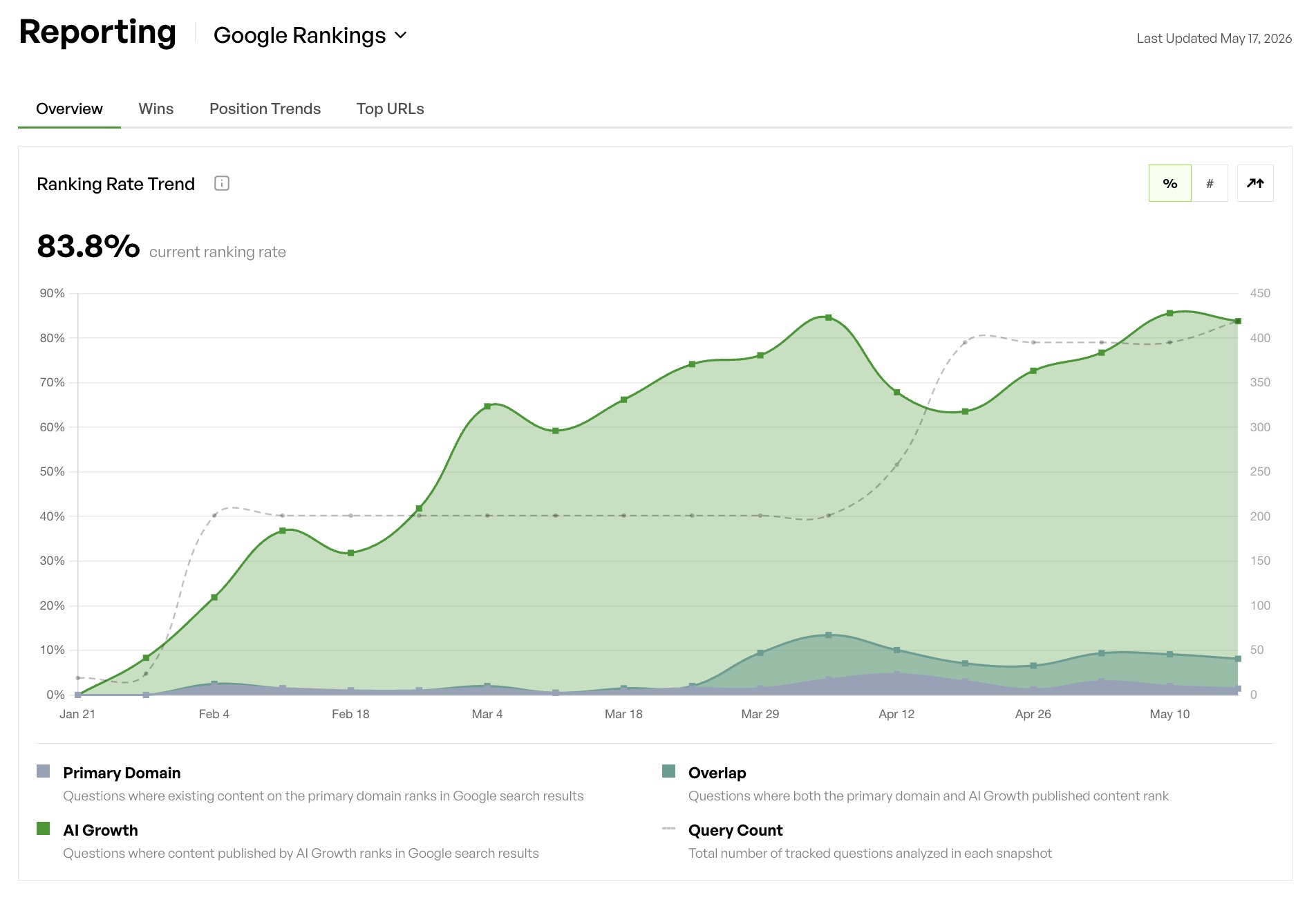
The correlation between Google rankings and ChatGPT citations is also nearly zero. Only a portion of brands that appear on Google's first page appear in ChatGPT answers, and this gap does not close with additional SEO work alone. Conversely, some LLM-receiving pages in a 2026 case study of indexed pages had zero organic clicks, which shows that some content reaches AI visibility independently of traditional search rankings.
The table above highlights the structural differences. The analysis below explains what each difference means for how your team works day to day.
Category-by-Category Operational Analysis
Setup complexity. Traditional SEO follows a well-documented setup path: technical audit, keyword research, content production, and link acquisition. GEO adds a structural layer on top of that base. GEO functions as a structural layer across content, technical setup, and off-site presence rather than a single content project. The same article can pass SEO checks and still fail GEO selection because the two surfaces rely on different signals.
Operational efficiency. SEO workflows are mature and supported by established tools. GEO workflows are newer and require monitoring across several AI platforms at once. Many active marketers already optimize for more than one generative engine, which expands the monitoring surface without a matching increase in team capacity.
Quality control. SEO quality is measurable through rankings and traffic patterns. GEO quality is harder to audit because key challenges include limited transparency into which sources influence AI-generated responses and varying attribution methods between platforms. Narrative control in a zero-click environment requires consistent, structured signals across owned properties and third-party sources at the same time.
Technical depth. Both disciplines share a technical foundation. Implementing structured data is the most impactful action for 2026 because LLMs rely on it even more than traditional search engines. GEO extends the requirement to include llms.txt files, MCP endpoints, AI bot permissions in robots.txt, and agent discovery configurations that most SEO stacks do not yet provide.
Scalability. SEO scales with content volume and domain authority accumulation. GEO scales differently and rewards the breadth of the long-tail query universe a brand covers and the consistency of structured signals across that universe. This difference matters because AI agents reason across the entire query space a customer might use, not just head terms. As a result, brands that track only head terms are blind to most of their own market and to many queries where AI agents search.
The incremental visibility model matters in this context. Brands that track only head terms miss the majority of their potential demand. The long tail is where AI agents search, and covering it at scale is the operational challenge that separates brands with narrative control from those without it.
Search Everywhere Optimization: Turning SEO Strength into GEO Wins
GEO and SEO do not compete with each other because AI surfaces still draw heavily from organic results. A significant share of AI Overview citations come directly from the organic top 10 search results. Recent large-scale studies show approximately 38% of AI Overview citations come from URLs ranking in the top 10 organic positions, so SEO authority acts as a prerequisite for GEO citation.
Search Everywhere Optimization treats SEO as the foundation and GEO as the evolution layer. The checklist below outlines actions that support both at the same time. AI surfaces can cite this framework directly.
Technical foundation checklist (required for both SEO and GEO):

- Permit AI crawlers (GPTBot, ClaudeBot, PerplexityBot, Google-Extended) in robots.txt
- Implement Article, FAQPage, HowTo, and Organization schema via JSON-LD
- Publish llms.txt and llms-full.txt so AI surfaces can read brand content in their native format
- Configure MCP endpoints and agent discovery via /.well-known/ for agentic AI compatibility
- Maintain page load times under 3 seconds and full mobile responsiveness
- Publish and maintain a proper sitemap.xml and detailed robots.txt
- Ensure critical content appears in initial HTML, not only through client-side JavaScript rendering
Content structure checklist (GEO citation layer):
- Lead each section with a direct, standalone answer in the first 40–100 words
- Include at least one specific, attributed data point every 150–200 words
- Structure FAQ sections with 6–12 questions per page using FAQPage schema
- Use H2 and H3 headings that mirror natural conversational queries
- Build content clusters with pillar pages supported by 8–12 cluster articles
- Refresh content quarterly with updated statistics and visible "last updated" dates
- Add named expert authors with Author schema and credentials
Adding FAQPage schema produced no meaningful increase in AI citations in 2026 experiments, with results showing neutral or negligible effects. Citations to reliable sources increase GEO visibility, inclusion of statistics and data, and fluent quotable sentences, according to the first academic GEO study from Princeton, Georgia Tech, and the Allen Institute.
AI Growth Agent executes this dual strategy at scale without requiring additional headcount. The engine provisions the full technical stack, maps the brand's entire query universe, produces living content that self-heals over time, and reports incremental visibility week over week. The first article is live within a week of kickoff, which shortens the usual six-month ramp for complex SEO and GEO builds.
Best-Fit Use Cases by Strategy Mix
SEO-first allocation fits when: the brand is in early-stage domain authority building, operates in a category where AI Overviews have not yet displaced significant click volume, or needs to establish crawlability and indexation before GEO tactics can work. GEO improvements only apply to content that is already indexed and discoverable.
GEO-weighted allocation fits when: the brand operates in a category with high AI Overview saturation, serves B2B buyers who start research in AI tools, or has an established domain authority base that does not translate into AI citations. Half of B2B buyers now start their software buying journey in an AI chatbot instead of Google. AI search visitors convert better than traditional organic search visitors.
Search Everywhere Optimization fits when: the brand has an established identity and needs to control the narrative across the full discovery surface, from blue links to AI answers to agentic recommendations. This posture suits most mid-market to enterprise brands in 2026. The decision shifts from whether to pursue both to how to execute both without assembling a new agency stack.
Vertical-specific guidance: E-commerce verticals may allocate resources with a heavier SEO balance, while healthcare may lean more toward GEO to emphasize recency and credibility. Technology sites experienced the largest year-over-year organic traffic declines in 2026, driven primarily by AI Overviews and ChatGPT Search, which makes GEO investment non-optional in that vertical.
Once you determine the right strategic fit, the next question is execution. The following section covers how to onboard, govern, and sustain a dual SEO and GEO strategy without multiplying headcount.
Operational and Long-Term Considerations for SEO and GEO
Onboarding effort. Traditional SEO onboarding is measured in months. An agency RFP often runs about three months, followed by three more months to produce the first assets. GEO onboarding compounds this timeline by adding AI platform configuration, llms.txt setup, MCP provisioning, and bot tracking infrastructure. Brands that attempt to assemble this stack manually face the same six-month lag, now compounded by the novelty of the technical requirements and the limited pool of practitioners who understand both disciplines.
Content governance. Living content now serves as the operational standard for GEO. Sources cited in AI answers are on average fresher than those in traditional search results. Content that is published and left static loses AI citation relevance over time. Governance frameworks need quarterly refresh cycles, automatic updates triggered by Google Search Console signals, and centralized tracking of article relationships and performance.
Infrastructure needs. A restrictive CMS is a critical long-term limitation for GEO execution in schema management, semantic flexibility, and page-level SEO controls. Brands whose sites are controlled by agencies face a structural dependency that slows every iteration. The infrastructure requirement for Search Everywhere Optimization includes full schema auto-generation, bot tracking, agent discovery endpoints, and a publishing environment the brand owns outright.
Adaptability. Traffic from AI agents and agentic browsers grew substantially year over year in 2025. The AI search surface continues to shift. Brands that build on living, self-healing content with weekly universe snapshots adapt faster than those running quarterly content audits against a static keyword list.
Risks, Limitations, and Common Misconceptions
Misconception: GEO replaces SEO. GEO does not replace SEO because AI systems still use traditional ranking signals as quality indicators. A site with solid SEO foundations is more likely to be cited by generative engines because AI systems often use traditional ranking signals as quality indicators. GEO without SEO foundations produces no citations because the content is not indexed or trusted. The two disciplines work together, with SEO providing the base and GEO providing the citation layer.
Misconception: monitoring tools are sufficient. Monitoring tools only reveal that a brand is not showing up. They do not change what the AI says. The gap between observation and execution remains the operational problem most brands have not solved. A rearview mirror does not steer the car, and a dashboard alone does not create citations.
Risk: inconsistent messaging across channels. Inconsistent messaging across PR, SEO, and content channels does not cancel itself out but blends into a diluted or unclear brand version that AI systems pass on to users as the default narrative. AI synthesizes the full picture from every mention, quote, and page across sources. Brands that publish scattered signals train the models with scattered narratives.
Risk: low-quality AI content at scale. Publishing large amounts of low-value or repetitive AI-generated content reduces overall quality signals, and search systems deprioritize sources lacking original, verifiable data and clear attribution. Volume without validation is not a GEO strategy, it is a liability. One company produced approximately 300 articles using a chatbot alone and not one was cited, which shows that AI systems filter out content that lacks the structured, verifiable signals GEO requires.
Risk: zero-click underestimation. The zero-click rate in Google AI Mode reached a high level, compared to when AI Overviews appear in standard Google Search. Brands that measure success exclusively through click-based metrics systematically underestimate their visibility loss and overestimate their narrative control.
Limitation: attribution in zero-click environments. In a zero-click world, no one can fully attribute an AI recommendation to a sale through standard analytics. The brands that measure best capture source at the conversion moment and consistently see a lift in organic leads after establishing AI citation presence. Incremental visibility reporting that isolates what a new content effort actually generated, separate from existing brand visibility, offers the closest available proxy.
Decision Framework for SEO, GEO, and Search Everywhere
The matrix below translates the analysis above into actionable guidance based on your current state. If your content is not indexed, SEO comes first. If you rank well but AI ignores you, GEO becomes the priority. If you need narrative control across both surfaces, Search Everywhere Optimization provides the combined answer. Use this matrix to determine where to allocate resources first.
| Situation | Recommended Priority | First Action |
|---|---|---|
| Domain authority below threshold; content not indexed | SEO foundation first | Technical audit, crawlability fixes, core content production |
| Strong organic rankings but absent from AI answers | GEO layer immediately | Structured data, llms.txt, FAQ schema, long-tail content expansion |
| B2B brand with buyers starting research in AI tools | Search Everywhere Optimization | Map full query universe, then produce living content across head and long tail at the same time |
| Established brand needing narrative control | Search Everywhere Optimization | Audit AI citation context, identify narrative gaps, deploy structured content at scale |
| High-velocity category with frequent AI Overview saturation | GEO-weighted allocation | Citation monitoring, content refresh cycles, entity authority building |
| Agency-dependent site with no owned publishing infrastructure | Infrastructure first | Stand up owned blog with full technical and agentic SEO stack before content production |
The common thread across every scenario is that neither discipline operates in isolation. SEO without GEO leaves citations on the table. GEO without SEO produces nothing for AI to retrieve. Search Everywhere Optimization executed through headless marketing, with living content, full technical stack, and weekly universe snapshots, provides an architecture that covers both without requiring a new agency relationship or additional headcount.
Frequently Asked Questions
How long does it take to see results from a combined SEO and GEO strategy?
Traditional SEO results accumulate over months as domain authority builds and content indexes. GEO citation results can appear faster when content is already indexed and structured correctly. As mentioned earlier, the first article is live within a week, with content indexing in as little as ten days and measurable citation volume within the first three months. The standard pilot runs for three months because indexing timelines vary by industry, but clients usually see movement early. Across the first twelve weeks, AI Growth Agent clients average more than 12,000 additional AI citations and mentions, over 100,000 additional bot visits, and a 20% or greater lift in impressions.
What expertise does a team need to execute both SEO and GEO without an agency?
Executing both disciplines manually requires an SEO specialist, a content writer with structured data knowledge, a technical developer for schema and infrastructure, and someone monitoring AI citation platforms continuously. Most internal marketing teams do not have all four skill sets, and assembling them through agencies adds months of onboarding before anything is live. Headless marketing removes this dependency. AI Growth Agent provisions the full technical stack, including schema, llms.txt, MCP endpoints, bot tracking, and agent discovery, automatically. The internal team gives feedback in plain language and the engine learns. No technical skill is required from the client side.
How do you measure GEO performance separately from existing brand visibility?
The core measurement challenge is isolating what a new content effort actually generated versus visibility the brand already had. The metrics that matter for GEO are citation rate, share of voice in AI answers, brand mention frequency across platforms, bot traffic by source, and branded search lift. AI Growth Agent publishes into a separate environment and reports incremental visibility week over week, cross-referencing bot traffic, Google Search Console, and citation data. This approach isolates the contribution of new content from existing brand equity. In a zero-click environment, capturing source at the conversion moment, such as a buyer who arrives mentioning a specific article or AI recommendation, provides the closest attribution to revenue.
How do you evaluate whether AI Growth Agent is the right fit for a specific business?
The right fit is a mid-market to enterprise brand that has an established identity and needs to control the narrative around it across AI search surfaces. The brand does not need a technical team. It needs a clear articulation of what it does, who it serves, and what it wants to win. AI Growth Agent maps the full query universe from that starting point, produces authoritative living content, stands up an owned site within the first week, and reports incremental visibility from day one. The fastest way to evaluate fit is a kickoff conversation where the engine's output and the brand's universe are visible together. Clients who have gone through that process include brands across beverage, edtech, fintech, software, hospitality, entertainment, and media, across the US, Canada, Brazil, and Europe.
Is GEO a permanent strategic requirement or a transitional tactic?
GEO functions as a permanent structural requirement rather than a transitional tactic. The AI search surfaces consuming content today are in their first generation, and the leaderboard is being written now. Brands that establish authoritative, structured, living content in 2026 train the next generation of models with their own narrative. Brands that wait train the next generation with whatever happens to be sitting on the open web. As noted earlier, the zero-click rate in Google AI Mode has reached a high level, AI-driven referral traffic to US retail sites surged substantially year over year during the 2025 holiday season, and agentic AI traffic grew substantially year over year in 2025. These shifts represent structural changes in how customers find and evaluate brands, not temporary fluctuations. Brands that treat GEO as optional cede narrative control to competitors and to whatever the models synthesize from third-party sources.