Written by: Mariana Fonseca, Editorial Team, AI Growth Agent
Key Takeaways
- No headcount AI visibility uses an autonomous engine to earn citations across ChatGPT, Perplexity, and Google AI Mode without hiring staff or retaining agencies.
- Traditional approaches, such as building internal teams or relying on DIY chatbots, create delays, inconsistent quality, and content that quickly becomes stale.
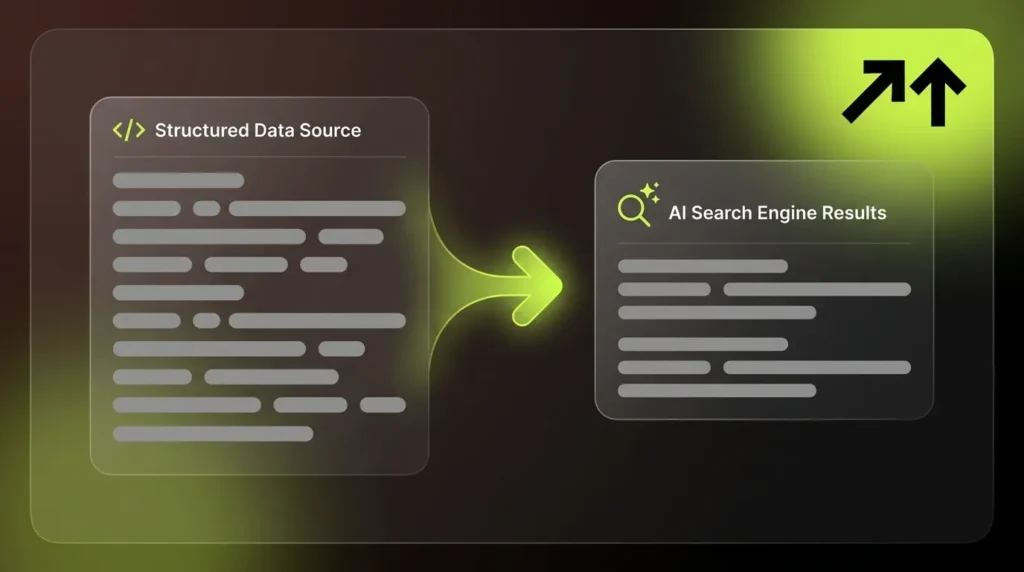
- Headless marketing separates the brand’s main site from a fully structured, AI-ready blog that the engine manages autonomously through reverse-proxy integration.
- Four data pillars, Search Intelligence, AI Analytics, Bot Tracking, and AI Ranking, drive real-time content decisions and self-healing updates that keep visibility compounding.
- Brands ready to replace both broken paths with one autonomous engine can book a demo with AI Growth Agent and launch their first article within a week.
The Two Wrong Doors Most Companies Hit
Most CMOs and founders see two paths when they pursue AI search visibility, and both paths are traps.
The first is the assemble-a-team path. An editor, an SEO specialist, a designer, and an engineer must be coordinated to get content onto a site. Hiring an agency is no faster. Monthly agency retainers for SEO typically range from roughly $1,000 to $15,000 per month, with lower figures common for SMBs and higher figures for enterprise clients, and an RFP process runs roughly three months before the first assets are produced. The time to fill a single marketing position can take several weeks to months, after which additional time is required for training and productivity ramp. Many brands spend close to a year before anything is in motion. That year goes into briefing, onboarding, and chasing. Meanwhile, CMOs are often asked to do more with less, and 72% of marketers report that a lack of resources, including headcount and bandwidth, is their primary barrier to achieving key objectives.
The second is the do-it-yourself chatbot path. Producing one good article with Claude or a similar tool is possible. Producing the second means running the entire process again, with more rounds of review, schema to maintain, legal language to get right, and quality that drifts from one article to the next. One company produced roughly 300 articles this way. Not one was cited. The content was full of errors and gaps. Engineers, marketers, and AI systems each need different things from the content, and those needs rarely align without a dedicated engine that writes for robots first.
These two doors look like opposites. They are the same trap. Both depend on stitching together a stack of agencies, tools, and people, and both leave the brand with content that goes stale the day it ships. A 2026 10Fold survey of 400 B2B technology marketing decision-makers found that 41% said only 25% to 49% of their content had been created or updated for AI-driven search visibility in the past year, confirming that most brands are already behind and falling further back with every passing week. A third path exists that avoids both traps entirely.
Headless Marketing for AI Search: Robot-First Content With No Extra Headcount
Headless marketing is the architecture that solves both wrong doors at once. It borrows its logic from headless commerce, where the storefront a customer sees is decoupled from the engine running the business. The frontend stays branded and curated. The backend runs autonomously and scales without dragging the brand experience with it.
Applied to brand presence in AI search, headless marketing means two things. First, marketing by and for the robots: content engineered for the AI surfaces that read, cite, and act on it, structured the way bots can parse, backed by validated primary sources, and living in formats that AI surfaces can actually pull from. This distinction matters because pages that look beautiful to a human and are invisible to a bot are not assets, they are decoration. Second, marketing with no headcount: a single engine doing the work that used to require a content team, an SEO team, an engineering hand, an agency, and a stack of monitoring tools.
The brand keeps its curated main site. AI Growth Agent stands up a separate, fully structured blog the brand owns, connected through a reverse proxy rewrite under a subdirectory or subdomain. The engine writes, publishes, monitors, self-heals, and reports. The brand decides what to win, in plain language, and the engine pursues those targets.
Narrative control is the strategic outcome. Fifty percent of B2B buyers now start their software buying journey in an AI chatbot instead of Google, a 71% increase versus the prior survey four months earlier. What those systems say about a brand when a customer asks now decides whether the brand exists in the conversation at all. Living content, content that updates and self-heals over time rather than going stale, keeps the brand’s narrative current across every training sweep and citation pass.
Four Data Pillars That Power the AI Growth Agent Engine
Everything AI Growth Agent generates is grounded in four pillars of data that feed the engine and steer content decisions. Any team that wants to win AI search needs to see all four and act on them in the same week.
| Pillar | What It Measures | Why It Matters |
|---|---|---|
| Search Intelligence | Complete portrait of the traditional search landscape: positioning, competition, search volume, and who is already winning each result | Turns raw market data into an actionable diagnosis, and only 12–54% of AI-cited URLs rank in Google's top-10 organic results, according to multiple 2025–2026 studies, so traditional search authority feeds AI citation eligibility |
| AI Analytics | Brand value and consumer behavior across the full journey, from external touchpoints like Google and AI-tool queries through content consumption, demographics, and sentiment | Fifty-two percent of B2B tech marketers now rank AI-generated search and answer engines as their top content distribution channel, which makes full-journey analytics essential for prioritizing where to compete |
| Bot Tracking | Every bot interaction, traditional crawlers and AI training agents alike, including every crawl, citation, and training sweep | If a brand cannot see who is reading it, it cannot tell whether it is being read at all, and per-article bot tracking becomes the signal that drives self-healing and internal linking decisions |
| AI Ranking | Order of mention and citation context in AI answers, tracked week over week against the content plan | AI answers have no static ordered list, so five new metrics define AI search performance: citation frequency, brand mention rate, competitive share of voice, contextual sentiment, and branded search lift |
Watch all four data pillars work together in real time by scheduling an AI Growth Agent walkthrough.
Checking AI Visibility With Metrics That Actually Move
Checking AI visibility starts with clarity on what is actually being measured. The five core presence metrics are prompt coverage, recommendation rate, linked citation rate, comparative win rate, and representation accuracy. Most monitoring tools track a capped set of prompts and report on those five metrics without providing any mechanism to improve them.
AI Growth Agent's approach starts differently. A professional journalist interviews the brand to build the manifesto, the single source of truth that the engine uses to generate every future piece of content. That interview becomes the foundation for the Content Topology, a hierarchy of seed terms, each backed by real-time Google and ChatGPT data, with dozens of long-tail queries beneath each one. A new account typically starts with three to four hundred queries and expands as it goes after more of the universe. Mature clients reach universes of 1,600 or more queries, with the system running 3,000 or more searches every week just to refresh the snapshot.
The site is provisioned within the first week with the full traditional and agentic technical SEO stack: highly structured HTML, rich schema markup across the full schema suite, internal linking, a proper sitemap.xml, advanced robots.txt, automated web stories, Blog MCP, OpenAI discovery and Agent Card guidance served via /.well-known/, natural language query parameters, Markdown served to agent crawlers, and llms.txt and llms-full.txt published so AI surfaces can read the brand the way they need to. Pages with structured data and schema markup appear up to 2.35× more often in AI-generated answers according to controlled A/B tests, which makes this the single highest-impact technical lever for citation, and it ships automatically in every package.
Content indexes in as little as ten days. The first article is typically live within a week of kickoff.
AI Search Visibility Without a Team: The Week-One Workflow
The week-one workflow moves the brand from zero to published, indexed, and reporting in the shortest possible time without requiring any technical skill from the brand's side.
Day one through three, the journalist interview produces the manifesto. The engine ingests any unstructured material the brand has, including PDFs, brand guidelines, and product pages, and maps the full universe of seed terms and long-tail queries. The Content Topology is reviewed with the client to confirm which areas of the universe to attack first.
Day three through five, the site is provisioned. The reverse proxy rewrite connects the blog to a subdirectory under the brand's domain. The full technical and agentic SEO stack goes live automatically. The first articles are generated, validated against primary sources, and reviewed with the client to tune the engine's voice and memory settings.
Day five through seven, the first articles are published. The engine begins tracking bot visits, impressions, and citation context from day one of publication. Incremental visibility reporting is live from the moment the first article indexes.
The engine isolates new results from existing brand visibility by publishing into a separate environment. Every metric it reports reflects what it generated, not what the brand already had. AI-referred traffic converts at 14.2% compared to 2.8% for standard Google organic traffic, so the incremental visibility the engine generates carries compounding commercial value from the first week.
Ready to launch your first article in a week? Walk through the week-one workflow in a live demo.
Incremental Visibility Reporting That Proves Real Lift
The core measurement problem in AI search is attribution. As noted earlier, most executives struggle to connect marketing activity to revenue, and in a zero-click world, no one can fully attribute an AI recommendation to a sale. AI Growth Agent's reporting is built around this constraint.
Because the engine publishes into a separate environment, it can take credit only for the visibility it actually generates. It reports week over week where its content is indexing, where it is driving new bot visits and impressions, and where those results overlap with the brand's pre-existing visibility. Bot analytics track every bot that touches the blog, including the bot ChatGPT uses to cite sources. Google Search Console serves as an independent audit layer.
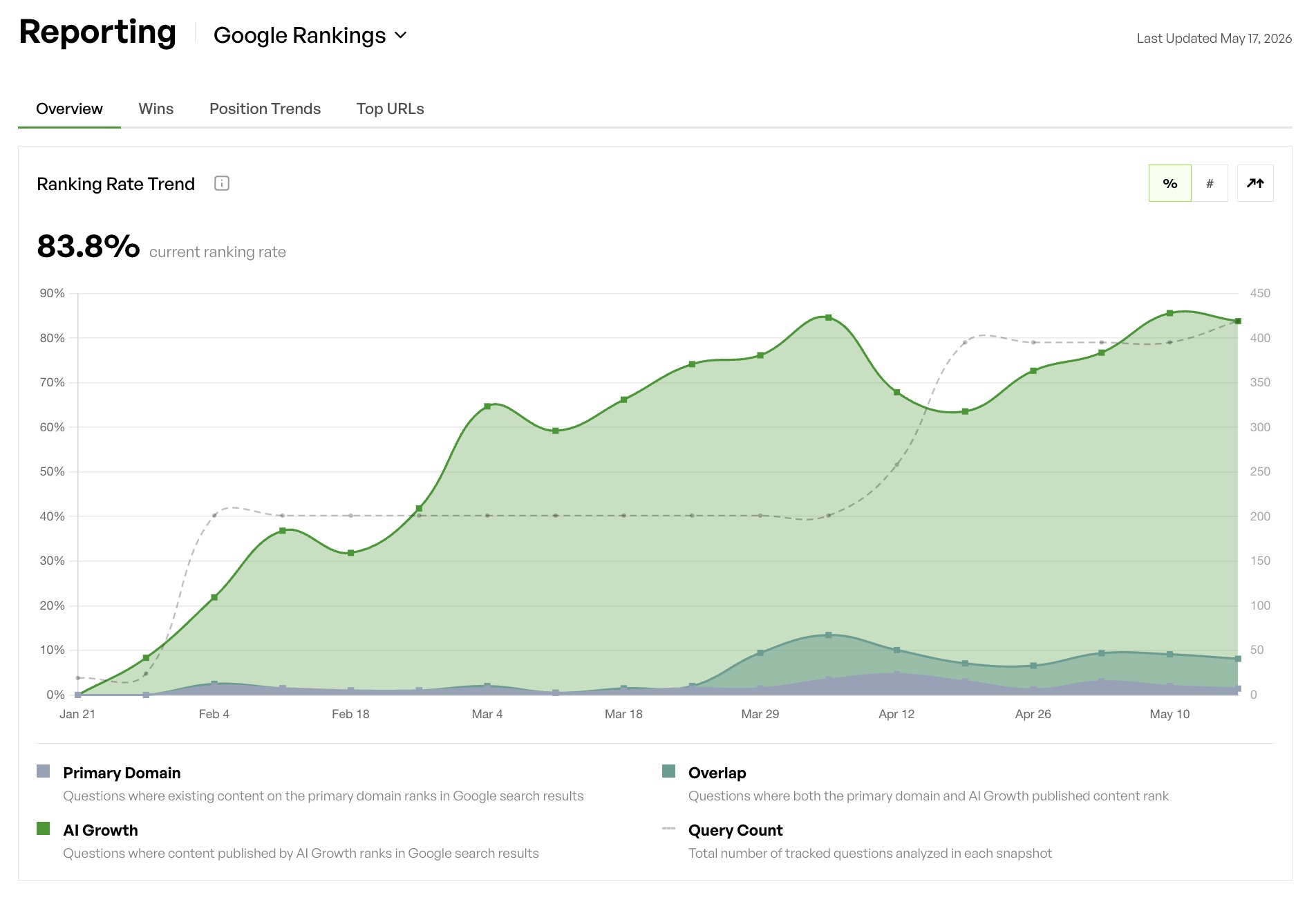
Across the first twelve weeks, clients average more than 12,000 additional AI citations and mentions, over 100,000 additional bot visits, and a 20% or greater lift in impressions. Leva Sleep, for example, now has ChatGPT citing its content over 10,000 times per month, with $40,000 to $50,000 in deals closed in under three weeks from buyers who found them through AI Growth Agent content. Breadless reached a 30x lift in Google Search Console impressions over six months, with ChatGPT citing eatbreadless.com over 45,000 times per month.
The engine is self-correcting. It doubles down on content that indexes well and uses internal linking to lift content that does not. Stale articles are refreshed automatically in response to Google Search Console signals and bot-traffic awareness. Authority compounds instead of decaying.
Frequently Asked Questions
What does “no headcount AI visibility” mean in practice?
No headcount AI visibility means earning citations, bot visits, and impressions across AI search surfaces without hiring additional team members, running an agency RFP, or managing ongoing production workflows. An autonomous engine handles the full stack: universe mapping, content production, technical and agentic SEO provisioning, bot tracking, and incremental visibility reporting. The brand's internal team gives feedback in plain language and the engine learns. No technical skill is required on the brand's side.
How is headless marketing different from using an AI content tool or a monitoring platform?
AI content tools generate text on demand but leave the brand to handle universe mapping, publishing, schema, technical SEO, bot tracking, and self-healing. Monitoring platforms track whether a brand appears for a capped set of prompts but provide no execution layer. Headless marketing replaces the entire stack with one engine. The brand keeps its curated main site. The engine stands up a fully structured, owned blog connected through a reverse proxy rewrite, produces authoritative living content, provisions the full technical and agentic SEO stack automatically, and reports the incremental visibility it generates week over week. Monitoring tells you what is happening. Headless marketing changes what is happening.
How quickly will results appear, and what metrics should I track?
As mentioned earlier, the first article usually publishes within a week of kickoff. Content has indexed in as little as ten days and often within two weeks. The primary metrics are brand mention rate, citation rate, Google Search Console impressions, and bot traffic. AI Growth Agent isolates these metrics to what the engine generated, separate from pre-existing brand visibility, so the reporting reflects real incremental results rather than a composite of old and new. The standard engagement is a three-month pilot, because indexing takes time and varies by industry, but clients see movement early.
Do I need a technical team to set this up?
No. The only integration step on the brand's side is the reverse proxy rewrite that connects the blog to a subdirectory under the brand's domain. AI Growth Agent provides setup documentation for the brand's host, whether Cloudflare, Vercel, or another provider. Everything else, including the full technical and agentic SEO stack, ships automatically in every package. The engine provisions schema, the WordPress plugin, robots.txt, sitemaps, automatic web stories, Blog MCP, agent discovery, llms.txt and llms-full.txt, instant indexing, autoredirects, and 404 tracking without any action from the brand's team.
What happens to the content if I stop using AI Growth Agent?
The brand owns the site and all the content outright. There is no agency dependency and no lock-in. The site is connected through a reverse proxy rewrite or subdomain that the brand controls. If the engagement ends, the brand retains the fully optimized property, all published articles, and the Google Search Console history. The content continues to index and generate visibility for as long as it remains live.
Conclusion: Choosing the Only Path That Scales AI Visibility
The leaderboard for AI search is being written now. AI search visibility is a frequently cited success metric among B2B tech marketers, ahead of marketing-qualified leads, brand awareness, and audience growth. Brands that establish authoritative content now are training the next generation of models with their own narrative. Brands that wait are training the next generation with whatever happens to be sitting on the open web.
The two wrong doors, assembling a team and doing it yourself with a chatbot, both require headcount or overhead that most organizations cannot justify. Headless marketing is the only architecture that removes the team entirely while delivering the full stack: universe mapping, living content, traditional and agentic technical SEO, bot tracking, and incremental visibility reporting from week one.
Traditional search tools show you where your brand stands. AI Growth Agent makes your brand the answer. Schedule a consultation session and see your first article live within a week.