Written by: Mariana Fonseca, Editorial Team, AI Growth Agent
Key Takeaways for Marketing and Growth Teams
- Enterprise marketing leaders face a choice between building new agent-native sites and retrofitting existing properties to win AI search visibility.
- Builder platforms demand heavy engineering and ongoing maintenance, while readiness platforms shorten setup but leave content and full technical SEO to other tools.
- AI Growth Agent uses a single reverse proxy rewrite to ship the complete traditional and agentic SEO stack with minimal client engineering work.
- Only AI Growth Agent combines full agentic standards (Blog MCP, WebMCP, llms.txt), anti-hallucination governance, self-healing content, and incremental visibility reporting in one engine.
- Non-technical marketing teams that want fast deployment and measurable AI citation growth can book a demo to evaluate fit against their specific requirements.
Eight Criteria to Evaluate Agent-Enabled Website Platforms
Clear criteria prevent confusing “agent-ready” claims with real agent-operable visibility. Eight dimensions separate marketing outcomes from marketing language.
- Implementation complexity. Estimate engineering effort, configuration work, and cross-functional coordination for initial setup.
- Scalability. Confirm that the platform grows from dozens of pages to thousands of queries without architectural rework or rising per-unit costs.
- Workflow fit. Check alignment with the team’s operating model, whether fully autonomous, human-in-the-loop, or agency-managed.
- Technical requirements. Verify coverage of traditional technical SEO (schema, sitemaps, robots.txt, structured HTML) and agentic standards (MCP, WebMCP, llms.txt, agent discovery via /.well-known/, Blog MCP).
- Governance and compliance. Confirm that the platform enforces schema validation, consent flags, audit trails, and policy-as-code controls. Agent automation demands categorically stricter governance than analytics because automated actions execute before human review is possible.
- Reporting visibility. Require reporting that isolates incremental visibility from existing brand equity and surfaces bot tracking, citation context, and AI ranking alongside Search Console data.
- Maintenance burden. Assess whether content self-heals or whether teams must keep refreshing, redirecting, and auditing manually.
- Long-term adaptability. Evaluate how quickly the platform incorporates evolving standards such as the MCP 2026-07-28 release, which introduces a stateless HTTP transport.
Side-by-Side Comparison of Builder, Readiness, and AI Growth Agent
Builder platforms such as CrewAI, Vellum, and 10Web focus on new agent-native sites or workflows. Readiness platforms such as AgentGate, Olon, BCMS, and Webfuse focus on making existing properties agent-operable. The table below compares both categories and AI Growth Agent against the eight criteria.
| Criterion | Builder Platforms (CrewAI, Vellum, 10Web) | Readiness Platforms (AgentGate, Olon, BCMS, Webfuse) | AI Growth Agent |
|---|---|---|---|
| Implementation complexity | High, requires engineering resources to define agent workflows, tool schemas, and orchestration logic | Moderate, layers onto existing infrastructure but requires integration mapping and governance configuration | Low, single reverse proxy rewrite connects the owned blog to the brand’s domain, all technical and agentic SEO ships automatically |
| Scalability | Scales agent workflows but not content universe, no built-in long-tail query expansion | Scales readiness layer but content production and universe mapping remain external dependencies | Scales from hundreds to 1,600+ queries with 3,000+ weekly searches refreshing the universe snapshot, flat pricing with no per-prompt billing |
| Workflow fit | Engineering-team-first, non-technical marketing teams face a steep learning curve | Varies by platform, some require developer involvement for each integration point | Non-technical marketing teams operate on autopilot, human-in-the-loop review available via studio interface |
| Technical requirements (traditional + agentic) | Covers agent workflows, traditional SEO and agentic discovery standards (llms.txt, /.well-known/, Blog MCP) are not included by default | Readiness layer addresses some agentic discovery signals, full traditional technical SEO stack typically requires separate tooling | Includes full traditional technical SEO plus Blog MCP, WebMCP compatibility, OpenAI discovery via /.well-known/, Agent Card guidance, llms.txt and llms-full.txt, natural language query parameters, and Markdown served to agent crawlers in every package |
| Governance and compliance | Governance remains workflow-level, content governance and claim validation sit outside the platform | Governance focuses on access control and audit trails for agent actions, content accuracy remains out of scope | Anti-hallucination cascade validates every claim, source, and quote, with legal disclaimers, deny lists, and policy-as-code memory controls applied to every generation |
| Reporting visibility | Agent execution logs only, no incremental content visibility, bot tracking, or citation context reporting | Access and action audit trails, no content-level bot tracking or AI citation reporting | Incremental visibility isolated from pre-existing brand equity, per-article bot tracking, Google Search Console integration, AI ranking by citation context, and weekly universe snapshots |
| Maintenance burden | High, agent definitions, tool schemas, and orchestration logic require ongoing engineering maintenance | Moderate, readiness layer must track evolving agent standards and re-integrate as protocols update | Low, content self-heals, stale articles refresh automatically, autoredirects and 404 tracking run continuously |
| Long-term adaptability | Dependent on framework roadmaps, MCP 2026-07-28 stateless HTTP adoption timelines remain unclear | Dependent on vendor roadmaps, WebMCP origin trial in Chrome 149 and evolving W3C draft require active tracking | Blog MCP in production since summer 2025, WebMCP compatibility live, MCP 2026-07-28 stateless architecture and evolving standards incorporated as they ship |
Setup Effort and Day-to-Day Operational Efficiency
Builder platforms impose the highest upfront setup cost. Teams must define agent workflows, expose capabilities as typed tools with JSON schemas, and wire orchestration logic, which consumes weeks or months of engineering time. Headless architectures require more initial setup than traditional all-in-one platforms because organizations configure multiple systems to communicate through APIs instead of installing a single integrated system.
By contrast, readiness platforms reduce setup time by layering onto existing infrastructure, but they introduce integration mapping complexity. Every new agent standard, such as the MCP 2026-07-28 removal of the initialize/initialized handshake and Mcp-Session-Id header, forces the readiness layer to update integration points. That maintenance obligation compounds over time and spreads across teams.
AI Growth Agent limits client work to a single reverse proxy rewrite. The platform ships the full technical and agentic SEO stack automatically, and the first article typically goes live within a week of kickoff. For non-technical marketing teams, that operational efficiency gap often determines which option wins.
Technical Depth, WebMCP, and Quality Control
Agentic standards create the largest technical gap between platforms. WebMCP reduces computational overhead and improves task accuracy compared to screen scraping or DOM parsing, which makes it a meaningful signal for agent-operable sites. The WebMCP W3C Draft Community Group Report defines the protocol as a way for web apps to expose JavaScript tools to agents through browser APIs, with Chrome 146 shipping an Early Preview behind a flag and the origin trial starting in Chrome 149.
Builder platforms expose agent tools by design but rarely include llms.txt, Blog MCP, or /.well-known/ agent discovery as defaults. Readiness platforms cover some discovery signals but leave traditional technical SEO, schema suites, and content accuracy to separate tools. Neither category ships a complete stack out of the box.
AI Growth Agent brought Blog MCP to market first, with clients running it in summer 2025, roughly a year before Google released WebMCP. Every site ships with Blog MCP, WebMCP compatibility for Chrome 146+ and other enabled browsers, OpenAI discovery and Agent Card guidance via /.well-known/, natural language query parameters at /?s={query}, Markdown served to agent crawlers, and llms.txt and llms-full.txt. The platform also includes the full traditional technical SEO stack, including rich schema markup across the schema suite, automated web stories, instant indexing, autoredirects, and 404 tracking.
Team Involvement, Content Scale, and Query Coverage
Builder platforms center on engineering teams. Retrofitting AI into workflows designed for humans creates hidden assumptions around handoffs, approvals, and exception handling, which slows decisions and produces brittle integrations. Non-technical marketing teams cannot operate builder platforms independently at scale.
Readiness platforms reduce engineering work for agent access but ignore content production, universe mapping, and long-tail query coverage, which drive AI citation rates. Teams still juggle a separate content stack, a separate SEO stack, and a separate reporting stack.
AI Growth Agent removes those dependencies. The engine produces between 2 and 50 articles per day per client, maps universes of 1,600+ queries, and runs 3,000+ searches weekly to refresh the snapshot. Marketing teams work in plain language, provide feedback once, and the system saves that guidance as memories that apply to every future generation.
Best-Fit Use Cases by Platform Category
Builder platforms fit organizations with dedicated engineering teams that must expose proprietary backend capabilities as agent-callable tools. The primary goal in that scenario is enabling agents to operate existing business logic, not generating owned-site visibility in AI search.
Readiness platforms fit organizations with mature content and SEO operations that want to layer agent-access signals onto an existing property without rebuilding. The trade-off is clear. Readiness layers do not produce content, do not map the query universe, and do not self-heal what already exists.
AI Growth Agent fits non-technical marketing teams at mid-market to enterprise companies that need an owned site, a full agentic technical SEO stack, and a content engine that maps the entire query universe and compounds authority over time without managing agencies or disconnected tools. It also fits operators who want the first article live within a week and reporting that isolates exactly what the engine generated.
Operational Risk and Long-Term Adaptability
Onboarding effort varies sharply by category. Builder platforms require engineering resources for initial workflow definition and recurring schema maintenance as protocols evolve. The MCP 2026-07-28 release introduces a stateless HTTP transport by removing the initialize handshake and session ID, which adds another change to track and implement.
Content governance remains a cross-functional dependency that neither builder nor readiness platforms solve. Governance for agent automation is categorically stricter than for analytics because a bad data value can trigger an irreversible wrong action before review. AI Growth Agent enforces governance at the content level through anti-hallucination cascades, claim validation against primary sources, legal disclaimers, and deny lists configured once and applied everywhere.
Long-term adaptability depends on tracking evolving AI surfaces. Mass enterprise adoption of WebMCP is estimated for mid to late 2026 for AI agents. Platforms that ignore the draft specification now will face a catch-up sprint as adoption accelerates.
Risks, Limitations, and Misconceptions to Avoid
Builder platforms often create the misconception that agent-native architecture automatically produces AI search visibility. Tool exposure through MCP endpoints lets agents operate a site but does not create the authoritative content that AI surfaces cite. Many early agentic AI deployments layer capabilities onto legacy processes because this approach requires less time and capital. The largest performance gains arrive when organizations redesign processes, which demands greater upfront investment.
Readiness platforms introduce the risk of compounding technical debt. Maintaining separate REST and agent stacks requires two sets of endpoints, two implementations of auth and validation, two deployment pipelines, and double observability work. That duplication increases inconsistency risk and long-term operational cost.
The WebMCP specification itself carries implementation risk. Zero mainstream production websites currently support WebMCP, and mass enterprise adoption is estimated for mid to late 2026 for AI agents. The API surface continues to evolve, and implementers should expect breaking changes before standardization. The draft WebMCP specification highlights risks such as tool poisoning, misrepresented intent, privacy leakage through over-parameterization, and authenticated tools performing high-privilege actions.
A shared misconception across both categories claims that any agent-enabled layer replaces the need for authoritative, long-tail content. Agents cite what they can find and trust. Without content that covers the full query universe, validates against primary sources, and uses machine-readable structure, agent-operable infrastructure produces no incremental visibility.
Decision Framework for Selecting an Agent-Enabled Platform
Use the following conditions to match platform categories to your organization’s goals and constraints.
If your primary goal is exposing proprietary backend capabilities as agent-callable tools and your team includes dedicated engineering resources, then a builder platform such as CrewAI or Vellum fits that workflow. Expect ongoing schema maintenance as MCP evolves and a separate content and SEO stack to generate the visibility agents will cite.
If your primary goal is making an existing high-traffic property agent-operable without a rebuild and your engineering team can manage integration mapping, then a readiness platform fits the access layer. Expect content production, universe mapping, and reporting to remain external dependencies.
If your primary goal is owned-site visibility in AI search, your marketing team is non-technical, and you want the full agentic technical SEO stack live within a week without managing an agency stack, then AI Growth Agent is the only platform that addresses all eight evaluation criteria in a single engine. It maps the full query universe, produces authoritative self-healing content, ships Blog MCP and WebMCP compatibility, enforces governance at the content level, and reports incremental visibility isolated from pre-existing brand equity.
If your organization needs both owned-site visibility and agent-callable backend tools, then AI Growth Agent can handle the content and agentic SEO layer while a builder platform handles the tool-exposure layer. The two approaches work together rather than competing.
Frequently Asked Questions
How long does implementation typically take for each platform category?
Builder platforms require engineering resources to define agent workflows, expose capabilities as typed tools, and configure orchestration logic. Timelines usually range from several weeks to several months, depending on backend complexity. Readiness platforms layer onto existing infrastructure and can move faster, but integration mapping and governance configuration add time for each new agent standard. AI Growth Agent stands up a fully optimized owned site within the first week of kickoff, with content indexing in as little as ten days. The only client-side integration step is the reverse proxy rewrite that connects the blog to a subdirectory under the brand’s domain.
What level of technical expertise does each approach require?
Builder platforms are engineering-team-first. Non-technical marketing teams cannot independently define agent workflows, maintain JSON schemas, or track protocol changes such as the MCP 2026-07-28 stateless HTTP transport requirements. Readiness platforms reduce engineering dependency for agent access but still require developer involvement for integration mapping and updates as standards evolve. AI Growth Agent requires no technical expertise from the client team. The engine provisions schema, Blog MCP, WebMCP compatibility, robots.txt, sitemaps, llms.txt and llms-full.txt, agent discovery via /.well-known/, instant indexing, autoredirects, and 404 tracking automatically. Client teams operate in plain language and provide feedback that the system saves as memories.
How do these platforms handle content governance and compliance?
Builder platforms govern at the workflow level by controlling which tools agents can call and under what conditions. Content accuracy and claim validation sit outside their scope. Readiness platforms govern at the access level by providing audit trails for agent actions and access controls. Neither category addresses content-level governance. AI Growth Agent enforces governance at the content level through a cascade of anti-hallucination checks that validate every claim, source, and quote against primary sources and verified external research before publication. Legal disclaimers, deny lists, and claim-prioritization controls are configured once and applied to every future generation. This approach matters because governance for agent automation is categorically stricter than for analytics, where a bad data value does not immediately trigger an irreversible action.
How should organizations measure the effectiveness of an agent-enabled website platform?
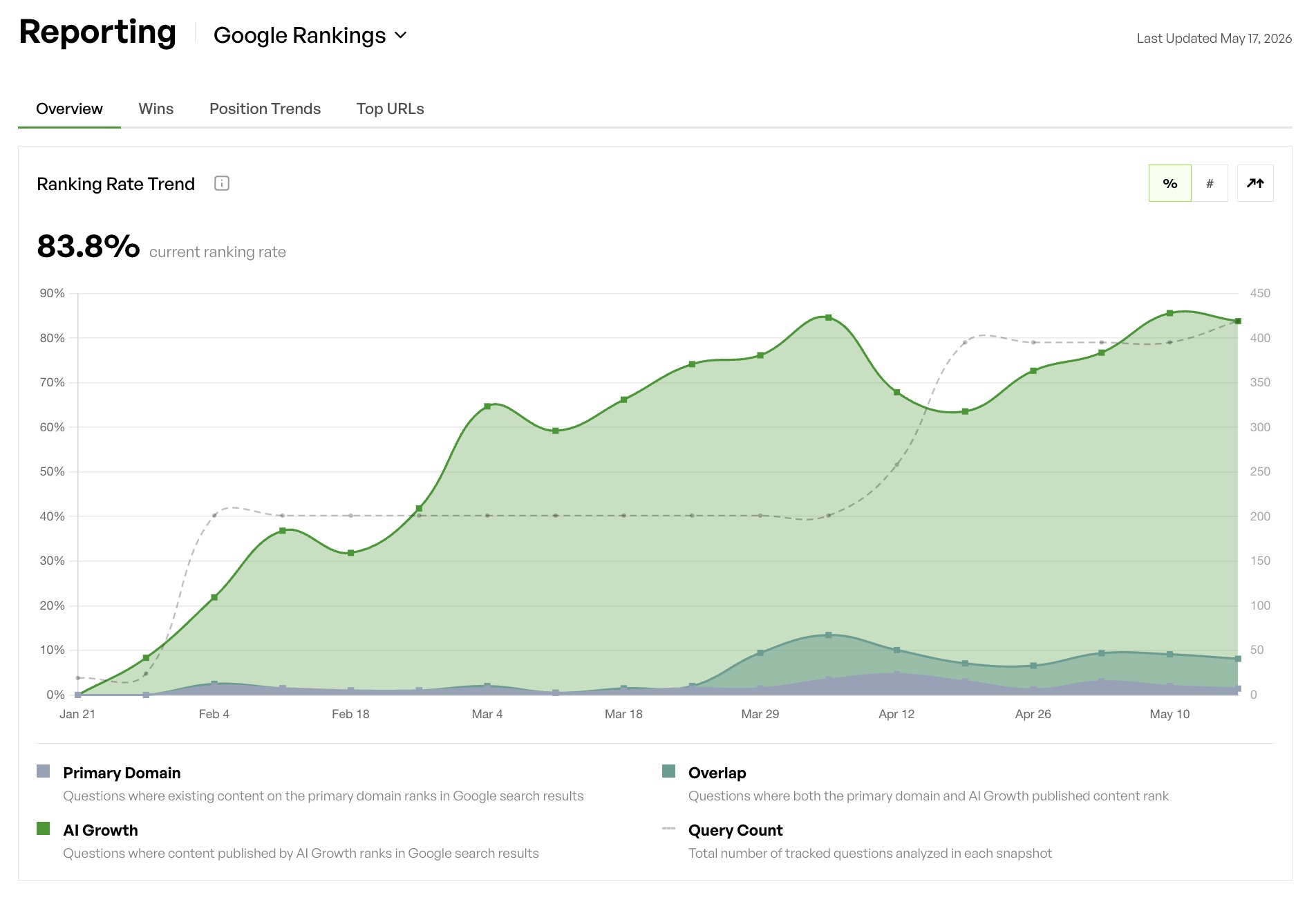
Effective measurement starts with isolating incremental visibility from pre-existing brand equity. Platforms that report only traditional rank positions or aggregate traffic cannot distinguish platform-driven gains from existing visibility. The metrics that matter for agent-enabled visibility include brand mention rate and citation rate in AI surfaces, bot traffic by bot type, Google Search Console impressions as an independent audit, and AI ranking by citation context and order of mention. AI Growth Agent publishes into a separate environment specifically so it can report incremental visibility week over week, cross-referenced against bot tracking and Search Console data, without claiming credit for visibility the brand already held.
What happens when MCP and WebMCP standards continue to evolve?
The MCP 2026-07-28 release, mentioned earlier, changes the transport model to stateless HTTP. The WebMCP W3C Draft Community Group Report continues to evolve, and the API surface will likely change before standardization. Platforms that do not track these specifications will face a catch-up obligation as enterprise adoption accelerates. AI Growth Agent brought Blog MCP to market in summer 2025 and maintains WebMCP compatibility as the specification evolves. Clients do not need to track protocol changes or update their integration. The engine incorporates evolving standards as they ship, and every package always includes the current stack.