Written by: Mariana Fonseca, Editorial Team, AI Growth Agent
Key Takeaways
- Headless marketing replaces traditional agencies and tools with one autonomous engine that maps queries, produces validated living content, and deploys full technical and agentic SEO.
- Zero-click searches and AI-generated answers shift narrative control upstream to content architecture instead of reactive reputation management.
- The seven-step rollout covers building a brand manifesto, mapping the full query universe, launching an owned site, deploying traditional and agentic SEO, and reporting only incremental visibility.
- Four data pillars, Search Intelligence, AI Analytics, Bot Tracking, and AI Ranking, replace disconnected dashboards and deliver actionable weekly insights.
- AI Growth Agent delivers this headless system at a flat fee. Book a demo to map your universe and publish your first article within a week.
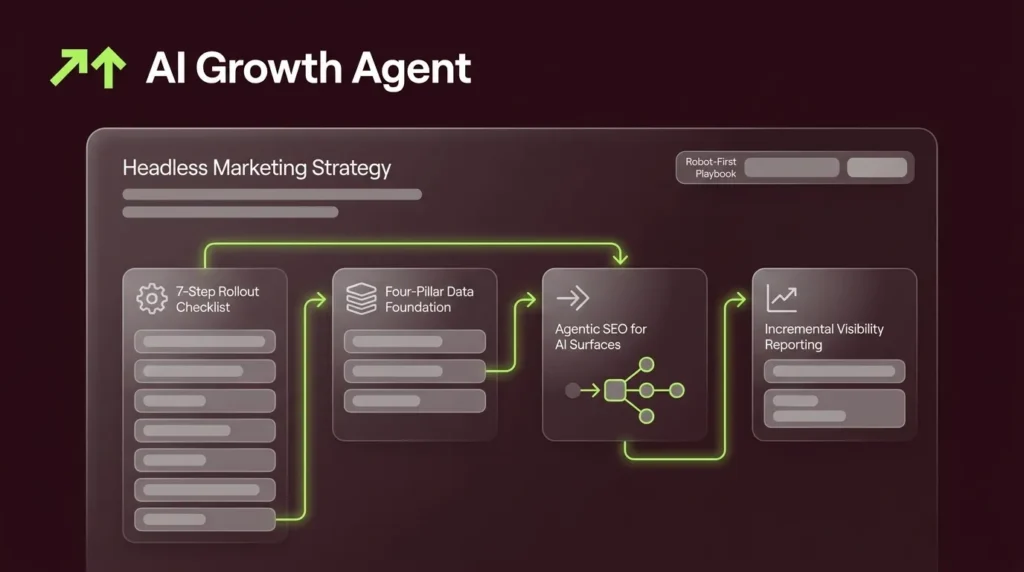
7-Step Rollout Checklist for a Headless Marketing Engine
- Build the brand manifesto. A journalist-led interview captures brand voice, factual references, deny lists, and the personalization rules the engine applies to every future generation. This becomes the single source of truth for all content.
- Map the full universe. The engine uses real-time Google and ChatGPT data to identify every seed term and the long-tail queries beneath each one. A mature universe runs 1,600 or more queries, refreshed weekly with 3,000 or more searches so the map never goes stale.
- Stand up the owned site. The system deploys a fully optimized blog the brand owns, connected through a reverse proxy rewrite under a subdirectory or subdomain. The blog is styled to match the main site and typically goes live within the first week.
- Deploy the full traditional technical SEO stack. Every article ships with structured HTML, full metadata, rich schema markup, internal linking, sanitized external linking, proper sitemaps, robots.txt, automated web stories, instant indexing, autoredirects, and 404 tracking. The client does not need to configure any of this.
- Activate agentic technical SEO. The engine publishes Blog MCP, llms.txt and llms-full.txt, OpenAI discovery and Agent Card guidance via /.well-known/, natural language query parameters, and Markdown served to agent crawlers so AI surfaces can read and cite the brand reliably.
- Produce and publish living content at scale. The system generates authoritative articles with validated primary sources, anti-hallucination checks, and brand voice memories applied in a single shot. Content self-heals over time as new data arrives instead of going stale after launch.
- Report incremental visibility only. Weekly reporting tracks bot visits, AI citations, Google Search Console impressions, and citation context, separating what the engine generated from visibility the brand already had.
Walk through this seven-step rollout against your specific universe in a live demo.
The Four-Pillar Data Foundation for Robot-First Content
Every content decision AI Growth Agent makes rests on four pillars of intelligence that work together as one system. Together they replace the disconnected dashboards that leave most marketing teams flying blind.
The first pillar, Search Intelligence, establishes the baseline by mapping where your brand stands today. It delivers a complete portrait of the traditional search landscape, including positioning, competition, search volume, and the structure of who already wins each result. The engine runs hundreds of real searches in the client's space every week, processing title structures, forum discussions, "people also ask" signals, and query fan-out. The client can view their entire universe from any competitor's point of view, including competitor domain rankings, top-ranking URLs, top YouTube videos and Reddit threads, and exactly where their own pages index. This view is more current than Google Search Console and actionable in the same week something moves.
AI Analytics then connects that landscape to real behavior. It maps brand value and consumer behavior across the whole journey, from external touchpoints like Google and AI-tool queries through content consumption, demographics, and sentiment. Only a minority of organizations have a unified customer data foundation enabling them to extract insights from all data created by AI agents and conversational interfaces, so most brands make content decisions without seeing the full picture. AI Analytics closes that gap and shows which stories actually move people.
Bot Tracking adds visibility into the real readers: crawlers and AI agents. It records every bot interaction, traditional crawlers and AI training agents alike, including every crawl, citation, and training sweep. If a brand cannot see who reads its content, it cannot tell whether it is being read at all. AI Growth Agent's bot tracking shows exactly when ChatGPT cites a piece of content and where, giving the engine the signal it needs to double down on what indexes well and lift what does not.
AI Ranking reframes performance for an AI-first world. AI answers have no static ordered list, so order of mention and citation context become the new leaderboard. AI Growth Agent tracks where the brand appears in the answer, who it is grouped with, and what claim it is cited for. The system then measures how that position evolves against the content plan week over week.
See all four pillars running live against your brand's data in a consultation session.
From Traditional Technical SEO to Agentic SEO for AI Surfaces
The four data pillars tell you what to build. The technical SEO stack determines whether AI surfaces can actually read and cite what you publish. Understanding the difference between traditional and agentic SEO matters because most brands are only doing half the work.
Traditional technical SEO remains table stakes, and AI Growth Agent delivers this foundation automatically. Every article and site ships with highly structured HTML and full Open Graph metadata so search engines can parse the content correctly. Rich schema markup across article, author, reviews, local business, product, and software application types then tells those engines exactly what each piece of content represents. Internal linking compounds that authority across the universe, while sanitized external linking protects the site's reputation. Fresh content with automatic updates triggered by Google Search Console signals keeps everything current without manual intervention. Proper sitemaps, a detailed robots.txt, automated web stories with a dedicated web-stories sitemap, real-time bot tracking, instant indexing, autoredirects, and 404 tracking complete the traditional layer, with no effort required from the client.
Agentic technical SEO adds the layer that traditional agencies and SEO suites rarely build. It creates the difference between a site that ranks for humans and a site that gets cited by machines. AI Growth Agent was the first to bring Blog MCP to market, with clients running it in the summer of 2025, roughly a year before Google released Web MCP. The full agentic stack starts with Blog MCP, compatible with Chrome 146 and other WebMCP-enabled browsers, which exposes schema, manifest, discovery, and capability guidance directly to agents. This foundation enables OpenAI discovery and Agent Card guidance served via /.well-known/, creating a standardized entry point for AI systems. Natural language query parameters via /?s={query} then auto-trigger personalized, internally linked responses so an agent passing a query straight into the URL receives a tailored answer instead of a generic page. Markdown served to agent crawlers ensures the content is readable in the format AI systems prefer, while llms.txt and llms-full.txt published at the root tell AI surfaces exactly how to read and cite the brand.
Only 38% of AI Overview citations come from pages ranking in the organic top 10, down from higher levels in late 2024. The brands earning citations are not always the ones with the highest traditional rankings. They are the ones whose content is structured for the actual reader, the crawler, the training agent, and the AI surface running a citation pass.
Incremental Visibility Reporting That Proves Real Impact
Incremental visibility reporting shows exactly what the new system adds on top of your existing presence. Most reporting in this space acts like a rearview mirror. A monitoring tool tells you whether your brand appeared for a capped set of prompts. It does not show whether that appearance came from anything you did, and it does not produce the content that would change the answer.
AI Growth Agent publishes into a separate environment so it can take credit only for the visibility it actually generates, never for visibility the brand already had. Reporting cross-references bot traffic, Google Search Console, and citation data that no single tool brings together, isolating exactly what the engine contributed week over week.
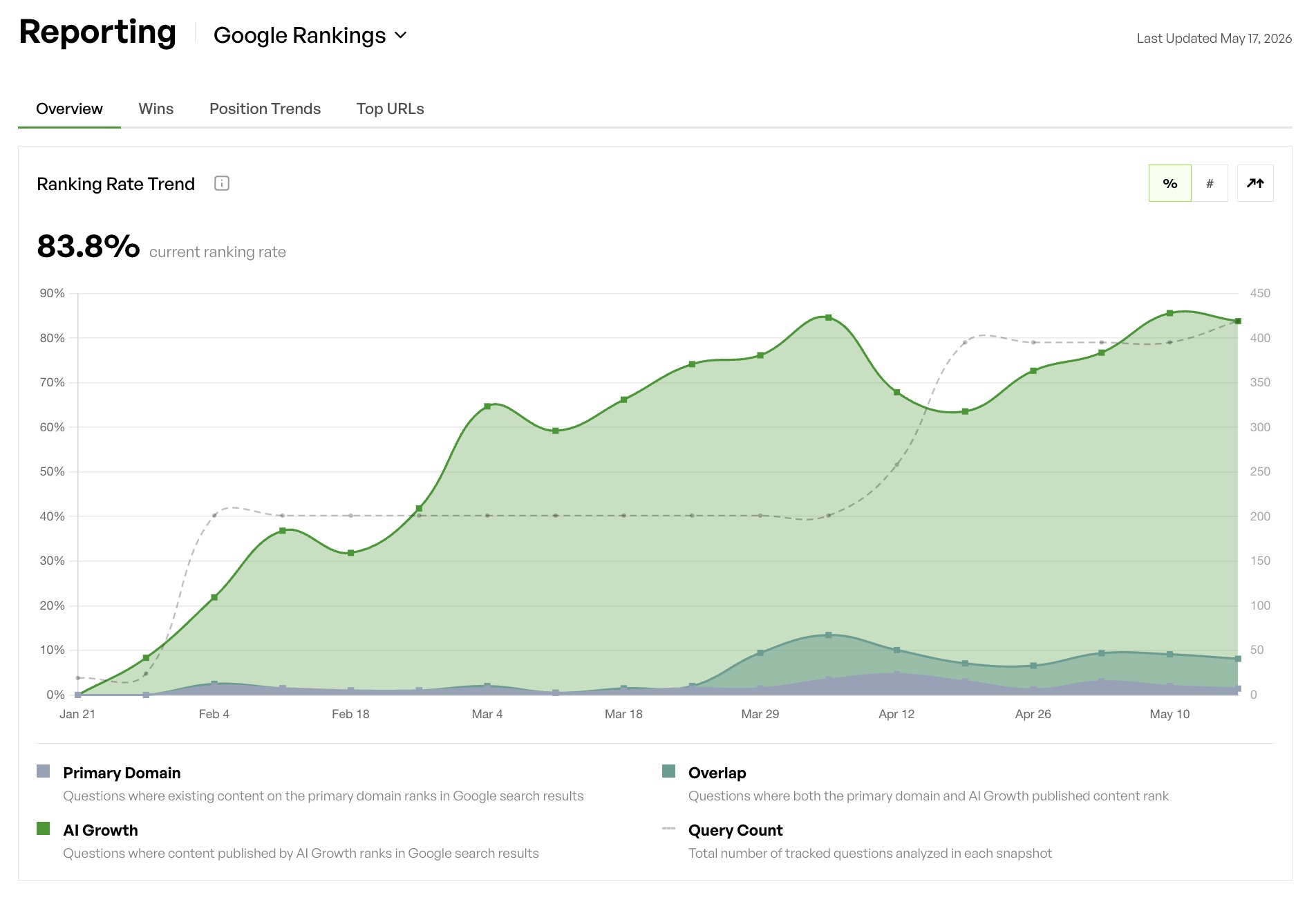
Across the first twelve weeks, clients average significant additional AI citations and mentions, substantial additional bot visits, and a meaningful lift in impressions. Breadless grew from hundreds of thousands to millions of Google Search Console impressions over six months, a substantial increase, while ChatGPT now cites eatbreadless.com thousands of times per month. Leva Sleep closed tens of thousands of dollars in deals in under three weeks from buyers who walked into the store carrying the blog and asking about specific features they had discovered through AI Growth Agent content. These outcomes are not vanity metrics. They represent the incremental results of a system that acts on data instead of only reporting it.
Only a minority of marketers can prove content marketing ROI to leadership, yet teams that demonstrate ROI receive higher budget increases. Incremental visibility reporting gives CMOs a defensible answer for the CEO every week.
Common Objections and Why DIY Approaches Fall Short
Monitoring tools are enough. Monitoring shows whether you appear for a capped set of prompts, but it stops there. It does not produce content, own publishing, or act on the data. The brands cited in AI search this year are training the next generation of models with their own narrative. Brands that only monitor are training the next generation with whatever happens to be sitting on the open web.
Our agency handles this. A typical agency RFP runs about three months, then three more months to produce the first assets. Nearly a year can pass before anything meaningful reaches production. AI search referral traffic grew substantially year-over-year, and the leaderboard is being written now, not in twelve months when the agency's first assets go live. The headless approach moves faster, with content live and indexing within days of kickoff instead of quarters.
We can do this with Claude or our own team. A chatbot can write one good article, but scaling that approach exposes the core problem. Each new article requires running the entire process again, and quality drifts from one piece to the next. One company produced hundreds of articles this way and not one was cited because the articles were full of errors and gaps that no single reviewer could catch at that volume. A deeper divide also exists between what an engineer thinks the content should be, what a marketer wants, and what robots actually need in order to cite it. AI Growth Agent acts as the system around the model. It maps the universe, validates every claim and source, publishes with full technical and agentic SEO, and self-heals over time.
AI content will all look the same. Purely AI-generated content shows a negative decline in ranking performance after 12 months compared to human-edited or hybrid content. Quality content and prompt-generated content do not look the same to AI indexers. The brand manifesto and the journalist-led layer create differentiation a generic tool cannot replicate. Long-tail strategies differ even within the same sector, so two competitors running AI content do not converge on the same answer.
Why Headless Brands Are Winning Narrative Control
Headless brands are already capturing AI-era discovery while others wait for legacy processes to catch up. The discovery shift is not a future event. A majority of consumers rely on AI-generated results for a significant portion of their searches, with organic web traffic declining across many sectors as a direct result. Brands cited in AI Overviews earn more organic clicks and more paid clicks than non-cited brands on the same SERP. The brands earning those citations are not waiting for their agency to catch up. They are running headless.
Headless marketing provides the architecture for AI-era discovery. It maps the full universe of seed terms and long-tail queries from real-time data. It produces living content that self-heals instead of going stale. It deploys the full stack of traditional and agentic technical SEO, including Blog MCP, llms.txt, agent discovery, and living content, without requiring a technical team on the brand's side. It reports only the incremental visibility it generates. It also runs on a flat fee with no per-article charges, credit limits, or per-prompt billing, so the brand sees its entire universe instead of a capped handful of tracked terms.
The AI surfaces are still in their first generation, and the leaderboard is being written this year. The window to shape AI training data is open now. Brands that act establish their narrative in the models being built today, while those that wait cede that influence to whatever random content already exists online.
Frequently Asked Questions
What is headless marketing strategy and how is it different from traditional content marketing?
Headless marketing strategy describes the architecture of marketing by and for the robots, with no added headcount. It borrows the structural logic of headless commerce: the brand keeps its curated main site while an autonomous engine runs behind it, mapping the full universe of seed terms and long-tail queries, producing living content validated against primary sources, deploying agentic technical SEO, and reporting only the incremental visibility it generates. Traditional content marketing is built for human readers and human search behavior. It produces articles tuned to a handful of head terms, publishes them to a site managed by an agency or internal team, and measures success by rankings that matter less in a zero-click world. Headless marketing strategy is built for the actual reader in 2026, the crawler, the training agent, the AI surface running a citation pass, and the agent acting on the user's behalf. The content is structured the way bots can parse, backed by validated primary sources so the AI trusts the claim, and deployed with the full technical stack that AI surfaces require, including Blog MCP, llms.txt, agent discovery, and living content that self-heals over time.
What is agentic technical SEO and why does it matter for AI citations?
Agentic technical SEO is the layer of technical infrastructure that makes a brand's content readable, trustworthy, and actionable for AI agents, not just traditional search crawlers. Traditional technical SEO covers structured HTML, metadata, schema markup, sitemaps, robots.txt, and internal linking. These elements remain table stakes. Agentic technical SEO adds the infrastructure that AI surfaces specifically require, including Blog MCP with schema, manifest, discovery, and capability guidance exposed to agents, OpenAI discovery and Agent Card guidance served via /.well-known/, natural language query parameters that auto-trigger personalized responses for agents passing queries directly into a URL, Markdown served to agent crawlers, and llms.txt and llms-full.txt published so AI surfaces can read the brand the way they need to. It matters for AI citations because AI surfaces do not rank pages the way Google does. They read, trust, and cite whatever they can find and parse. A site that looks beautiful to a human and remains invisible to a bot is not an asset. Agentic technical SEO strips the decoration and builds for the actual reader. AI Growth Agent pioneered this approach, launching Blog MCP for clients a full year before Google's Web MCP release.
How does incremental visibility reporting work and why does it matter?
Incremental visibility reporting isolates the visibility a new effort actually generated, separate from the visibility the brand already had. The system isolates new results by publishing to a dedicated environment, ensuring reported metrics reflect only the engine's contribution rather than pre-existing brand presence. Reporting cross-references bot traffic, Google Search Console impressions, and citation data week over week, showing exactly where AI Growth Agent's content drives new visibility and where the brand's existing presence accounts for results. This matters because most reporting in the AI search space acts as a rearview mirror or a vanity metric. Monitoring tools show whether you appeared for a capped set of prompts, but they do not show whether that appearance came from anything you did. Incremental visibility reporting gives CMOs and founders a defensible answer for leadership every week, grounded in the specific bot visits, AI citations, and impression lifts that the engine generated. Across the first twelve weeks, clients average significant additional AI citations and mentions, substantial additional bot visits, and a meaningful lift in impressions.
How long does it take to see results from a headless marketing strategy?
Most brands see early movement within weeks, not quarters. The first article is typically live within a week of kickoff. Content has indexed in as little as ten days and often within two weeks. The standard engagement is a three-month pilot, because indexing takes time and varies by industry, but clients see movement early. Jota saw a substantial rise in daily average impressions and clicks in the first three weeks. Arco saw a meaningful rise in impressions and clicks within 28 days. Jelly earned its first citation within three weeks and reached the number one cited solution for restaurant inventory management in the UK within the same period. The speed advantage over traditional agency-led approaches is structural. An agency RFP runs about three months, then three more months to produce the first assets, while AI Growth Agent moves from kickoff to the first published article in about one week, with no RFP and no year-long ramp.
What does AI Growth Agent replace in a typical marketing stack?
AI Growth Agent replaces the SEO agency, the content tool, the web agency, the GEO monitor, the schema plugin, the analytics stack, and the PR firm. In practice, this means the engine handles keyword research and universe mapping, content production at scale with anti-hallucination controls and brand voice enforcement, site setup and ownership, the full traditional and agentic technical SEO stack, bot tracking and citation monitoring, and incremental visibility reporting. The client owns the site and all the content outright. No agency controls the domain, and there are no per-article charges, credit limits, or per-prompt billing. The only integration step on the client's side is the reverse proxy rewrite that connects the blog to a subdirectory under their domain. Everything else is included in every package, and the internal team needs no technical skill to operate it. Feedback is given in plain language, the engine learns, and the same correction is never needed twice.