Written by: Mariana Fonseca, Editorial Team, AI Growth Agent
Key Takeaways
- Tracking brand mentions in ChatGPT is only the starting point. Turning that visibility data into authoritative, self-healing content drives ongoing citations in 2026.
- Four core metrics, AI Share of Voice, Mention Rate, Citation Context, and Positional Authority, each connect to specific content actions that close visibility gaps.
- A repeatable five-step workflow that builds prompts from real data, runs them across multiple models, and logs both mentions and citations produces reliable weekly snapshots of brand visibility.
- Manual checks and capped monitoring tools only sample limited prompts. Brands need production systems that cover the full prompt universe and generate living content at scale.
- AI Growth Agent turns visibility gaps into published, self-healing content that earns new citations. See how the engine converts your visibility data into live content.
Four Metrics That Drive AI Content Decisions
Four metrics define competitive position inside generative AI answers. Each measures a distinct dimension of visibility and maps directly to a content action. The table below shows how each metric is calculated, which benchmarks to watch, and how the qualitative Citation Context metric differs from the three percentage-based scores.
| Metric | Definition | Formula | 2026 Context |
|---|---|---|---|
| Share of Voice (AI SOV) | Percentage of category-relevant AI responses that mention your brand relative to all brand mentions across the same prompt set | (Your Brand Mentions ÷ Total Brand Mentions) × 100 | Category leaders in B2B maintain 25-40% AI SOV |
| Mention Rate | Percentage of tracked prompts where the brand name appears anywhere in the AI answer | Brand Appearances ÷ Total Prompts Tracked | AI engines mention brand names less frequently for informational queries than for comparative queries. |
| Citation Context | Where the brand appears in the answer, what claim it is cited for, and which competitors it is grouped with, replacing the concept of a rank number | Qualitative log: position (first, second, etc.), sentiment (positive, neutral, negative), claim type | First-mentioned brands receive disproportionate user attention due to position-one bias similar to traditional search (source: digitalapplied.com) |
| Positional Authority | Citation-based SOV that shows how often your domain is the source the model trusts, not merely mentioned | (Citations of Your Domain ÷ Total Citations) × 100 | Only a small fraction of domains appear as cited sources across multiple AI models, so platform-level tracking is mandatory. |
Each metric gap functions as a content brief that points to a specific fix. For example, a low mention rate on comparison prompts signals that the brand lacks structured comparison content. Low positional authority shows that third-party sources are winning the citation instead of owned pages. Before moving to production, map every metric shortfall to the content type that will close that specific gap.
Five-Step Workflow To Track Brand Mentions In ChatGPT
This five-step workflow creates a repeatable weekly snapshot of brand visibility across the prompt universe that actually matters.
- Define the prompt universe from real data. Build the prompt list from live ChatGPT search results and Google AI Overview data, not from guesswork. Use 10–20 word conversational queries organized into buckets: category queries such as “best [category] for [use case]”, comparison queries such as “[Brand] vs [Competitor]”, best-of queries, and use-case queries. A minimum viable panel runs 100–200 buyer-intent prompts weekly. Seed terms anchor the universe, and long-tail queries beneath each seed term represent the actual surface area where customers are asking.
- Run prompts across models. Execute the full prompt set across ChatGPT, Perplexity, Google AI Overviews, and Gemini at minimum. Single-platform tracking produces a structurally incomplete picture because each engine cites a different mix of domains. Run each prompt five to ten times per cycle to smooth out probabilistic output variance.
- Record mentions and citations separately. Log whether the brand name appears in the answer body as a mention and whether your domain appears as a cited source. AI engines cite sources but mention brand names less frequently, so combining the two metrics hides important differences in how the model treats your brand.
- Calculate metrics by platform and prompt category. Compute AI SOV, mention rate, and citation-based SOV separately for each engine and each prompt bucket. Gaps between the highest and lowest citing engines can be large for identical prompts, so segmentation prevents aggregate averages from hiding real weaknesses.
- Log citation context for every mention. Record position within the answer, the claim the brand is cited for, sentiment, and which competitors appear in the same response. This log becomes the direct input to content planning. A brand cited fifth in a comparison answer needs a stronger comparison page, not more general blog volume.
Building A Prompt List From Live AI Queries
Start with 25–50 “money prompts” structured as recommendation queries such as “best X for Y industry”, comparison queries such as “X vs Y”, and alternative queries such as “alternatives to X”. Pull these directly from Google AI Overview results and live ChatGPT searches for your seed terms. The prompts that surface competitors in AI answers are the exact prompts where your brand needs to appear. Expand the list weekly as new long-tail queries emerge from the data.
The prompt list forms the foundation of the entire tracking system. A capped or static list produces a capped and static view of the market. Brands that track only the head terms they already planned to defend stay invisible to most of their own universe by default.
Why Manual Checks And Capped Tools Miss The Real Picture
AI monitoring tools rely on sampling-based coverage and only display responses to the specific prompts they run. Any query a user asks that falls outside the prompt library remains invisible. That structural gap is inherent to how monitoring works, not a product bug that a new feature can fix. The table below compares coverage, actionability, and output so you can see why capped tools cannot close the loop between visibility and content.
| Dimension | Capped Monitoring Tools | Full-Universe Production Engine |
|---|---|---|
| Coverage | 30–50 prompts provide only directional coverage, and queries outside the library are invisible (source: shadow.inc) | Hundreds of seed terms and thousands of long-tail queries refreshed weekly, with prompt count never treated as a billed metric |
| Actionability | Tools identify that a brand is missing but cannot submit corrections or produce content. Brands must publish updated content and wait for index refreshes (source: therankmasters.com) | Visibility gaps connect directly to content production, and the engine produces and publishes citation-ready content against each gap |
| Output | Dashboard showing mention rate and SOV for the tracked prompt slice | Published, self-healing content indexed in as little as ten days, with week-over-week incremental visibility reporting that isolates what the engine generated |
Only 30% of brands maintain consistent visibility across AI answers from one session to the next, and cited domains can shift significantly from month to month. A monitoring tool that shows where you stood last Tuesday functions as a rearview mirror. Brands that win citations publish fast enough to stay inside the current citation window.
Turning Missing Brand Mentions Into Content Roadmaps
A missing brand reflects a content gap, not a monitoring failure. The shift from observation to production starts with the citation context log built in step five of the tracking workflow. Each gap maps to a specific content type.
The citation context log reveals which content types deserve priority. Comparative content often earns more brand mentions than informational content, so if the log shows competitors winning comparison prompts, the production priority becomes structured comparison pages. When the brand is absent from use-case queries, the priority shifts to long-tail guides that target the specific use cases surfacing in the prompt data.
Seed terms organize the production roadmap. Each seed term spawns dozens of long-tail queries, and each long-tail query becomes a content brief. Brands producing 12 or more new or refreshed pieces of content per month achieve up to 200x faster visibility gains in AI responses than those producing four (source: onely.com). The math focuses on systematic long-tail coverage before competitors claim those prompts.
Living content keeps that coverage in place. Pages not updated in three or more months are 3x more likely to lose AI citations than freshly maintained content (source: omnibound.ai). Content that ships and then goes stale stops acting as an asset and starts eroding the brand’s citation position over time.
Building An Automated Tracking-To-Content Engine
The gap between observation and action is where most marketing stacks break down. A monitoring tool produces a dashboard. A content tool produces a draft. Neither system closes the loop between what the data shows and what gets published, indexed, and cited.
AI Growth Agent operates as a single headless engine that replaces the monitoring tool, the content tool, the web agency, the schema plugin, and the analytics stack. It maps the full universe of seed terms and long-tail queries from real-time Google and ChatGPT data, produces authoritative content that validates every claim and source, and stands up a fully optimized site the brand owns within the first week. The content behaves as living content that updates and self-heals over time instead of going stale. Every package includes the full agentic technical SEO stack, including Blog MCP, llms.txt and llms-full.txt, OpenAI discovery via /.well-known/, and natural language query parameters that return personalized responses to agent crawlers.
The architecture follows a headless marketing model, marketing by and for the robots with no added headcount. The brand keeps its curated main site. AI Growth Agent runs the engine behind it, connected through a reverse proxy rewrite under a subdirectory or subdomain. No RFP and no year-long ramp. The first article typically goes live within a week of kickoff.
See the full tracking-to-content loop in action during a live walkthrough.
How To Measure Incremental AI Visibility
The core reporting challenge in AI search is attribution. Google AI Overviews drive 83% zero-click consumption and Google AI Mode drives 93% zero-click consumption (source: arcalea.com), so most AI-influenced consideration never produces a measurable click. Standard analytics cannot see this behavior.
Incremental visibility reporting isolates what a new content effort actually generated, separate from visibility the brand already had. AI Growth Agent publishes into a separate environment and reports week over week where its content drives new citations, new bot visits, and new impressions. Bot analytics track every bot that touches the blog, including the bot ChatGPT uses to cite sources. Google Search Console acts as an independent audit layer.
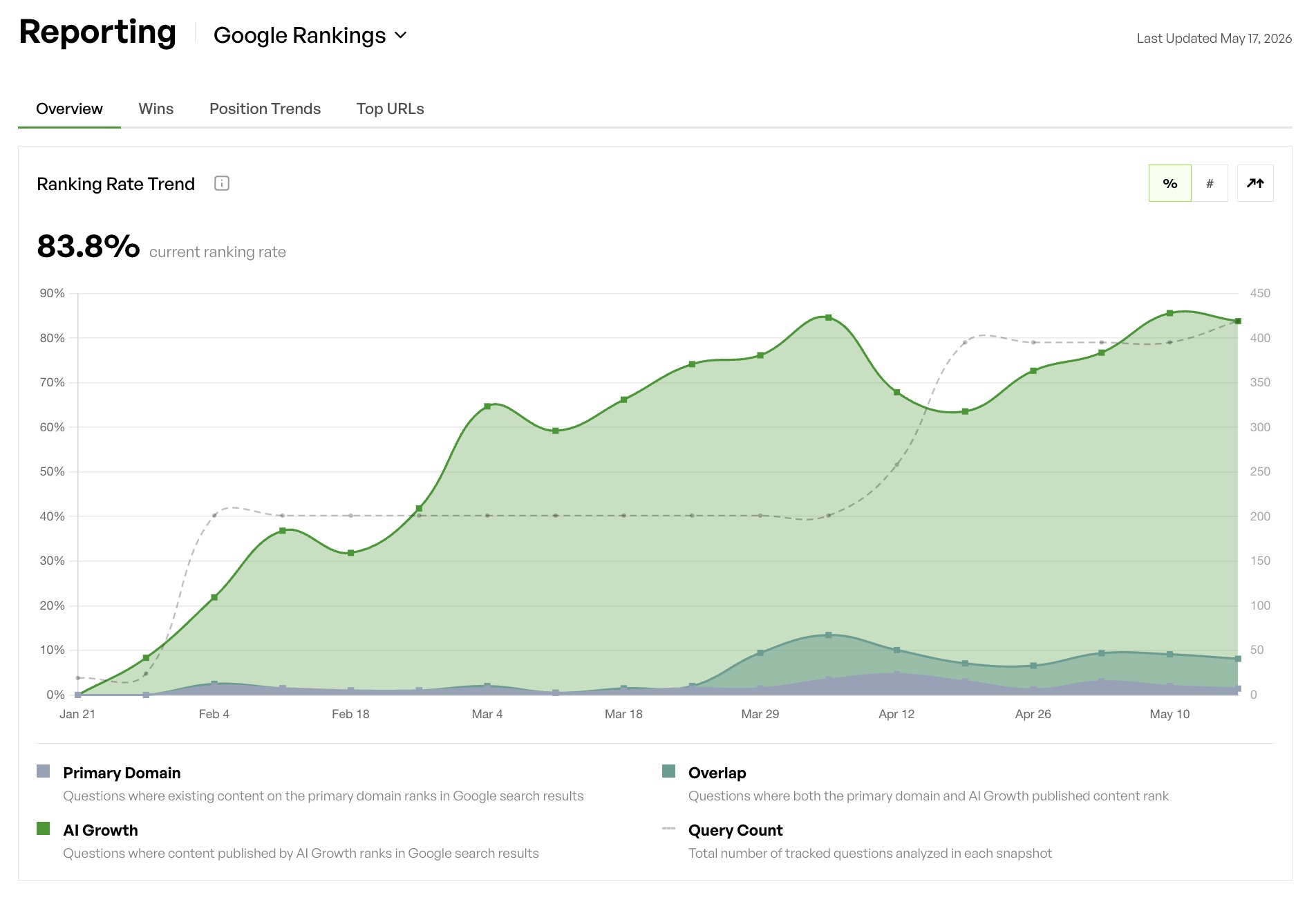
Across the first twelve weeks, AI Growth Agent clients average more than 12,000 additional AI citations and mentions, over 100,000 additional bot visits, and a 20% or greater lift in impressions. Breadless grew from 387,000 to 12.3 million Google Search Console impressions in six months, with ChatGPT citing eatbreadless.com over 45,000 times per month. Leva Sleep closed $40,000 to $50,000 in deals in under three weeks from buyers who discovered the brand through AI Growth Agent content. These outcomes reflect production, not monitoring.
The metrics AI Growth Agent commits to are brand mention rate and citation rate, accompanied by Google Search Console impressions and bot traffic. These metrics are reported weekly so the engine can double down on what indexes well and use internal linking to lift what does not. If you want to see how these metrics translate into live articles and new citations, schedule a walkthrough and watch your first piece go live within a week.
Conclusion
Tracking brand mentions in ChatGPT covers only the first half of the job. Brands that win in 2026 treat visibility data as a content brief and execute against it faster than the citation window closes. Only 16% of Fortune 500 brands systematically track AI search performance, according to McKinsey’s CMO survey, and brands with structured programs see higher citation rates than those relying on organic SEO alone. The leaderboard is being written this year. Brands that establish authoritative content now train the next generation of models with their own narrative.
AI Growth Agent completes the loop, from prompt universe mapping to content production to self-healing living content to incremental visibility reporting, in one headless engine at a flat fee with no per-prompt billing.
Frequently Asked Questions
What is the difference between a brand mention and a citation in ChatGPT?
A mention means the brand name appears somewhere inside an AI-generated answer. A citation means ChatGPT references content from your domain as the authoritative source for a specific claim. The two are tracked separately because they signal different things. A brand can be mentioned frequently without its domain ever being cited, which means the model is drawing on third-party descriptions of the brand rather than the brand’s own content. Citation-based share of voice, calculated as your domain’s citations divided by total citations across the prompt set, measures whether your content is the source the model trusts, not just whether your name appears in the answer.
How many prompts do I need to track to get a reliable picture of brand visibility in ChatGPT?
A minimum viable tracking panel runs 100 to 200 buyer-intent prompts per week, executed across ChatGPT, Perplexity, Google AI Overviews, and Gemini at minimum. Each prompt should be run five to ten times per cycle because generative AI outputs are probabilistic, and single-run results can reflect noise rather than true visibility changes. Tools that cap clients at 30 to 50 prompts produce only directional coverage. Any query a user asks that falls outside the tracked prompt library remains invisible to the monitoring system, which is why the prompt list should be built from real ChatGPT and Google AI Overview data rather than a static keyword list decided in advance.
Why does content go stale in AI search faster than in traditional SEO?
AI models and retrieval indexes refresh continuously. Cited domains can shift by large margins from month to month across major platforms, so a brand that earns citations this month has no guarantee of holding them next month without fresh content. Pages not updated in three or more months are significantly more likely to lose AI citations than freshly maintained content. Traditional SEO rankings change slowly because Google’s index remains relatively stable. AI citation patterns change within weeks due to model updates, retrieval index refreshes, and competitor content changes. Living content, meaning content that self-heals and updates automatically rather than shipping and going stale, is the structural requirement for sustained AI visibility rather than a nice-to-have.
What content formats earn the most citations in ChatGPT?
Comparative content earns substantially more brand mentions than informational content. How-to guides with numbered steps, comparison tables, FAQ sections with direct answers under question-mirroring headers, and original research with named data points are the formats AI systems most readily cite. Content structure matters as much as content type. Sections that open with a direct answer in the first one or two sentences, use clear H2 and H3 headings framed as natural-language questions, and include structured data markup earn materially higher citation rates than pages using conventional SEO formatting alone. Pages with FAQ schema and HowTo schema are significantly more likely to appear in AI Overviews than pages without them.
How is AI Growth Agent different from a monitoring tool like Profound or Athena?
Monitoring tools track whether a brand appears for a capped set of prompts and stop there. They show that the brand is missing from AI answers but leave you to solve it, typically with no system to produce and publish the content needed to change the outcome. AI Growth Agent is not a monitoring company. It maps the full universe of seed terms and long-tail queries from real-time data, produces authoritative, validated content against each gap, publishes it to a fully optimized site the brand owns, and self-heals that content over time. Incremental visibility reporting then isolates exactly what the engine generated week over week, separate from visibility the brand already had. The distinction sits between observation and execution. Monitoring tools act as a rearview mirror, and AI Growth Agent functions as the steering wheel.