Written by: Mariana Fonseca, Editorial Team, AI Growth Agent
Key Takeaways
- Buyers now discover brands through AI answers in ChatGPT, Perplexity, and Google AI Overviews. Traditional CRM platforms were not built to shape what these systems say about your brand.
- HubSpot’s contact-based pricing and constant upsell motion drive costs up as lists grow. Flat-rate models give mid-market teams more predictable, scalable economics.
- Feature bloat in legacy platforms slows lean teams down. AI-native engines shorten the path from strategy to published, indexed content that AI systems can actually read.
- Most traditional marketing tools lack the AI-native infrastructure needed to map queries, publish citable content, and secure brand visibility across AI surfaces in 2026.
- Teams ready to replace a bloated stack with a single flat-rate engine that launches in about a week can book a demo with AI Growth Agent to get started.
1. Contact-Based Pricing and Upsell Fatigue
HubSpot’s pricing architecture ties cost directly to the size of a contact database. As a company grows its list, its platform bill grows with it, regardless of whether those contacts are active, converting, or even reachable. For mid-market teams managing tens of thousands of contacts, this model creates a compounding cost problem that has no natural ceiling. Forum discussions across communities like Reddit consistently surface the same frustration. Teams feel penalized for doing their jobs well, because building a larger audience means paying more just to hold the data.
The upsell pressure compounds the contact-based structure. Features that appear available at one tier are frequently gated behind the next, and the gap between what a team needs and what their current plan provides tends to widen as the organization matures. The result is a pattern of escalating spend that mid-market CMOs describe as pricing fatigue. The platform feels like it is extracting value rather than delivering it.
For teams evaluating alternatives, the first question is not which platform is cheapest at entry. It is which pricing model stays rational as the business scales. This matters because contact-based pricing creates an artificial ceiling on growth, where more success means higher software costs for the same workflows. Flat-fee structures, where the cost does not move as the contact list or query volume grows, remove that penalty and create a more durable partnership between the platform and the client.
2. Feature Bloat That Slows Lean Teams
HubSpot has expanded aggressively through acquisition and internal development, adding CMS tools, operations hubs, service hubs, and a growing suite of AI features to a platform that began as a marketing automation tool. For enterprise teams, this breadth can be an asset. For mid-market teams with lean marketing functions, it is frequently the opposite. They face a sprawling interface that requires significant onboarding, produces internal disagreement about which tools to use, and slows execution because the path from strategy to published output runs through too many menus.
Feature bloat is not a cosmetic problem. When a platform’s surface area exceeds a team’s capacity to use it, the unused features do not disappear from the bill. They remain as overhead, both financial and cognitive. Teams report spending more time managing the platform than producing work that reaches customers. A platform sold on the promise of efficiency becomes a source of inefficiency at scale.
The operational impact for 2026 is direct. Teams that need to move quickly in AI search, where the leaderboard is being written this year and early movers are training the next generation of models with their own narrative, cannot afford a platform that slows them down. Speed from strategy to published, indexed, AI-readable content is now a competitive variable, not a nice-to-have. If your current platform is slowing you down in the race for AI visibility, a different approach becomes mandatory.
3. Missing AI-Native Capabilities and Visibility Gaps
This speed requirement exposes a deeper problem inside traditional marketing platforms. The AI features in these tools were built as additions to existing workflows, not as the core architecture. HubSpot’s AI content tool, for example, operates within a prompt-capped environment and tends to produce content that does not carry brand mentions in the formats AI surfaces need to cite a source. The content looks like activity. It does not move the brand’s position in what ChatGPT or Google’s AI Mode says when a customer asks a relevant question.
This gap creates a visibility problem that mid-market and enterprise CMOs are beginning to confront directly. Google’s AI Mode crossed one billion monthly users within its first year, and the queries flowing through that surface are answered by whatever the model can find, trust, and cite. A brand that is not producing content in the right structure, with the right validation, against the right long-tail queries, is simply absent from those answers. No amount of contact management or email automation changes that absence.
AI-native visibility requires a different kind of infrastructure. The system must map the full universe of queries a market actually uses, produce authoritative content validated against primary sources, and publish it with the technical signals that AI surfaces need to read and cite it. That is not a feature inside a CRM. It is a separate discipline, and in 2026 it is the discipline that determines whether a brand exists in the conversation at all.
4. Narrative Control Across AI Answers
Brands now control their message by shaping what AI systems say, not only by managing owned channels. Traditional marketing platforms were built around the assumption that a brand controls its message by controlling its channels: the website, the email list, the ad creative. That assumption is being dismantled by zero-click search. When a buyer asks an AI system about a product category, they receive an answer and, in most cases, they do not click through to verify it. The AI’s answer becomes the brand’s message, whether the brand shaped it or not.
Narrative control in 2026 is upstream work. Teams must produce the content that models will use to describe the brand, in the formats and structures models can parse, with the validation that earns the citation. They must show up across the long tail of queries the customer actually asks, not just the head terms a brand pre-decided to defend. A CRM platform that monitors competitor visibility but does not create visibility functions as a rearview mirror. The work of narrative control requires a steering wheel.
For mid-market CMOs, the practical implication is clear. The right alternative to HubSpot is not simply a cheaper CRM with better AI features. It is a system that actively changes what AI says about the brand, week over week, across ChatGPT, Perplexity, and Google’s AI Mode at the same time.
Schedule a demo to see if AI Growth Agent is a good fit for your team’s narrative control needs.
5. Site Ownership and Agency Dependency
Ownership of your site and content now directly affects your ability to compete in AI search. A structural problem that surfaces repeatedly in mid-market HubSpot exits is site ownership. Teams that built their web presence inside HubSpot’s CMS find that leaving the platform means negotiating access to their own content. The dependency is not always visible until the decision to leave is made. At that point it becomes a migration cost that delays the transition and, in some cases, reverses it.
The broader pattern is agency dependency. In this situation, the brand does not own its digital infrastructure and must route every change through a vendor or agency that controls the environment. This dependency is expensive in time and money, and it is structurally incompatible with the speed that AI search requires. When something moves in the competitive landscape, a brand that cannot publish and update content without an agency in the loop is always behind.
Ownership of the site, the content, and the relationship with AI surfaces is a non-negotiable requirement for any team that intends to compete in 2026’s discovery environment. The right alternative is one where the brand holds the asset outright, with no vendor lock-in and no agency as a dependency in the publishing chain.
6. Reporting That Proves Incremental Results
Marketing leaders under pressure to justify spend need reporting that isolates what a specific investment actually generated. They must separate new visibility from the visibility the brand already had. Traditional platform reporting often conflates the two. A dashboard that shows total impressions or total traffic does not tell a CMO whether the platform produced those results or whether they would have happened anyway. In a zero-click world, where the buyer may never visit the site after receiving an AI answer, the measurement problem becomes even more acute.
Incremental visibility reporting, which tracks exactly what a new content effort generated week over week and cross-references bot traffic, Google Search Console data, and citation signals, is the standard that 2026 demands. Most traditional platforms cannot meet this standard, because they were not built to publish into a separate environment and isolate their own contribution from existing brand equity.
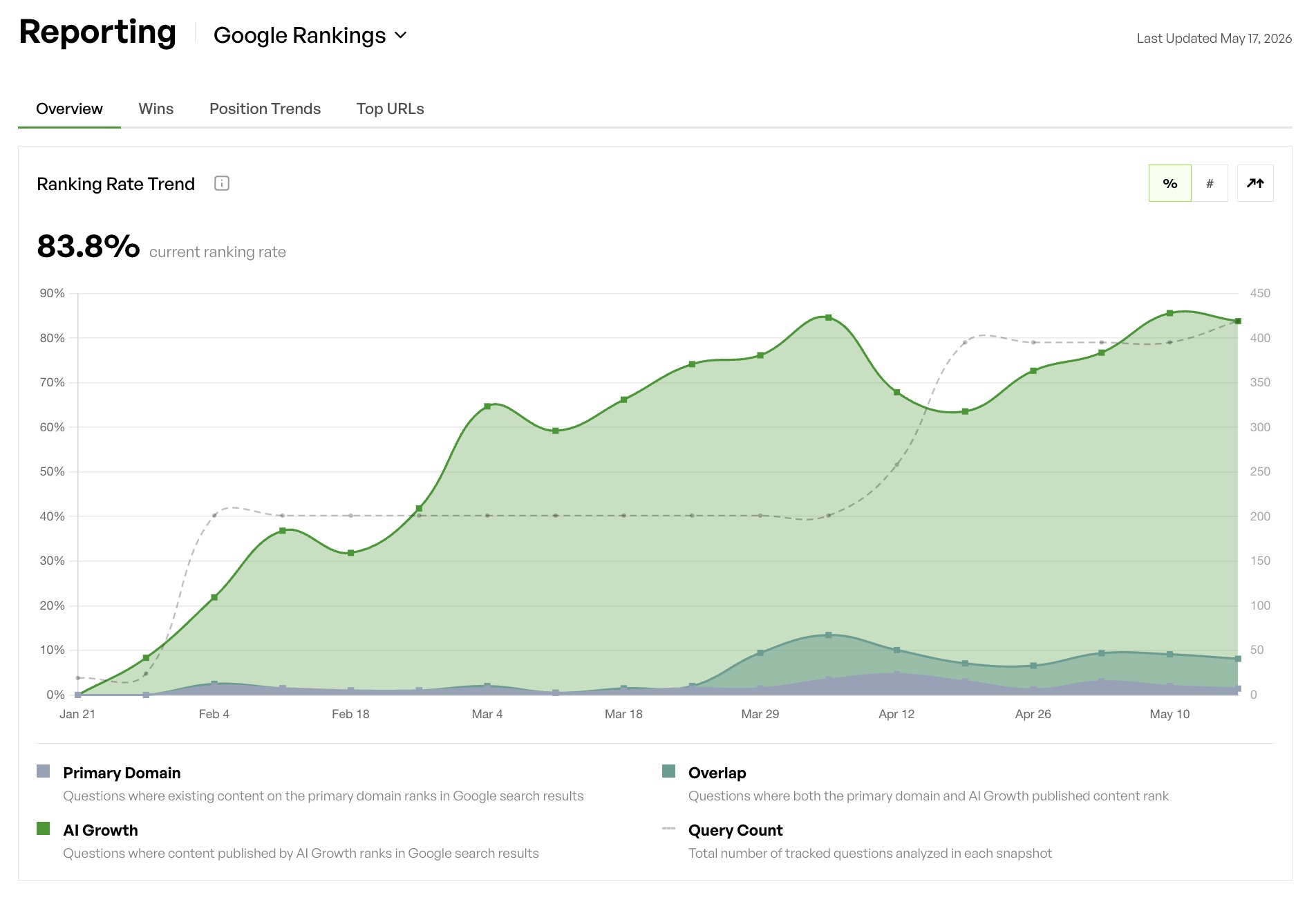
For CMOs who need a defensible answer for the CEO every week, the reporting architecture of the platform they choose is as important as the content it produces.
A Decision Framework for Choosing the Right Alternative
The six considerations above form a decision framework that maps cleanly to team size and primary pain point. Teams leaving HubSpot primarily over pricing should evaluate whether a new platform’s cost structure stays rational as the business scales and whether flat-fee models eliminate the contact-based ceiling. Teams leaving over feature bloat should prioritize platforms where the path from strategy to published content is short and does not require managing a complex internal tool. Teams leaving because they are invisible in AI search need a system that maps their full query universe, produces authoritative living content, and publishes with the technical signals AI surfaces require.
The platforms most commonly cited as HubSpot alternatives, including Pipedrive, Zoho, Salesforce, and ActiveCampaign, address the first two categories with varying degrees of success. None of them address the third. They are CRM and marketing automation tools built for the previous discovery model. They do not map a brand’s universe of AI queries, produce content that earns citations, or report incremental visibility across ChatGPT and Google’s AI Mode.
AI Growth Agent is the headless marketing engine built specifically for the third category. It replaces the SEO agency, the content tool, the web agency, the GEO monitor, the schema plugin, the analytics stack, and the PR firm with one flat-fee engine. It maps the full universe of seed terms and long-tail queries from real-time Google and ChatGPT data, produces authoritative living content that validates every claim and source, stands up a fully optimized site the client owns within the first week, and reports the incremental visibility it generates week over week.
Conclusion
The decision to leave HubSpot in 2026 is rarely just about the platform. It signals that the team has outgrown the assumptions the platform was built on: that discovery happens through blue links, that contact management is the center of marketing, and that content is a feature rather than the primary mechanism of brand authority. The right alternative depends on which of those assumptions is most broken for a specific team.
For teams whose primary pain is pricing or bloat, traditional CRM alternatives offer relief. For teams whose primary pain is invisibility in AI search, the answer is a headless marketing engine that changes what AI says about the brand, not one that only monitors what AI is already saying. The leaderboard in AI search is being written this year. The brands establishing authoritative content now are training the next generation of models with their own narrative.
Frequently Asked Questions
What is a headless marketing engine and how is it different from a CRM?
A headless marketing engine is a system that produces and publishes authoritative content for AI surfaces, with no headcount required from the client. The term borrows from headless commerce architecture, where the customer-facing storefront is decoupled from the engine running the business. In headless marketing, the brand keeps its curated main site while the engine runs a fully optimized blog the brand owns, connected through a reverse proxy rewrite or subdomain.
A CRM manages contact data, pipelines, and communications between a brand and its known customers. A headless marketing engine manages the brand’s presence in AI search, where unknown buyers are forming opinions before they ever become a contact. The two systems address different problems, and in 2026 the AI search problem is the one that determines whether a brand exists in the conversation at all.
How long does it take to migrate from HubSpot and see results from an AI-native platform?
Migration timelines vary depending on how deeply a team’s content and site are embedded in HubSpot’s CMS. For teams using HubSpot primarily as a CRM and email tool, the transition is largely a data and integration question. For teams whose website lives inside HubSpot, the migration involves standing up a new owned property, which AI Growth Agent does within the first week of kickoff.
Content indexing typically begins within ten days and often within two weeks. The standard engagement is a three-month pilot, because indexing timelines vary by industry and competitive landscape, but clients consistently see movement in bot traffic, impressions, and AI citations early in that window. The first article is typically live within a week of the kickoff interview.
Are free tiers on HubSpot alternatives worth using for mid-market teams?
Free tiers on most marketing platforms are designed for very early-stage teams with minimal contact lists and basic automation needs. For mid-market teams, free tiers typically impose limits on contacts, users, features, and integrations that make them impractical for real marketing operations. The more relevant question for mid-market CMOs is not whether a free tier exists but whether the paid pricing model stays rational as the business scales.
Contact-based pricing that escalates with list size, prompt-capped AI tools that limit how much of the market a team can see, and per-article or per-prompt billing structures all create the same problem at scale. The cost of seeing the full picture becomes prohibitive. Flat-fee models that do not penalize growth or curiosity are structurally better suited to mid-market and enterprise needs.
What AI features should mid-market CMOs require from any HubSpot alternative in 2026?
The AI features that matter in 2026 are the ones that determine whether a brand appears in AI Overviews, ChatGPT answers, and Perplexity results when a buyer asks a relevant question. The capabilities that matter are a full universe map of seed terms and long-tail queries drawn from real-time AI search data, not a capped set of tracked prompts. They also include content production that validates every claim and source against primary evidence rather than relying on a model’s training data.
Technical publishing infrastructure is equally important. Teams need schema markup, MCP endpoints, llms.txt files, and bot tracking so AI surfaces can find and cite the content. Living content that self-heals over time rather than going stale, and incremental visibility reporting that isolates what the platform actually generated, complete the picture. Any platform that offers AI as a feature inside a broader CRM suite, rather than as the core architecture, is unlikely to deliver these capabilities at the depth mid-market teams need.
How do you evaluate whether an AI search platform is actually moving the needle versus just generating content?
The distinction between content generation and AI search visibility is the most important evaluation criterion in 2026. A platform that produces articles without tracking whether those articles are being crawled by AI training agents, cited in ChatGPT responses, or surfaced in Google’s AI Overviews is generating activity, not results.
The metrics that indicate real movement are bot traffic broken down by bot type, including the specific bots that ChatGPT and Perplexity use to cite sources. They also include citation rate and brand mention rate across AI surfaces, Google Search Console impressions on the specific content the platform produced, and incremental visibility reporting that separates the platform’s contribution from existing brand equity. Platforms that report only on traditional SEO metrics like keyword rankings or organic sessions are measuring the previous discovery model. The right platform reports on the new one.