Written by: Mariana Fonseca, Editorial Team, AI Growth Agent
Key Takeaways
- MCP self healing content uses a closed-loop system where AI agents autonomously detect, diagnose, and repair schema errors and failed publish events without human intervention.
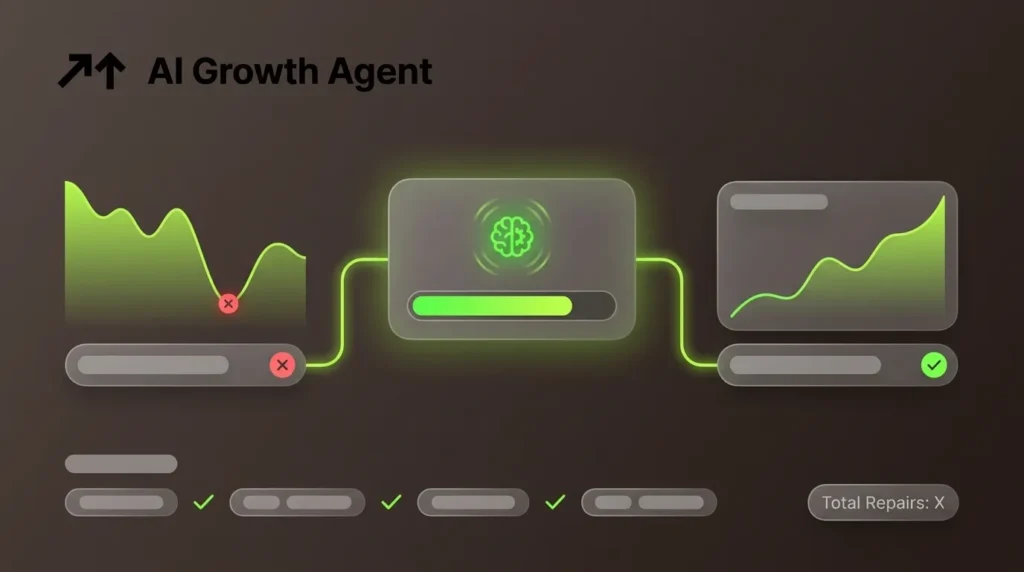
- A continuous repair workflow of detection, diagnosis, patching, verification, and logging keeps content schema-valid and crawlable across AI search surfaces like ChatGPT and Perplexity.
- Schema drift and silent publish failures accumulate over time and reduce citation probability. Self-healing systems counter this decay through continuous monitoring and autonomous correction.
- Integration with llms.txt, Blog MCP, and incremental visibility measurement turns routine maintenance into a compounding authority signal that improves AI surface engagement.
- AI Growth Agent delivers the complete MCP self-healing stack as a managed service. Schedule a demo to see how it applies to your publishing workflow.
How Stale Content Erodes AI Search Citations
AI search surfaces including ChatGPT, Perplexity, and Google AI Mode cite content based on what their crawlers can find, trust, and parse at the moment of a query. When published content carries broken schema, outdated structured data, or a failed publish state, the surface either skips the citation or substitutes a competitor’s page that is structurally sound.
Schema drift is the gradual divergence between the structured data a page declares and the content it actually contains. It occurs when article bodies are updated without updating the corresponding JSON-LD blocks, when CMS migrations strip markup, or when plugin updates overwrite custom schema fields. Each drift event reduces the probability that an AI surface will cite the affected page.
Failed publish events form a separate failure class. A publish pipeline can fail silently. The CMS records a successful post, but the page returns a 404, the sitemap entry is missing, or the canonical tag points to a staging URL. From an AI crawler’s perspective, the content does not exist.
Both fault classes compound over time. A brand with hundreds of published articles accumulates schema drift and silent publish failures faster than any manual review cycle can address them. The result is a decaying citation footprint in AI search surfaces, not because the content is wrong, but because the structural signals the models rely on have degraded.
How Self-Healing Content Works with MCP
The solution to this accumulating fault problem is a self-healing content system built on the Model Context Protocol. The Model Context Protocol is an open standard that defines how AI agents communicate with external tools, data sources, and services through a structured client-server interface. In a self-healing content system, MCP servers expose the tools an orchestrating agent needs to inspect, repair, and verify published content without leaving the protocol boundary.
A self-healing content architecture connects three MCP server classes. A publishing MCP server wraps the CMS API. An observability MCP server exposes schema validation and crawl-status tools. A verification MCP server confirms post-repair state. These three servers work together to enable autonomous repair. The orchestrating agent calls tools across all three servers in sequence, following the continuous repair loop described above.
The key architectural property is that the repair loop is closed. The agent does not hand off to a human for approval on routine faults. It attempts repair autonomously within defined attempt limits and escalates only when those limits are exhausted or when the fault class is outside its repair authority.
Step 1: Detection of Broken Schema or Failed Publish
Detection acts as the entry point of the repair loop. A monitoring agent polls two signal sources on a configurable schedule: the schema validation layer and the publishing pipeline event log.
Schema validation runs the published page’s JSON-LD blocks against the relevant schema.org type definitions. A fault is raised when a required property is missing, when a property value fails type validation, or when the declared type does not match the page’s content class. Common fault patterns include Article schema blocks missing the dateModified property after a content update, FAQ schema blocks with empty acceptedAnswer nodes, and Organization schema blocks with stale url values pointing to redirected URLs.
Publishing pipeline detection reads the event log for failed or incomplete publish states. A fault is raised when a post ID is recorded as published but the live URL returns a non-200 status, when the sitemap entry for the post is absent, or when the canonical tag value does not match the intended URL. These conditions are detectable without a full crawl by querying the CMS API and the sitemap index directly through the publishing MCP server.
Step 2: Diagnosis via Observability MCP Servers
Diagnosis classifies each detected fault before a repair is attempted. An observability MCP server exposes a structured set of diagnostic tools. These include a schema diff tool that compares the current JSON-LD payload against the expected schema for the content type, a crawl-status tool that returns the last known crawl timestamp and HTTP status for a given URL, and a dependency graph tool that maps the affected content node to its internal linking relationships.
The orchestrating agent calls these tools in sequence and constructs a fault record containing the fault class, the affected content node identifier, the specific property or pipeline stage that failed, and the severity level. Severity is determined by the content node’s citation frequency and its position in the internal linking graph. A high-citation node with a broken schema block is a severity-one fault. A low-traffic node with a missing dateModified property is a severity-three fault.
Fault classification drives repair priority. The agent processes severity-one faults immediately and queues lower-severity faults for the next scheduled repair cycle. This prevents a large batch of minor faults from blocking repair of a high-impact schema failure.
Step 3: Autonomous Patch and Re-Publish
Once a fault record is complete, the repair agent constructs a corrected payload. For schema faults, the agent reads the current article content through the publishing MCP server, extracts the values needed to populate the missing or invalid properties, and generates a corrected JSON-LD block. For publish pipeline faults, the agent calls the CMS API to re-trigger the publish action, force a sitemap regeneration, or correct the canonical tag value.
The corrected payload is submitted to the publishing pipeline through the publishing MCP server. The server returns a transaction ID that the agent records in the fault record before moving to the verification step. If the publish call returns an error, the agent increments the attempt counter and retries after a configurable backoff interval, subject to the attempt limit defined in the recovery manager.
Step 4: Repair Attempt Limits and Audit Trail
Attempt limits prevent autonomous repair from creating infinite retry loops that can saturate a CMS API or mask a deeper infrastructure fault. A production recovery manager enforces a hard cap on repair attempts per fault record and writes every attempt outcome to an immutable audit trail.
The standard pattern caps repair attempts at three to five per fault record within a rolling 24-hour window. When the cap is reached without a successful repair, the fault record is escalated to a human review queue and the affected content node is flagged in the reporting layer. The audit trail entry for the escalation includes the fault class, all attempt timestamps, all error responses from the publishing pipeline, and the escalation reason.
The audit trail serves two functions. It provides the evidence base for post-incident review, because every repair action is traceable to a specific fault record, a specific agent call, and a specific MCP tool invocation. It also feeds the verification and visibility measurement layer, which uses repair timestamps to correlate schema corrections with changes in crawl frequency and citation rate.
Step 5: Integration with llms.txt and Blog MCP
A self-healing content system that repairs schema and publish faults in isolation still leaves two critical AI-surface signals unmanaged. These signals are the llms.txt file and the Blog MCP endpoint. Both are read by AI crawlers to understand the structure and authority of a content property. Both can drift out of sync with the published content state.
llms.txt and llms-full.txt are plain-text files that describe the brand’s content universe in a format AI surfaces can parse directly. When new articles are published or existing articles are substantially updated, the llms.txt index must be regenerated to reflect the current state. A self-healing system integrates llms.txt regeneration as a post-repair step. After a successful schema correction or re-publish, the recovery manager calls the publishing MCP server to regenerate the index file and confirm the updated version is accessible at the expected path.
Blog MCP exposes the content property’s schema, manifest, and capability guidance to agents. A repair event that changes a content node’s type or structural properties must propagate to the Blog MCP manifest. The recovery manager includes a manifest sync step that runs after every successful repair and verifies that the MCP manifest reflects the current content state.
Verification and Incremental Visibility Measurement
Verification confirms that a repair has produced the intended live state. The verification agent calls three tools through the observability MCP server. These tools are a live-URL check that confirms the corrected page returns a 200 status, a schema validation check that confirms the corrected JSON-LD block passes type validation, and a sitemap presence check that confirms the URL appears in the current sitemap index.
When all three checks pass, the fault record is closed with a resolved status and the repair timestamp is written to the visibility measurement layer. The measurement layer correlates repair timestamps with changes in bot visit frequency, crawl depth, and citation rate over the following 7-to-14-day window. This correlation produces an incremental visibility signal, which is the measurable change in AI surface engagement attributable to the repair event, isolated from background visibility the brand already held.
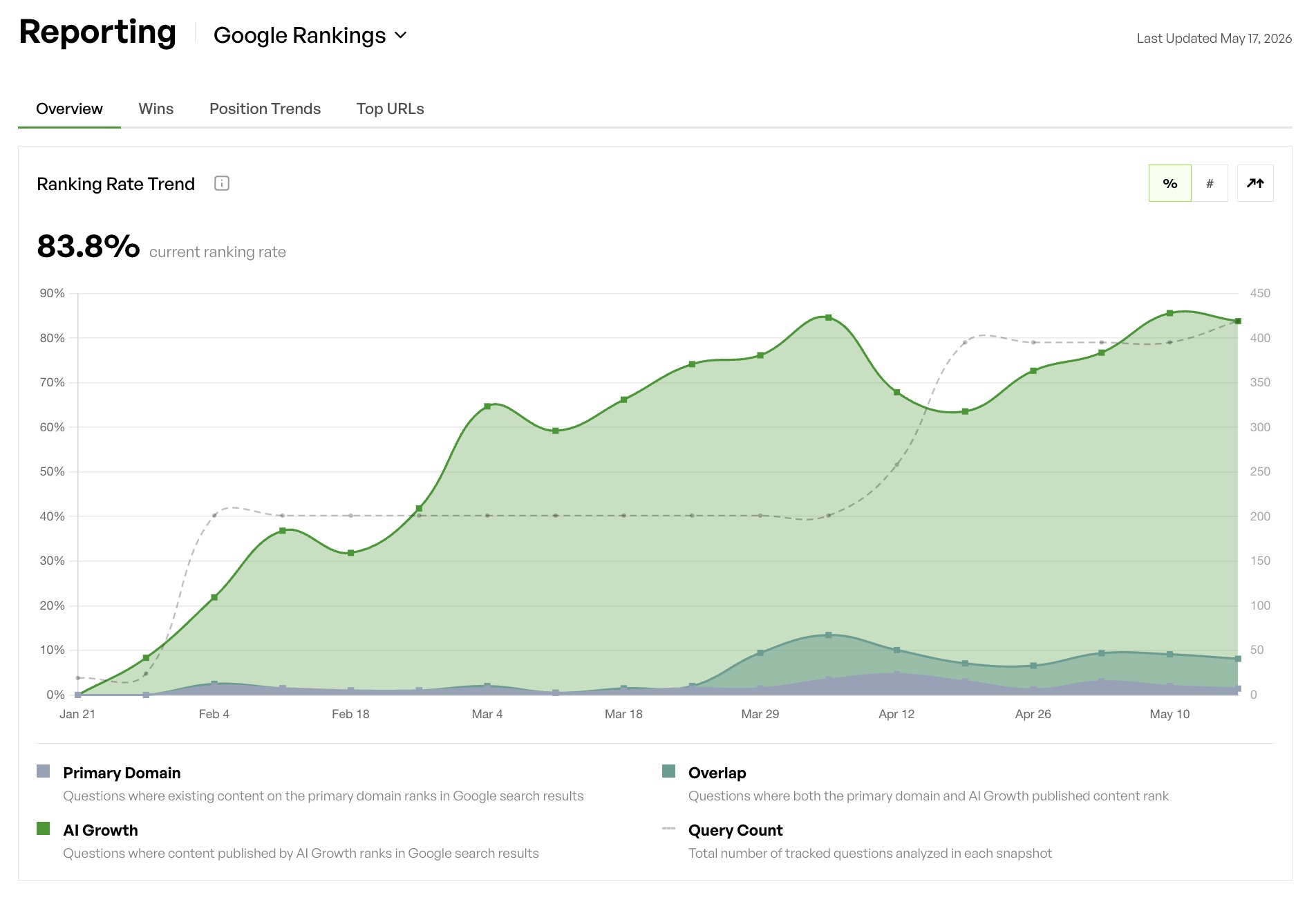
Incremental visibility measurement turns self-healing from a maintenance function into a compounding authority signal. Each repair event that restores a high-citation content node to a schema-valid, crawlable state contributes to the brand’s cumulative citation footprint in AI search surfaces. See how incremental visibility measurement works in your publishing environment during a live demo.
MCP Self Healing Content Example
A concrete example illustrates the full repair loop in practice. A brand publishes an Article page with a JSON-LD block that includes a datePublished property but omits dateModified. The CMS records the publish as successful, and the monitoring agent’s next schema validation poll detects the missing property and raises a severity-three fault record.
The diagnosis step confirms the fault class as a missing required property on an Article schema block. The repair agent reads the article’s last-modified timestamp from the CMS API through the publishing MCP server, constructs a corrected JSON-LD block with the dateModified value populated, and submits the corrected block to the CMS. The publish call succeeds on the first attempt. The verification agent confirms the live page returns a valid schema block. The fault record is closed, the repair timestamp is logged, and the llms.txt index is regenerated.
Over the following ten days, the monitoring layer records an increase in bot visit frequency for the repaired URL, consistent with AI crawlers re-indexing the corrected schema. The visibility measurement layer attributes this change to the repair event and adds it to the brand’s incremental visibility report.
MCP Self Healing Content GitHub Landscape
Production implementations of MCP self healing content are not yet widely represented in public GitHub repositories. The existing open-source landscape for MCP covers general-purpose server implementations, tool registration patterns, and client SDKs. Closed-loop content repair pipelines that integrate schema validation, publishing MCP servers, and audit logging in a single deployable system remain proprietary or in early-stage development.
A GitHub-hosted implementation would require several components. These include an MCP server wrapping a CMS API such as the WordPress REST API, a schema validation tool compatible with schema.org type definitions, a recovery manager module with configurable attempt limits and backoff logic, an audit log writer with immutable append semantics, and a verification agent that calls live-URL, schema, and sitemap checks in sequence. Each component is individually implementable using the published MCP specification and standard CMS APIs. The integration layer that connects them into a closed-loop system is where production complexity concentrates.
Self-Healing Locators in Playwright for Content Pipelines
Self-healing locators in Playwright are a test automation pattern in which a test runner automatically updates element selectors when the DOM structure of a page changes. This pattern prevents test failures caused by minor UI updates. The pattern is relevant to content publishing workflows because the same principle, detecting structural drift and repairing the reference rather than failing, applies directly to schema validation and content node identification in a self-healing content system.
In a content pipeline context, the equivalent of a Playwright locator is the content node identifier used by the monitoring agent to reference a specific article, schema block, or sitemap entry. When a CMS migration or plugin update changes the internal ID structure of published posts, the monitoring agent’s node references can drift out of sync with the live content state and produce false-positive fault detections. A self-healing locator pattern addresses this by storing multiple reference strategies per content node, falling back to secondary identifiers such as slug or canonical URL when the primary ID fails to resolve, and updating the primary reference when a fallback succeeds.
Self-Healing Deployment Agent MCP
A self-healing deployment agent MCP is an MCP server that wraps a deployment pipeline and exposes tools for detecting failed deployments, rolling back to a known-good state, and re-triggering deploys with corrected configuration. In a content publishing context, the deployment agent handles the infrastructure layer beneath the CMS. This layer includes the CDN cache invalidation, the reverse proxy rewrite rules, and the DNS configuration that determines whether a published article is reachable at its intended URL.
The deployment agent integrates with the content repair loop at the publish pipeline fault class. When a repair agent’s re-publish call succeeds at the CMS level but the live URL still returns a non-200 status, the fault is escalated to the deployment agent, which checks CDN cache state, proxy configuration, and DNS resolution in sequence. If the fault is attributable to a stale CDN cache, the deployment agent calls the cache invalidation tool and re-runs the verification check. If the fault is attributable to a proxy misconfiguration, the deployment agent raises an escalation to the human review queue with a structured diagnosis record.
Five-Layer Production Architecture
The production architecture for an MCP self healing content system consists of five layers connected in a closed loop.
Layer 1: Content Store. The CMS database and file system hold published articles, schema blocks, sitemap indexes, llms.txt files, and Blog MCP manifests. All content state is readable and writable through the publishing MCP server.
Layer 2: Publishing MCP Server. This layer wraps the CMS API and exposes tools for reading content node state, writing corrected payloads, triggering publish actions, regenerating sitemaps, and updating llms.txt and Blog MCP manifests. All write operations return a transaction ID.
Layer 3: Observability MCP Server. This layer exposes schema validation, crawl-status, live-URL check, sitemap presence, and dependency graph tools. It reads from the content store and from external crawl-status APIs. All tool calls are read-only.
Layer 4: Recovery Manager. The orchestrating agent runs the repair loop. It reads fault signals from the observability layer, constructs fault records, calls repair tools through the publishing layer, enforces attempt limits, and writes all outcomes to the audit log. It also escalates unresolved faults to the human review queue.
Layer 5: Visibility Measurement Layer. This layer reads repair timestamps from the audit log and correlates them with bot visit frequency, crawl depth, and citation rate signals from the analytics stack. It produces incremental visibility reports that isolate repair-attributable changes from background brand visibility.
The loop closes when the visibility measurement layer feeds citation rate signals back to the recovery manager’s fault prioritization logic. High-citation content nodes then receive higher repair priority in subsequent cycles.
Pseudocode for Recovery Manager
RECOVERY_MANAGER: MAX_ATTEMPTS = 5 BACKOFF_BASE_SECONDS = 60 function run_repair_cycle(): faults = observability_mcp.call("detect_faults") sorted_faults = sort_by_severity(faults) for fault in sorted_faults: if fault.attempt_count >= MAX_ATTEMPTS: audit_log.append({ fault_id: fault.id, status: "ESCALATED", reason: "MAX_ATTEMPTS_EXCEEDED", timestamp: now() }) human_review_queue.push(fault) continue diagnosis = observability_mcp.call("diagnose_fault", fault.node_id) corrected_payload = repair_agent.build_patch(diagnosis) result = publishing_mcp.call("apply_patch", corrected_payload) fault.attempt_count += 1 audit_log.append({ fault_id: fault.id, attempt: fault.attempt_count, result: result.status, transaction_id: result.transaction_id, timestamp: now() }) if result.status == "SUCCESS": verification = observability_mcp.call("verify_repair", fault.node_id) if verification.all_checks_passed: publishing_mcp.call("regenerate_llms_txt") publishing_mcp.call("sync_blog_mcp_manifest") audit_log.append({ fault_id: fault.id, status: "RESOLVED", timestamp: now() }) visibility_layer.record_repair_event(fault.node_id, now()) else: fault.status = "VERIFICATION_FAILED" schedule_retry(fault, BACKOFF_BASE_SECONDS * fault.attempt_count) else: schedule_retry(fault, BACKOFF_BASE_SECONDS * fault.attempt_count)
The recovery manager enforces a hard cap of five attempts per fault record, writes every attempt to an immutable audit log with a transaction ID, escalates unresolved faults to a human review queue, and triggers llms.txt regeneration and Blog MCP manifest sync on every verified resolution.
Comparison of Self-Healing Approaches
The table below compares four approaches to content repair on four dimensions: repair scope, attempt guardrails, audit logging, and AI surface integration. Figures reflect documented capabilities of each approach category rather than vendor-specific benchmarks.
| Approach | Repair Scope | Attempt Guardrails | Audit Logging | AI Surface Integration |
|---|---|---|---|---|
| Manual review cycle | Human-identified faults only | None | None by default | None |
| CMS plugin auto-repair | Schema and 404 faults within plugin scope | Varies by plugin, often none | Plugin log only | None |
| Custom MCP repair loop (open-source components) | Schema, publish pipeline, and deployment faults | Configurable, requires implementation | Configurable, requires implementation | Requires manual llms.txt and MCP manifest integration |
| AI Growth Agent | Schema, publish pipeline, deployment, llms.txt, and Blog MCP manifest faults | Enforced, built into recovery manager | Immutable, cross-referenced with visibility reporting | Native: Blog MCP, llms.txt, llms-full.txt, agent discovery, and OpenAI discovery included in every package |
Frequently Asked Questions
What is MCP self healing content?
MCP self healing content is a publishing architecture in which a Model Context Protocol server orchestrates autonomous detection, diagnosis, and repair of content faults including broken schema, failed publish events, and structural drift in AI surface integration files. The system runs a closed loop. A monitoring agent detects faults, an observability MCP server classifies them, a repair agent patches and re-publishes the corrected content, a verification agent confirms the live state, and an audit log records every action. The loop runs continuously without human intervention on routine faults and escalates only when repair attempts are exhausted or when the fault class is outside the system’s repair authority.
Who owns the repaired content and audit logs?
Ownership of repaired content and audit logs depends on the implementation. In a self-hosted MCP repair system, the operator owns all content state and audit data because both reside in infrastructure the operator controls. In a managed implementation, the client should confirm that the service agreement assigns content ownership to the client and that audit logs are exportable in a standard format. AI Growth Agent clients own all content produced and published through the system, and audit and reporting data are accessible through the client’s reporting view and Google Search Console as an independent audit layer.
What technical dependencies are required?
A production MCP self healing content system requires a CMS with a programmable API, an MCP-compatible orchestration runtime, an observability layer that can validate schema.org structured data and check live URL status, a publishing pipeline that accepts corrected payloads and returns transaction IDs, and an audit log store with append-only semantics. For AI surface integration, the system also requires the ability to regenerate llms.txt and llms-full.txt files and to sync a Blog MCP manifest after each verified repair. The only integration step required on the client side in a managed implementation is the reverse proxy rewrite that connects the blog to a subdirectory under the brand’s domain.
How long does a full repair cycle take?
A full repair cycle from fault detection to verified resolution typically completes in under five minutes for schema faults and publish pipeline faults that resolve on the first attempt. The dominant time variable is the CMS API response time for the patch submission and the CDN propagation delay for the corrected page to become live at its URL. Deployment-layer faults that require cache invalidation or proxy reconfiguration add additional latency depending on CDN provider. The recovery manager’s backoff schedule, which starts at 60 seconds and scales with attempt count, sets the minimum cycle time for faults that require multiple attempts.
How is incremental visibility measured?
Incremental visibility is measured by correlating repair event timestamps with changes in bot visit frequency, crawl depth, and citation rate over a 7-to-14-day window following each repair. The measurement layer isolates changes attributable to the repair event from background brand visibility by comparing the repaired content node’s performance trajectory against a baseline established before the fault was introduced. The resulting signal shows the measurable change in AI surface engagement produced by restoring the content node to a schema-valid, crawlable state. This data is cross-referenced with Google Search Console impressions and per-article bot tracking to produce a weekly incremental visibility report.
Conclusion
MCP self healing content addresses a structural problem in AI-native publishing. Content faults accumulate faster than manual review cycles can resolve them, and each unresolved fault reduces the probability that an AI surface will cite the affected page. The closed-loop detection, diagnosis, and resolution workflow described in this article replaces manual maintenance with a deterministic repair system that keeps schema valid, publish pipelines clear, and AI surface integration files current.
Evaluating a self-healing content implementation requires assessing four criteria. These criteria are repair scope, attempt guardrails, audit logging, and incremental visibility measurement. Repair scope covers schema, publish pipeline, deployment, and AI surface integration files. Attempt guardrails determine whether the recovery manager enforces a hard cap and escalates unresolved faults. Audit logging confirms that every repair action is traceable and exportable. Incremental visibility measurement shows whether the system isolates repair-attributable visibility gains from background brand performance.
AI Growth Agent delivers this architecture as a managed service with the full technical stack described above, enforced recovery management, and incremental visibility reporting. Schedule a consultation to see the MCP self healing content stack in a live environment and evaluate fit for your publishing architecture.