Written by: Mariana Fonseca, Editorial Team, AI Growth Agent
Key Takeaways for 2026 Buyers
- Pardot aligns natively with Salesforce, while HubSpot connects through an integration that adds sync and monitoring work.
- HubSpot offers a lower learning curve for generalist teams. Pardot usually requires Salesforce Admin or Marketing Ops support.
- Both platforms ship AI features in 2026, yet neither provides native reporting for zero-click AI search surfaces like ChatGPT or Google AI Mode.
- Pricing for both tools scales with contacts, seats, and add-ons. Enterprise deployments see total cost of ownership rise quickly.
- Organizations that want AI search visibility without CRM lock-in can schedule a consultation session to see if you’re a good fit with AI Growth Agent.
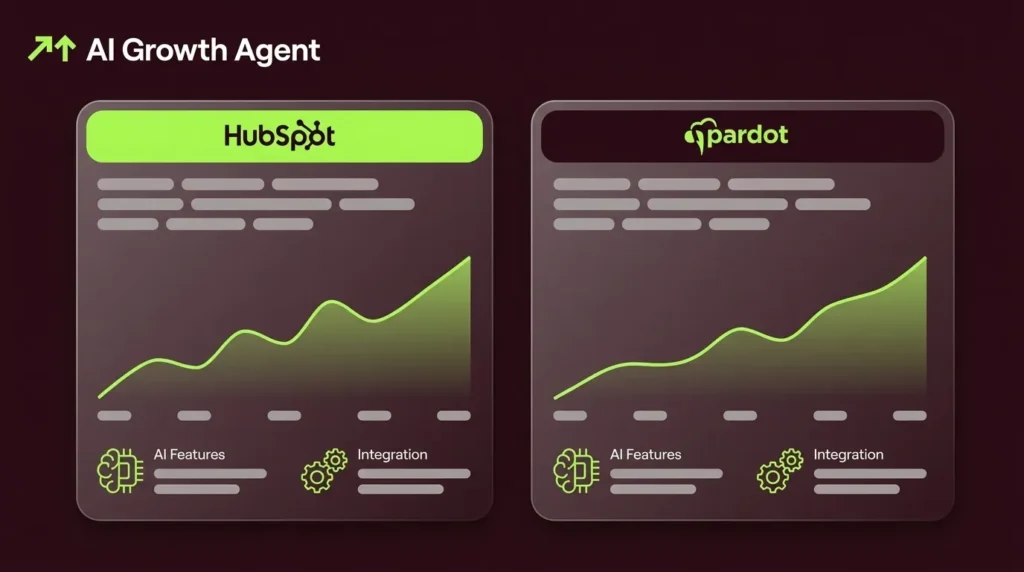
HubSpot vs Pardot: Side-by-Side Comparison
| Criterion | HubSpot Marketing Hub | Salesforce Marketing Cloud Account Engagement (Pardot) |
|---|---|---|
| CRM Integration | Native to HubSpot CRM, third-party Salesforce connector available but adds sync complexity | Native to Salesforce CRM, built on the same data model and object structure |
| Ease of Use | Widely cited as more intuitive, lower onboarding barrier for generalist marketing teams | Steep learning curve, typically requires dedicated Marketing Ops or Salesforce Admin resources |
| Lead Scoring | Rule-based and predictive scoring available, scoring tied to HubSpot contact records | Einstein-powered predictive scoring on higher tiers, deep Salesforce Lead and Contact object alignment |
| Pricing Model | Tiered by contact volume and feature set, costs scale with database size | Tiered by edition and contact volume, enterprise editions carry significant per-seat and add-on costs |
| AI Features (2026) | AI content assistant, predictive lead scoring, conversation intelligence, prompt limits apply on lower tiers | Einstein AI suite including send-time optimization, engagement scoring, and generative content, depth varies by edition |
| Reporting | Multi-touch attribution, campaign influence reporting, limited incremental visibility for AI search surfaces | B2B Marketing Analytics add-on for advanced reporting, Salesforce native dashboards, no native AI search visibility reporting |
| AI Search Adaptability | Content tools produce assets for traditional channels, no native zero-click or AI citation reporting | No native capability for AI search visibility or citation tracking |
Note: Specific pricing figures are not cited in this table because both vendors adjust list pricing frequently and publish custom quotes for enterprise volumes. Total cost of ownership comparisons appear in prose in the pricing section below.
CRM Integration Realities for Salesforce-Centric Teams
The comparison table above highlights several decision points, but CRM integration often decides the evaluation for Salesforce-first organizations. Pardot was acquired by Salesforce and is now formally branded as Marketing Cloud Account Engagement within the Salesforce ecosystem. It shares the same data model, the same object hierarchy of Leads, Contacts, Accounts, and Opportunities, and the same permission structure. Campaigns created in Pardot map directly to Salesforce Campaign objects, and sync runs bidirectionally on the same underlying platform rather than through an API bridge.
HubSpot offers a native Salesforce integration that handles contact, company, deal, and activity sync between two separate platforms. Field mapping requires configuration, sync errors require monitoring, and workflow dependencies that cross the two systems add operational overhead. Teams that rely heavily on Salesforce custom objects, complex permission sets, or real-time data parity between CRM and marketing automation often report that the HubSpot-Salesforce connector introduces friction that the native Pardot environment avoids.
The practical implication is clear. When Salesforce is the authoritative source of truth for revenue data and marketing workflows must read and write against that data in real time, Pardot holds a structural integration advantage. When an organization is open to migrating CRM or already runs HubSpot CRM, that advantage disappears.
Ease of Use and Learning Curve for Real Teams
HubSpot focuses heavily on interface accessibility and speed to competency. Campaign builders, email editors, workflow tools, and reporting dashboards are designed for marketing generalists, and the platform’s onboarding resources support that audience. Teams without a dedicated Marketing Ops function usually reach operational competency faster on HubSpot than on most enterprise alternatives.
Pardot presents a well-documented steep learning curve. SmartBug Media and Campaign Creators both note that Pardot implementations typically require either a certified Salesforce Admin or a dedicated Marketing Ops specialist. That specialist configures automation rules, manages the Salesforce sync, and maintains the platform over time. Completion forms, dynamic content, and Engagement Studio nurture programs each carry configuration logic that differs from how HubSpot structures similar features.
Headcount dependency becomes the long-term operational concern. Pardot environments that lack active maintenance from someone with Salesforce expertise tend to accumulate sync errors, orphaned automation rules, and data quality issues that later demand specialist intervention. HubSpot’s lower technical floor allows a smaller team to keep the platform healthy, although the ceiling for complex, Salesforce-dependent workflows remains lower than Pardot’s.
If your team is already evaluating which platform fits your stack and you want a framework built around your specific CRM dependency and team structure, book a personalized stack assessment with AI Growth Agent.
HubSpot vs Pardot Pricing 2026: What Costs Look Like at Scale
Both platforms use tiered pricing models that scale with contact database size and feature access, and both carry costs that compound at enterprise volumes beyond the base subscription.
HubSpot Marketing Hub pricing is structured across Free, Starter, Professional, and Enterprise tiers. The Professional and Enterprise tiers include the automation, lead scoring, and reporting features relevant to mid-market and enterprise B2B buyers. Contact limits at each tier carry overage charges, and add-ons such as additional seats, reporting dashboards, and the Operations Hub for data sync introduce separate costs. RevPartners notes that HubSpot’s all-in-one model can appear cost-efficient at lower volumes, yet total cost of ownership at enterprise scale often exceeds initial estimates once contact overages, seat costs, and required add-ons enter the picture.
Pardot pricing is structured across Growth, Plus, Advanced, and Premium editions. The Advanced and Premium editions, which include Einstein AI features, B2B Marketing Analytics, and advanced personalization, carry list prices that place them firmly in enterprise budget territory. Organizations also need to account for the underlying Salesforce Sales Cloud or Service Cloud licenses that Pardot requires, so Pardot’s true cost of ownership includes the Salesforce platform cost as a baseline.
Budget fit usually follows a predictable pattern. Organizations with smaller contact databases and generalist marketing teams often view HubSpot’s Professional tier as a more predictable entry point. Organizations already paying for Salesforce enterprise licenses may find that Pardot’s incremental cost over an existing Salesforce investment is lower than adding HubSpot as a second platform. At true enterprise scale, both platforms require deliberate budget planning that covers licenses, seats, add-ons, and implementation services.
AI Features, Reporting, and Zero-Click Search Gaps
Both platforms have expanded their AI feature sets in recent product cycles. HubSpot’s AI content assistant, predictive lead scoring, and conversation intelligence tools are available across Marketing Hub tiers, with feature depth and prompt access varying by subscription level. Salesforce’s Einstein suite within Pardot includes send-time optimization, engagement frequency scoring, and generative content features, with the most capable Einstein features gated to Advanced and Premium editions.
The more consequential gap in 2026 sits between what both platforms report and what actually happens to your brand’s visibility. Neither platform has native reporting for AI search surfaces. Neither tracks whether your content is being cited in ChatGPT, Perplexity, or Google’s AI Mode. Neither maps the long-tail queries your buyers are asking inside AI surfaces before they ever reach a form on your site. Hyperscayle observes that both platforms were architected for a click-based web, and their reporting models still reflect that architecture.
The practical risk for Marketing Ops leaders is straightforward. Your attribution model measures the traffic that arrives, not the AI-surface conversations that shape intent before arrival. In a zero-click environment where buyers resolve trust through AI answers and rarely click through to verify sources, a reporting stack that only measures clicks remains structurally blind to a growing share of the buyer journey.
Decision Framework: HubSpot, Pardot, or a Headless Alternative
The decision between HubSpot and Pardot reduces to three variables: CRM dependency, team capability, and budget structure.
Choose Pardot when your organization runs Salesforce as the authoritative CRM, your revenue workflows depend on real-time data parity between marketing automation and Salesforce objects, and you have a dedicated Marketing Ops or Salesforce Admin resource. The native integration advantage remains real and operationally significant for Salesforce-heavy organizations.
Choose HubSpot when your organization is CRM-flexible or already uses HubSpot CRM, your marketing team is more generalist than technically specialized, and you prioritize onboarding speed and interface accessibility over deep Salesforce data model alignment.
Consider a headless alternative when your evaluation criteria include AI search visibility, zero-click brand presence, and the ability to map and win the full universe of queries your buyers are asking inside AI surfaces. Neither HubSpot nor Pardot addresses that AI visibility gap mentioned earlier. AI Growth Agent replaces both with a fixed-fee, headless engine that delivers the query mapping and citation tracking these platforms lack.
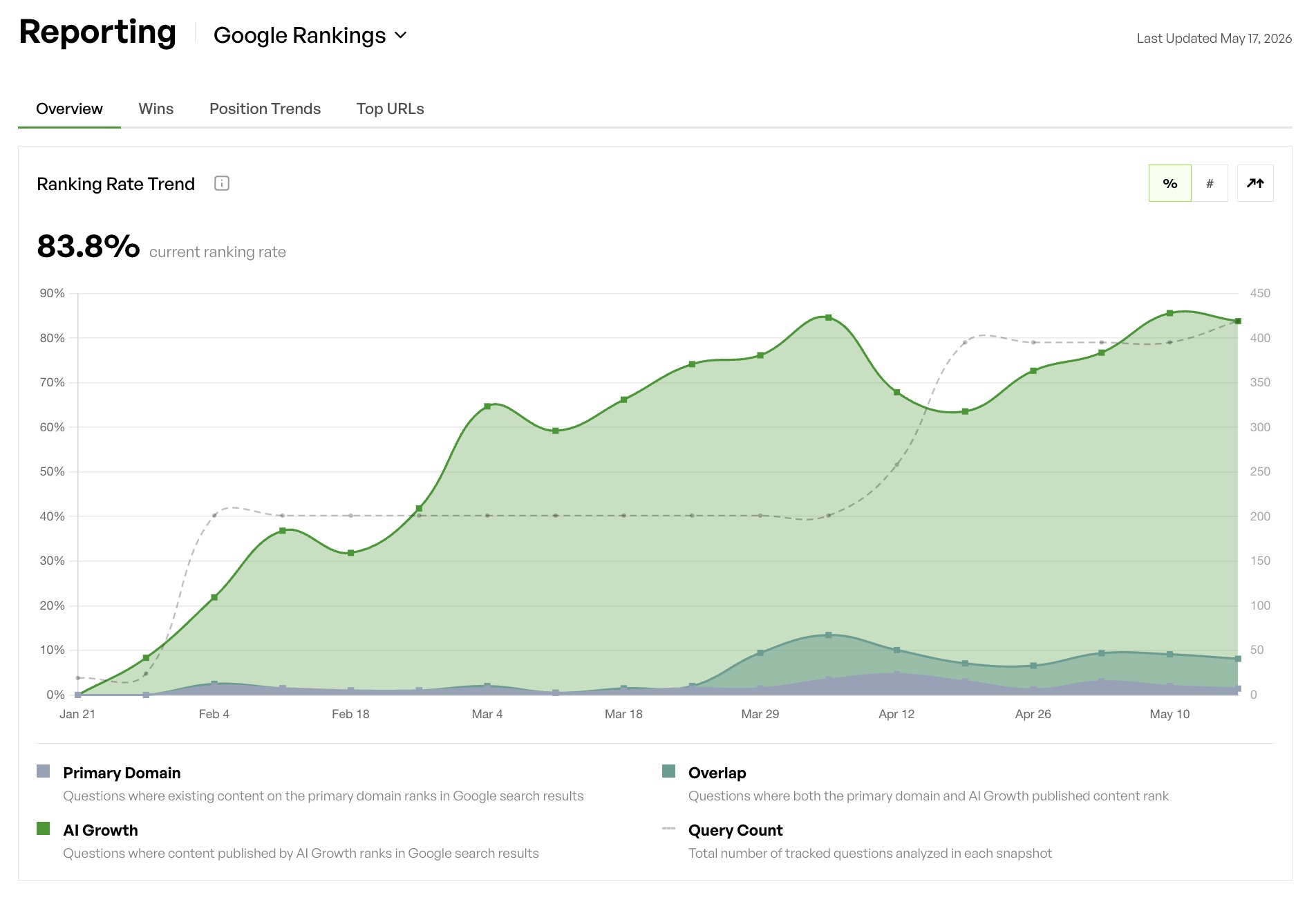
Get a custom framework for your CRM stack and AI visibility strategy, and book your assessment here.
Operational and Long-Term Stack Decisions
Migration between platforms creates a significant operational project regardless of direction. Moving from HubSpot to Pardot requires rebuilding automation logic in Engagement Studio, remapping contact fields to Salesforce objects, and retraining the team on a different configuration model. Moving from Pardot to HubSpot requires exporting and cleaning Salesforce-synced data, rebuilding nurture sequences in HubSpot’s workflow engine, and establishing a new Salesforce connector configuration. Both migrations usually require external implementation support and introduce a period of reduced marketing automation capability during transition.
Content governance becomes a shared challenge over time. Both platforms produce content assets, email templates, landing pages, and nurture sequences that accumulate and require active maintenance to stay current. Neither platform offers a native mechanism for identifying and refreshing stale content at scale, so content debt compounds as the database grows.
Long-term adaptability now hinges on AI search behavior. As AI search surfaces capture a larger share of the buyer journey, your marketing stack must help ensure your brand appears as the answer those surfaces return. HubSpot and Pardot remain tuned for a click-based web. Brands that establish authoritative content in AI search now train the next generation of models with their own narrative, while brands that wait train those models with whatever sits on the open web.
Unlike the traditional automation platforms discussed above, AI Growth Agent provides the query mapping and self-healing content capabilities that close the AI search visibility gap. There are no prompt caps, no per-article charges, and no CRM dependency. See how headless marketing fits your stack and schedule your demo now.
Frequently Asked Questions
How long does it typically take to implement HubSpot or Pardot for a mid-market B2B organization?
Implementation timelines vary by organizational complexity, data quality, and the scope of automation being configured. A straightforward HubSpot implementation for a mid-market team with a clean contact database and a defined set of nurture sequences can reach operational status in four to eight weeks. Pardot implementations for Salesforce-heavy organizations with complex object relationships, custom fields, and multi-step Engagement Studio programs can take longer, often several months when accounting for Salesforce Admin involvement, data mapping, and user training. Both timelines extend when the implementation involves migrating from an existing platform, cleaning legacy data, or building net-new automation logic from scratch.
Does using Pardot require a dedicated Salesforce Admin or Marketing Ops specialist?
Most mid-market and enterprise deployments benefit from a dedicated resource. Pardot’s configuration model is built on Salesforce’s permission and object structure, which means tasks like managing the Salesforce connector, configuring dynamic content rules, building Engagement Studio programs, and troubleshooting sync errors require familiarity with Salesforce administration. Organizations that attempt to run Pardot without a dedicated resource typically accumulate configuration debt, sync errors, and data quality issues over time. HubSpot’s lower technical floor means a generalist marketing team can manage more of the platform independently, though complex workflow logic and Salesforce connector maintenance still benefit from technical oversight.
How do HubSpot and Pardot handle lead scoring for complex B2B buyer journeys with long sales cycles?
Both platforms support rule-based and predictive lead scoring, but the implementation differs in ways that matter for complex B2B journeys. HubSpot’s predictive scoring uses contact behavior and demographic data within the HubSpot data model to surface engagement signals. Pardot’s Einstein-powered scoring, available on Advanced and Premium editions, draws on Salesforce’s full account and opportunity data, which gives it access to a richer signal set for organizations where CRM data is comprehensive and current. For organizations with long sales cycles, multiple buyer personas, and complex account hierarchies, Pardot’s native access to Salesforce opportunity stage data and account-level engagement signals becomes a meaningful advantage. HubSpot’s scoring is more accessible to configure but operates with less native access to downstream revenue data unless the Salesforce connector is carefully maintained.
What are the most common reasons B2B organizations switch from Pardot to HubSpot, or vice versa?
Organizations switching from Pardot to HubSpot most commonly cite the steep learning curve, the requirement for dedicated Salesforce Admin resources, and the difficulty of building and maintaining automation without specialist support. Interface accessibility and faster onboarding act as the primary pull factors toward HubSpot. Organizations switching from HubSpot to Pardot most commonly cite the need for deeper Salesforce data model alignment, real-time bidirectional sync without connector overhead, and the desire to consolidate their marketing and CRM investment within the Salesforce ecosystem. Both switches carry significant migration effort, and the decision is rarely reversed quickly once made.
How should a Marketing Ops leader evaluate whether their organization needs a headless AI search alternative alongside or instead of a traditional marketing automation platform?
The evaluation starts with a clear look at where buyers form intent. When a meaningful share of buyers ask questions inside ChatGPT, Perplexity, or Google’s AI Mode before they reach a form on your site, and your current stack has no visibility into those conversations, you face a reporting and content gap that HubSpot and Pardot are not designed to close. A headless AI search engine like AI Growth Agent addresses that gap by mapping the full universe of queries your buyers are asking, producing authoritative content that AI surfaces can find and cite, and reporting the incremental visibility generated week over week. It operates independently of CRM dependency and does not require a choice between HubSpot and Pardot to be useful. For organizations where AI search visibility now shapes a growing share of the buyer journey, it functions as a layer that neither platform provides.
Conclusion: Matching Your Stack to Today’s Buyer Journey
The HubSpot versus Pardot decision in 2026 is a CRM dependency decision first, a team capability decision second, and a budget structure decision third. For Salesforce-native organizations with dedicated Marketing Ops resources, Pardot’s native integration depth creates a genuine structural advantage. For organizations prioritizing onboarding speed, interface accessibility, and CRM flexibility, HubSpot’s lower technical floor and broader ecosystem often make it the more practical choice.
Neither platform, however, was built for the buyer journey now shaped by AI search. AI surfaces capture intent before the click, and brands that establish authoritative content in those surfaces today train the next generation of models with their own narrative. HubSpot and Pardot report on the traffic that arrives, while AI Growth Agent focuses on changing what the AI says before the buyer decides to arrive at all.
AI Growth Agent delivers autonomous, AI-native content and visibility without CRM lock-in, per-prompt pricing, or the headcount required to run a traditional content and SEO stack. A single fixed-fee engine maps your query universe, produces living authoritative content, and reports incremental visibility across real-time Google and ChatGPT surfaces from the first article live within a week of kickoff.