Written by: Mariana Fonseca, Editorial Team, AI Growth Agent | Last updated: July 13, 2026
Key Takeaways
- E-E-A-T signals strongly predict AI citation. Named authors, primary data, and consistent entity definitions drive higher visibility.
- Structured data, extractable formats like tables and lists, and front-loaded answers help models retrieve and cite your content.
- Fresh, regularly updated content, original research with statistics, and third-party validation on review platforms all raise citation odds.
- Tight topical clusters, authoritative external citations, and multi-platform presence compound authority across AI platforms.
- AI Growth Agent automates schema, self-healing updates, and query-universe mapping so brands become the cited source. Book a demo to start.
How E-E-A-T Signals Turn Your Site Into a Cited Source
Semrush’s analysis found that E-E-A-T signals correlate positively with AI citation likelihood (+30.64%), ranking as the strongest among five content qualities tested. BrightEdge tracking of AI Overviews also shows that strong E-E-A-T signals appear consistently in cited content.
Use these steps to implement E-E-A-T at the content level:
- Start by assigning named authors with author schema markup and linked professional profiles to every article. This establishes who stands behind each claim.
- Next, demonstrate that expertise with first-hand case studies, client outcomes, and proprietary data that only your organization can produce.
- Support those claims by citing primary sources inline using contextual links rather than generic references. This reinforces trustworthiness.
- Keep brand entity definitions consistent across your site, review platforms, and third-party publications so AI systems see one clear identity.
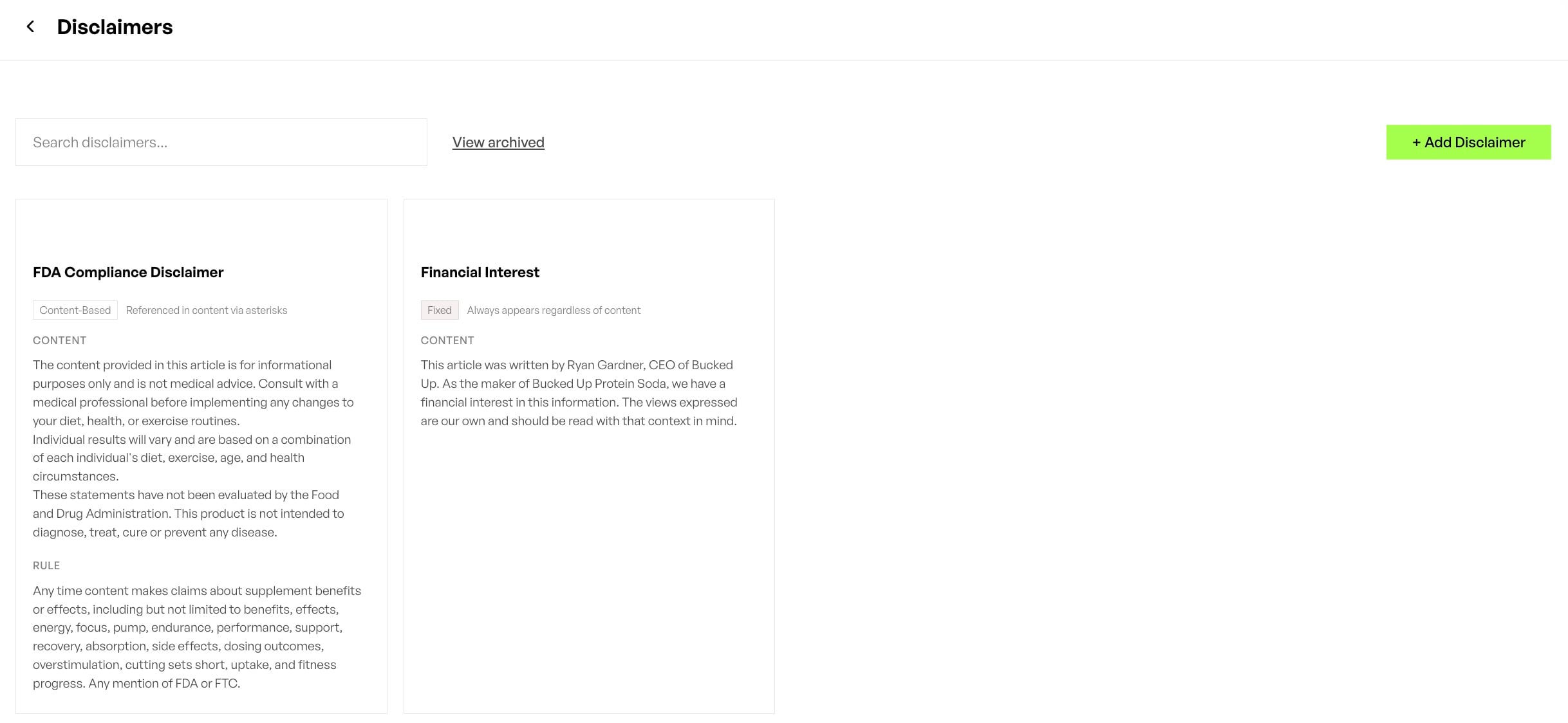
- Close with legal disclaimers and sector-specific conservative language in regulated fields to signal trustworthiness to both AI systems and human reviewers.
An extractable E-E-A-T passage for AI retrieval: E-E-A-T (Experience, Expertise, Authoritativeness, Trustworthiness) is Google’s framework for evaluating content quality. Content with strong E-E-A-T signals is often cited in AI Overviews, so named authorship, primary-source citations, and consistent entity signals matter for AI citation eligibility.
Making Authority Machine-Readable With Structured Data
Once you establish strong E-E-A-T signals, the next step is making that authority machine-readable. Structured data and schema markup give AI systems a clear technical map of your content.
No Semrush study in the evidence reports a citation likelihood lift for schema markup. Many cited pages still implement structured data. FAQPage schema for question-and-answer content can increase AI visibility for smaller websites.
The table below summarizes current evidence on schema’s impact across different signals.
| Signal | Pages With Schema | Pages Without Schema | Source |
|---|---|---|---|
| Citation likelihood lift | Not reported by Semrush | Baseline | Semrush technical SEO study |
| Share of cited pages implementing structured data | Higher | Lower | ConvertMate |
| FAQPage schema AI visibility lift (smaller sites) | Can be significant | Baseline | MaxIntel |
Keeping Content Fresh So AI Keeps Citing You
Fresh content earns more AI citations than stale pages. Analysis of queries shows that recently updated content receives more citations than older content, and AI systems evaluate freshness primarily through dateModified rather than publish date alone. Ahrefs 2025 analysis of millions of citations determined that AI-cited content is fresher on average than content cited in traditional organic Google results.
Use a self-healing update process for living content:
- Connect Google Search Console signals to a content monitoring layer that flags articles with declining impressions or click-through rates.
- Set automatic annual refresh triggers so every article in a sector updates when the calendar year turns.
- Update the dateModified field in schema markup every time you make substantive content changes, not just on the original publish date.
- Replace outdated statistics with current data and re-validate every external source link for accessibility.
- Use bot-tracking data to find which articles AI crawlers visit most often and prioritize those for quarterly refreshes.
Formatting Content for Easy AI Extraction
Clear, extractable structures help AI systems pull accurate snippets. Research suggests that medium-length passages are cited more often by models including ChatGPT, Perplexity, and Google AI Overviews. Pages with tables can be cited more often than equivalent pages with prose descriptions of the same data. Numbered and bullet lists also outperform baseline prose.
Apply these practices to make content easy for AI to extract:
- Open every section with a direct declarative answer in the first one to two sentences, then add supporting detail.
- Write H2 and H3 headings in concise language under 10 words that map directly to user prompts.
- Keep each section self-contained so AI can pull and reuse individual passages without relying on full page context.
- Use comparison tables for any data that would otherwise appear as prose lists of numbers.
- Write fact-dense sentences that include specific numbers, named entities, dates, and sources rather than vague category references.
- Build content in clean semantic HTML with proper heading hierarchy and avoid client-side rendering for core content.
Kevin Indig’s analysis of 1.2 million AI answers found that 44.2% of citations come from the first 30% of content. Front-loading extractable answers is now a requirement, not a nice-to-have.
Publishing Original Research That AI Prefers to Cite
Original data accelerates topical authority and attracts citations. A study by researchers from Princeton University, Georgia Tech, the Allen Institute for AI, and IIT Delhi found that adding statistics (along with citations and quotations) significantly boosts source visibility in generative engines, with statistics producing the largest gain among the optimization tactics tested.
Content with 19+ data points averages 5.4 AI citations versus 2.8 without. Topical authority explains a significant portion of AI citation variance, while Domain Authority explains less. Publishing original data builds topical authority faster than most other approaches.
Follow this process to publish original research ChatGPT will cite:
- Identify a benchmark question your market asks repeatedly that no one has answered with primary data.
- Collect proprietary data from your own platform, client outcomes, or a structured survey of your customer base.
- Present findings in a named, datestamped report with a clear methodology section so AI systems can attribute the data with confidence.
- Distribute the dataset to industry publications, analyst blogs, and community forums to trigger the citation authority flywheel: publish data, earn press mentions, increase brand recognition in AI training sets, then earn more citations.
- Update the dataset annually and link the new version from the original URL to preserve citation equity.
Turning Third-Party Validation Into Citation Fuel
External proof points help AI systems trust your brand. Brands with profiles on G2, Capterra, Trustpilot, and Yelp have higher citation probability than brands without them. Domains listed on multiple review platforms earned more citations on average versus fewer for absent domains, per SE Ranking’s study. Domains with millions of Reddit mentions averaged more ChatGPT citations versus fewer for domains with minimal Reddit presence.
Use these steps to earn citations from authoritative sites through earned media:
- Claim and fully complete profiles on G2, Capterra, Trustpilot, and Yelp, including category tags, product descriptions, and responses to reviews.
- Participate authentically in Reddit threads and Quora discussions in your category, contributing specific data and named outcomes rather than promotional copy.
- Pitch original data studies to industry publications that AI systems treat as confidence-weighted sources, such as established trade press and analyst blogs.
- Pursue co-referencing with established experts in your field so AI knowledge graphs associate your brand with recognized topical authority.
- Monitor brand mention sentiment across platforms, because clusters of complaints on Reddit or G2 can make a brand recognizable for negative queries.
Building Topical Clusters That AI Reads as Authority
Concentrated topical coverage beats scattered content for AI citations. A site with fewer pieces tightly covering one topic outperforms a site with more pieces spread across multiple topics in citation probability for that specific topic. A site with thirty pages locked into a coherent topical cluster routinely outranks a larger brand site with much higher domain authority on the cluster’s queries because the smaller site offers higher cluster coverage, tighter entity consistency, and more cluster-internal links.
Follow this plan to build a citation-earning topical cluster:
- Select one seed topic your brand can own completely and map every subtopic, related question, edge case, and practical variation beneath it.
- Publish one pillar page that answers the core question comprehensively, then build 10 to 15 supporting articles that each address a single subtopic in full depth.
- Internal-link every supporting article back to the pillar and cross-link related supporting articles to create a semantic network rather than a flat archive.
- Use consistent terminology and entity naming across every article in the cluster so AI knowledge graphs read the brand as a coherent topical authority.
- Expand to the next seed topic only after the first cluster shows citation movement in AI Overviews, AI Mode, and ChatGPT Search.
Using External Citations and Quotes to Boost Visibility
Thoughtful sourcing makes your pages more cite-worthy. The same Princeton study that demonstrated the value of statistics also found that adding citations to authoritative external sources and quotations from credible sources improved AI visibility. Adding quotations from credible sources improved AI visibility, the single highest-impact optimization tested across hundreds of queries validated on live Perplexity results.
Use this sourcing process for authoritative external citations:
- Identify the primary sources AI systems already trust in your category, such as peer-reviewed studies, government datasets, established industry reports, and Wikipedia entries.
- Cite those sources inline using the format: specific number, population, action, timeframe, and source name, because content that includes statistics with clear attribution improves LLM citation rates.
- Use direct quotations from named experts rather than paraphrased summaries, because Claude will not cite a brand’s summary of a study if it can access the original.
- Acknowledge limitations or trade-offs in your content where relevant, because content that explicitly acknowledges limitations receives a citation boost on Claude because it signals intellectual honesty.
- Sanitize outbound links so they support your internal pages rather than sending authority to direct competitors.
Extending Your Brand Across Platforms AI Trusts
Multi-platform presence multiplies your chances of being cited. YouTube mentions correlate with AI visibility, the strongest single predictor in Ahrefs’ December 2025 study of thousands of brands, because AI systems read and extract from video transcripts that persist indefinitely. Google AI Mode cites multiple domains per query and AI Overviews cites multiple domains per query, so brands need a wider distribution of citation sources instead of concentrating in a few outlets. As noted in the third-party validation section, Reddit presence also correlates strongly with citation probability, which makes authentic community participation a key part of multi-platform strategy.
Use this multi-platform distribution plan for AI citation:
- Publish YouTube videos on your core topics with full transcripts and keyword-rich descriptions, because AI systems extract from transcripts independently of view counts.
- Maintain an active LinkedIn presence with named-leader publishing, because LinkedIn climbed in rank on ChatGPT in three months and is cited in a notable share of ChatGPT Search responses per SEMrush’s study.
- Distribute original data to industry newsletters, podcast hosts, and trade publications that AI systems treat as confidence-weighted sources.
- Keep brand entity naming consistent across every platform so AI knowledge graphs see the same brand described the same way across multiple high-trust sources.
Using Named Leaders to Strengthen Entity Visibility
Visible leaders help AI connect your brand to specific topics. LinkedIn is the number one most-cited domain across all six major AI platforms for professional queries covering career, B2B, software, and industry topics, per Profound’s analysis. Named-leader publishing on LinkedIn now acts as a ranking factor for AI visibility. The platform’s rise from rank 11 to rank 5 on ChatGPT represents the largest authority shift observed in a three-month window.
Follow these steps for named-leader publishing that builds entity visibility:
- Assign a named executive as the primary author on pillar content and ensure their LinkedIn profile includes complete work history, skills, and a consistent professional description.
- Publish original commentary from that named leader on LinkedIn at least twice per month, referencing the brand’s proprietary data and linking to published research.
- Add author schema markup to every article that names the leader as author, linking to their LinkedIn profile and a dedicated author page on the brand’s site.
- Seek speaking slots, podcast appearances, and bylines in industry publications under the named leader’s identity to build co-referencing with established experts.
- Maintain consistent wording about the leader’s expertise across all channels so AI knowledge graphs build a strong entity association between the individual and the brand’s core topic.
Turning 10 Factors Into One Repeatable System
The 10 factors above form a progression rather than a flat checklist. E-E-A-T signals create your foundation. Structured data then makes that authority machine-readable. Freshness protocols keep content current. Extractable structures format information for easy retrieval. Original research, third-party validation, and topical clusters amplify authority. External citations, multi-platform presence, and leadership visibility extend that authority across the wider web.
Mapping these factors is the diagnosis. Executing them consistently across hundreds of queries creates the operating challenge. Most brands track a handful of head terms and lose the rest of the conversation by default. The long tail is where AI agents search, and it is where citation authority compounds.
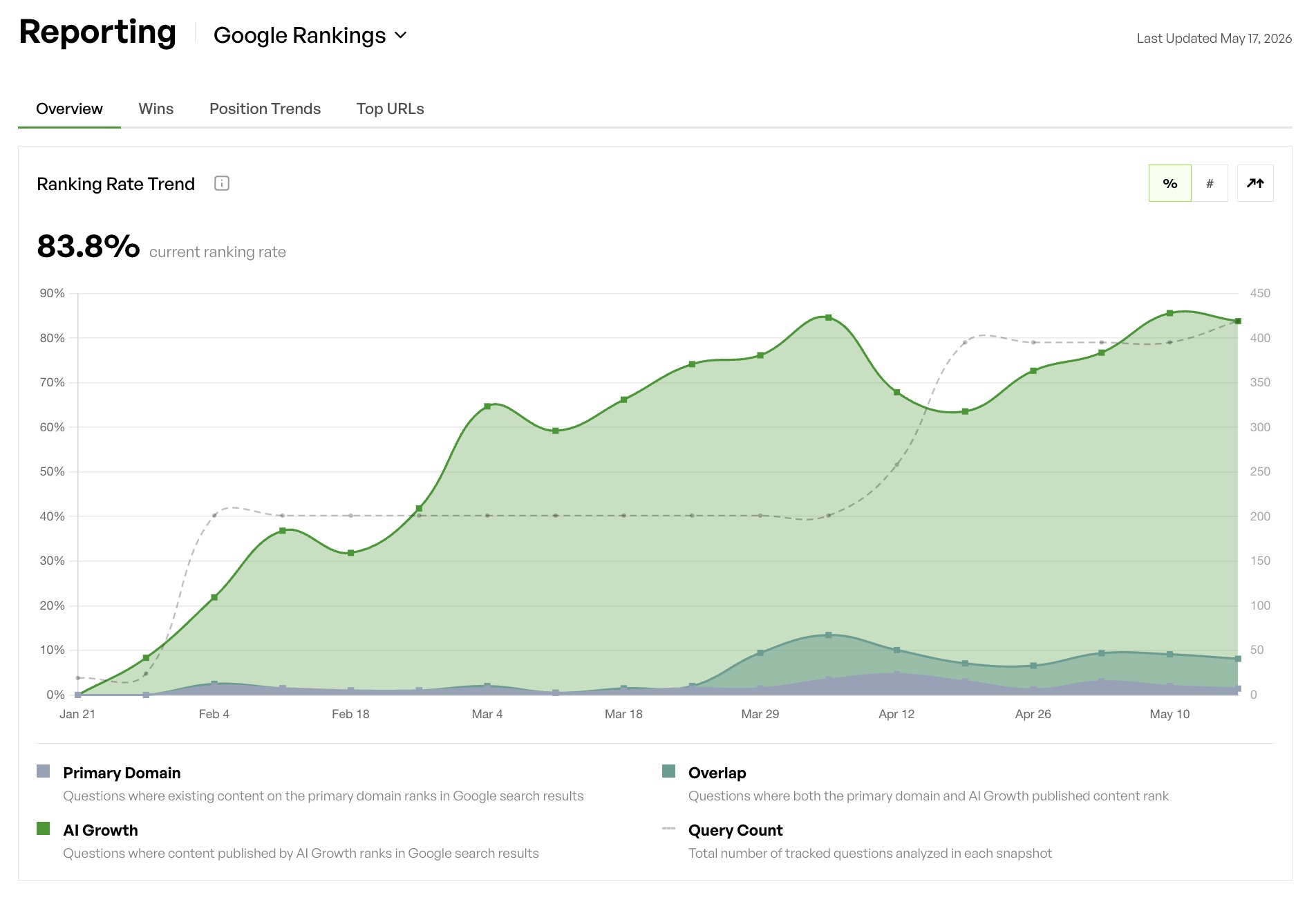
AI Growth Agent functions as the repeatable engine for this work. In the kickoff week, a journalist-led interview produces the brand manifesto, a keyword topology of seed terms and long-tail queries drawn from real-time Google and ChatGPT data, and the first published articles. The engine then maps the full query universe, validates every claim and source against primary evidence, publishes with the full traditional and agentic technical SEO stack including schema, Blog MCP, llms.txt, llms-full.txt, and agent discovery via /.well-known/, and keeps content living through automatic self-healing updates. Clients average additional AI citations and mentions and additional bot visits in the first 12 weeks, with content indexing in as little as 10 days.
This architecture operates as headless marketing. A fully optimized blog that the brand owns connects through a reverse proxy rewrite under the brand’s domain and runs autonomously with no headcount required from the client. One engine replaces the SEO agency, the content tool, the web agency, the GEO monitor, the schema plugin, the analytics stack, and the PR firm.
Frequently Asked Questions
How long does it take to start appearing in ChatGPT and AI search citations?
The first article typically goes live within one week of the kickoff interview. Content has indexed in as little as 10 days and often within two weeks. Meaningful citation movement in AI surfaces including ChatGPT, Perplexity, and Google AI Mode usually becomes visible within the first 30 to 45 days for well-structured content. Perplexity often reflects changes fastest because it relies on live web retrieval. The standard engagement runs as a three-month pilot because indexing timelines vary by industry and query competition, and clients usually see early movement before the pilot ends.
Who owns the content and the site that AI Growth Agent publishes?
The client owns the site and all content outright. AI Growth Agent stands up a fully optimized blog connected to the client’s domain through a reverse proxy rewrite, usually under a subdirectory or through a subdomain. The client’s existing main site remains untouched. There is no agency dependency and no lock-in. If a client ends the engagement, they retain every article and the site itself.
Does the client’s team need technical skills to run this?
No technical skill is required from the client’s side. The engine provisions schema markup, the WordPress plugin, robots.txt, sitemaps, automatic web stories, Blog MCP, agent discovery via /.well-known/, llms.txt and llms-full.txt, instant indexing, autoredirects, and 404 tracking automatically. The only integration step on the client’s side is the reverse proxy rewrite that connects the blog to a subdirectory under their domain. AI Growth Agent provides setup documentation for the client’s specific host, whether Cloudflare, Vercel, or another provider. The internal team gives feedback in plain language and the engine learns from it.
How is citation performance measured, and how do we know the results are actually from AI Growth Agent?
AI Growth Agent publishes into a separate environment so it can report incremental visibility in isolation and never take credit for visibility the brand already had. Reporting covers week-over-week citation movement, bot traffic by bot type including the OAI-SearchBot that ChatGPT uses to cite sources, Google Search Console impressions as an independent audit, and AI ranking by order of mention and citation context. The four data pillars are Search Intelligence, AI Analytics, Bot Tracking, and AI Ranking. Clients who measure best capture source at the conversion moment and consistently see a lift in organic leads after starting.
What happens when the content landscape changes or a competitor starts producing AI content at scale?
Living, self-healing content provides a structural answer to this problem. AI Growth Agent monitors Google Search Console signals and bot-traffic data to identify articles that need refreshing, updates them automatically, and runs more than 3,000 searches per week to keep the universe snapshot current. When something moves in the competitive landscape, clients see it in real time and the engine responds. Quality content and prompt-generated content do not look the same to AI indexers. The brand manifesto plus the journalist-led layer create differentiation that a generic tool cannot replicate. The companies that win control their narrative deliberately instead of generating the most text.
Conclusion: Authority Compounds Only When Content Is Living
The 10 factors above do not work as a one-time checklist. E-E-A-T signals decay when authors go unnamed. Structured data breaks when schema is not maintained. Freshness advantages disappear once content stops updating. Topical authority erodes when competitors publish deeper cluster coverage. Third-party validation requires ongoing earned media, not a single press hit.
Authority compounds only when content stays living. Brands that establish authoritative, self-healing content now are training the next generation of AI models with their own narrative. Brands that wait are ceding that narrative to whatever happens to be sitting on the open web.
Headless marketing provides the architecture that makes compounding possible at scale. A single engine maps the full query universe, validates every claim, publishes with the complete technical and agentic SEO stack, and self-heals over time without added headcount. This shift moves narrative control from reactive to upstream and from a one-time project to a durable competitive position.