Written by: Mariana Fonseca, Editorial Team, AI Growth Agent
Key Takeaways
- New PR agency offerings for AI are productized services that help clients get discovered, cited, and recommended across AI surfaces like ChatGPT, Perplexity, and Google’s AI Mode.
- The three flagship products are AI Visibility (auditing and monitoring), AI Authority (authoritative content production), and AI Reputation (monitoring and correcting AI-generated information).
- These offerings sit on top of traditional PR services such as earned media, thought leadership, and crisis communications rather than replacing them.
- Agencies are adopting GEO strategies and measurement frameworks, and many PR professionals now treat AI search visibility as a core part of the communications strategy.
- AI Growth Agent provides the delivery engine that maps queries, produces authoritative content, and reports incremental visibility without per-prompt billing.
Book A Demo With AI Growth Agent
The Three Flagship Products PR Agencies Are Selling In 2026
AI Visibility
AI Visibility is the standalone diagnostic and monitoring product. It tells a client exactly how they appear across AI answer engines and how that position changes over time. Deliverables include a structured audit that benchmarks competitors, identifies the publications and content types most frequently cited in AI responses, and surfaces narrative gaps or inaccuracies. Monthly reporting covers citation tracking, prompt monitoring across multiple large language models, and a competitive comparison that shows where the brand ranks in AI answers relative to its peers. V2 Communications launched its AI Visibility solution on February 26, 2026, powered by an AI auditing platform that analyzes brand presence within ChatGPT, Google AI Overviews, Gemini, Claude, and other large language models.
Traditional PR services underneath it include media monitoring, coverage reporting, and competitive press analysis.
AI Authority
AI Authority is the content and thought-leadership layer. It produces the authoritative content that AI surfaces cite when they describe the brand. It positions executives and the organization as the primary reference point in their category. Deliverables include authoritative content production, executive positioning programs, and a systematic effort to place the brand in the outlets and formats that AI systems favor. Earned media accounts for 84% of AI citations, with journalism alone representing 27%, so the press placements an agency already secures become the raw material for AI authority when structured correctly.
Traditional PR services underneath it include thought leadership, byline placement, executive media training, and editorial calendar management.
AI Reputation
AI Reputation is the crisis-adjacent product. It monitors what AI says about the brand and its executives, identifies hallucinated or outdated facts, and executes a remediation path through authoritative sources. SPM Communications launched Engineered Brand Discovery on May 21, 2026. Its strategic GEO practice includes LLM-driven crisis response within its crisis communications offering. The practice tracks prompt responses from five large language models daily, measuring visibility score, mention rate, rank, source citations, and competitive position.
Traditional PR services underneath it include crisis communications, reputation monitoring, and issues management.
How AI Is Reshaping PR Work In 2026
Those three products reflect a broader shift in how PR work is done. AI is now used in the PR industry primarily to monitor, influence, and measure how brands appear in AI-generated answers. A growing number of agencies are launching productized GEO services on top of their existing earned media work. Muck Rack’s July 9, 2026 State of PR report found that 73% of PR professionals say Generative Engine Optimization (GEO) is at least somewhat important to their communications strategy, yet 29% say no one at their organization owns it and 39% are not measuring it at all.
The agency launches grounding this shift are real and dated. V2 Communications launched its AI Authority and Earned Media at Scale capabilities on February 26, 2026, connecting earned, owned, and social signals into a single system for AI-driven discovery. SPM Communications announced Engineered Brand Discovery on May 21, 2026, a full-service GEO offering spanning owned, earned, and social channels with daily prompt tracking across five large language models. These are productized service lines with named deliverables and measurement frameworks, built on the recognition that approximately 99% of AI citations come from non-paid sources, which makes earned media the most direct input into AI visibility.
What AI PR Tools Agencies Actually Use
Agencies in 2026 use two distinct categories of tools. Monitoring-first platforms meter prompts and hand the work back to a human. Delivery engines map, publish, and self-heal. The first category tells an agency what is wrong. The second category fixes it.
Monitoring-first tools track whether a brand appears for a configured set of prompts. They surface gaps and generate recommendations. Acting on those recommendations, producing and publishing the content, maintaining the technical infrastructure, and proving the incremental result all sit with the agency and its client. That gap is the delivery problem no monitoring tool closes.
AI Growth Agent is the delivery engine that closes the loop. It maps the client’s full universe of seed terms and long-tail queries from real-time Google and ChatGPT data. It produces authoritative content that validates every claim and source. It stands up a fully optimized site the agency’s client owns within the first week, and it reports incremental visibility week over week. Prompt count is never a billed metric. Pricing is a flat fee, and that fee does not change based on article volume, credit usage, or the number of prompts tracked. The agency keeps the client relationship and the strategy. The engine handles the technical stack.
See The Delivery Engine In Action
How PR Agencies Measure AI Visibility
The PRCA AI Innovation Group published “How to Measure GEO” in June 2026 as practical guidance for PR and communications teams. Its central argument is that article counts no longer describe what clients are buying. Information footprint does. To make that shift operational, the guide recommends seven starter metrics: GenAI visibility percentage by topic, GenAI share of voice versus competitors, GenAI net sentiment, cited URL count, branded search volume trend, key event completions, and accuracy of AI answers.
Citation context replaces the old ranking number. Where the brand appears in an AI answer, who it is grouped with, and what claim it is cited for become the new leaderboard positions. The PRCA guide structures reporting in three tiers: a boardroom view of objective and result, a programme-team view of quality and reach, and an analyst view with full prompt and platform testing detail. That structure maps directly to the client conversations agencies need to have. The boardroom wants to know whether the investment changed the brand’s position, not how many prompts were run.
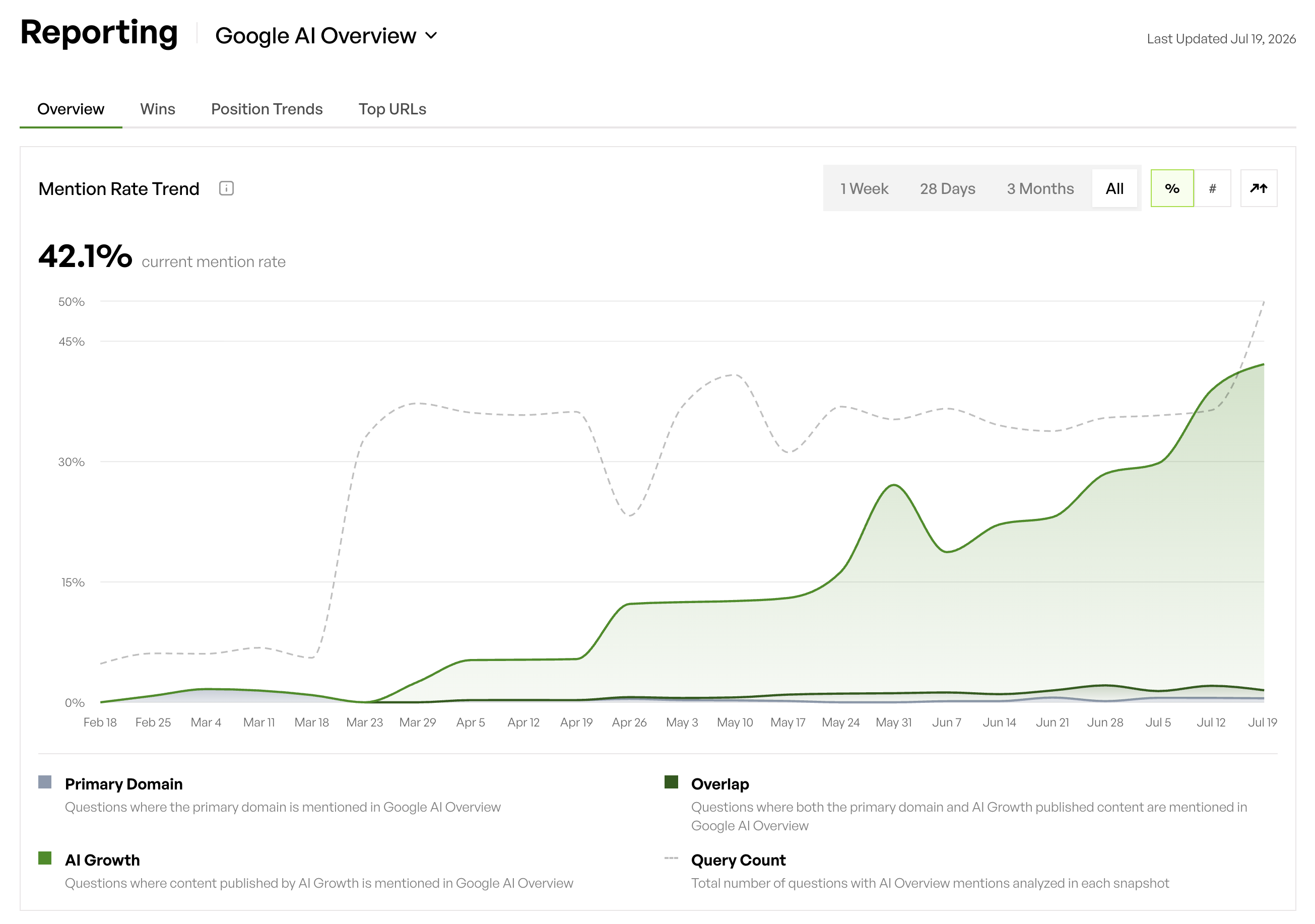
AI Growth Agent is the engine that cross-references bot traffic, Google Search Console, and citation data that no single monitoring tool brings together. It produces incremental visibility reporting that isolates exactly what the new effort generated rather than taking credit for visibility the brand already had.
The Delivery Gap PR Agencies Need To Close
A PR agency can run the strategy, the client relationship, the earned media program, and the measurement narrative. It usually cannot run in-house the technically optimized publishing layer that makes AI visibility work at scale. The blocker is structural: most PR agencies lack an engineer, schema capability, and owned publishing infrastructure.
Traditional technical SEO is now table stakes for any content that expects to be cited by AI surfaces. That work includes structured HTML and rich schema markup so answer engines can parse the page. It also includes full metadata and proper sitemaps so crawlers can find it, internal and sanitized external linking so authority flows to the right pages, and instant indexing, autoredirects, and 404 tracking so nothing breaks as the site grows. The PRCA’s June 2026 guide states that most organizations would gain more from solid, broad technical SEO than from any GEO-specific tactic, because answer engines lean on search and retrieval.

On top of traditional technical SEO, agentic technical SEO now matters. That includes Blog MCP, agent discovery via /.well-known/, llms.txt and llms-full.txt, and Markdown served to agent crawlers. These formats are the way AI surfaces read and cite content.
AI Growth Agent provisions all of it automatically. The only integration step is a reverse proxy rewrite under a subdirectory or a subdomain, or the dedicated Shopify plugin for Shopify merchants. The agency keeps the client relationship and the strategy. The engine handles the technical stack, the publishing, the self-healing, and the reporting.
How AI Is Changing PR Jobs
AI is changing PR work by displacing the slow earned-media retainer model and creating a new service line for the agency that adapts. The distinction sits between the agency that keeps selling the same press-placement retainer and the agency that layers AI search on top of press and influencer work as a measurable, recurrent offering.
61% of PR professionals expect AI and automation to grow in importance over the next five years, and 51% say thought leadership accounts for at least a quarter of their job, up six percentage points year over year. Those two trends point in the same direction. The skills that define PR, such as authoritative storytelling, source relationships, and narrative strategy, are exactly what AI surfaces reward. The agency that packages those skills into an AI service line becomes more valuable.
AI Growth Agent replaces the traditional earned-media vendor that a brand no longer needs in its stack. It does not replace the forward-thinking agency that runs the engine on behalf of its clients. That agency uses AI Growth Agent to deliver a capability its competitors cannot match and to turn AI search into a high-margin, recurrent service line.
How To Position The Agency In The AI Discovery Era
The winning label in 2026 is closer to “PR for the AI discovery era” than to “AI PR agency.” The agency layers AI search on top of its press and influencer work as a new service line, without hiring an engineer, an SEO specialist, or a content team. That framing keeps the agency’s existing identity intact while opening a capability that clients are actively asking for.
AI Growth Agent is the intelligence and content engine behind that offering. It turns AI search into a high-margin, recurrent service line in a traditionally low-margin industry. The agency walks into client meetings with a data-backed point of view and walks out delivering visibility in AI answers, not just impressions.
Add An AI Visibility Service Line
Frequently Asked Questions
What Are New PR Agency Offerings For AI?
New PR agency offerings for AI are productized services that help clients get discovered, cited, and recommended across AI surfaces. The three flagship products are detailed above. In short, AI Visibility audits and monitors, AI Authority produces citable content, and AI Reputation corrects what AI says about the brand.
How Is AI Being Used In The PR Industry?
AI is used in the PR industry to monitor brand appearance in AI-generated answers, produce content structured for AI citation, and measure share of voice across large language models. Agencies are launching productized GEO service lines because earned media, the core of PR work, accounts for most AI citations. That reality places PR teams in a natural position to own AI search visibility.
What AI PR Tools Do Agencies Actually Use?
Agencies use monitoring-first tools that track brand appearance for a configured set of prompts and delivery engines that map, produce, publish, and self-heal content at scale. Monitoring tools identify gaps and hand the work back to the agency. Delivery engines close the loop. AI Growth Agent is the delivery engine built specifically for this, with flat-fee pricing and no per-prompt billing.
Is AI Replacing PR Jobs?
AI is changing PR roles by shifting value toward measurable AI search visibility and away from slow, retainer-heavy models. The skills that define PR, including authoritative storytelling, source relationships, and narrative strategy, are exactly what AI surfaces reward when deciding what to cite. Agencies that package those skills into an AI service line become more valuable, while static press-placement retainers carry more risk.
How Do PR Agencies Measure AI Visibility?
PR agencies measure AI visibility using a framework grounded in citation context rather than article counts. The PRCA’s June 2026 GEO measurement guidance recommends seven core metrics and a three-tier reporting structure for boardroom, programme team, and analyst views. Client conversations shift from counting articles to explaining how the brand’s information footprint changed.
What Is The Difference Between AEO And AI Visibility?
Answer Engine Optimization (AEO) focuses on structuring content so that specific answer engines return a brand’s content in response to direct questions. AI visibility is the broader outcome, describing how often a brand appears, is cited, and is recommended across AI-generated answers for a defined set of prompts. AEO acts as one input into AI visibility, while AI visibility measures whether those inputs are working and how the brand’s position evolves.
Conclusion: The Delivery Engine Behind The New Service Menu
The old earned-media retainer is losing ground. The agency that layers AI search on top of press and influencer work is gaining it. New PR agency offerings for AI collapse into three sellable products: AI Visibility, AI Authority, and AI Reputation. Each has named deliverables and a measurement framework grounded in the PRCA’s June 2026 GEO guidance, with real industry precedent in the launches from V2 Communications and SPM Communications.
The delivery gap is the problem most competitors leave unaddressed. The structural blocker described earlier, including limited in-house engineering, schema capability, and publishing infrastructure, turns this into a delivery challenge rather than a strategy challenge. Monitoring tools identify the gap and hand the work back. AI Growth Agent closes it. It maps the client’s full universe, produces authoritative self-healing content, stands up a fully optimized owned site within the first week, and reports the incremental visibility it generates rather than the visibility the brand already had. The agency keeps the client relationship and the strategy. The engine handles everything else.
Book A Kickoff And See Your First Article Live