Written by: Mariana Fonseca, Editorial Team, AI Growth Agent
Key Takeaways
- AI search agencies specialize in Generative Engine Optimization (GEO) so brands get cited by AI assistants like ChatGPT, Perplexity, and Google AI Overviews through entity work, citation building, and technical schema audits.
- Traditional SEO foundations still matter, and AI search adds a new layer that focuses on citation rate, share of voice, and presence in AI-generated answers instead of blue-link rankings.
- Core services include entity and semantic work, citation and trust building, technical schema audits, share-of-voice tracking, AI-ready content creation, and AI-specific reporting.
- Pricing ranges from $2,000 to $5,000 for audits and $3,000 to $25,000+ per month for retainers, with flat-fee models giving clearer visibility than per-prompt billing.
- AI Growth Agent replaces the entire agency stack with one autonomous engine that maps queries, produces authoritative content, and delivers measurable results, so you can book a demo today.
Core AI Search Services You Should Demand
- Entity And Semantic Optimization: Your content must align with the real-world concepts, people, and connected data AI engines use to judge credibility. AI systems evaluate brands as structured entities, not keyword-matched pages. Schema markup, cross-platform consistency, and knowledge graph signals now carry weight that traditional SEO rarely emphasized.
- Citation And Trust Building: Your brand needs mentions on third-party directories, industry media, and trusted marketplaces that feed data into LLMs. Brand mentions correlate with AI visibility about three times more strongly than backlinks, which reshapes how you build and measure authority.
- Technical And Schema Audits: Your site must use advanced schema markup and clean crawl paths so AI agents can read and parse pages. This work includes llms.txt files, robots.txt configuration for AI crawlers, and structured data that AI systems can extract reliably. Blocking AI crawlers via robots.txt quickly removes a brand from generative search results.
- Share-Of-Voice Tracking: Your agency should measure how often your brand appears in specific AI prompts compared to competitors, with a clear baseline before work starts. Citation rate only has meaning in competitive context, so every visibility number needs a share-of-voice comparison.
- Content Creation: Your content should be structured for AI extraction as well as human reading. That means answer-first formatting and validated claims. Content should follow direct question-answer formats, clear headings, and extractable facts.
- Reporting: Your reports should highlight AI-specific metrics like citation rate, share of voice, and prompt coverage instead of traditional rankings. Standard web analytics tools do not capture these natively.
You need this full stack of services before you sign with any AI search agency, because partial coverage leaves visibility gaps.

AI Search Pricing Models And Real Costs
AI search pricing varies more than SEO or PPC because the category is still young and packages are not standardized. Entry-level AI visibility audits usually cost $2,000 to $5,000 as a one-time project. Ongoing retainers for SMBs often start at $3,000 to $8,000 per month. Enterprise multi-platform programs can reach $10,000 to $25,000 or more per month.
Common pricing models include flat monthly fees, per-project engagements, per-article billing, and per-prompt billing. Many monitoring tools cap tracked prompts and charge more to expand coverage, which limits your view of the full prompt universe. Flat-fee models with unlimited tracking give clearer visibility and simpler budgeting.
A legitimate provider states exactly how many schema updates, content pieces, and brand-mention placements you receive each month. Vague promises signal weak delivery.
The right pricing model depends on the concrete work the agency delivers. Schedule a consultation session to see what a complete offering includes.
Expected Deliverables From An AI Search Engagement
A well-scoped AI search engagement produces concrete, verifiable outputs you can inspect. If someone outside the engagement cannot verify the work product, it is not a real output.
Typical deliverables include:
- Content calendars that target specific queries and sub-queries users ask across AI platforms
- Published articles structured for AI extraction, with answer-first formatting and validated claims
- Technical SEO implementations such as schema markup, llms.txt files, and robots.txt configuration for AI crawlers
- Monthly reports that track citation frequency and share of voice across platforms
- Dashboards that show platform-specific performance against a documented baseline
Incremental visibility reporting matters as much as the deliverables themselves. A genuine AI search agency separates the visibility it generates from the visibility your brand already had. If an agency cannot isolate its contribution, it claims credit for results it did not create.
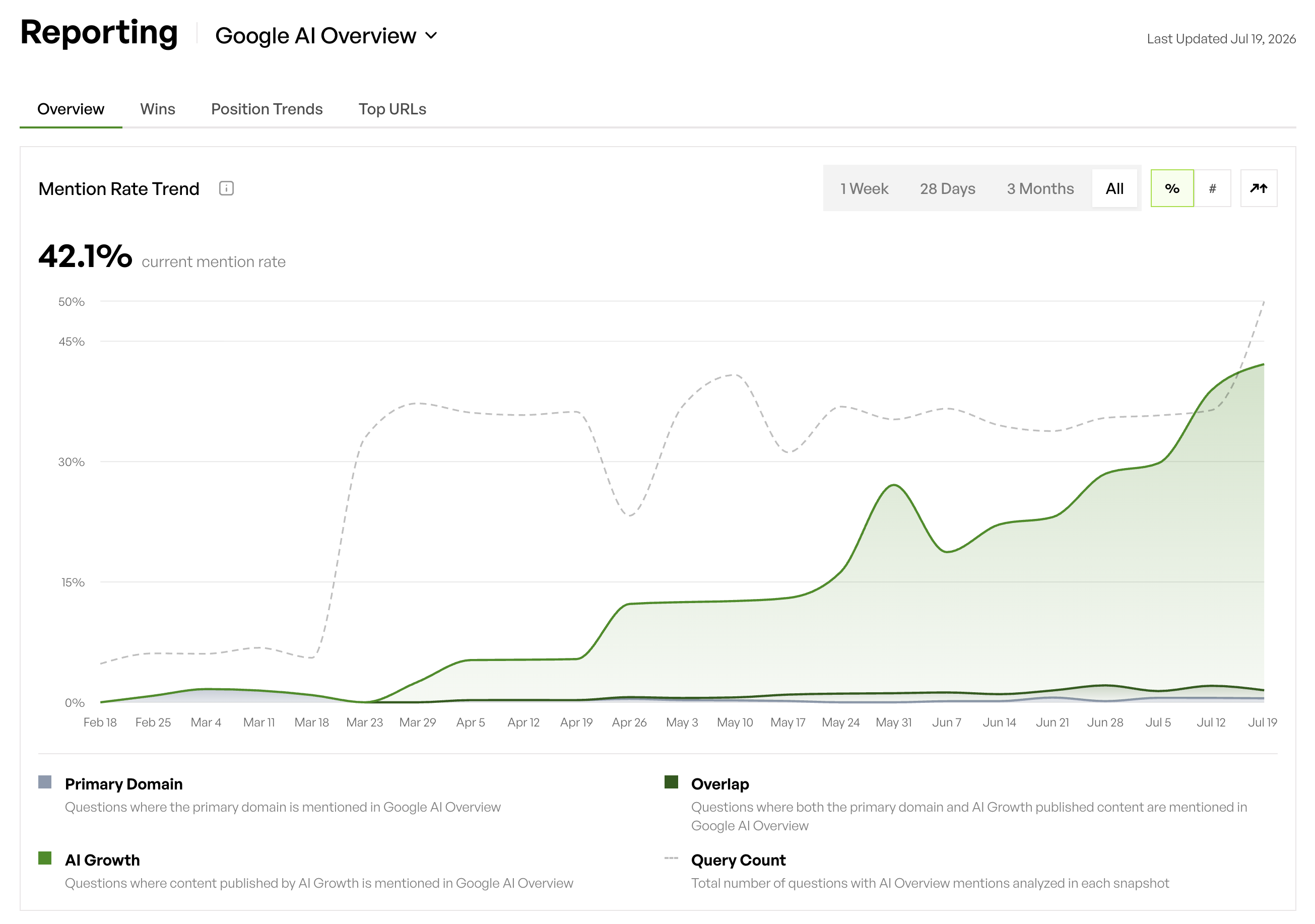
Deliverables show what you pay for, and measurement shows whether the work performs. Schedule a demo to confirm fit and see exactly what you should receive.
How To Vet An AI Search Agency
You need specific questions and clear red flags when you evaluate AI search partners.
Key questions to ask any prospective AI search agency:
- “How do you track citations across platforms?”
- “What is your approach to content freshness?”
- “Walk me through your AI visibility audit process.”
- “What structured data types will you implement on my site?”
- “Can you share AI citation data from a current client?”
- “What does month one look like?”
Red flags to watch for:
- Agencies that only monitor and hand back to-do lists instead of closing the loop
- Capped tracked prompts that block a full view of your prompt universe
- No ownership or control of the publishing infrastructure
- Guarantees of AI citations, which no reputable agency can legitimately make because LLM retrieval mechanisms remain outside direct control
- Lack of transparency about data sources and sampling methods
- Success measured only in traffic or impressions instead of citation rate and prompt coverage
- No mention of entity optimization or structured data, no AI visibility measurement, and vague claims with no specifics, which signals a rebranded SEO shop
The right partner explains its approach in detail and connects each step to measurable outcomes. If an agency cannot do that, keep looking and schedule a consultation with AI Growth Agent.
AI Search Metrics That Prove Success
Three primary metrics define AI search performance: citation rate, share of voice across AI platforms, and prompt coverage. Standard web analytics tools do not capture these natively.
Traditional rankings matter less in this channel. Citation context now plays the role rankings once held. You need to know where your brand appears in an AI answer, which brands appear alongside you, and which claims reference your content. AI-origin sessions usually convert at 1.5 to 3 times the rate of organic-search sessions because buyers arrive pre-qualified by the AI answer.
The metrics an agency reports reveal what it truly does. Confirm that those metrics match your required outcomes and see AI Growth Agent’s reporting in action.
Common AI Search Pitfalls To Avoid
Many companies assume their SEO agency already covers AI search, then discover the agency simply rebranded its keyword-ranking playbook as GEO. The measurement layer exposes this. If an agency claims AI citation visibility while relying on traditional rank tracking software and position data, it has not rebuilt its approach.
DIY chatbot content creates another trap. One company produced about 300 articles with AI tools and no system, and none of those articles received citations. The content contained errors and gaps. A chatbot can produce one strong article, then quality drifts as you repeat the process without a structured engine.
Monitoring tools that stop at alerts form the third common mistake. Monitoring tools show where you remain invisible, but they do not create visibility. If an agency hands you a to-do list, it has not delivered the outcome. Even the action layers monitoring tools added in 2026 still send work back to humans, leaving brands to produce and publish content without a scalable system.
You can avoid each of these pitfalls with the right architecture. AI Growth Agent removes them by design, so schedule a consultation session.
Why AI Growth Agent Leads AI Search
AI Growth Agent turns your brand into the answer instead of just reporting where you stand.
AI Growth Agent replaces the entire agency stack with one autonomous engine. A single engine replaces the SEO agency, the content tool, the web agency, the GEO monitor, the schema plugin, the analytics stack, and the PR firm. It maps your full universe of seed terms and long-tail queries from real-time Google and ChatGPT data. It then produces authoritative content that validates every claim and source, launches a fully optimized site you own within the first week, and reports the incremental visibility it generates every week.
The content stays alive and current. It updates and self-heals over time instead of going stale. Pricing uses a flat fee with no per-article charges, credit limits, or per-prompt billing, so you see your entire universe instead of a small set of tracked terms. Across the first twelve weeks, AI Growth Agent clients often gain more than 12,000 additional AI citations and mentions, over 100,000 additional bot visits, and a 20%+ lift in impressions, with content indexing in as little as ten days and the first article live within a week.
This approach delivers large language model optimization at Level 4 autonomy. The AI operates on its own within a predefined domain, creates plans, executes them, handles its own errors, and alerts a human only when it hits a roadblock it cannot resolve. The human manages by exception while the engine drives the program. This model provides narrative control instead of a basic AI content factory.
The client results show the impact. Breadless now ranks among the most recommended healthy franchises in the US within its search universe, ahead of CAVA, Rush Bowls, and Sweetgreen, with ChatGPT citing eatbreadless.com over 45,000 times per month and a 30x lift in Google Search Console impressions over six months. Leva Sleep now stands as the most mentioned retailer for adjustable beds in Canada, with ChatGPT citing Leva Sleep content over 10,000 times per month and $40,000 to $50,000 in deals closed in under three weeks from buyers who discovered them through AI Growth Agent content.
AI Growth Agent turns traditional search reporting into proactive AI visibility. Book a kickoff and see your first article live within a week.
Frequently Asked Questions
What Does An AI Search Agency Do?
An AI search agency improves a brand’s presence in AI-generated answers across ChatGPT, Perplexity, Google AI Overviews, Gemini, and similar surfaces. Services include entity work, citation building, technical schema audits, share-of-voice tracking, and content creation structured for AI extraction. The goal is to become the source an AI system cites or summarizes in a generated answer, including zero-click scenarios where users never visit the site.
How Much Does AI Search Optimization Cost?
Entry-level audits usually cost $2,000 to $5,000 as a one-time project. Ongoing retainers often range from $3,000 to $8,000 per month for SMBs, $4,000 to $8,000 for mid-market engagements, and $10,000 to $25,000 or more for enterprise multi-platform programs. Flat-fee models with unlimited tracking provide clearer visibility than per-prompt billing, which caps insight into your universe and charges more to expand coverage.
How Is An AI Search Agency Different From A Traditional SEO Agency?
Traditional SEO focuses on ranking blue links in Google’s organic results. AI search optimization focuses on earning citations in AI-generated answers. It adds entity work, structured data, citation-focused strategy, and different measurement. AI search sits on top of SEO because AI systems still rely on the same technical foundation, including crawlability, site speed, and clean structure. The key difference is that AI systems evaluate brands as structured entities, and success is measured in citation rate and share of voice instead of ranking position and click-through rate.
How Long Until We See Results?
Initial AI citation gains usually appear within 30 to 60 days for well-established domains, especially after technical fixes such as unblocking AI crawlers and implementing schema markup. Consistent AI search visibility typically requires 3 to 6 months of sustained work. Building durable LLM authority usually takes 6 to 12 months. Any promise of full results in 30 days ignores how the mechanism actually behaves.
Do We Need A Technical Team To Run This?
You do not need an internal technical team for a complete AI search program. A genuine AI search agency handles schema, llms.txt files, robots.txt configuration, and technical SEO end to end. If an agency hands technical work back to your team, it has not delivered a complete offering. A headless marketing engine provisions valid schema, advanced WordPress plugins, bot tracking, agent discovery, and the full technical stack automatically, with no engineering hours required on your side.
Can An Agency Guarantee AI Citations?
No agency can guarantee specific citations. LLM retrieval mechanisms remain outside direct control. AI answers generate per query and per session, influenced by phrasing, context, and model updates the agency does not manage. A strong agency systematically builds signals that increase citation likelihood, including content authority, structured data, entity clarity, and third-party credibility, and then proves that probability is rising through repeated sampling against a documented baseline. Any agency that guarantees specific AI rankings or citation positions shows a weak grasp of AI search.
Ready to see a complete AI search agency offering in practice? Book a kickoff with AI Growth Agent.