Written by: Mariana Fonseca, Editorial Team, AI Growth Agent
Key Takeaways
- Google AI Overviews now appear on roughly half of US queries, and cited brands earn 120% more organic clicks than uncited ones. Visibility in AI answers now shapes brand survival.
- An AI Overviews audit measures brand mention rate, citation context, share of voice, and query trigger rate so you can see where your brand wins or loses AI-generated answers.
- The audit combines manual incognito testing, Google Search Console’s generative AI performance report, and third-party tools to capture snapshot and trend data across 20–50 target queries.
- Pages that answer queries in the first 100–150 words, use clear headings, lists, and tables, and receive frequent updates earn far more AI citations than older, unstructured content.
What An AI Overviews Audit Covers
An AI Overviews audit reviews how often and how favorably your brand appears in Google’s AI-generated answers. It measures visibility across target queries, highlights citation gaps, and shows where competitors win mentions instead of you.
The audit focuses on four core metrics:
- Brand Mention Rate: How often your brand name appears in AI-generated answers across your target query set.
- Citation Context: The claim your brand is cited for and how it is positioned relative to competitors in the answer.
- Share Of Voice: Your citation frequency as a percentage of all brand citations across your tracked queries.
- Query Trigger Rate: Which queries in your set produce an AI Overview and which return only classic results.
Google has confirmed that no special AI Overview markup is required. Content quality, structure, and authority determine citation eligibility, and the audit shows where those factors already work and where they fall short.
Setting Up Your AI Overviews Audit
Step 1: Define Your Target Queries. Start with seed terms that describe your market, then expand to the long-tail questions your customers actually ask. Use Google’s autocomplete, “People Also Ask” panels, and conversational AI tools to surface real buyer phrasing. Write queries the way a person would speak to an assistant, because AI Mode responds to natural language rather than two-word keywords. Aim for 20 to 50 queries, grouped into buckets such as category definition, how-to and workflow, tool shortlisting, comparison, and high-intent commercial queries tied to your key product lines.
Step 2: Identify Your Competitors. List three to five brands that should appear alongside you in AI answers. Use tools like Semrush or Ahrefs to see who ranks organically in your space. These brands form the benchmark for citation share throughout the audit.
Step 3: Gather Your Data Sources. You need three inputs:
- Google Search Console, specifically the generative AI performance report.
- Manual testing results from incognito browser sessions.
- Optionally, a third-party AI visibility tool for scale and trend data.
Prepare a tracking spreadsheet with columns for query, AI Overview present (yes/no), brand mentioned (yes/no), competitor mentioned, cited URL, citation context, and priority tier.
Checking Whether Your Brand Appears In AI Overviews
Step 4: Run Manual Tests. Open an incognito browser window, set your location to your primary market, and search each target query on Google. For each query, record whether an AI Overview appears. When it does, expand the citations and note whether your brand or domain is listed. Capture the exact claim your brand is cited for, the position within the answer, and which competitors appear alongside you. Sample each query at least three times to account for AI variability, where the same query can return different answers minutes apart.
Step 5: Use The Google Search Console Generative AI Performance Report. Google launched the Search Generative AI performance reports on June 3, 2026, and reached full availability by August 2026. The report sits under both the Search results and Discover sections in Search Console, each with its own Generative AI view. It shows impressions from AI Overviews and AI Mode, broken down by page, country, device, and date. Filter by your key pages to see which URLs appear in AI features. The report omits clicks, click-through rate, and query-level data, so treat it as a directional signal rather than a full performance view.
Step 6: Use Third-Party Tools For Scale. Manual testing covers a limited query set. Third-party tools extend coverage across hundreds of queries and provide trend data over time. The table below compares primary options:
| Tool | Pricing Model | Key Features | Limitations |
|---|---|---|---|
| Google Search Console (Generative AI Report) | Free for verified site owners | Impressions from AI Overviews and AI Mode; page, country, device, and date breakdowns | No clicks, CTR, or query-level data; sites with low AI impressions may not see a report |
| Ahrefs Free AI Visibility Checker | Free tier; paid plans from $129/month | Brand checks across ChatGPT, Gemini, Perplexity, Copilot, AI Overviews, and AI Mode | Each report section limited to top five results; no ongoing monitoring on free tier |
| Otterly AI | From $29/month | Daily tracking across ChatGPT, AI Overviews, Perplexity, Copilot; sentiment analysis; 50+ regions | Lite plan limited to 15 prompts; no API access on entry tier |
| Profound | From $99/month | Competitive share-of-voice scoring; audit logs; compliance reporting | Prompt-metered; costly for broad coverage; action layers still require manual work |
| SE Ranking | AI tracking from $129/month | Tracks AI Overviews, AI Mode, ChatGPT, Gemini, and Perplexity within a full SEO suite | AI tracking features newer and less mature than dedicated tools; prompt-metered |
For a comprehensive audit across your full query universe, a dedicated solution like AI Growth Agent maps every query automatically, tracks citations without prompt caps, and connects findings directly to content production.
Analyzing Citation Gaps And Competitor Wins
Step 7: Compare Your Visibility To Competitors. For each query in your set, record which brands receive citations. Look for patterns across topic clusters. Identify where competitors appear consistently and where they hold deeper or more authoritative content. Track citation rate, brand mention rate, and competitor share of voice as separate metrics instead of blending them into a single score.
Step 8: Prioritize Gaps By Business Impact. Treat citation gaps differently based on revenue potential. Focus first on queries that align with high-intent commercial keywords or key product lines. The overlap between AI Overview citations and organic top-10 rankings has collapsed to roughly 17 to 38%, so strong organic rankings no longer guarantee AI citations. Many gaps come from pages that bury the answer, lack extractable structure, or have not been refreshed recently. Content updated within 30 days receives 3.2x more AI citations than older content.
Improving Your AI Overview Citations
Once you know where you lose citations, you can apply consistent fixes. Pages that place direct answers in the first 100 to 150 words, use clear H2 and H3 headings that match question variations, include numbered lists and bullet points for processes, use tables for comparisons, and present original data or research earn more AI visibility. The front-loading statistic mentioned earlier shows how much weight the first section of content carries.
Treat content as a living asset. Google’s AI Overviews favor current, authoritative sources, and a page cited six months ago can lose that citation as fresher content enters the index. Schema markup, particularly Article and FAQ schema, helps Google classify and extract content and supports rich results, although markup alone does not secure a citation.
Given the scale of fixes across dozens or hundreds of queries, most teams struggle to sustain manual updates. AI Growth Agent automates the audit-to-content loop by mapping your full query universe, producing authoritative content validated against primary sources, publishing it to a site you own, and refreshing it over time. The system closes the loop from audit finding to live, indexed content without requiring a separate content team, SEO agency, or web agency.
To take control of your brand’s AI narrative, schedule a consultation with AI Growth Agent.
AI Overviews Audit Checklist
- Define 20 to 50 target queries organized by topic bucket.
- Identify three to five competitors to track citation share against.
- Run manual tests in incognito mode, sampling each query at least three times.
- Pull the Search Console generative AI performance report and filter by key pages.
- Log AI Overview presence, brand mention, competitor mention, cited URL, and citation context for each query.
- Compare your citation rate and share of voice against competitors.
- Prioritize gaps by business impact, focusing on high-intent and commercial queries first.
- Create or update content to answer target queries directly, with structured formatting and front-loaded answers.
- Monitor changes monthly, using Search Console impressions and manual spot-checks as your primary signals.
Use a tracking spreadsheet with these columns: Query, AI Overview Present (Y/N), Brand Mentioned (Y/N), Competitor Mentioned, Cited URL, Citation Context, Priority Tier, and Last Reviewed Date.
Common Mistakes To Avoid
Several recurring patterns weaken AI Overviews audits and slow progress.
- Tracking Only Head Terms. 68% of AI Overview triggers receive fewer than 100 searches per month, so long-tail, high-intent queries carry outsized influence that many brands ignore.
- Ignoring Citation Context. A brand mention differs from a brand recommendation. Record the claim attached to your brand and confirm that the description matches your positioning.
- Relying Solely On Manual Testing. Manual tests capture a single moment. AI answers shift with model updates, new content, and competitor moves, so you need ongoing tracking.
- Changing The Query Set Between Measurement Periods. A visibility figure measured against a changing query set becomes meaningless. Keep the core set fixed and document additions separately.
- Failing To Update Content. Publishing marks the midpoint of the work. Content that never receives updates loses citation eligibility as the landscape evolves.
If you see no AI Overviews for your target queries, test more conversational phrasing or question-format queries. Comparison queries trigger AI Overviews on 95.4% of searches, and question-format queries on 85.9%, so reframing head terms as questions often surfaces the AI Overview layer. When your brand is missing from overviews that do appear, confirm that your content is indexed, that Googlebot is not blocked, and that your pages qualify for snippets.
Measuring The Success Of Your Audit
Audit success shows up across several signals. Track your brand mention rate and citation rate across a fixed query set on a monthly cadence. Monitor Search Console generative AI impressions week over week for the pages you updated. Watch for increases in branded search volume, which can rise 23% within 30 days of a brand’s first AI Overview citation, as a proxy for brand priming even when clicks are hard to attribute.
Most programs benefit from a monthly review. Weekly checks help during active content campaigns or after significant site changes. Use Search Console as your independent audit layer and a third-party tool for competitive share-of-voice data.
AI Growth Agent reports incremental visibility in isolation, showing exactly what it generated week over week, separate from visibility the brand already held. That clarity supports budget conversations with executives who want proof that the investment works.
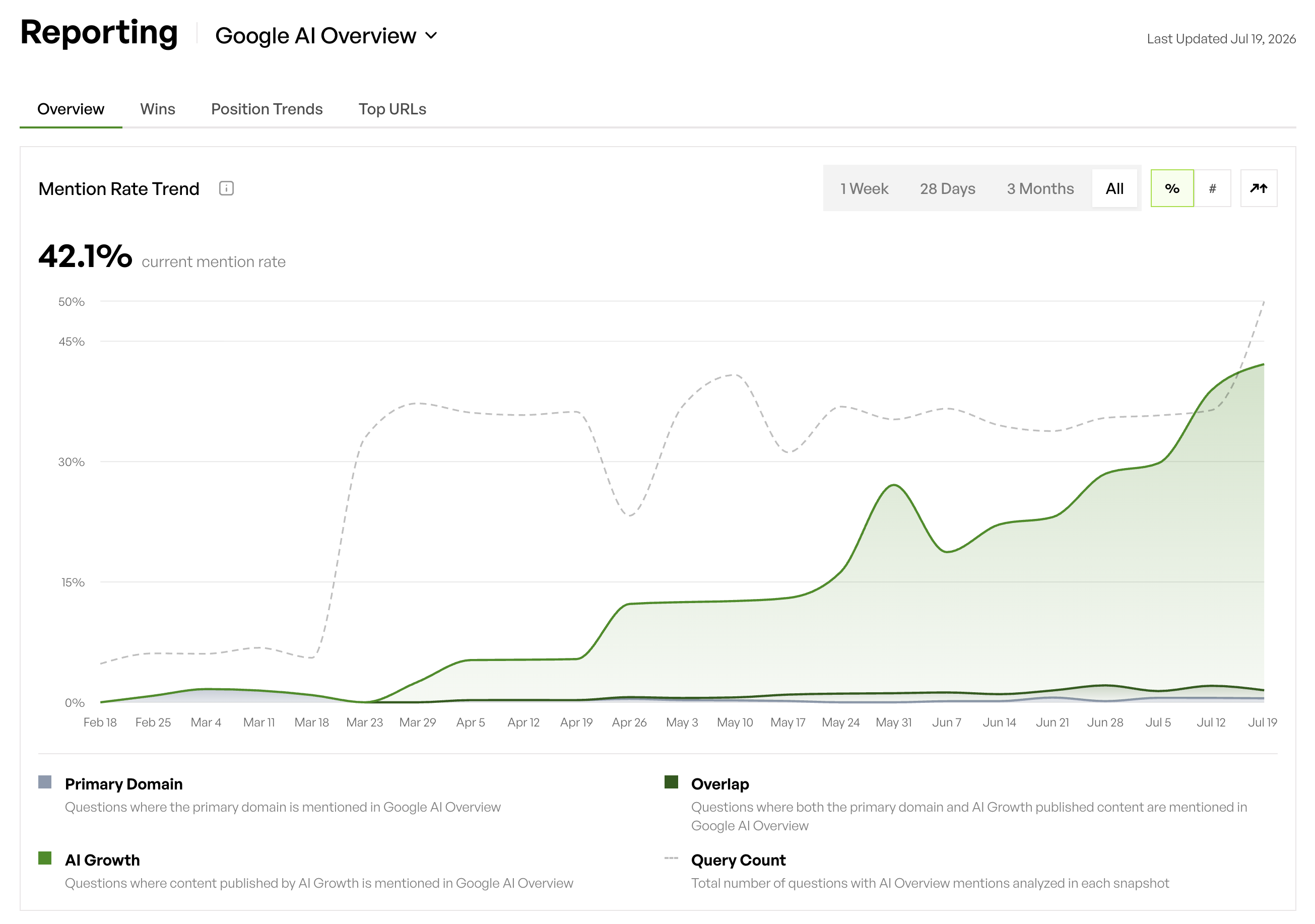
Next Steps: Moving From Audit To Continuous Growth
Brands with large content libraries or multiple domains quickly hit the limits of manual auditing. A mature AI Growth Agent client tracks a universe of 1,600 or more queries, with the engine running more than 3,000 searches every week to refresh the snapshot. Manual workflows cannot operate at that scale.
After the initial audit, the next phase is a continuous improvement program. AI Growth Agent operates at Level 4 autonomy. It plans, executes, and self-heals without daily human input. Each day, a predictive model reviews all account data, calculates the next best action, and maps out the coming week. The human owner manages by exception while the engine delivers results.
Across the first twelve weeks, AI Growth Agent clients often see more than 12,000 additional AI citations and mentions, over 100,000 additional bot visits, and a lift of 20% or more in impressions. Leva Sleep moved from unknown to the most mentioned retailer for adjustable beds in Canada, with ChatGPT citing its content more than 10,000 times per month and $40,000 to $50,000 in deals closed in under three weeks from buyers who discovered the brand through AI Growth Agent content. Breadless became one of the most recommended healthy franchises in the US, ahead of CAVA and Sweetgreen in its search universe, with Google Search Console impressions growing roughly 30x in six months.
See if AI Growth Agent fits your growth goals and schedule a demo to get your first article live within a week.
Frequently Asked Questions
What Is An AI Overviews Audit?
This article describes an AI Overviews audit as a structured review of how often and how favorably your brand appears in Google’s AI-generated answers. The process measures brand mention rate, citation context, share of voice, and which queries in your target set trigger AI Overviews so you can close specific content and structural gaps.
How Often Should I Audit My AI Overviews Visibility?
Most brands benefit from a monthly review cadence. Run a full manual spot-check of your core query set each month and use Search Console generative AI performance data for weekly directional signals. Weekly manual checks also help during active content campaigns, after major site changes, or when a competitor makes a significant move. Keep your query set fixed between periods so you measure the same thing every time.
What Does The New Google Search Console Generative AI Report Show?
The Search Generative AI performance report, which reached full availability by August 2026, shows impressions from AI Overviews and AI Mode, broken down by page, country, device, and date. It omits clicks, click-through rate, and query-level data. The report works best for spotting which URLs Google’s AI features pull from and for tracking week-over-week impression direction on those pages. It covers only Google surfaces and provides no data on ChatGPT, Perplexity, or other AI platforms.
Do I Need Special Schema Or Markup For AI Overviews?
Google does not require special structured data for AI Overview eligibility. A page must be indexed and eligible to show a snippet in standard search results. Article and FAQ schema help Google classify and extract content and support rich results that can increase overall visibility. The main drivers of AI Overview citation remain content quality, directness of the answer, page structure, topical authority, and freshness.