Written by: Mariana Fonseca, Editorial Team, AI Growth Agent
Key Takeaways
- AI search visibility in 2026 relies on a hybrid strategy that pairs programmatic content agents for long-tail coverage with traditional SEO for domain authority.
- Programmatic agents generate hundreds of pages per day at $5–$30 each, while traditional SEO produces 10–30 pages per month at $200–$500+ per page.
- Traditional SEO authority signals remain the primary driver of consistent AI citations, even as Google top-ten rankings no longer guarantee inclusion in AI answers.
- Brands succeed when they map full query universes, publish authoritative content at scale, apply technical and agentic SEO, keep content updated, and report incremental visibility.
- Traditional search tools show you where your brand stands. AI Growth Agent makes your brand the answer.
Programmatic Content Agents and Traditional SEO in Plain Terms
A programmatic content agent is an AI-driven system that automatically generates and publishes content at scale. It targets long-tail queries across the full universe of customer prompts. The system treats content production as a data and engineering problem. It uses structured datasets and templates to produce hundreds of pages where a human team would produce a handful.
Traditional SEO focuses on improving a website for search engines through keyword research, on-page work, link building, and authority building. Each page is researched, written, and edited individually. The goal is to earn rankings and domain trust over time.
Both approaches are evolving quickly in the context of AI search. Each one covers a different part of the discovery landscape.
Key Differences Between Programmatic SEO and Traditional SEO
The table below compares both approaches across six dimensions that matter for AI search visibility. Every data point is sourced inline.
| Dimension | Programmatic Content Agents | Traditional SEO |
|---|---|---|
| Speed | Hundreds of pages per day | 10–30 pages per month |
| Cost per page | $5–$30 for a published, reviewed page | $200–$500+ per page |
| Quality | Variable, depends on data layer and editorial oversight | High, human-edited with deep research |
| Scalability | Limited by data ingestion and compute, not labor | Limited by writing capacity |
| Authority | Low without editorial oversight, risks quality classifiers | High, builds domain trust over time |
| AI Search Implication | Fast long-tail coverage for citations, penalized when thin | Authority signals drive consistent citation |
The authority gap in the table is the critical insight. An Ahrefs 2026 analysis found that only 38% of pages cited inside a Google AI Overview still rank in Google's top ten results for the same query, down from 76% seven months earlier. Traditional ranking no longer reliably predicts AI citation. Traditional SEO authority signals still determine whether AI models trust a source enough to cite it consistently.
When Programmatic Content Agents Create an Edge
Programmatic content agents excel at scale. Their primary advantage is covering the long tail of queries that customers actually ask. These queries represent the vast majority of prompts that a brand focused only on head terms will never reach.
Forrester research highlights that programmatic approaches can capture 5x more long-tail traffic compared to traditional methods, provided the algorithms are properly tuned. Programmatic agents work best when several conditions hold true.
- The brand has strong existing domain authority to support new page indexing.
- The data layer is proprietary and genuinely differentiates each page.
- Editorial oversight is applied before publishing, not after.
- The content targets top-of-funnel queries where breadth of coverage matters.
Real-world outcomes confirm this model. Leva Sleep, running AI Growth Agent's programmatic and authority content engine, became a notable retailer for adjustable beds in Canada. ChatGPT cites its content frequently. Breadless became a recommended healthy franchise in the US. It now earns substantial ChatGPT citations per month and a significant lift in Google Search Console impressions over six months.
These results come from more than volume. They come from volume paired with authority, structure, and validated sourcing. AI surfaces reward that combination.
Where Traditional SEO Still Leads
Traditional SEO builds the trust infrastructure that AI models depend on when deciding which sources to cite. Google's John Mueller has stated that retrieval-augmented generation is basically what SEO works on, making crawlable and indexable content for search, and that flows into all AI Overviews.
Traditional SEO plays a central role in several areas.
- Bottom-of-funnel content where a single authoritative answer is expected.
- High-value pages competing against entrenched domain authorities.
- Building the E-E-A-T signals that AI models use to assess citation worthiness.
- Earning backlinks that compound domain authority over time.
According to RankLens, Live Nation Entertainment's AI brand visibility in July 2026 was extremely low, with an average Visibility Index of about 5 across its entities and the top entity appearing in only about 25% of measured AI iterations. That outcome rests on traditional SEO foundations such as structured HTML, schema, internal linking, and authority signals. These elements make content trustworthy to both Google and the AI surfaces that pull from its index.
Chloe Steele, SEO Account Manager at Verde Digital, notes that GEO is becoming a critical part of SEO as AI-driven search and LLMs shape how information is discovered. She also stresses that traditional SEO fundamentals such as strong technical and on-page optimization and high-quality content following E-E-A-T principles should remain the foundation before teams add specific AI optimization tactics.
The Hybrid Strategy for AI Search Visibility
Brands winning AI search visibility in 2026 run both approaches in parallel. Programmatic agents handle the long tail and rapid content production. Traditional SEO principles, including authority, schema, and technical optimization, ensure that content is trusted and cited. AI Growth Agent executes this combined, headless marketing architecture.
The implementation framework follows five compounding steps.
- Map your universe. Identify the full set of seed terms and long-tail queries that describe your market. Refresh this list weekly from real-time Google and ChatGPT data. Most brands track a handful of head terms and lose the rest of the conversation by default. AI Growth Agent clients start with a few hundred queries and expand to universes of 1,600+ as the engine matures.
- Produce authoritative content at scale. Generate content that validates every claim and source. Combine programmatic volume with journalistic rigor. Adding authoritative citations to content boosts AI visibility by 39.6%, and including specific statistics increases it by 26.5%.
- Apply technical and agentic SEO. Provision schema, MCP endpoints, llms.txt, and advanced robots.txt so AI surfaces can read and trust your content. 82% of domains cited by ChatGPT use schema markup, and implementing it increases the likelihood of appearing in AI-generated summaries by over 36%.
- Monitor and self-heal content. Keep content living and updated so authority compounds instead of decaying. 40–60% of cited sources in AI search change month-to-month, and pages not refreshed in 90 days are three times more likely to lose their citation position.
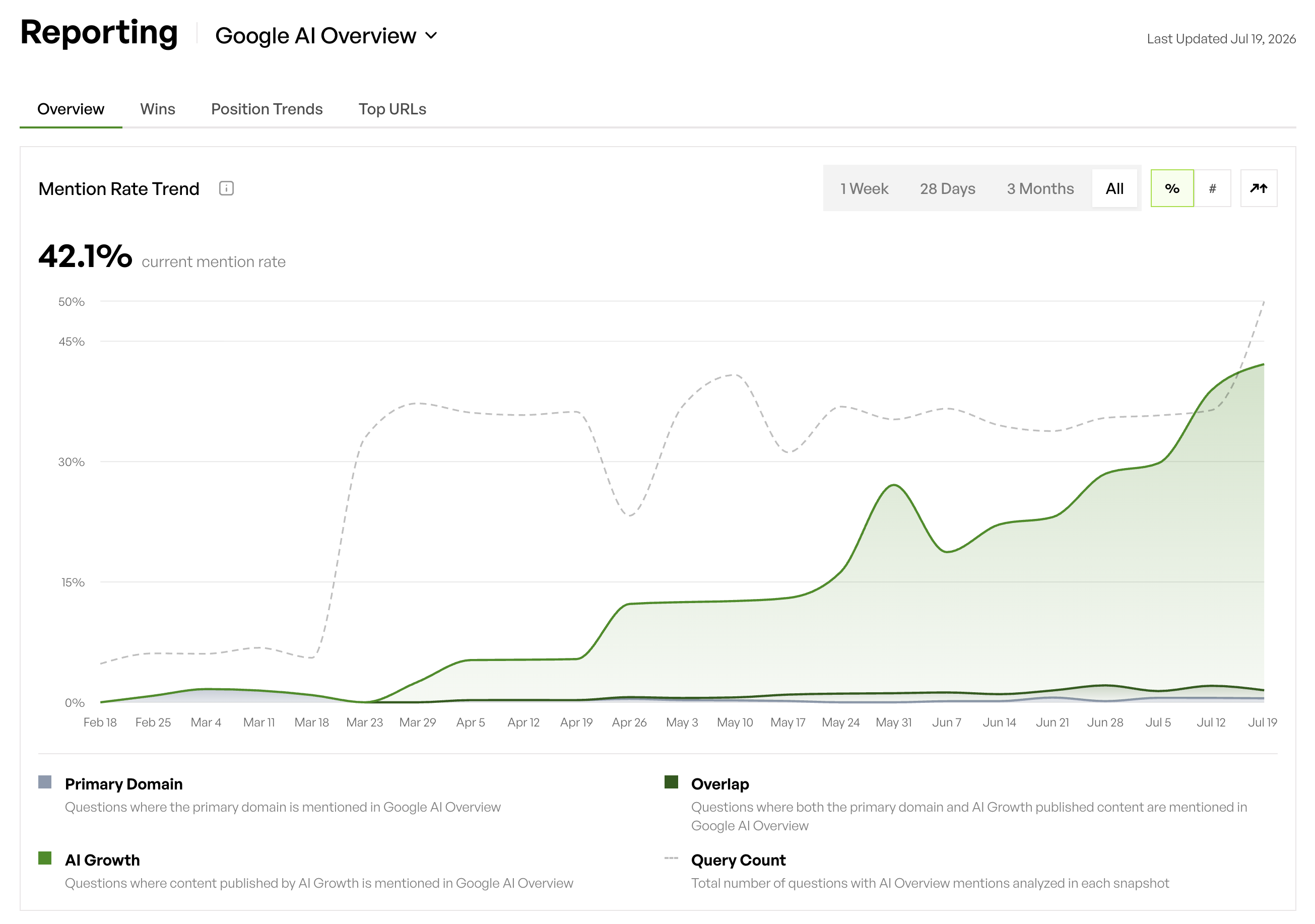
- Report incremental visibility. Isolate exactly what the new effort generated, separate from existing brand visibility. AI Growth Agent clients typically see substantial increases in AI citations, bot visits, and impressions within the first few months.
Stop letting AI define your brand at random. Instead, control the narrative across online search by booking a kickoff with AI Growth Agent to start building your hybrid strategy.
Risks and Pitfalls for Each Approach
Programmatic content agents fail when they produce noise. Noise means content that is not cited because it lacks unique value or authority. The pattern is well documented. The "Casual" AI site published approximately 1,800 AI-generated articles with minimal human review and was fully deindexed in the March 2024 core and spam update. TailRide published 22,000 machine-generated pages and watched traffic drop to effectively zero.
Google's March 2026 core update explicitly targeted scaled content abuse, with AI content farms averaging a 45% traffic loss and programmatic SEO sites averaging a 32% loss. The update does not penalize AI-generated content as such. It penalizes the abuse pattern of producing content at a scale and speed that makes quality control impossible.
Traditional SEO fails in a different way. It moves too slowly to keep pace with AI search dynamics. A typical mid-market agency RFP runs roughly eight to fourteen weeks from draft to signed agreement, followed by about three months to produce the first assets, though timelines vary by scope and channel. By the time content is live, the AI search landscape has often shifted. Traditional SEO also cannot cover the long tail at the scale AI surfaces require. The average conversational query in AI interfaces averages 23 words, representing high-intent research behavior that traditional keyword tools cannot track.
The hybrid approach reduces both failure modes. Programmatic volume is constrained by editorial oversight and a proprietary data layer. Traditional SEO authority extends through programmatic scale. Given these trade-offs, the right investment depends on where your brand sits today.
Decision Framework for Your Next Investment
Strong domain authority, broad market to cover: Lead with programmatic agents for long-tail coverage. Apply traditional SEO principles to every page. Run both in parallel from day one.
Building authority from scratch: Invest in traditional SEO foundations first. Add programmatic scale once the domain has enough authority to support new page indexing. Programmatic SEO on a new domain with no authority typically fails to index.
Mid-market to enterprise with an existing identity: Use a hybrid approach. Programmatic agents provide scale and traditional SEO provides trust. This architecture produces AI search visibility at the speed the market now expects.
As noted earlier, the overlap between Google top-10 rankings and AI-cited sources has collapsed dramatically. Each approach covers only one channel. The hybrid strategy addresses the full discovery landscape without compromise.
FAQ
Is SEO dead now with AI?
SEO remains the foundation that AI search visibility builds on. Every major AI search engine relies on retrieval-augmented generation, which fetches documents from a search index. That index is built through core SEO work such as crawlability, indexability, structured HTML, schema, and authority signals. What changed is that ranking in the top ten no longer guarantees citation inside an AI answer. New disciplines, including large language model optimization and agentic technical SEO, now sit on top of the traditional foundation. The combined stack supports modern discovery.
What are the key differences between programmatic SEO and traditional SEO?
Programmatic SEO focuses on speed and long-tail coverage, while traditional SEO focuses on authority and trust. The comparison table above details how they differ on cost, scale, and AI search impact.
When does programmatic content fail?
Programmatic content fails when it produces thin, templated pages without unique data or editorial oversight. The failure pattern is consistent. Pages rely on single-variable templates where only a city or keyword changes. They lack proprietary data per page and show publishing spikes that engagement signals cannot support. The content offers nothing beyond what AI can already synthesize from existing sources. Google's March 2026 core update made this failure mode more immediate and harder to recover from, extending the Helpful Content classification into a core ranking factor. Recovery requires removing the offending content corpus and rebuilding around E-E-A-T signals, a process that typically takes 60–180 days before site quality re-evaluates.
How do you combine programmatic and traditional SEO for AI search?
The hybrid strategy follows five steps. Start by mapping the full universe of seed terms and long-tail queries using real-time Google and ChatGPT data. Then produce authoritative content at scale, validating every claim and source to combine programmatic volume with journalistic rigor. Next, apply technical and agentic SEO across every page, including schema, MCP endpoints, llms.txt, and advanced robots.txt. After that, keep content living and self-healing so authority compounds instead of decaying. Finally, report incremental visibility in isolation from existing brand visibility so the contribution of the new effort is measurable week over week. AI Growth Agent executes this entire framework as a single headless marketing engine, with no technical headcount required from the client.
How does AI Growth Agent differ from a monitoring tool or a traditional SEO agency?
Monitoring tools track whether a brand appears for a capped set of prompts. They do not produce content, own publishing, or act on the data. Traditional SEO agencies move slowly, cost more, and sit too far from AI surfaces to keep pace. AI Growth Agent takes a different role. It maps the full universe, produces authoritative content that validates every claim and source, stands up a fully optimized site the client owns within the first week, and reports the incremental visibility it generates week over week. The content stays living and self-healing instead of going stale. One engine replaces the SEO agency, the content tool, the GEO monitor, the schema plugin, the analytics stack, and the PR firm. It operates at a flat fee with no per-article charges or per-prompt billing.
Conclusion: Take Control of Your Brand in AI Search
The programmatic content agent vs traditional SEO debate resolves into a single reality. AI search surfaces reward both long-tail coverage and domain authority, and no single approach delivers both. The brands cited in AI answers this year are training the next generation of models with their own narrative. The brands that wait train the next generation with whatever happens to be sitting on the open web.
The hybrid strategy stays straightforward. Map your universe. Produce authoritative content at scale. Apply technical and agentic SEO. Keep content living. Report incremental visibility. The complexity sits in the execution, and AI Growth Agent is built to handle that work.
Traditional search tools show you where your brand stands. AI Growth Agent makes your brand the answer. Book a kickoff and see your first article live within a week.
Read Next
- AI Growth Agent vs. Competitors: Winning in AI Search
- AI Growth Agent Alternatives: Complete Comparison Guide
- AI Content vs Traditional Agencies: The Strategic Choice for AI Search Optimization
- Compare Traditional SEO Agency vs AI Content Platform
- SEO Agency Using AI for Programmatic Content Optimization