Written by: Mariana Fonseca, Editorial Team, AI Growth Agent
Key Takeaways
- Enterprise marketing leaders evaluating AirOps alternatives face four categories: governance tools, GEO monitors, GTM writers, and full execution platforms that replace the entire stack.
- Four evaluation criteria expose where each category stops short: implementation complexity, governance and compliance, AI search visibility tracking, and incremental visibility reporting.
- Governance tools, GEO monitors, and GTM writers each solve specific problems but still require separate tools or teams for content production, publishing, and AI search visibility.
- Full execution platforms like AI Growth Agent combine governance, monitoring, writing, and publishing in one headless engine that maps, publishes, and self-heals a brand’s entire AI search universe.
- Teams ready to replace a fragmented stack with a single engine can book a demo with AI Growth Agent and see a first article live within a week.
Four Evaluation Criteria Enterprise CMOs Use
Enterprise CMOs rely on four criteria to reveal where each category of AirOps alternative falls short.
Implementation complexity. The core issue is not how easy a tool is to demo but how many internal roles, engineering sprints, and agency relationships it needs before the first piece of content indexes. A mature enterprise GEO governance model typically requires named owners for multiple distinct roles, from executive sponsor to legal reviewer to analytics owner, before a program reaches operational status.
Governance and compliance. Brand governance platforms must turn voice, tone, claims, and approval requirements into checkable controls instead of static guidelines. A brand governance platform differs from static brand guidelines by codifying rules into an enforcement layer that checks live drafts, routes content through approvals, and records outcomes, but it still does not replace human review or function as a CMS.
AI search visibility tracking. Effective visibility tracking covers citation rate, mention rate, share of voice, and source attribution across ChatGPT, Perplexity, Google AI Mode, and Gemini, not a single platform.
Incremental visibility reporting. Only 30% of brands that appear in one AI answer maintain visibility in the next answer to the same question, making baseline-isolated, query-level reporting essential. Isolating incremental AI visibility improvements requires tracking new citation wins, competitive displacement rate, and AI bot crawl coverage so teams can prove that gains come from optimization rather than pre-existing brand strength.
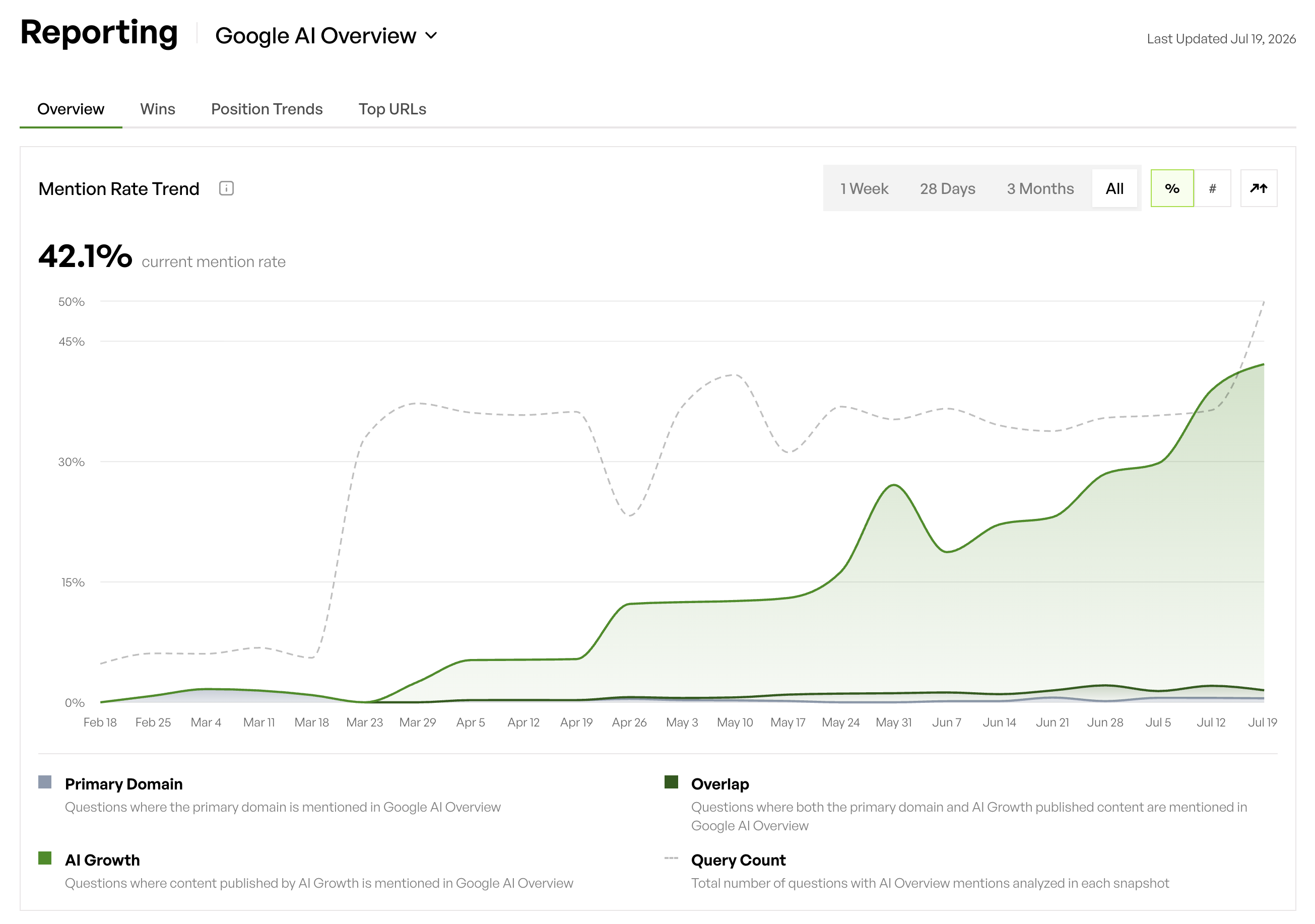
Teams that want to see how a single headless engine maps to all four criteria can schedule a consultation session to see if AI Growth Agent is a good fit.
The following comparison table applies these four evaluation criteria across all categories and shows where each approach excels and where it stops short.
Side-by-Side Category Comparison
| Category | Implementation Complexity | Governance & Compliance | AI Search Visibility Tracking | Incremental Visibility Reporting |
|---|---|---|---|---|
| Governance Tools (e.g., Writer, Jasper) | Requires structured brand inputs, workflow configuration, and human approval steps matched to existing team processes, and content team and legal reviewers must be onboarded separately. | Scores drafts against brand rules and routes through approvals, but does not publish or manage technical SEO, so compliance scope stays limited to internal content. | No native AI citation tracking, which means a separate GEO monitor must measure AI search presence. | No incremental visibility reporting; output is content approval status, not AI citation or impression data. |
| GEO Monitors (e.g., Profound, Athena) | Requires the multi-role governance structure described earlier so teams can turn monitoring data into content action. | No content governance or approval workflow; the monitor observes external AI answers but does not enforce brand rules on content production. | Tracks citation rate, mention rate, share of voice, and sentiment across AI platforms for a capped prompt set but does not produce content to improve those metrics. | Tracks visibility changes over time but cannot isolate gains tied to specific content actions without a separate execution layer. |
| GTM Writers (e.g., Copy.ai) | Average B2B team relies on tools from 23 separate vendors, and GTM writers add to that stack instead of replacing it, which requires RevOps or content ops ownership. | Brand governance remains limited; teams must configure voice rules manually per campaign, and those rules do not enforce compliance at scale across distributed teams. | No native AI search visibility tracking, so a separate monitor must measure citation or mention performance. | No incremental visibility reporting; output is drafted copy, not AI citation or impression data tied to published content. |
| Full Execution Platforms (AI Growth Agent) | Kickoff interview to first published article takes about one week, and a reverse proxy rewrite is the only client integration step, with no engineering team or agency RFP required. | Brand manifesto, style memories, legal disclaimers, and anti-hallucination controls apply to every article at generation, so compliance is configured once and enforced automatically. | A four-pillar data foundation covers Search Intelligence, AI Analytics, Bot Tracking, and AI Ranking across ChatGPT, Perplexity, Google AI Mode, and AI Overviews, with the universe refreshed weekly across 3,000+ searches. | The platform publishes into a separate environment and reports incremental visibility week over week, cross-referencing bot traffic, Google Search Console, and citation data, and clients average more than 12,000 additional AI citations in the first 12 weeks. |
Governance Tools: Six Practical Tradeoffs
Setup timeline. Governance platforms require structured brand inputs, template configuration, and approval workflow mapping before any content ships. Enterprise buyers must match the platform’s operating model to existing team processes, including multi-brand support and separate scorecards by channel or market, which stretches initial setup across multiple stakeholder groups.
Operational efficiency. Once configured, governance tools reduce subjective brand review by providing a content score and flagged issues before human approval. A brand governance platform improves human review by providing a concrete content score and flagged issues before approval instead of relying on subjective judgments, and this structure becomes critical as output scales.
Quality control. Governance tools enforce rules on content that humans or other tools produce, but their scope ends at the approval stage. They do not generate, publish, or validate content against external AI citation standards, so other systems in the stack must handle those functions.
Technical depth. These platforms provide no schema provisioning, no technical SEO, no bot tracking, and no agentic infrastructure. The system checks whether content follows brand rules but does not make that content discoverable by AI surfaces.
Team involvement. Governance platforms are most useful for multi-SKU teams, regional marketing groups, in-house creative teams, agency partners, and creator programs with high monthly output, and all of these groups must stay active participants in the workflow.
Scalability. Governance tools scale approval throughput but not content production volume or AI search coverage. Prompt caps and hidden complexity in multi-brand configurations limit how far a governance tool can extend without additional tooling.
GEO Monitors: Six Practical Tradeoffs
Setup timeline. Prompt set configuration and platform onboarding move relatively fast, yet turning the data into action still requires a cross-functional team. The biggest mistake in enterprise GEO is treating it as an add-on to the SEO team alone, since search specialists do not own product truth, legal signoff, executive messaging, or knowledge-base maintenance.
Operational efficiency. Monitoring dashboards surface citation gaps but do not close them. Every insight still needs a separate content production and publishing workflow before the brand’s AI presence changes.
Quality control. GEO monitors provide no content quality controls because they operate in observation mode only. The monitor reports what AI surfaces say but cannot influence what they say, since it lacks any content production or publishing capability.
Technical depth. Monitors that track a capped prompt set miss most AI visibility opportunities by design, since they only see a narrow slice of the universe.
Team involvement. Enterprise GEO implementation at scale requires a central standards team of 2 to 4 people plus engineering sprints during the rollout year, and execution is then federated to business-unit content owners who must act on monitoring data independently.
Scalability. Prompt count caps limit universe coverage. Only 11% of domains are cited by both ChatGPT and Perplexity, so per-platform measurement multiplies the prompt volume needed for complete coverage.
GTM Writers: Six Practical Tradeoffs
Setup timeline. GTM writers produce copy quickly but still require RevOps or content operations ownership to connect with publishing, CRM, and analytics systems. Enterprise GTM orchestration implementations require a dedicated technical owner with 50% of one person’s time allocated during initial rollout.
Operational efficiency. These tools work well for campaign copy and short-form assets. They become inefficient for long-form, schema-marked, technically sophisticated content at the volume needed to cover an enterprise brand’s full AI search universe.
Quality control. Output quality depends entirely on prompt quality and human review because GTM writers lack systematic controls that ensure consistency at scale. They provide no manifesto-level brand memory, no anti-hallucination cascade, and no claim validation against primary sources, so quality can drift significantly from one piece to the next.
Technical depth. GTM writers provide no schema, no bot tracking, no agentic technical SEO, and no publishing infrastructure. The client must assemble and maintain every surrounding system.
Team involvement. Organizations running fragmented stacks spend more time stitching systems together than executing, and GTM writers add a content layer without removing any surrounding stack dependencies.
Scalability. Workflow fragmentation limits scale. Producing the second article means running the entire process again, and quality drifts over time without a system that enforces consistency.
Full Execution Platforms: Six Practical Tradeoffs
Setup timeline. A journalist-led kickoff interview produces the brand manifesto, keyword topology, and first articles within one week. Content has indexed in as little as ten days. The tradeoff is that manifesto quality directly determines output quality, so a shallow or incomplete manifesto produces content that needs more human correction in early weeks.
Operational efficiency. One engine replaces the SEO agency, content tool, web agency, GEO monitor, schema plugin, analytics stack, and PR firm. The internal team gives feedback in plain language, and the engine saves memories and applies corrections to every future generation without re-briefing.
Quality control. Anti-hallucination controls cascade through every stage of generation. The system prioritizes the manifesto and primary sources, adds verified external research, and then re-extracts claims from the draft and checks them against product pages and primary sources before any article moves to publication.
Technical depth. Every article ships with full schema markup, Blog MCP, OpenAI discovery, Agent Card guidance, llms.txt and llms-full.txt, natural language query parameters, Markdown for agent crawlers, instant indexing, autoredirects, and 404 tracking. The client does not need technical skills.

Team involvement. No additional headcount is required. The client states what to win in plain language, and the engine maps, publishes, monitors, and self-heals. The only integration step is the reverse proxy rewrite that connects the blog to a subdirectory under the brand’s domain.
Scalability. Flat-fee pricing removes per-article charges, credit limits, and per-prompt billing. Mature clients reach universes of 1,600+ queries, with the system running 3,000+ searches weekly to refresh the universe snapshot. The main risk is dependency on manifesto quality and the initial onboarding effort needed to tune the engine to brand voice and compliance requirements.
Best-Fit Use Cases by Team Structure and Maturity
Governance-first teams are typically large enterprises with distributed content operations, multiple brands or SKUs, and existing legal review workflows. They benefit from governance tools when the primary problem is brand consistency across human-produced content at high volume. The gap is that governance tools do not produce content, do not publish, and do not track AI search visibility, so a governance-first team still needs a separate execution and monitoring stack.
GEO-first teams have already invested in AI search monitoring and understand their citation gaps. They fit GEO monitors when the primary need is competitive benchmarking and executive reporting on AI share of voice. The multi-month rollout timeline discussed earlier becomes even longer when teams build on a monitoring-only foundation that still needs separate execution.
Full-execution teams are enterprise CMOs and marketing leaders who need AI search visibility, brand governance, and scalable content production without adding headcount or managing a stack of agencies and tools. They are the primary fit for a headless execution platform. The maturity requirement is a clear brand identity and the ability to complete a kickoff interview that produces a detailed manifesto, while teams without a defined brand voice or product truth should expect more iteration in the first weeks.
Operational Considerations Across Categories
Onboarding effort varies significantly by category. Governance tools require workflow mapping across legal, brand, and content teams. GEO monitors need prompt set design and a cross-functional team to act on data. GTM writers require RevOps ownership and integration with existing publishing systems. Full execution platforms need a kickoff interview and a reverse proxy rewrite, and the engine handles everything else.
Cross-functional dependencies reach their highest levels with governance tools and GEO monitors. Typical editorial SLAs for enterprise GEO include 5 to 10 business days for legal and compliance risk review of high-risk or regulated content, and those delays compound across a large content program. Full execution platforms reduce cross-functional dependencies by handling compliance configuration once at kickoff and applying it automatically to every future generation.
Adaptability to changing search behavior favors living, self-healing content. Static content produced by GTM writers or approved through governance tools goes stale the day it ships. The 30% visibility retention rate mentioned earlier makes continuous content refresh a requirement rather than a nice-to-have.
Risks and Limitations by Category
Governance tools carry the risk of hidden complexity in multi-brand or multi-region configurations. Prompt caps in enterprise tiers limit how many content types can be scored simultaneously, and the platform does not produce or publish content, which leaves execution entirely to other tools or teams.
GEO monitors carry the risk of monitoring-only scope. A monitor that reports citation gaps without closing them leaves the brand’s AI search presence unchanged. Prompt caps also mean the monitor is blind to the long-tail queries where most AI citations occur.
GTM writers carry the risk of workflow fragmentation. Given the 23-vendor stack fragmentation mentioned earlier, adding a GTM writer without removing surrounding dependencies increases coordination overhead. Limited brand governance means output quality drifts across campaigns and authors.
Full execution platforms carry the risk of initial onboarding effort and dependency on manifesto quality. A shallow manifesto produces content that needs more human correction in early weeks. Teams with deep legal or regulatory requirements must invest time in compliance configuration at kickoff, and those rules are then applied automatically to every future generation.
Decision Framework for Choosing a Category
- If the primary problem is brand consistency across human-produced content at high volume and the team already has a content production and publishing workflow, then a governance tool addresses the approval and compliance layer.
- If the primary need is competitive benchmarking and executive reporting on AI citation share and the team has a separate content execution capability, then a GEO monitor provides the visibility data layer.
- If the primary need is faster campaign copy production and the team has RevOps ownership and an existing publishing stack, then a GTM writer accelerates short-form content output.
- If the primary need is AI search visibility, brand governance, and scalable content production without adding headcount or managing a stack of agencies and tools, then a full execution platform replaces the entire stack with one headless engine.
- If the team has already tried governance tools and GEO monitors and still cannot close the gap between monitoring data and published, indexed, self-healing content, then the missing layer is execution, and a full execution platform provides the structural fix.
Schedule a demo to see if AI Growth Agent fits your team’s structure and maturity level.
Frequently Asked Questions
How long does it take to go from evaluation to first published content with a full execution platform?
A journalist-led kickoff interview produces the brand manifesto, keyword topology, and first articles within approximately one week of engagement start. Content typically indexes within ten days and often within two weeks. This timeline compares to a governance tool or GEO monitor implementation, which requires cross-functional team onboarding before any content ships, and a traditional agency RFP, which runs about three months before the first assets are produced. The standard pilot period is three months, because indexing timelines vary by industry and competitive density, but clients see measurable movement in AI citations and bot traffic early in that window.
What internal expertise does an enterprise team need to operate a full execution platform?
No technical expertise is required from the client team. The engine provisions schema, the WordPress plugin, robots.txt, sitemaps, Blog MCP, agent discovery, llms.txt and llms-full.txt, instant indexing, autoredirects, and 404 tracking automatically. The only integration step on the client’s side is the reverse proxy rewrite that connects the blog to a subdirectory under the brand’s domain. The internal team gives feedback in plain language through a studio interface, and the engine saves memories so the same correction is never needed twice. Brand managers with no technical or engineering background can operate the platform on autopilot after kickoff.
How does a full execution platform handle brand governance and compliance at scale?
Brand governance is configured once at kickoff and then applied automatically to every future generation. The brand manifesto serves as the primary source of truth. Style memories carry voice rules, preferred terminology, and words the brand never uses. Legal disclaimers, claim prioritization for sensitive sectors, and anti-hallucination steering are configured once and enforced at every stage of content generation. Every claim, source, and quote is validated against product pages, the manifesto, primary sources, and verified external sources before any article moves to publication. For regulated sectors such as finance or healthcare, conservative language and sector-specific disclaimers are applied automatically without re-briefing the engine.
How is incremental AI search visibility measured separately from baseline brand performance?
A full execution platform publishes into a separate environment so it can report only the visibility it actually generates and never take credit for visibility the brand already had. Incremental reporting cross-references bot traffic, Google Search Console impressions, and citation data week over week. The four-pillar data foundation covers Search Intelligence, AI Analytics, Bot Tracking, and AI Ranking, which provides a single data backbone that separates optimization-driven gains from baseline brand strength. Clients can audit results independently through Google Search Console as a third-party signal. Across the first twelve weeks, clients average more than 12,000 additional AI citations and mentions, more than 100,000 additional bot visits, and a 20%+ lift in impressions.
What are the risks of choosing a monitoring-only or governance-only tool instead of a full execution platform?
The primary risk is that monitoring and governance tools identify gaps without closing them. A GEO monitor reports that the brand is missing from AI answers for a set of tracked prompts but leaves content production, publishing, technical SEO, and self-healing to other tools or teams. A governance tool enforces brand rules on content that humans or other tools produce but does not generate, publish, or track AI search visibility. Both approaches require assembling and maintaining a surrounding stack of agencies and tools, which increases coordination overhead, extends time to first indexed content, and leaves the brand’s AI search presence dependent on the speed of the slowest component in the stack. The structural risk is that content produced through fragmented stacks goes stale the day it ships, while AI surfaces continuously update which sources they cite.
Conclusion
The four categories of AirOps alternatives serve distinct functions. Governance tools enforce brand rules on human-produced content. GEO monitors track AI citation share for a capped prompt set. GTM writers accelerate campaign copy production. Each category addresses a real problem and stops short of the next one.
The fourth category, full execution platforms, removes the stack instead of adding to it. One headless engine maps the brand’s full universe, produces authoritative content, publishes with complete technical and agentic SEO, and reports the incremental visibility it generates week over week.
Enterprise CMOs evaluating AirOps alternatives should apply the four criteria before selecting a vendor: implementation complexity, governance and compliance, AI search visibility tracking, and incremental visibility reporting. The category that satisfies all four without requiring additional agencies, tools, or headcount is the one that removes the stack dependency instead of extending it.
Traditional search tools show you where your brand stands. AI Growth Agent makes your brand the answer. Schedule a consultation session and see your first article live within a week.