Written by: Mariana Fonseca, Editorial Team, AI Growth Agent
Key Takeaways
- AI search visibility tools fall into two categories: pure monitors that report gaps and execution platforms that close them by publishing content.
- Monitoring-only solutions like RedRover, Profound, Peec AI, Scrunch AI, Otterly, and Authoritas leave content creation, technical SEO, and publishing to the client.
- AI Growth Agent is the only platform in this guide that maps the full query universe, generates authoritative content, owns the publishing stack, and self-heals over time.
- Clients adopting AI Growth Agent see measurable results within weeks, including thousands of new AI citations, bot visits, and meaningful lifts in impressions without hiring internal teams.
- Teams ready to move from measurement to execution can book a demo with AI Growth Agent to map their query universe and start closing visibility gaps.
Eight Evaluation Criteria for AI Visibility Platforms
Use a consistent framework before comparing any vendor so every platform is judged on the same dimensions.
These eight criteria fall into three groups: operational readiness (implementation complexity, scalability, workflow fit), technical capability (technical requirements, governance, maintenance burden), and strategic value (reporting visibility, long-term adaptability). Together they show whether a platform can deliver sustained visibility gains without constant manual work.
- Implementation complexity. How long from contract to first published output? What technical resources does the client need to provide?
- Scalability. Can the platform cover hundreds of seed terms and thousands of long-tail queries without per-prompt billing caps?
- Workflow fit. Does the platform connect visibility data directly to content actions, or does it hand findings to a separate team to execute?
- Technical requirements. Does the platform handle schema, robots.txt, sitemaps, MCP endpoints, and agentic discovery, or does it leave technical SEO to the client?
- Governance. Does the platform support brand voice controls, legal disclaimers, anti-hallucination checks, and role-based access?
- Reporting visibility. Does reporting isolate incremental visibility from pre-existing brand presence, or does it blend the two?
- Maintenance burden. Does content self-heal over time, or does it go stale the day it ships?
- Long-term adaptability. Does the platform update its universe map as AI search behavior changes, or does it lock clients into a static prompt set?
Side-by-Side Comparison of Monitoring and Execution Tools
The table below maps each platform against the evaluation criteria. Ratings reflect publicly documented capabilities. When a capability is not documented, the cell notes the gap instead of guessing.
| Platform | Category | Execution Capability | Key Limitation |
|---|---|---|---|
| RedRover | AI search monitor | None documented | Tracks citations, no content production or publishing |
| Profound | Enterprise monitor | Limited, caps content creation at three articles per month on its Growth plan | Deep analytics, prompt-volume estimates lack reliability for prioritization |
| Peec AI | Dedicated monitor | None documented | Built exclusively for tracking, no content publishing or workflow execution |
| Scrunch AI | Dedicated monitor | None documented | Monitoring and data extraction only, no content or publishing layer |
| Otterly | Entry monitor | None documented, provides crawlability checks and prioritized recommendations but lacks a content generation engine | Manual implementation required for all recommendations |
| Authoritas | AI citation tracker | Dashboard showing AI Overview citation frequency, no publishing | Focused on citation tracking and share of voice, execution left to client |
| AI Growth Agent | Execution platform | Full: universe mapping, content production, publishing, technical SEO, self-healing, incremental reporting | Requires reverse proxy rewrite as the single client-side integration step |
The table above provides a high-level view of each platform. The next sections unpack each dimension so you can see how these differences affect day-to-day operations.
Category-by-Category Analysis
Setup and Initial Implementation
Monitoring tools like RedRover, Profound, Peec AI, Scrunch AI, Otterly, and Authoritas share a similar onboarding pattern. The client defines a prompt set, the platform starts tracking, and a dashboard fills in within days. Setup stays fast because the scope stays narrow.
Enterprise AI visibility programs that rely on pure monitoring still require an eight-week technical audit phase covering robots.txt, schema markup, sitemaps, and crawlability across dozens of domains before any optimization begins, because the monitoring tool does not handle those layers.
AI Growth Agent moves from kickoff interview to first published article in about one week, with content indexing in as little as ten days. The only client-side integration step is a reverse proxy rewrite that connects the blog to a subdirectory under the brand domain. Every technical layer, including schema, MCP endpoints, llms.txt, and bot tracking, ships automatically.
Operational Efficiency and Execution Gap
Analytics and visibility scores from pure monitoring tools rarely translate into action without additional manual analysis, because they lack built-in recommendations for content creation, technical fixes, or competitor response strategies. The operating model for monitoring-only platforms requires a separate content team, a separate publishing workflow, and a separate technical SEO resource to act on findings.
Most AI search brand monitoring tools tell you where your brand appears and where it does not, then stop, which creates an operational lag between discovering visibility gaps and publishing the content that fixes them.
AI Growth Agent removes that lag. The engine maps the universe, identifies which long-tail queries are worth pursuing using real-time AI Overview and ChatGPT data, produces authoritative content, and publishes it without requiring a client-side content team.
Quality Control and Editorial Standards
Monitoring platforms do not produce content, so they do not offer quality control features. The quality burden falls entirely on the internal team or agency that acts on monitoring findings.
AI Growth Agent runs a cascade of anti-hallucination checks across primary and external sources, validates every claim and source before publication, and saves brand voice memories so corrections are not repeated. A journalist with more than ten years of experience shaped the editorial standards behind the system.
Technical Depth and Agent Readiness
Pure monitoring tools track citations and mentions but do not provision schema, configure robots.txt, generate web stories, expose MCP endpoints, or publish llms.txt files. Enterprise AI SEO implementations require dedicated technical SEO resources for schema deployment across multiple domains, JavaScript rendering audits, AI crawler access configuration for 10+ crawlers, and cross-domain structured data coordination. Monitoring tools leave all of that work to the client.
AI Growth Agent ships the full agentic technical SEO stack on every article and every site: Blog MCP, OpenAI discovery via /.well-known/, Agent Card guidance, natural language query parameters, Markdown served to agent crawlers, and llms.txt and llms-full.txt, alongside the complete traditional technical SEO suite.
Team Involvement and Governance
Monitoring platforms require a team to act on their output. Successful enterprise AI visibility programs require cross-functional stakeholder alignment among CMO, SEO and content teams, product marketing, sales, and legal and compliance. That coordination overhead is real and ongoing.
AI Growth Agent is designed for a team of zero on the content and technical side. The client provides brand direction in plain language, and the engine handles the rest.
Scalability Across Queries and Surfaces
Enterprise-focused monitoring tools such as Profound score high on measurement but low on execution, and their prompt tracking is bounded by plan limits. AI Growth Agent does not track prompt count as a billed metric.
Mature clients operate universes of 1,600 or more queries, with the system running more than 3,000 searches every week to refresh the snapshot.
Best-Fit Use Cases by Platform
Tool selection depends on organizational context, internal resources, and the actual goal for AI visibility.
- RedRover, Peec AI, Scrunch AI, Otterly. Best for teams that already have a content production and publishing operation and need a lightweight citation tracking layer on top. These tools report the gap, and the team closes it manually.
- Profound. Best for enterprise teams with dedicated analytics resources, Fortune 500 compliance requirements, and a separate content agency already under contract. Profound raised a $96M Series C in 2026 and targets directors who need SSO, multi-market coverage, and board-ready reporting. The monitoring is deep, but the execution gap remains.
- Authoritas. Best for teams focused on AI Overview citation tracking and share-of-voice benchmarking within a broader SEO stack. Authoritas provides dashboards showing how often a brand appears in AI Overviews for target queries but does not produce or publish content.
- AI Growth Agent. Best for mid-market to enterprise CMOs and founders who need to change what AI surfaces say about their brand, not just measure it. The right fit is an organization that wants the full universe mapped, authoritative content produced and published, and incremental visibility reported week over week, without assembling a team or managing an agency stack.
Operational and Long-Term Considerations
Onboarding a pure monitoring tool is fast, but onboarding an execution capability is where the real work begins for teams that choose the monitoring-only path. Enterprise GEO programs require 12 to 24 month timelines and distributed budget authority across business units. Content governance across hundreds of articles, schema maintenance, and ongoing refresh cycles all land on internal teams or agencies that are already stretched.
The AI search landscape itself keeps shifting. Enterprise AI SEO requires ongoing maintenance through quarterly audits due to monthly citation drift in Google AI Overviews, which makes static implementations insufficient for sustained visibility. AI Mode and AI Overviews cite the same URL only 14% of the time even for similar answers, so optimization for one surface does not transfer automatically to another.
AI Growth Agent’s living content model addresses this directly. Content self-heals as the world changes. When the year turns, every article in a sector refreshes automatically.
Bot tracking and Google Search Console signals feed back into the engine. The system doubles down on what indexes well and uses internal linking to lift what does not.
Risks, Limitations, and Common Misconceptions
Several misconceptions in the AI search visibility market shape buying decisions and often slow progress.
Misconception: More prompts tracked equals more visibility. Tracking more prompts does not change what AI surfaces say. Pure AI search monitoring tools can reveal that a competitor page is being cited instead of a brand’s content, but they do not explain the structural, evidentiary, or narrative changes required for the brand to win that citation. The gap between diagnosis and action is where most monitoring-only programs stall.
Misconception: Automation guarantees quality. Not all execution platforms apply the same rigor. One company produced about 300 articles using a chatbot-based approach and did not earn a single citation, because the content lacked validated sources, proper structure, and the technical signals AI surfaces need to trust a claim. Volume without quality becomes noise.
Misconception: Monitoring tools are a stepping stone to execution. In practice, teams that start with monitoring rarely build the execution layer. Analytics alone are not enough. Dashboards and visibility scores are interesting at first, but without guidance, they rarely turn into action. The monitoring-to-execution gap widens as the content backlog grows and the team’s capacity stays fixed.
Misconception: Traditional ranking predicts AI citation. Many AI chatbot citations point to URLs that do not appear in the top organic search results. Ranking well in traditional search no longer serves as a reliable proxy for AI citation. The content itself, its structure, its sourcing, and its technical accessibility to AI crawlers determine citation eligibility.
Risk: Overreliance on a single AI surface. Only 11% of domains are cited by both ChatGPT and Perplexity, so single-engine monitoring tools miss most of the AI search landscape. Any strategy optimized for one surface without coverage of others leaves most of the citation opportunity unaddressed.
Decision Framework for Choosing a Platform
The practical decision centers on whether the organization needs to know where it stands or needs to change where it stands.
Teams focused on measurement can use any of the monitoring tools in this guide for citation tracking, share-of-voice benchmarking, and competitive reporting. The execution gap remains, and the team must close it independently.
Teams focused on change need an execution engine. In this guide, AI Growth Agent is the only platform that maps the full query universe, produces authoritative content, owns the publishing stack, and self-heals over time.
The benchmarks are documented. Across the first twelve weeks, AI Growth Agent clients average more than 12,000 additional AI citations and mentions, more than 100,000 additional bot visits, and a 20% or greater lift in impressions. Breadless grew from 387,000 to 12.3 million Google Search Console impressions in six months, about a 30x lift, and ChatGPT now cites eatbreadless.com more than 45,000 times per month. Leva Sleep closed $40,000 to $50,000 in deals in under three weeks from buyers who discovered the brand through AI Growth Agent content. These outcomes are incremental and isolated to what the engine generated, not blended with pre-existing brand visibility.
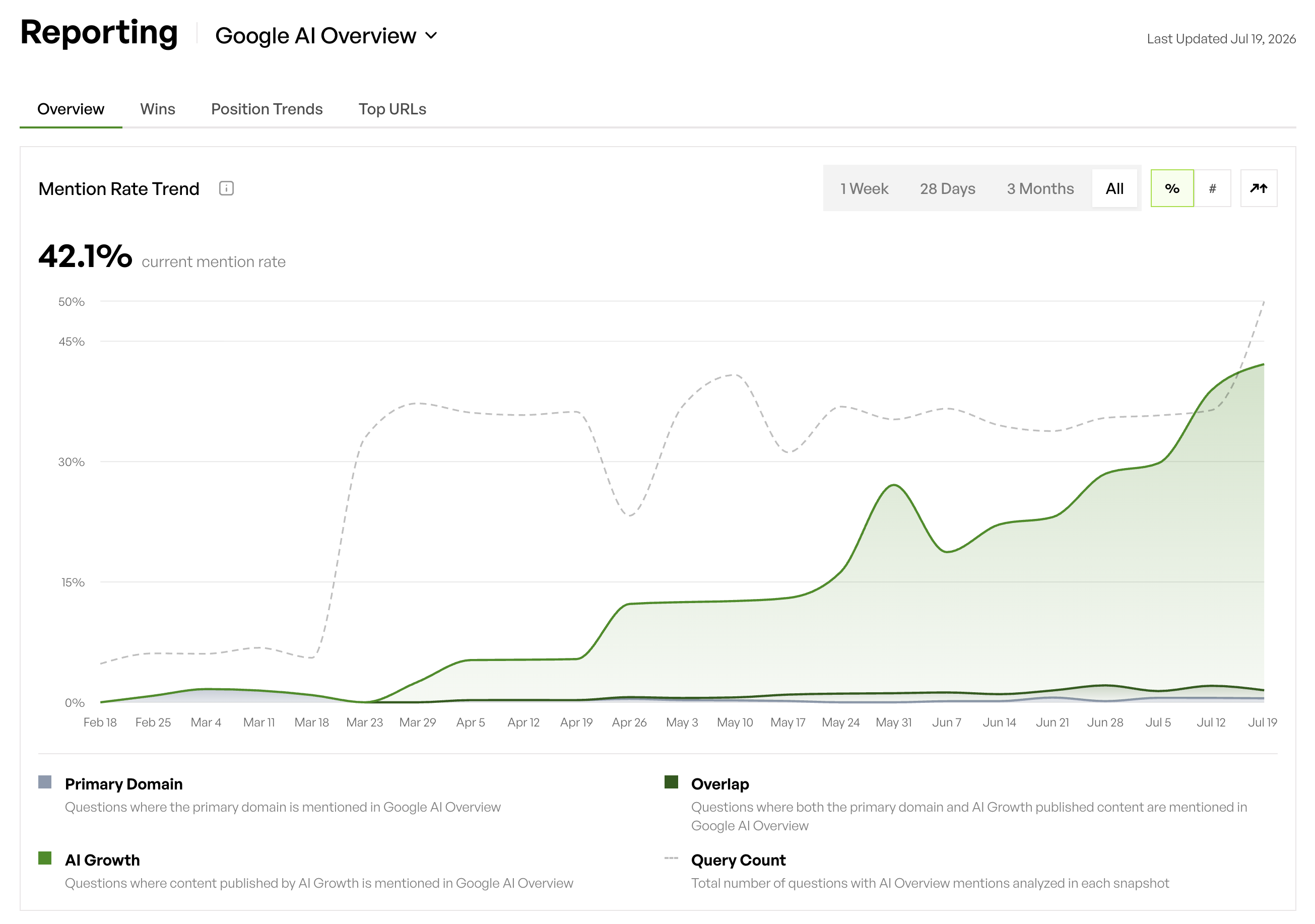
The broader market context reinforces the urgency. Businesses tracking AI visibility report substantial year-over-year growth in AI-referred traffic. AI-referred traffic converts at 14.2% versus 2.8% for Google organic, a 5.1x advantage. Brands that establish authoritative content now are training the next generation of models with their own narrative. Brands that wait are training the next generation with whatever happens to be sitting on the open web.
Frequently Asked Questions
How long does it take to implement AI Growth Agent compared to a pure monitoring tool?
A pure monitoring tool can be configured in hours once a prompt set is defined. As noted in the setup comparison, AI Growth Agent takes about a week from kickoff to first published article, with indexing following within ten days. The difference is scope. Monitoring tools set up a dashboard, while AI Growth Agent stands up a fully optimized, owned site, maps the full query universe, and begins producing authoritative content. The only client-side integration step is a reverse proxy rewrite connecting the blog to a subdirectory under the brand’s domain, so no technical team is required on the client side.
What expertise does a team need to run AI Growth Agent?
Teams only need the ability to describe the brand’s market and goals in plain language. The engine provisions the full technical stack described earlier automatically, including schema, MCP endpoints, and llms.txt files, along with bot tracking, instant indexing, autoredirects, and 404 tracking. Brand voice controls, legal disclaimers, and anti-hallucination focus areas are configured once in plain language and applied to every future generation.
The internal team reviews finished articles and provides feedback. The engine updates and saves memories so the same correction is not needed twice.
How does AI Growth Agent measure results, and how do I know the visibility is actually new?
AI Growth Agent publishes into a separate environment so it can report only on the visibility it generates, never on visibility the brand already had. Reporting covers incremental impressions, bot visits, AI citations, and Google Search Console data week over week.
Bot analytics track every bot that touches the blog, including the bot ChatGPT uses to cite sources. This cross-referenced reporting separates a monitoring dashboard that blends new and existing visibility from an execution platform that proves its own contribution.
Can AI Growth Agent handle multiple brands, regions, or languages?
Yes. AI Growth Agent operates across multiple markets and languages, with significant client traction in the United States, Brazil, Canada, and Europe. The multi-agent orchestration selects models by task and by language, drawing on OpenAI, Anthropic, Gemini, Grok, Perplexity, Exa, and Firecrawl.
Each brand or product line operates its own universe map and content topology. Clients with distinct buyer journeys, such as consumer and corporate audiences, can run parallel engines with separate universe maps and content strategies.
What happens to content quality at scale, and how does AI Growth Agent prevent hallucination?
Quality is enforced at every stage of generation. The engine pulls from the brand manifesto, primary-source links, product pages, and saved memories before generating a single word. Parallel research agents gather what a real journalist would need, validate every source and claim against evidence found online, and run a cascade of anti-hallucination checks across primary and external sources.
After a draft is generated, every claim is re-extracted and checked against the manifesto, primary sources, and verified external sources. Any claim that cannot be backed up is removed or softened before the article moves further down the pipeline. The client can also specify which claim types deserve the heaviest scrutiny, such as ingredient amounts or pricing claims, and the engine applies that focus to every article without re-briefing.
Conclusion and Next Steps
The monitoring-versus-execution split defines AI search visibility strategy in 2026. RedRover, Profound, Peec AI, Scrunch AI, Otterly, and Authoritas all deliver citation tracking and competitive benchmarking but do not produce content, own publishing, or self-heal what is live. They act as rearview mirrors. They report where the brand stands and leave the work of changing it to whoever the client can assemble.
AI Growth Agent is the only platform in this guide that maps the full query universe, produces authoritative content, owns the publishing stack, and self-heals over time. It replaces the SEO agency, the content tool, the web agency, the GEO monitor, the schema plugin, the analytics stack, and the PR firm with one engine at a flat fee. The client owns the site, the content, and the incremental visibility it generates.
The leaderboard in AI search is being written this year. Brands that establish authoritative content now are training the next generation of models with their own narrative.
Schedule a consultation session with AI Growth Agent and see your first article live within a week.